Search This Blog

Showing posts with label Lucy Osburn. Show all posts

Thursday, October 29, 2026

The Nightingale Wing – Sydney Hospital, Macquarie Street – Lucy Osburn, Florence Nightingale's Sisters and the Birth of Australian Nursing – 1868 to Today

Walk through the front of Sydney Hospital on Macquarie Street, past the bronze boar, and out into the courtyard behind. There you'll find a colourful fountain and, behind it, a Gothic building in sandstone and patterned brick that looks like it belongs in an English cathedral close. That's the Nightingale Wing. Sydney Living Museums' Sydney Open program calls it the oldest building still standing on the hospital campus and the site of the first nursing school in Australia. Up on the first floor, in the rooms where the first Lady Superintendent lived, there's a small museum that a lot of Sydneysiders have never heard of.

The Nightingale Wing and the fountain in the Sydney Hospital courtyard.

The Nightingale Wing and the fountain in the Sydney Hospital courtyard. Photo: Adam.J.W.C., via Wikimedia Commons (CC BY-SA 2.5).

The Rum Hospital

To understand why nurses were needed so badly, you have to go back to the hospital itself. When Governor Lachlan Macquarie arrived at the start of 1810, Sydney's hospital was a collection of tents and temporary sheds. London wouldn't pay for a new one, so on 6 November 1810 Macquarie signed a contract with three businessmen, Garnham Blaxcell, Alexander Riley and later D'Arcy Wentworth. They would build the hospital in return for convict labour, supplies and the right to import 45,000 gallons of rum, later raised to 60,000. That's how it got the name the Rum Hospital. According to the Historic Houses Trust's study of the Mint site, the contractors didn't do as well out of it as they'd hoped.

The building was poorly built. In 1815 the convict architect Francis Greenway reported that it "must soon fall into ruin". The convict patients moved in during 1816. Over the years the two wings were taken over for other uses. The north wing became the meeting place of the Legislative Council in 1829 and is now part of Parliament House. The south wing became the Sydney branch of the Royal Mint in 1854. The central building stayed a hospital, and from 1848 it was run by the Sydney Infirmary and Dispensary, a charity for the poor.

The old central building of the Rum Hospital, photographed some time between 1865 and 1875

The old central building of the Rum Hospital, photographed some time between 1865 and 1875, before it was pulled down. Photographer unknown, via Wikimedia Commons (Public domain).

By the 1860s the Infirmary was in a dreadful state. The Australian College of Nursing's history says the newly arrived nurses found it built over open sewer drains with no running water. Patients lay on rotting mattresses, and rats ran over them at night.

Parkes writes to Florence Nightingale

Henry Parkes, then Colonial Secretary, had seen the wards for himself. On 21 July 1866 he wrote to Florence Nightingale asking for four trained nurses for the Sydney Infirmary. In his letter he said he hoped they would set up "a nursery for hospital attendants" that could supply hospitals all over the country. That letter is quoted in a 2025 paper on Parkes and Nightingale nursing published through PubMed Central. Nightingale wrote back by 24 October 1866 and offered six nurses instead of four. The same paper says she wanted to advance nursing and also to repay the colony for the money it had sent her fund in 1856.

Judith Godden, writing in the Dictionary of Sydney, says the request was backed by a detailed memo from the surgeon Alfred Roberts. Lucy Osburn, born in Leeds in 1835, had entered the Nightingale School at St Thomas's Hospital in London as a Lady Probationer in September 1866. She was one of the few lady probationers in training, and she was willing to emigrate for the sake of her health. She was picked to lead the team even though illness made her miss a third of her year's training.

Lucy Osburn, photographed around 1869.

Lucy Osburn, photographed around 1869. Freeman and Prout, State Library of NSW, via Wikimedia Commons (Public domain).

Six women off the Dunbar Castle

Osburn and five nurses left England on 2 December 1867 and reached Sydney on 5 March 1868. The PubMed Central paper says they came out on the Dunbar Castle. Museums of History NSW names the five: Mary Barker, Eliza (Elizabeth) Ann Blundell, Bessie (Betsy) Annie Chant, née Barthorpe, Annie Miller and Haldane Colquhoun Turriff. All six were employed by the NSW Government on three-year contracts. The Australian College of Nursing says crowds cheered as they went down Macquarie Street in their white starched caps.

They hardly had time to unpack. A week later, on 12 March 1868, Henry James O'Farrell shot Prince Alfred, Duke of Edinburgh, at Clontarf. Osburn supervised the nursing of the prince. The PubMed Central paper names Annie Miller and Haldane Turriff as the two sisters who nursed him back to health, at Government House rather than at the Infirmary. The newspapers loved them for it.

Reform, and the fights that came with it

Osburn got the basics of Nightingale nursing going. Godden writes that she gradually got rid of the male nurses and replaced them with women. She also brought in training both on and off the wards, and put the nursing staff under her own control. She copied the two-tier system used at St Thomas's. Working-class women came in as ordinary probationers, while middle-class "Sister Probationers" trained to become ward sisters, and could aim to become matrons later.

It made her enemies. The surgeon Alfred Roberts, who had helped bring her out, kept getting in her way, and she was attacked in Parliament. A Royal Commission on public charities in 1873 criticised the Infirmary's board for neglect and for meddling in the nurses' work, and praised what Osburn had done. Godden says her achievements were "marred by continual criticism of her autocratic style of management". In 1884, while she was ill and facing public calls to go, she resigned. She went back to England, did district nursing, and died in December 1891. Her death certificate listed the cause as diabetes.

Her nurses spread the Nightingale system further. Bessie Chant left in 1869 to marry and later became Sister Simpson. She was matron of Gladesville Hospital for the Insane for 26 years. Osburn's first Sister Probationer, a Sister Bland, was matron at Gladesville before her.

Building the Nightingale Wing

The nurses needed somewhere decent to live, and that's where the Nightingale Wing comes in. The architect was Thomas Rowe, and Sydney Open says he designed the sandstone and polychrome brick Gothic Revival building "with Nightingale's input". The sources don't quite agree on the date. Sydney Open's fact panel says built 1868 but its text says opened in 1869. The Dictionary of Sydney and the City of Sydney Archives both say 1869, and the Archives describe it as accommodation for the Nightingale nurses led by Osburn. A floor and a wing to the east were added in 1901, and it was extended again in 1918.

A building specially designed as a home for Nightingale nurses, this early and this far from London, is quite something. You'll sometimes read that it was the first Nightingale nurses' home built outside Britain. I couldn't find that claim in any of the heritage or museum sources I checked, so I'd treat it as a story rather than a fact. What the sources do agree on is that this was where Australian nurse training began.

The Nightingale Wing around 1870, soon after it was finished.

The Nightingale Wing around 1870, soon after it was finished. Walter Chaffer, State Library of NSW, via Wikimedia Commons (Public domain).

The Nightingale Wing today.

The Nightingale Wing today. Photo: Orestes654, 2011, via Wikimedia Commons (CC BY 3.0).

The rest of the old Rum Hospital didn't last much longer. The City of Sydney Archives say the central wing was pulled down in 1879. Rowe won the competition to design a new hospital, but work stopped for years, and John Kirkpatrick finished it in a revised design. The new building opened in September 1894. In 1881 the Infirmary was renamed Sydney Hospital. That makes the Nightingale Wing older than the main hospital building in front of it.

Sydney Hospital on Macquarie Street. The Nightingale Wing is in the courtyard behind.

Sydney Hospital on Macquarie Street. The Nightingale Wing is in the courtyard behind. Photo: sv1ambo, 2014, via Wikimedia Commons (CC BY 2.0).

The Gothic windows and polychrome brick of the Nightingale Wing.

The Gothic windows and polychrome brick of the Nightingale Wing. Photo: boeckli, 2015, via Wikimedia Commons (CC BY-SA 2.0).

The Lucy Osburn-Nightingale Foundation Museum

The museum is in Osburn's old rooms on the first floor of the Nightingale Wing. It's run by the Lucy Osburn-Nightingale Foundation, which Godden calls one of the many monuments to Osburn's achievements, and it has an archive as well as the displays. Sydney Open describes the collection as medical equipment, records, instruments and pathology covering the history of nursing and medicine in Australia from 1788. It also has pieces from the original nurses' home, Lucy Osburn's own chair and desk, and the Kanematsu Collection of morbid anatomy specimens, which is still used for teaching.

Before you go, check the opening details, because the sources don't quite match. MED Sydney's venue page says the museum is open every Tuesday from 10am to 3pm, costs $5, and is shown by volunteer guides. Museums and Galleries of NSW lists one-hour tours at $10, with bookings on 02 9382 7427. The Dictionary of Sydney says it opens every Tuesday or by appointment. During Sydney Open it's usually open 10am to 5pm, last entry 4.45pm. Access is by stairs only. I'd ring ahead before you make the trip. Enter from the hospital at 8 Macquarie Street.

The Nightingale Wing from the southwest.

The Nightingale Wing from the southwest. Photo: Ymblanter, 2024, via Wikimedia Commons (CC BY-SA 4.0).

Why it matters

Godden says Osburn "laid the foundations of modern nursing in Australia" and "pioneered the employment of high status professional women in public institutions". When she died, Sydney Hospital barely mentioned it. Nurses never forgot her, though, and her rooms are still there in the courtyard. Next time you're on Macquarie Street, rub the boar's nose for luck and then go through to the courtyard to have a look.

The courtyard fountain in front of the Nightingale Wing.

The courtyard fountain in front of the Nightingale Wing. Photo: Adam.J.W.C., 2010, via Wikimedia Commons (CC BY-SA 2.5).

Where this came from

  • Judith Godden, "Osburn, Lucy", Dictionary of Sydney.
  • Nicole Cama, "The Lucy Osburn-Nightingale Museum", Dictionary of Sydney blog, 2017.
  • Sydney Open (Museums of History NSW): Lucy Osburn-Nightingale Museum.
  • Museums of History NSW: Nurses guide.
  • Australian College of Nursing: Nurse education in Australia, Part 2.
  • "Sir Henry Parkes and the Relationships That Enabled Nightingale Nursing to Advance Mental Healthcare in Nineteenth Century Australia", PubMed Central (PMC11751756).
  • Australian Dictionary of Biography: Lucy Osburn (search summary; the page blocked direct fetch).
  • City of Sydney Archives: Sydney Hospital.
  • MED Sydney: Lucy Osburn-Nightingale Museum venue page; Museums and Galleries of NSW: Lucy Osburn-Nightingale Museum.
  • Crook, Ellmoos and Murray, Assessment of Historical and Archaeological Resources of the Royal Mint site, Historic Houses Trust, 2003 (via the Wikipedia article on Sydney Hospital).

Thursday, October 15, 2026

The Attempted Assassination of Prince Alfred – Clontarf – 12 March 1868 – Henry James O'Farrell and the Fenian Scare

On a sunny Thursday afternoon in March 1868, a man walked up behind Queen Victoria's son at a charity picnic on the beach at Clontarf, put a revolver to within a few feet of his back and fired. Prince Alfred, Duke of Edinburgh, the first member of the royal family ever to visit Australia, went down shouting that his back was broken. He lived. The gunman, Henry James O'Farrell, very nearly got lynched on the sand, and six weeks later he was hanged at Darlinghurst Gaol.

It's remembered as the first attempted political assassination in Australia. What came after it is just as much of a story: a colony gripped by panic about Fenians, a law rushed through Parliament in a single day, Henry Parkes chasing a conspiracy that was never found, Sydney's first Nightingale nurse at the Prince's bedside, and in the end a great hospital in Camperdown that still carries his name.

Engraving of O'Farrell firing at Prince Alfred at the Clontarf picnic, 1868
"Attempted assassination of H.R.H. the Duke of Edinburgh at Clontarf, N.S.W.", wood engraving by Samuel Calvert, 1868. Samuel Calvert, Public domain, via Wikimedia Commons

The First Royal Tour

Alfred was born at Windsor Castle on 6 August 1844, the second son and fourth child of Queen Victoria and Prince Albert. He joined the Royal Navy at 14 as a midshipman, and by 1866 he was a captain in command of HMS Galatea, a steam frigate that still carried a full set of sails. That same year he was made Duke of Edinburgh.

The Galatea was a 26-gun wooden screw frigate, launched at Woolwich in 1859, about 280 feet long with a crew of around 450. With the Prince in command she set out on a world cruise in 1867, calling at Rio de Janeiro, Tristan da Cunha and the Cape before crossing to Australia. The National Museum of Australia has the Prince landing at Glenelg, outside Adelaide, on 31 October 1867. It was the first royal tour this country had seen, taking in South Australia, Victoria, Tasmania, New South Wales and Queensland.

Carte de visite portrait of Prince Alfred in naval uniform, Sydney, about 1868
Prince Alfred, Duke of Edinburgh, in a captain's undress uniform of the Royal Navy, photographed in Sydney by Montagu Scott about 1868. Montagu Scott, State Library of New South Wales, Public domain, via Wikimedia Commons
HMS Galatea under sail, about 1868
HMS Galatea, the frigate Prince Alfred commanded on his world cruise, about 1868. Unknown author, Public domain, via Wikimedia Commons

The crowds were huge everywhere, and things didn't always go well. In Melbourne in November 1867 a Protestant hall was decorated with a picture of William of Orange beating the Catholic armies at the Battle of the Boyne. Irish Catholics gathered outside and threw stones, shots were fired from inside the hall into the crowd, a Catholic boy was killed and a riot followed. A free public banquet a few days later turned into another riot when about 40,000 people turned up for food and wine laid on for 10,000 and the Prince cancelled. At Bendigo three boys were burnt to death inside a firework model of the Galatea.

Sydney Puts On a Show

The Galatea came into Sydney from Tasmania on 21 January 1868. The Prince was met at Circular Quay by the Colonial Secretary, Henry Parkes, and the Governor, Lord Belmore, in a pavilion built for the occasion, and was driven through the crowds to Government House. After about a month he went up to Brisbane for a week, then came back to Sydney in early March, when his staff asked for a lighter round of engagements.

Triumphal arch at the Prince's Stairs, Circular Quay, January 1868
The triumphal arch at the Prince's Stairs, Circular Quay, put up for the Duke of Edinburgh's landing in January 1868. Photographer unknown, State Library of New South Wales, No known copyright restrictions, via Wikimedia Commons
HMS Galatea at anchor in Farm Cove with Government House at left, about 1870
HMS Galatea in Farm Cove, with Government House to the left, about 1870, when the Prince was back in Sydney on a later visit. Photograph attributed to Charles Pickering. Attributed to Charles Pickering, State Library of New South Wales, Public domain, via Wikimedia Commons

There was a man in the crowd at the Quay that first day who had come to kill him. Henry O'Farrell later said: "I had gone to Circular Quay on the day of the Prince's arrival in Sydney, and I intended to shoot him there, but the opportunity did not present itself."

Who Was Henry James O'Farrell?

O'Farrell was born about 1833 at Arran Quay in Dublin, the youngest child of William O'Farrell, a butcher, according to the Australian Dictionary of Biography. The family moved to Liverpool and then to Melbourne, arriving early in 1841. Henry was schooled at David Boyd's school and St Francis's school, went on to St Francis's seminary and received deacon's orders. He spent 1853–54 studying in Europe, but in 1855 he fell out with Bishop Goold and was never ordained.

He tried sheep farming near Clunes, then became a grain merchant at Ballarat in partnership with his cousin Joseph Kennedy. Things went downhill from there. In 1864 his brother Peter, a leading Melbourne solicitor, lost his reputation in a libel case and fled the colony, and Kennedy soon afterwards died of delirium tremens. O'Farrell failed in speculations, fell into debt, took to drink and brooded over never becoming a priest.

In January 1867 he had a serious breakdown, with bouts of delirium tremens, talk of plots to poison him, waving pistols about and threatening to kill people. Two of his sisters took him to Melbourne. Back in Ballarat he collapsed again and had several epileptic fits. In September 1867 he went to Sydney and stayed at Tierney's Currency Lass Hotel until he was asked to leave because of his strange behaviour. From December he lived at the Clarendon Hotel on money his sister sent him, and the ADB says he became noticeably agitated whenever Fenianism came up. On 11 March 1868 he practised pistol shooting at Waverley.

Studio portrait of Henry James O'Farrell, 1868
Henry James O'Farrell, photographed in Sydney by Montagu Scott in 1868. Montagu Scott (1835–1909), Public domain, via Wikimedia Commons

The Sailors' Home Picnic at Clontarf

Clontarf takes its name from the site of the Battle of Clontarf near Dublin. It sits on the north-eastern side of Middle Harbour with a long, sheltered beach facing west. From the early 1860s the Sydney publican Isaac Moore and his family ran pleasure grounds there, advertised in 1863 as "the oldest, largest, and most shady pleasure grounds in the harbour", with quoits, skittles and cricket bats always on hand. By the time Moore died in 1866 his sons had made it a favourite spot for holiday excursions.

The picnic on Thursday 12 March 1868 was a fundraiser for the Sydney Sailors' Home, organised by the barrister and politician William Manning, and the Prince had agreed to come. Five steamers ran people across from Circular Quay through the day. A big marquee was put up as a "luncheon saloon", a tent was pitched opposite the beach for the Prince and his party, and yachts and steamers dressed in flags lay at anchor off the beach. By midday there were somewhere between two and three thousand people on the grounds.

Watercolour of Balmoral Beach and the Clontarf entrance to Middle Harbour
George Podmore's watercolour "Balmoral Beach, Clontarf Entrance, Middle Harbour", dated 1877, though the date may be 1897. George Podmore, Public domain, via Wikimedia Commons
The Sydney Sailors' Home building in George Street, The Rocks
The Sydney Sailors' Home building in George Street, The Rocks, as it stands today. Rangasyd, CC BY-SA 4.0, via Wikimedia Commons

Emily Nuttall Thorne was there, and her handwritten account is now in the State Library of NSW: "directly we saw the little 'Fairy' coming we ran along the beach to the little pier at which he would land. All the yachts saluted him as he passed by them." The Prince came over from the Galatea on the steam yacht Fairy and landed at the Clontarf jetty at about two o'clock. The committee met him with an address, and after lunch and a toast to the Queen he went across to his own tent at about 3.20 pm.

The Shooting

From the tent, the Prince and Sir William Manning walked over towards a clump of trees by the beach where a band was playing, and the Prince handed Manning a cheque for the Sailors' Home. O'Farrell had been standing in the shade with a group of people. He came up behind the Prince and, once he was within five or six feet, pulled out a revolver, took aim and fired.

The bullet hit the Prince in the middle of the back, about two inches to the right of the spine. He fell forward onto his hands and knees. The National Museum of Australia gives his words as "Good God, I am shot … My back is broken." Manning sprang at O'Farrell but lost his footing and fell, and O'Farrell turned the gun on him.

Who Grabbed the Gun?

This is where the accounts start to differ. Wikipedia's account, drawn from the newspapers, says a coach-maker named William Vial grabbed O'Farrell from behind and pinned his arms to his sides, the revolver went off as they struggled, and the second shot hit a bystander named George Thorne in the foot, who fainted. The National Museum of Australia says instead that "a Mr Thorne" tackled O'Farrell and wrestled the gun off him as he tried to fire again. There's more on this further down.

Whoever got to him first, plenty of others piled in, and there were shouts of "lynch him" and "hang him". Police under Superintendent Orridge took charge of O'Farrell and had the greatest trouble keeping the crowd from "tearing him limb from limb". By the time they got him to the wharf and aboard the steamer Paterson, the clothes had been ripped off his upper body and he was bruised and bleeding.

According to Wikipedia's article on Alfred, Vial was the master of a Masonic lodge and had helped organise the picnic, and the Prince presented him with a gold watch for securing his life.

The Wound and the Nightingale Nurses

Three or four men carried the Prince to his tent, where several doctors took over. They found the bullet had gone in to the right of the lower spine and run around the line of the ribs, lodging just under the skin at the front of his abdomen. He never lost consciousness. Seeing how worried everyone was, he told them: "Tell the people I am not much hurt, I shall be better presently." At about five o'clock he was carried aboard the steamer Morpeth on a litter and taken back to Sydney.

Why the wound wasn't worse depends on who you read. The Dictionary of Sydney says the bullet glanced off his ribs. Wikipedia's article on Alfred says it ricocheted off a metal clip on his trouser braces, and its Clontarf article puts it down to his India-rubber braces crossing at that spot.

Portrait photograph of Lucy Osburn, about 1869
Lucy Osburn, Lady Superintendent of the Sydney Infirmary, photographed by Freeman Bros & Prout about 1869. Freeman and Prout, Public domain, via Wikimedia Commons

Sydney had trained nurses waiting, just. Henry Parkes had asked Florence Nightingale for trained nurses for the Sydney Infirmary, and Lucy Osburn was appointed lady superintendent. The ADB says she and five trained sisters, including Haldane Turriff, reached Sydney on 5 March 1868, only a week before the picnic. Born in Leeds in 1836, she had trained at the Nightingale Training School at St Thomas's Hospital, and the ADB says she was "called on to supervise the nursing of the wounded Duke of Edinburgh" within a week of arriving. Wikipedia's Alfred article says six Nightingale-trained nurses led by Matron Osburn looked after him for the next two weeks.

He mended quickly. The doctors reported on 16 March that he could sit up, though the wound still hurt now and then, and by late March he was said to be regaining strength "as rapid as the most sanguine could expect". According to the Dictionary of Sydney and Government House, he had recovered completely by the end of March.

The Fenian Panic

Sydney's reaction was enormous. The Sydney Morning Herald wrote the next day: "One universal feeling of sorrow, shame, and rage pervades the community. The whole colony has been wounded in the person of its Royal guest." On 13 March an "indignation meeting" at the Pavilion in Hyde Park drew somewhere between seventeen and twenty thousand people. One count puts the number of indignation meetings across the colonies at 250 or more, most of them within a week of the shooting. The Dictionary of Sydney describes "an outpouring of prejudice and racism towards Catholics and Irish", and Orange lodge membership in New South Wales grew fast, peaking in 1876 at over 19,000 members in 120 lodges.

The Fenians were the Irish republican brotherhood, founded in the United States, that had carried out violent attacks in Canada, and Australians had already been reading about "Fenian terrorism" in England. When police were struggling with O'Farrell at Clontarf, several of them later testified, he claimed to be a Fenian.

Henry Parkes and the Treason Felony Act

On 18 March Parkes, as Colonial Secretary, went to see O'Farrell in gaol with the Speaker, William Arnold. According to the Herald, the prisoner was "very communicative" and claimed he had written orders from the Fenian leadership to execute the Prince. That same day the Legislative Assembly put the Treason Felony Act through every stage in one sitting, and it had vice-regal assent by evening. It allowed up to two years' jail for language "disrespectful to the Queen" or for "expressing sympathy with certain offenders", and the Dictionary of Sydney notes that it made it an offence to refuse to drink the Queen's health.

Portrait of Henry Parkes
Henry Parkes, the Colonial Secretary who led the hunt for a Fenian conspiracy in 1868. From "Eminent Citizens of New South Wales, 1850–1900". Unknown author, Public domain, via Wikimedia Commons

Parkes wrote to the Victorian Colonial Secretary, James McCulloch, saying his government knew O'Farrell was one of a group of Fenians, some of them in Victoria. No such group was ever found. Police and detectives turned up nothing, and Parkes came to be seen as having whipped up public hysteria and sectarian feeling for political gain. Even so, in a speech at Kiama in August 1868 he insisted the government had proof of a conspiracy. He resigned as Colonial Secretary in September 1868.

In December a select committee chaired by William Macleay was set up to look into the alleged conspiracy, and by February 1869 it had found there was no Fenian conspiracy behind the shooting. Parkes then got the Assembly to vote that the report was "made an instrument of personal hostility against a member of the House", and it was struck from the parliamentary record.

The Trial

A preliminary hearing began the day after the shooting before the magistrate Houlton Voss, held in the debtors' prison at Darlinghurst Gaol and running from 13 to 16 March. O'Farrell was arraigned on 26 March for wounding the Duke of Edinburgh with intent to murder, and pleaded not guilty. His trial opened in the Central Criminal Court on Monday 30 March before Justice Alfred Cheeke.

Pencil drawing of Henry O'Farrell seated in his cell
Henry O'Farrell in Darlinghurst Gaol, a pencil drawing by Francis Newry, 1868. Francis Newry (1842-1915), Public domain, via Wikimedia Commons

His barrister, Butler Aspinall, came up from Melbourne and argued he was insane, "a man whose intellect was in such a state that he could not be held to be responsible for his actions." The jury was out for about an hour and came back with a verdict of guilty, and Cheeke sentenced him to death.

The Prince Asks for Mercy

On 5 April the Prince wrote to Lord Belmore asking that O'Farrell's life be spared. His reason was that under English law attempted murder wasn't punishable by death, and he didn't want the man treated more harshly in Sydney than he would have been in England. The letter didn't become public until February 1869. O'Farrell's sister also petitioned the Governor, arguing that her brother was insane and had nothing to do with the Fenians. The Executive Council met on the evening of 6 April, the night the Prince sailed, and let the sentence stand.

The Galatea left Sydney in early April. The National Museum of Australia dates the sailing to 4 April, while Wikipedia puts the Prince's departure on 6 April. He reached Spithead on 26 June 1868, seventeen months after he'd set out.

The Hanging at Darlinghurst

O'Farrell was hanged inside Darlinghurst Gaol at nine o'clock on the morning of 21 April 1868, just forty days after the shooting. The newspapers said he met his death "with the most imperturbable nerve and firmness". He was buried in the Catholic section of Rookwood Cemetery.

Aerial photograph of Darlinghurst Gaol about 1930
Darlinghurst Gaol from the air about 1930, after it had closed as a prison. Adam.J.W.C., Public domain, via Wikimedia Commons

Instead of a speech from the scaffold he left a written statement, and it caused a row of its own. When Parliament asked to see it, Parkes said Cabinet would have to consider it first. The next day William Macleay read out a copy in the Assembly anyway. In it O'Farrell took back his Fenian story, saying he "had not the slightest foundation" for claiming others were ready to do the deed, and that he had "no foundation for stating that there was a Fenian organisation in New South Wales." The ADB quotes his own explanation: "From continually thinking and talking of … 'the wrongs of Ireland', I became excited and filled with enthusiasm for the subject, and it was then under the influence of those feelings that I attempted to perpetrate the deed for which I am now justly called upon to suffer." Nobody ever found out how the copy got out of the gaol.

The ADB's verdict is blunt. It says the excitement around the crime "made a fair trial impossible", and that the Prince's efforts to save O'Farrell "support the view that the correct verdict would have been not guilty because of insanity." It also calls the shooting an important factor in sharpening sectarianism in the colony. The family's story had one more twist: on 21 August 1882 Henry's brother Peter shot at Archbishop Goold at Brighton in Victoria.

Royal Prince Alfred Hospital

Sydney wanted something lasting to mark the Prince's recovery. At a public meeting called by the Mayor, the city resolved to raise "a permanent and substantial monument" by public subscription, and settled on a hospital to be called Prince Alfred's Hospital. Wikipedia's O'Farrell article dates that meeting to 20 March, and its article on Alfred to 23 March. The plan was first to build it on the Sydney Infirmary site in Macquarie Street, but the Infirmary's board turned the idea down.

The RPA Hospital administration building flanked by its pavilions, Camperdown
Royal Prince Alfred Hospital, Camperdown. The main administration building stands between the Victoria and Albert Pavilions, which are on the NSW State Heritage Register. Collywolly, CC BY-SA 4.0, via Wikimedia Commons

Parliament passed an Act incorporating Prince Alfred Hospital on 3 April 1873, and Thomas Holt was its founder and director from 1873 to 1883. The Mansfield Brothers designed the buildings, work on the Administration Building and the first pavilions started in 1876, and the hospital opened in Camperdown in 1882. The Dictionary of Sydney says the Prince allowed his coat of arms to be used as the hospital's crest. In 1903 King Edward VII granted the title "Royal", and it has been Royal Prince Alfred, or RPA, ever since. The Victoria and Albert Pavilions, designed by Walter Liberty Vernon and finished in 1904, were also built to commemorate the Prince's royal visit.

The Victoria Pavilion at RPA Hospital
The Victoria Pavilion at RPA, designed by Walter Liberty Vernon and completed in 1904. Collywolly, CC BY-SA 4.0, via Wikimedia Commons

Melbourne raised money in the same way, and the National Museum of Australia notes that the Alfred Hospital there opened in 1871. In Sydney, Prince Alfred Park and a street at Circular Quay were also named after him. As for Lucy Osburn, she stayed on and, in the ADB's words, "successfully established trained nursing on Nightingale principles in New South Wales" before she resigned in 1884.

Clontarf Today

Clontarf stayed a cheap and fairly out-of-the-way spot for a long time. During the 1930s Depression a tent city of several hundred people grew up on Clontarf Reserve, in tents made of hessian coated with whitewash, lime and fat to keep the rain out. During the Second World War beachfront blocks went for £100, and people said "you couldn't even give it away". It only became easy to reach after the new Spit Bridge opened in November 1958, and in 1960 the beach was washed away by the tsunami from the Chilean earthquake.

The Dictionary of Sydney says a Norfolk Island pine, planted to mark the place where the Duke was shot, still stands in Holmes Avenue. The yachtsman Ben Lexcen, who designed the winged keel of Australia II, had premises next to the Clontarf marina. In 2021 Transport for NSW named one of its new Manly ferries Clontarf.

Clontarf Beach seen from the Spit to Manly walk
Clontarf Beach today, seen from the Spit to Manly walk. Dragonfly27356, CC BY-SA 4.0, via Wikimedia Commons

Timeline

  • About 1833: Henry James O'Farrell is born at Arran Quay, Dublin. The family reaches Melbourne early in 1841.
  • 6 August 1844: Prince Alfred is born at Windsor Castle.
  • 1866: Alfred is made Duke of Edinburgh and is in command of HMS Galatea.
  • January 1867: O'Farrell has a serious mental breakdown at Ballarat.
  • 31 October 1867: The Prince lands at Glenelg, South Australia. It is Australia's first royal tour.
  • November 1867: There is a sectarian shooting and riot during the Melbourne visit.
  • 21 January 1868: The Galatea arrives in Sydney.
  • 5 March 1868: Lucy Osburn and her Nightingale sisters reach Sydney (ADB date).
  • 11 March 1868: O'Farrell practises pistol shooting at Waverley.
  • 12 March 1868: At the Sailors' Home picnic at Clontarf, O'Farrell shoots the Prince in the back.
  • 13 March 1868: An indignation meeting in Hyde Park draws up to 20,000 people, and O'Farrell's preliminary hearing begins.
  • 18 March 1868: Parkes visits O'Farrell, and the Treason Felony Act passes in a single day.
  • 20 or 23 March 1868: A public meeting resolves to build Prince Alfred's Hospital.
  • 30 March 1868: The trial is held before Justice Cheeke, and O'Farrell is found guilty and sentenced to death.
  • 5 April 1868: The Prince writes to Lord Belmore asking that O'Farrell's life be spared.
  • Early April 1868: The Prince sails for England, and the Executive Council confirms the sentence.
  • 21 April 1868: O'Farrell is hanged at Darlinghurst Gaol.
  • 26 June 1868: The Prince reaches Spithead.
  • September 1868: Parkes resigns as Colonial Secretary.
  • February 1869: The Macleay committee finds no Fenian conspiracy, and its report is expunged.
  • 3 April 1873: Parliament passes the Act incorporating Prince Alfred Hospital.
  • 1882: Prince Alfred Hospital opens at Camperdown.
  • 30 July 1900: Alfred dies at Coburg as reigning Duke of Saxe-Coburg and Gotha.
  • 1903: Edward VII grants the title "Royal".

Where the Sources Disagree

  • Who grabbed O'Farrell, and who was shot in the foot: Wikipedia's O'Farrell and Alfred articles say William Vial pinned O'Farrell's arms or wrested the gun away, and that George Thorne was hit in the foot by the second shot. The National Museum of Australia says "a Mr Thorne" tackled O'Farrell and wrestled the weapon off him.
  • Why the wound was slight: The Dictionary of Sydney says the bullet glanced off his ribs. Wikipedia's Alfred article says it ricocheted off a metal clip on his braces, and its Clontarf article says it struck where his India-rubber braces crossed.
  • Lucy Osburn's arrival: The ADB says she reached Sydney on 5 March 1868. Wikipedia's Alfred article says February 1868.
  • The hospital meeting: Wikipedia's O'Farrell article dates the public meeting to 20 March, and its Alfred article to 23 March.
  • When the Prince sailed: The National Museum of Australia gives 4 April. Wikipedia's O'Farrell article says the Prince left Sydney on 6 April, the evening the Executive Council met.
  • The Prince's words: The National Museum of Australia gives "Good God, I am shot … My back is broken", Government House gives "Good God, my back is broken", and Wikipedia gives "My back is broken".
  • The pistol: The National Museum calls it a double-barrelled pistol, and Wikipedia calls it a revolver.
  • Peter O'Farrell's fall: The ADB dates his libel case and flight to 1864. Wikipedia puts the libel trial in February 1863 and has him gone from Victoria by early 1864.

My Earlier Posts

Sources

Thursday, March 27, 2025

Sydney Hospital – The Rum Hospital – Macquarie Street, Sydney – From Macquarie's Rum Deal to the Nightingale Wing and Il Porcellino

Sydney Hospital – The Rum Hospital – Macquarie Street, Sydney

If you've ever walked up Macquarie Street from the Quay you'll know the stretch. Parliament House with its long verandahs, the sandstone hospital in the middle, the Mint next door, and out the front a bronze boar with a nose rubbed gold by about fifty years of Sydney hands. It looks like three or four separate buildings from different centuries, and that's exactly what it is. But they all started life as one job: a hospital paid for with rum.

I've written about Sydney Hospital a few times over the years and taken a fair few photos in and around it, so I've pulled all those pages together into this one. The story's first, then all my photos and notes from each visit, oldest first.

The old central block of the Rum Hospital on Macquarie Street, about 1875, a few years before it came down
The old central block of the Rum Hospital on Macquarie Street, about 1875, a few years before it came down. Unknown photographer, c. 1875, State Library of New South Wales, public domain, via Wikimedia Commons

Before Macquarie Street: the tents at The Rocks

Sydney's first hospital wasn't on Macquarie Street at all. Wikipedia's history of the hospital says many of the convicts who came out on the First Fleet arrived sick with dysentery, smallpox, scurvy and typhoid, and Governor Phillip and Surgeon-General John White put up a tent hospital along what's now George Street in The Rocks. The Dictionary of Sydney says the first proper general hospital, on the western side of Sydney Cove, was a prefabricated building that came out from Britain on the Second Fleet in 1790. By the early 1800s it was falling apart and far too small for the town.

Macquarie's rum deal

When Lachlan Macquarie took over as governor in 1810 he wanted a real hospital, and he wanted it up on the ridge at the eastern edge of town. The Dictionary of Sydney says the site ran along most of the eastern side of what became Macquarie Street, between the governor's Domain and Hyde Park. The catch was money. London wouldn't pay for it, according to Wikipedia, so Macquarie went to three of Sydney's businessmen instead: Garnham Blaxcell, Alexander Riley and D'Arcy Wentworth.

Governor Lachlan Macquarie, painted by Arthur Levett Jackson in 1874
Governor Lachlan Macquarie, painted by Arthur Levett Jackson in 1874. Arthur Levett Jackson, public domain, via Wikimedia Commons

The deal went like this. The Australian Dictionary of Biography's entry on Wentworth says the government's direct cost was about £4,200, made up of 80 oxen for slaughter, 20 convicts for three years and 20 draught oxen on loan. In return the three men got permission to import first 45,000 and then 65,000 gallons of rum (rum being the catch-all word for spirits back then). For four years, other private imports were restricted. The contractors still had to pay a duty of three shillings a gallon, and for that they promised a hospital big enough for more than 200 sick.

Wikipedia puts the contract signing at 6 November 1810. Blaxcell's ADB entry calls it the right to import 45,000 gallons over three years. Either way, it was a monopoly in all but name, and that's why Sydney has called it the Rum Hospital ever since.

Were they rorting it? The ADB says Macquarie saw it as a tremendous bargain, while his critics saw an undeserved monopoly. London didn't cancel the contract, but it criticised it hard. The contractors reckoned they lost money on it, and their enemies said they made at least £10,000 each. The ADB thinks the contractors were probably right. Blaxcell certainly didn't get rich. His ADB entry says he was buried in debt by 1817, slipped off to England on the Kangaroo in April that year, and died at Batavia in October.

Wentworth was the money in the deal. The ADB says he was far wealthier than the other two and the scheme couldn't have happened without him. He was also the colony's principal surgeon, and Wikipedia says he became the first surgeon to live in the hospital's surgeons' quarters. His son William Charles Wentworth went on to help shape the colony's parliament, which ends up sitting in that very same building.

Built by convicts, and built badly

The Dictionary of Sydney says the hospital went up between 1811 and 1816 with convict labour: three colonnaded wings, each two storeys high. Nobody's quite sure who designed it. The Dictionary of Sydney says the architect is unknown but there's speculation the Macquaries had a hand in it. Wikipedia names John O'Hearen as the stronger contender, because he defended how it was built and signed himself as 'Architect' in letters about it.

It wasn't built well. Wikipedia says the convict architect Francis Greenway was asked to report on it in 1815, as it neared completion, and he said it 'must soon fall into ruin'. He found weak joints in the beams, rotting stone, feeble foundations and dry rot. By 1820 part of the south wing was said to have collapsed and had to be rebuilt. The Dictionary of Sydney says Greenway was then put in charge of big repairs to all three wings in the 1820s.

Francis Greenway, the convict architect who said the new hospital would 'soon fall into ruin'
Francis Greenway, the convict architect who said the new hospital would 'soon fall into ruin'. Unknown artist, pencil, State Library of New South Wales, public domain, via Wikimedia Commons

Convict patients moved into the new hospital in 1816, according to Wikipedia. The Dictionary of Sydney says the central wing was used for convicts first, and that buildings on that central site have been used as hospital wards ever since.

Too big for the town: the wings find new jobs

The funny thing is that the hospital was too big for Sydney. The Dictionary of Sydney says the north and south wings were meant to house the surgeon and assistant surgeon, but both were soon handed over to other uses.

The north wing becomes Parliament House

Wikipedia says that under pressure from Lord Bathurst, Macquarie gave the north wing and part of the centre to Judge Jeffery Hart Bent as chambers and a temporary courthouse. Then in January 1829 Governor Darling foreshadowed taking over the north wing for the Legislative Council. The Council first met there on 21 August 1829, with the surgeons still using about a third of the space. In 1852 the legislature took over the whole building. Today the old surgeons' wing is the front of Parliament House, and Wikipedia's Parliament House page calls it the oldest public building in the City of Sydney.

The old north wing of the Rum Hospital, now the front of NSW Parliament House
The old north wing of the Rum Hospital, now the front of NSW Parliament House. Bidgee, CC BY-SA 3.0, via Wikimedia Commons

The south wing becomes the Mint

The south wing had an even busier life. Wikipedia says it was used for the assistant surgeon and storage at first, then for military hospital wards from 1823. The Sydney Dispensary, a charity started in 1826 to treat the free poor, moved into it in 1845 and became the Sydney Infirmary and Dispensary. In 1848, when the convict medical system wound up, the Infirmary gave up the south wing and moved into the whole middle block.

John Rae's 1842 watercolour of Macquarie Street, with the Dispensary that later became the Sydney Mint
John Rae's 1842 watercolour of Macquarie Street, with the Dispensary that later became the Sydney Mint. John Rae, 1842, State Library of New South Wales, public domain, via Wikimedia Commons

Then came the gold. Wikipedia says the Legislative Council asked for a mint in 1851 after Hargraves' find at Ophir, and royal assent came in 1853. To save time and money they put it in the old south wing, which officially became the Sydney branch of the Royal Mint in 1854. A coining factory, prefabricated in England, went up behind it. The Mint closed in 1926, and the building later held government offices, courts and a museum. Today Museums of History NSW looks after it as The Mint.

The Royal Mint, Sydney branch, in the old south wing of the Rum Hospital, 1870
The Royal Mint, Sydney branch, in the old south wing of the Rum Hospital, 1870. Attributed to Charles Pickering, 1870, State Library of New South Wales, public domain, via Wikimedia Commons
The Mint on Macquarie Street today, still with its Rum Hospital verandahs
The Mint on Macquarie Street today, still with its Rum Hospital verandahs. J Bar, CC BY-SA 3.0, via Wikimedia Commons

Lucy Osburn and the Nightingale nurses, 1868

By the 1860s the Infirmary was in a bad way. Wikipedia says Henry Parkes was worried enough about the state of it that he wrote to Florence Nightingale asking for trained nurses. Lucy Osburn, who trained at the Nightingale School at St Thomas' Hospital, arrived in Sydney on 5 March 1868 as Lady Superintendent, along with five other St Thomas' nurses.

Lucy Osburn in Sydney, about 1869
Lucy Osburn in Sydney, about 1869. Freeman Bros. & Prout, c. 1869, State Library of New South Wales, public domain, via Wikimedia Commons
Florence Nightingale, around 1857–58, whose school sent Lucy Osburn and her nurses to Sydney
Florence Nightingale, around 1857–58, whose school sent Lucy Osburn and her nurses to Sydney. Henry Hering, public domain, via Wikimedia Commons

They hit the ground running. Within a week, according to Wikipedia, Osburn was asked to supply nurses for Prince Alfred, the Duke of Edinburgh, after he was shot at Clontarf, and they nursed him at Government House, not the hospital. Wikipedia's hospital page describes the Infirmary they took on as crumbling, foul-smelling and full of vermin. The idea of gentlewomen nursing was still shocking to plenty of people, and Osburn copped hostility. She was obstructed by one surgeon, Dr Alfred Roberts, and attacked in Parliament. A Royal Commission into public charities in 1873 condemned the Infirmary's management and praised her work. Her nurses went on to become matrons around the colony. Wikipedia says that by December 1868 she'd trained 16 more nurses, and she left Sydney in 1884.

The Nightingale Wing went up in 1869 to house the nurses. The Dictionary of Sydney says it was designed by the Cornish-born architect Thomas Rowe, and it's now the oldest building on the hospital grounds. Wikipedia describes it as brick and sandstone Gothic Revival, built with input from Florence Nightingale herself.

The new Nightingale Wing, the nurses' home, about 1870
The new Nightingale Wing, the nurses' home, about 1870. Walter Chaffer, c. 1870, State Library of New South Wales, public domain, via Wikimedia Commons
The Nightingale Wing today
The Nightingale Wing today. boeckli, CC BY-SA 2.0, via Wikimedia Commons
The Nightingale Wing from the southwest
The Nightingale Wing from the southwest. Ymblanter, CC BY-SA 4.0, via Wikimedia Commons
The Sydney Infirmary in 1872, in the old central block of the Rum Hospital
The Sydney Infirmary in 1872, in the old central block of the Rum Hospital. Charles Percy Pickering, Government Printing Office, 1872, State Library of New South Wales, public domain, via Wikimedia Commons

Pulling down the Rum Hospital: Thomas Rowe's new hospital, 1879–1894

The old centre block couldn't go on forever. The Dictionary of Sydney says a competition for a new hospital was announced in 1878, Rowe's design won, and the old central wing came down the following year. Work stopped in 1884 because it was over budget and didn't start again until 1892, when Rowe was taken off the job and John Kirkpatrick took over. The new hospital was officially opened in September 1894, in sandstone, in what the Dictionary calls the Victorian Free Classical style, and it doesn't look much like Rowe's original plans.

Rowe was one of the busiest architects in the colony. The ADB says he was born in Penzance in 1829, came to Sydney in 1848, and that people said in 1890 you could walk down Pitt Street and always be opposite one of his buildings. He was also the first mayor of Manly. He lost nearly everything in the 1893 crash and died almost penniless in 1899. Wikipedia says his peers criticised him for under-quoting costs to win competitions, and that the Sydney Infirmary was the classic example. Meanwhile, in 1881, the Infirmary was renamed Sydney Hospital.

The architect Thomas Rowe, who designed the Nightingale Wing and won the competition for the new hospital
The architect Thomas Rowe, who designed the Nightingale Wing and won the competition for the new hospital. Unknown photographer, public domain, via Wikimedia Commons
Rowe and Kirkpatrick's new Sydney Hospital on Macquarie Street in 1900
Rowe and Kirkpatrick's new Sydney Hospital on Macquarie Street in 1900. Unknown photographer, 1900, public domain, via Wikimedia Commons
Sydney Hospital, photographed by William Henry Broadhurst in the early 1900s
Sydney Hospital, photographed by William Henry Broadhurst in the early 1900s. William Henry Broadhurst, State Library of New South Wales, public domain, via Wikimedia Commons
A new wing for Sydney Hospital, as shown in <i>Building</i> magazine in January 1909
A new wing for Sydney Hospital, as shown in Building magazine in January 1909. Building magazine, 1909, public domain, via Wikimedia Commons
Soldiers marching down Macquarie Street during the First World War, with Sydney Hospital in the background
Soldiers marching down Macquarie Street during the First World War, with Sydney Hospital in the background. Australian National Maritime Museum, no known copyright restrictions, via Wikimedia Commons
The Robert Brough fountain in the hospital courtyard
The Robert Brough fountain in the hospital courtyard. Sardaka, CC BY 3.0, via Wikimedia Commons
The courtyard fountain with the Nightingale Wing behind it
The courtyard fountain with the Nightingale Wing behind it. Witty lama, CC BY-SA 2.5, via Wikimedia Commons

Il Porcellino, 1968

Now for the pig. Il Porcellino, 'the little pig', is a bronze copy of Pietro Tacca's wild boar in Florence. The City of Sydney says it was a gift from Marchesa Clarissa Torrigiani in memory of her father Thomas Fiaschi and her brother Piero Fiaschi, who were both honorary surgeons at Sydney Hospital. She gave it to help raise money for the hospital, after a replica given to a children's hospital in Kansas City in 1962 had brought in plenty of donations there. The City says the Sydney bronze was installed by 18 April 1968, and the formal presentation was held on 16 December 1969, after the Marchesa had to rush back to Italy because of illness in the family.

Thomas Fiaschi was a Florentine who, according to Wikipedia, became an honorary surgeon at Sydney Hospital in 1890 and died at Darling Point in 1927. The Sydney Morning Herald wrote that he's also remembered as a father of Australian viticulture, after he set up the Tizzana vineyard in 1882.

The legend goes that if you rub his snout you'll have good luck, and that's why his nose is polished gold. The Herald and the local health district both say the coins tossed into the fountain have raised more than $500,000 for the hospital. The Herald also tells the story of nine-year-old Tom Yates, the Marchesa's great-nephew, who threw in the first coins. One of the inscriptions on the base, as the City of Sydney records it, reads: 'Il Porcellino – When you rub my nose and make a wish your donation supports research, education and development at Sydney Hospital Australia's First Hospital.'

Il Porcellino outside Sydney Hospital, with his snout rubbed shiny
Il Porcellino outside Sydney Hospital, with his snout rubbed shiny. Greg O'Beirne, CC BY 2.5, via Wikimedia Commons
Il Porcellino in January 2021
Il Porcellino in January 2021. Maksym Kozlenko, CC BY-SA 4.0, via Wikimedia Commons
The bronze boar facing Macquarie Street
The bronze boar facing Macquarie Street. David Stanley, CC BY 2.0, via Wikimedia Commons

Sydney Hospital and Sydney Eye Hospital today

Wikipedia says the Sydney Eye Hospital started at Millers Point in 1882, moved to Woolloomooloo in 1922 and joined the Sydney Hospital campus in 1996, when the new Clinical Services building opened on 30 October. The restoration of the old Rum Hospital wings was finished by 1984. The Dictionary of Sydney says it's no longer a general hospital, but Sydney Hospital and Sydney Eye Hospital is still the oldest working hospital in Australia, and Wikipedia says it specialises in eye and hand surgery.

Sydney Hospital on Macquarie Street, from the State Records NSW photographic collection
Sydney Hospital on Macquarie Street, from the State Records NSW photographic collection. State Records NSW, CC BY 2.0, via Wikimedia Commons
The Macquarie Street front of Sydney Hospital
The Macquarie Street front of Sydney Hospital. sv1ambo, CC BY 2.0, via Wikimedia Commons
The back of the hospital, looking towards the Domain
The back of the hospital, looking towards the Domain. Orestes654, CC BY 3.0, via Wikimedia Commons

Timeline

  • 1788 – A tent hospital goes up along today's George Street, The Rocks
  • 1790 – A prefabricated hospital arrives with the Second Fleet
  • 6 November 1810 – The rum contract with Blaxcell, Riley and Wentworth is signed (Wikipedia)
  • 1811–1816 – Convicts build the General Hospital on Macquarie Street
  • 1815 – Francis Greenway condemns the work
  • 1816 – Convict patients move in
  • 1820s – Greenway oversees repairs to all three wings
  • 21 August 1829 – The Legislative Council first meets in the north wing
  • 1845 – The Sydney Dispensary moves into the south wing
  • 1848 – The Sydney Infirmary and Dispensary moves into the central block
  • 1852 – The legislature takes over the whole north wing
  • 1854 – The south wing becomes the Sydney branch of the Royal Mint
  • 5 March 1868 – Lucy Osburn and five Nightingale nurses arrive
  • 1869 – Thomas Rowe's Nightingale Wing is built
  • 1873 – A Royal Commission condemns the Infirmary's management and backs Osburn
  • 1878 – A competition is held for a new hospital, and Rowe wins
  • 1879 – The old central block is demolished
  • 1881 – The Infirmary is renamed Sydney Hospital
  • 1884 – Work stops over the budget, and Osburn leaves Sydney
  • 1892 – John Kirkpatrick takes over
  • September 1894 – The new hospital is officially opened
  • 1926 – The Mint closes
  • 18 April 1968 – Il Porcellino is installed
  • 16 December 1969 – Il Porcellino is formally presented
  • 1984 – Restoration of the Rum Hospital wings is completed
  • 30 October 1996 – The Clinical Services building opens, and the Eye Hospital joins the campus

Where the Sources Disagree

  • How much rum? Blaxcell's ADB entry says 45,000 gallons over three years. Wentworth's ADB entry says first 45,000 and then 65,000 gallons. Wikipedia says 45,000, later increased to 60,000.
  • Who designed the hospital? The Dictionary of Sydney says the architect is unknown and floats the Macquaries. Wikipedia names John O'Hearen as the stronger contender. Greenway reported on it and repaired it, but neither source says he designed it.
  • When did Rowe win? The Dictionary of Sydney says the competition was announced in 1878, with the old wing demolished the following year. Wikipedia says the centre came down in 1879 and Rowe won the competition in 1880. Rowe's ADB entry dates his Sydney Hospital to 1879, completed by Kirkpatrick 'after 1891', while the Dictionary of Sydney says Kirkpatrick came in in 1892.
  • When was the hospital founded? Wikipedia dates the hospital itself to 1788 and the Macquarie Street site to 1811. The Dictionary of Sydney dates the continuous use of the central site to 1816. One of the inscriptions on the building gives 'Founded A.D. 1814'.
  • How old is the Florence boar? The Dictionary of Sydney says it has stood in the Florence straw market since 1547. The City of Sydney says around 1633 and that Cosimo II commissioned it in 1621. The Herald and the health district say it was placed in front of the Straw Market in 1612.
  • When did Sydney's Il Porcellino arrive? The City of Sydney says it was installed by 18 April 1968, with the formal presentation on 16 December 1969. The Herald puts the first coin-throwing ceremony on a rainy day in December 1968. One Commons photo caption calls it 'a 1962 copy', a date the City of Sydney gives for the Kansas City replica.

My Photos and Notes from Sydney Hospital

Sydney Hospital – Macquarie Street (My Australian History Journey, 17 February 2015)


Sydney Hospital - The "Rum Hospital" - Macquarie Street - Sydney - NSW


Sydney Hospital And Other Government Buildings Came Around As A Result Of The Hard Work Governor Lachlan Macquarie When He Took Over As Governor In 1810.
And It's Hard To Imagine What Lachlan Macquarie And His Wife Were Sailing Into When They Came From England. Rum Ruled Everything. It Was The Currency Of New South Wales, And The Renegade Red Coats Were Probably In Control. I Don't Know Much About That Period Between Governor Bligh Hiding Under His Bed When The Red Coats Got Him And Took Over In 1808, Which Sticks In My Head From A Famous Painting Of The Scene, And The Time Governor Macquarie Arrived.

Sydney Was Pretty Much Slums With a Few Muddy Tracks.
Macquarie Went On To Name The Streets And Map Them Out.
In Relation To Sydney Hospital I've Often Heard That Macquarie Paid For It From Rum Proceeds. But What An Amazing Piece Of Work It Is. The Whole Of That Part Of Macquarie Street Is Amazing. It holds
- Hyde Park Barracks
- The NSW Mint
- The NSW Parliament (which I Think Was Originally Part Of The Hospital)
- The Mitchell Wing
-  The Conservatorium Of Music (Originally The Government Horse Stables)
- Government House, Which Is Hidden Away From  View In The Botanical Gardens And  The Domain
- The Sydney Garden Palace Would've Been The Jewel In The Macquarie Street Crown If Any Part Of It Were Still There. Yet Another Piece Of History Gone up In Smoke Probably From Arson. I will be writing About How I Found Out About Its Existence In Some Rubbish.


Just To Name A Few Things
I Happened To Be At Sydney Hospital Recently And Gee..... Its Upkeep Has Really Started To Deteriorate. It Was Quite Disheartening Considering It's A Group Of Buildings That Has Really Stood The Test Of Time, & Is Still A Fully Working Hospital.
Nobody's Sure Who Designed It. The Dictionary Of Sydney Says The Architect Is Unknown And The Macquaries May Have Had A Hand In It, While Wikipedia Reckons John O'Hearen Is The Likeliest. Francis Greenway, The Convict Architect Behind A Lot Of Macquarie's Buildings Who'd Been Sent Out For Forgery, Inspected It In 1815, Said It Would Soon Fall Into Ruin, And Later Oversaw The Repairs.


The Main Entrance To The Hospital And Up The Stairs.


Some Of The Stonework Is Truly Amazing Once You Get Up Close To It.


Sydney Hospital – Macquarie Street (My Australian History Journey, 4 June 2015)

Sydney Hospital on Macquarie Street still wears the nickname of the deal that paid for its ancestor: the Rum Hospital. Governor Macquarie, short of cash in 1810–11, contracted D’Arcy Wentworth, Garnham Blaxcell and Alexander Riley to raise a colonnaded hospital in return for a short monopoly on spirit imports. The foundation stone went down on 30 October 1811; shoddy work delayed opening until 1816. The north wing became Parliament House, the south wing the Mint — those verandahs are the Rum Hospital you can still touch. The central ward block was cleared from 1879 for a new hospital that opened in 1894.

So when you stand on Macquarie Street you are looking at layered time: 1816 wings in civic dress, late-Victorian wards where the original centre stood, and a working hospital (Sydney Hospital and Sydney Eye Hospital) that claims continuous service on this ridge.


Sydney “Rum” Hospital - Macquarie Street 

I


Governor Macquarie On The 27th July 1822 Reported Building 
“A Large Stone Built Colonial General Hospital, Two Stories High, With Quarters For 6 Medical Officers, With Upper And Lower Verandahs Round All The Buildings .
It Could Accommodate Up To 300 Patients, And Garden Ground For Medical Officers And The Sick, And The Whole Premises Enclosed With A Nine Foot Wall. 

The Chosen Spot For Sydney Hospital Was On A Ridge, Seven Acres South Of Government House. 
Governor Macquarie Allowed 45,000 Gallons Of Bengal Rum, With A Six Month Grace Period Before They Had To Pay A Duty Of Three Shillings Per Gallon


Sydney Hospital – The Rum Hospital (Historic Sydney Mansions, 22 January 2020)

At a glance

  • Address: 8 Macquarie Street, Sydney
  • Origins: the “Rum Hospital”, built under Governor Macquarie’s contract with Garnham Blaxcell, Alexander Riley and D’Arcy Wentworth in return for a monopoly on imported rum; completed 1816
  • Survivors of the Rum Hospital: its north and south wings, now Parliament House and the Sydney Mint
  • Nightingale Wing: designed by Thomas Rowe, 1869, for Lucy Osburn and the Nightingale-trained nurses
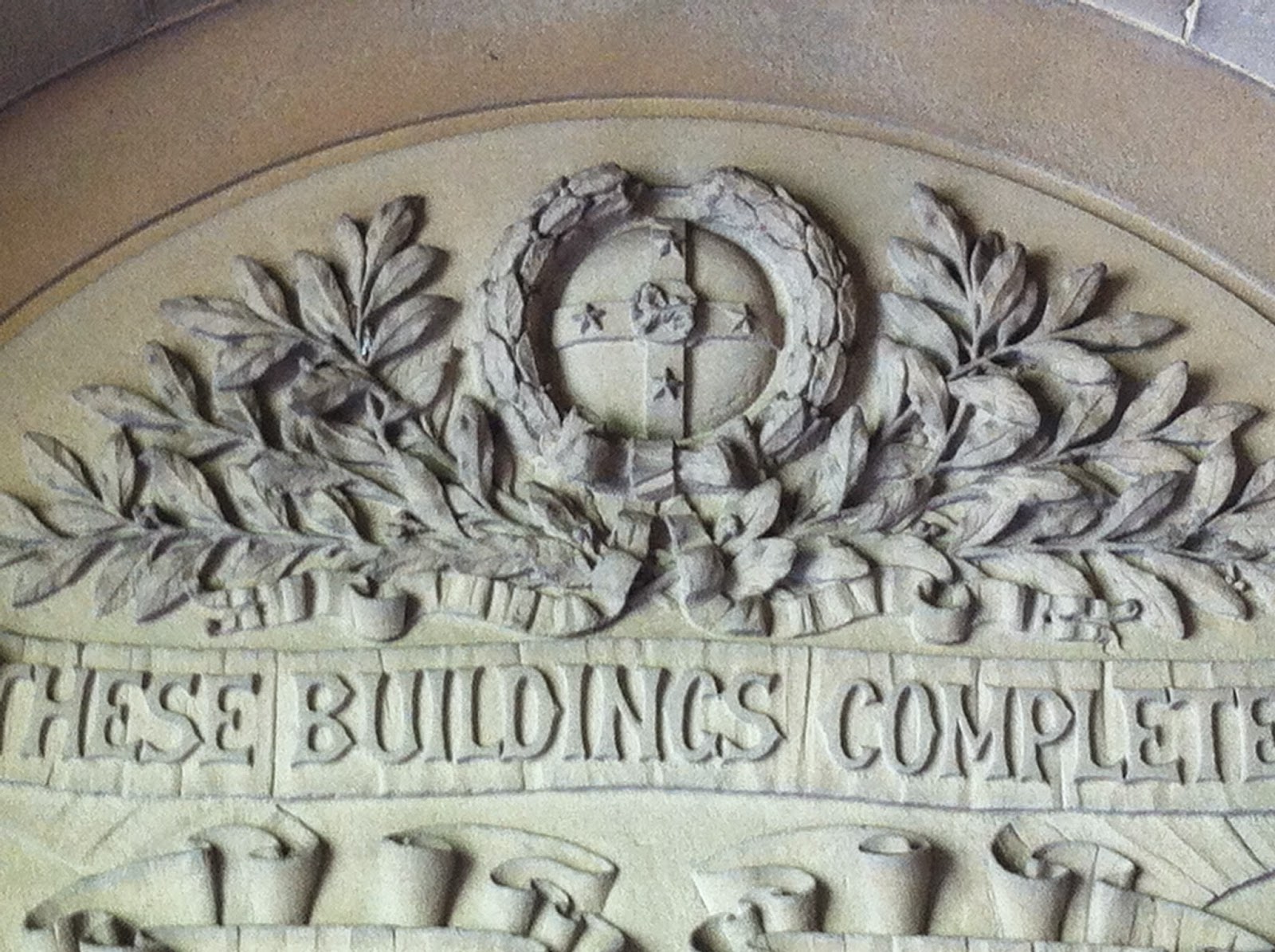
  • Present main buildings: Thomas Rowe won the 1878 design competition; the Victorian Classical buildings were completed and opened in 1894 (inscribed “These buildings completed A.D. 1894”)
  • Status: standing, still an operating public hospital


Sydney Hospital. Sydney Hospital traces its origins to the colony’s early medical services, established soon after the First Fleet arrived in 1788. The present Macquarie Street hospital grew from the colony’s first permanent hospital, built under a contract partly paid in rum. Opened in 1816, it is Australia’s oldest continuously operating hospital.


Transcription:

THESE BUILDINGS COMPLETED / A.D. 1894


Transcription:

THESE BUILDINGS COMPLETED / A.D. 1894


Transcription:

SPES

SYDNEY HOSPITAL


Transcription:

THE SYDNEY HOSPITAL / FOUNDED A.D. 1814


Transcription:

THE SYDNEY HOSPITAL / FOUNDED A.D. 1814


Sources

Sydney Hospital – Macquarie Street – August 2021 (My Australian History Journey, 10 August 2021)

Sydney Hospital August 2021


I went past Sydney Hospital again in August 2021 and took these photos. Its full name these days is Sydney Hospital and Sydney Eye Hospital.


The hospital's roots go back to the tent hospital the First Fleet put up at The Rocks in 1788, but the Macquarie Street site dates from Governor Macquarie's Rum Hospital, built between 1811 and 1816. It's still the oldest working hospital in Australia. At first it looked after convicts.


It sits on Macquarie Street, right in the city, near the Royal Botanic Garden, with the State Library and NSW Parliament House close by.


It's a public hospital with an emergency department, and it's known for eye care. The Sydney Eye Hospital moved onto the campus in 1996.


The main sandstone building on Macquarie Street went up between 1879 and 1894, in the Victorian Free Classical style. The old Georgian Rum Hospital wings on either side are now Parliament House and the Mint. The hospital has been added to plenty of times over the years.


It's a heritage-listed site, and it's been a teaching hospital for University of Sydney medical students since 1909.


For a building that's been through so much, it's still doing the job it was built for.


Sydney Hospital – The Rum Hospital (My Australian History Journey, 27 March 2025)

Macquarie Street’s hospital stretch is one of those Sydney stories where the nickname outlived the building. Governor Lachlan Macquarie wanted a proper public hospital, London wouldn’t fund it, so in 1810 he contracted D’Arcy Wentworth, Garnham Blaxcell and Alexander Riley to build a big colonnaded complex in return for a short-term monopoly on importing spirits. He laid the foundation stone on 30 October 1811; shoddy work delayed opening until 1816. Sydneysiders called it the Rum Hospital — and the name stuck.


The finished group had a central ward block with two flanking wings. Those wings were soon pulled into other government jobs: the north wing became the Legislative Council (and later Parliament House), the south wing became the Sydney Mint. Francis Greenway surveyed the dodgy fabric soon after completion and later supervised reinforcing that helped the surviving wings endure. The central Rum Hospital block itself was demolished from 1879. The Infirmary was renamed Sydney Hospital in 1881, and the present building opened in 1894.


Sydney Hospital and Sydney Eye Hospital remains Australia’s oldest continuously operating hospital on this Macquarie Street site — though the working wards are the late-Victorian and later buildings, not the 1816 central block.




My Earlier Posts

Sources