
Three men stand out in the paperwork and testimony around the Death Fleet of 1790: Donald Trail (sometimes Traill), master of Neptune; Lieutenant John Shapcote, naval agent in Neptune; and Captain William Hill of the New South Wales Corps, who commanded the military guard in Surprize. They were not all in the same ship. Hill was not in Neptune.
A companion article covers the three transports and mortality figures. This one follows who these three men were, what each could see, what each wrote or was said about them, and what courts and later research have established.

Thomas Watling. Public domain (Wikimedia Commons). Licence: public domain. Source: record.

Names and roles
- Donald Trail — also spelled Traill in some papers. Former navy master; had commanded a slave ship for Camden, Calvert & King. First assigned to Surprize, then moved to Neptune after Thomas Gilbert was removed. Master of Neptune for the voyage to New South Wales.
- Lieutenant John Shapcote — naval agent for the three contractor transports, embarked in Neptune. Flynn’s Dictionary of Sydney entry records him as aged 50. His duty was to monitor compliance with the Navy Board contract. Not the ship’s master. Collins and the Dictionary of Sydney record his sudden death at sea on 12 May 1790. His son Peter John Shapcote came out in Justinian and learned of the death on arrival.
- Captain William Hill (1760–1793) — second captain in the New South Wales Corps; commander of the Corps detachment in Surprize, under master Nicholas Anstis. His letter from Sydney Cove, 26 July 1790, to Jonathan Wathen (copy in the State Library of New South Wales) is firsthand for Surprize and secondhand for the fleet as a whole.

Thomas Rowlandson. Metropolitan Museum of Art. CC0 1.0. Licence: CC0 1.0. Source: record. Also collection page.

Authority at sea
Before the ships cleared England there was a fight over who controlled the convicts. Army officers of the new Corps wanted the keys and the discipline. The masters had signed bonds and answered to the Navy Board through the agent. On Surprize, Hill went on board while Trail was still that ship’s master and claimed the convicts as his prisoners. Trail refused to hand over the keys and pointed to Shapcote’s authority. Similar quarrels broke out in Neptune between Macarthur, Nepean and first master Thomas Gilbert, ending in a bloodless duel and Gilbert’s replacement by Trail.
Elizabeth Macarthur, who sailed first in Neptune, was glad to see Gilbert go, then decided Trail was of a “much blacker dye” and called him “a perfect sea-monster.” The Macarthurs transferred to Scarborough about a month out. Her journal and letters are passenger evidence about Trail’s manner, not a court finding about convict deaths.
Shapcote’s position was awkward. He was one agent for three ships. Hill later argued that government should lodge a controlling power in each ship — preferably in army officers — because one agent could only see what went on in his own vessel. Edward Riou of Guardian, meeting the fleet at the Cape, thought Shapcote foolish and beholden to Trail. Those are contemporary judgments by gentlemen who disliked the contractors’ men.

Unidentified painter; Dixson Galleries, State Library of New South Wales, DG 221. Public domain. Licence: public domain. Source: record.

Donald Trail and Neptune
Trail’s Neptune carried about four hundred and twenty male and seventy-eight female convicts, the naval agent, surgeon William Gray, and a large Corps party. Male convicts were held mainly on the orlop deck. After a mutiny scare on Scarborough in February, male convicts across the three ships were kept longer in irons. Women in Neptune were unironed on the upper deck under Navy Board orders that they not be abused.
By Cape Town, Flynn’s figures give 45 men and one woman already dead on Neptune. Fresh food was taken on. Some salvaged Guardian stores and about twelve Guardian convicts were crowded in. The ships sailed again on 29 April.
On return to England, Neptune seamen gave depositions alleging short rations, brutal irons, beatings by Trail and chief mate William Ellerington, and sales of leftover provisions in Sydney. Lawyer Thomas Evans pushed a private prosecution. The Admiralty case that went to trial in June 1792 charged Trail and Ellerington with the murder of the ship’s Portuguese cook. They were acquitted on that charge. The acquittal did not amount to a judicial finding that every allegation about convict treatment was false.
Gary L. Sturgess, in a 2025 Botany Baymen essay drawing on Neptune crew depositions in UK National Archives TS 11/381, has argued that a printed “convict letter” under the name Thomas Milburn was fabricated for Evans’s campaign, and that some deposition language is formulaic across witnesses. That is Sturgess’s secondary research conclusion.
Phillip, writing officially, blamed overcrowding and confinement. He told London he first learned of some alleged remarks attributed to him from the newspapers themselves. Neptune left Sydney in August 1790, loaded tea at Canton, and reached England in 1791. The ship burned at Cape Town in 1796. Trail’s later life after the acquittal is thinly documented in the open sources used here. No reliable portrait of him has been identified for this set.

Jacques-Nicolas Bellin. Geographicus Rare Antique Maps / Wikimedia Commons. Public domain. Licence: public domain. Source: record.

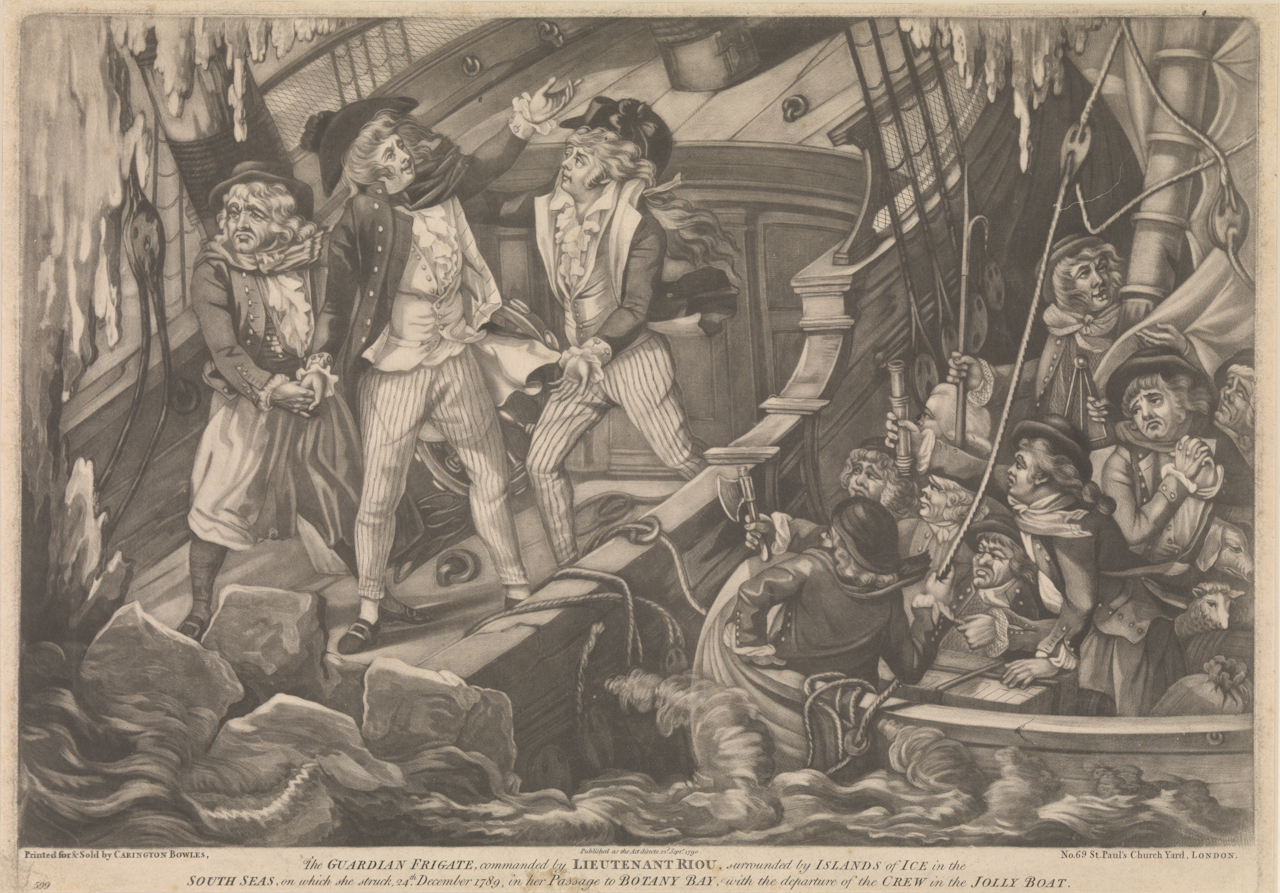
Print published by Carington Bowles, 22 September 1790 (Royal Museums Greenwich). Public domain. Licence: public domain. Source: record. Also collection page.

Lieutenant John Shapcote
Shapcote was the Crown’s eyes on the contract. He investigated complaints about irons before sailing and cleared the officers. At the Cape he obtained fresh supplies and accepted some Guardian stores. He died suddenly in the early hours of 12 May 1790, two weeks out from the Cape, in his cabin. Collins records the fact; Dictionary of Sydney follows it. Contemporary sources used here do not give a detailed medical cause.
Because Shapcote died before Port Jackson, he never answered Phillip and never gave evidence in London. Trail later found it useful to blame the dead agent for some missing convict property. Crew gossip later tied him to a convict mistress; that appears in secondary narratives of the depositions and remains allegation, not a court finding.

Francis Wheatley, c.1786. State Library of New South Wales, ML 124. Public domain. Licence: public domain. Source: record.

Captain William Hill and Surprize
Hill was baptised at Stroud, Gloucestershire, in 1760. As second captain of the Corps he sailed in Surprize with Ensign John Thomas Prentice and a smaller guard than Neptune carried. His quarrel with Trail over the keys happened while Trail was still Surprize’s master. At False Bay, tensions between Hill and Prentice ended with Hill’s arrest.
On 26 July 1790, a month after Surprize anchored (26 June), Hill wrote to Jonathan Wathen of Bond Court, Walbrook. A 1791 copy is in the Mitchell Library (MLMSS 6821). He said he had also written to William Wilberforce. Passages that bear on the fleet include:
- He sailed from Cowes on 17 January and reached False Bay on 13 April; left the Cape 29 April; anchored in Port Jackson 26 June.
- The misery of the voyage was “render’d so by the Villiany, oppression and shameful Peculation of the masters of the Transports.”
- Of Surprize herself: unfit in make and size; in a trifling gale she shipped so much water that from the Cape the convicts were considerably above their waists in water; when gales abated, no fumigation or vinegar was used.
- Fleet-scale figures in his letter — 370 of 900 male convicts already dead, 450 landed sick — are round numbers. They differ from Flynn’s reconstructed voyage deaths and should be read as letter testimony, not as a ledger.
- He called the irons barbarous, said the contractors had used Guinea Trade shackles with a short bolt, and wrote: “the slave trade is mercifull, compar’d with what I have seen in this Fleet.”
- He urged a controlling power in each ship over “low lif’d barbarous masters,” instead of one agent who could only see his own ship.
What Hill described from direct experience was Surprize and the landing of the sick in the cove. What he wrote about the masters’ bookkeeping and about the fleet as a whole was accusation across ships. Both layers are historical evidence; they are not the same layer.
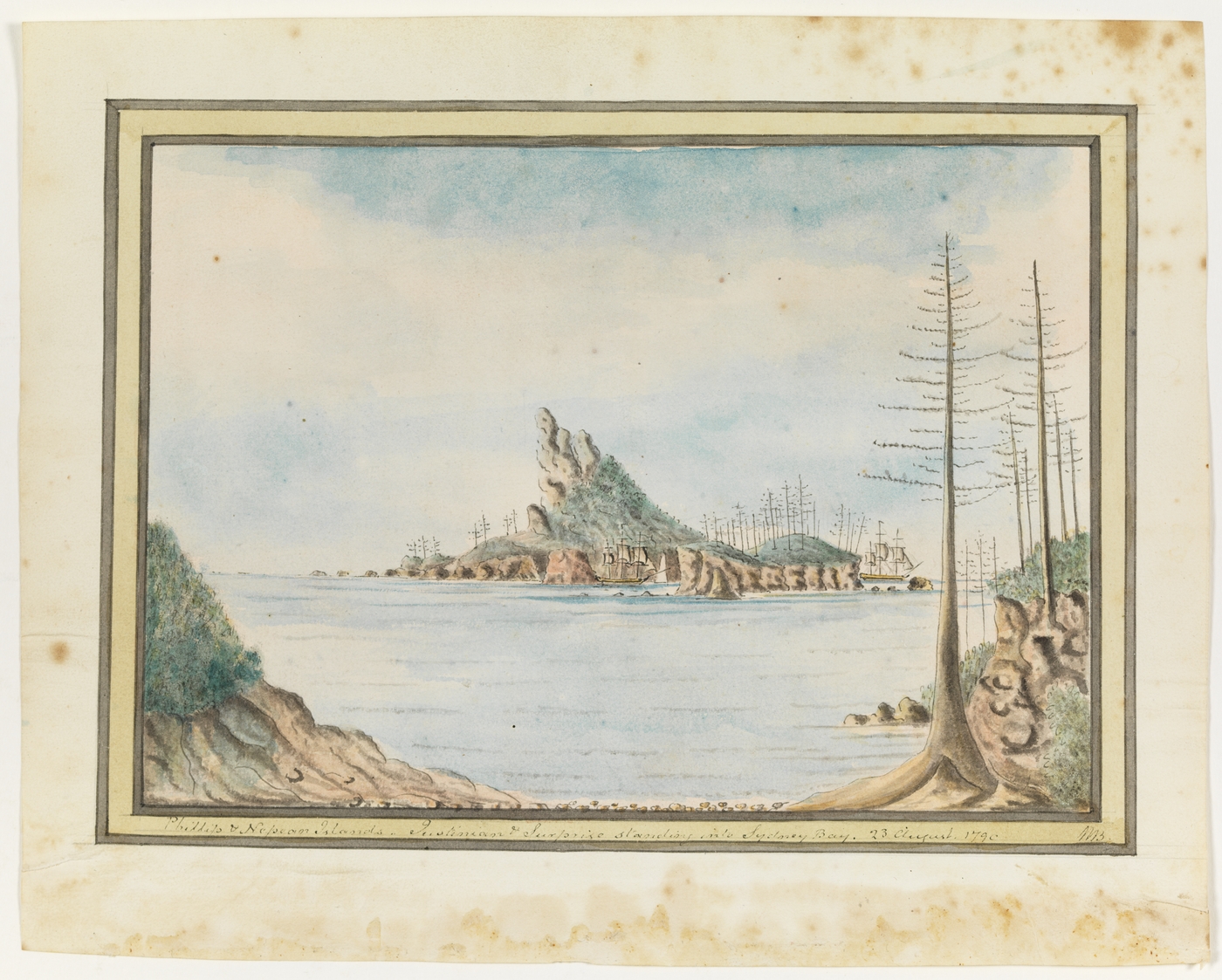
William Bradley. State Library of New South Wales, Safe 1/14. Public domain. Licence: public domain. Source: record.


Attributed to Frederick Buck. State Library of New South Wales. Public domain. Licence: public domain. Source: record.

Hill after the letter
Marine diarists record quarrels in the colony, including a duel with Major Ross and attempts to court-martial Nepean. He was critical of Phillip’s land and exploration policy in the same Wathen letter. He left Sydney in the early 1790s and in April 1793 sailed for India in Shah Hormuzear. On 1 July 1793, at Erub (Darnley Island; called Tate’s Island by the ship’s master) in Torres Strait, a shore party seeking water and refreshment was attacked. Hill and a seaman were found dead on the beach. He was about thirty-three. No portrait is included here; none with clear free licence and firm identification was located for this set.
Allegations, testimony and findings
| Claim | Who says so | Status |
|---|---|---|
| Trail a “sea-monster,” harsh to gentlemen passengers | Elizabeth Macarthur | Contemporary passenger opinion |
| Barbarous irons; short rations; masters’ peculation; Surprize flooded | Hill’s letter (Surprize firsthand; fleet figures estimated) | Testimony |
| Overcrowding and too much confinement caused the hospital scene | Phillip to Grenville | Official judgment |
| Starvation, beatings, withheld dead men’s rations, and related claims | Neptune crew depositions via Thomas Evans | Allegations; some language formulaic per Sturgess; cook-murder trial did not convict |
| Trail and Ellerington murdered the cook | Admiralty prosecution, June 1792 | Acquitted on that charge |
| “Thomas Milburn” convict letter from Neptune | Published in London campaign | Sturgess concludes fabrication |
| Shapcote incompetent / beholden to Trail | Riou; Hill’s structural criticism of one agent | Opinion; Shapcote dead before inquiry |
| Shapcote died 12 May 1790 | Collins; Dictionary of Sydney | Accepted fact; medical cause not detailed in those sources |

Photograph by Julioenrekei. Wikimedia Commons (own work, released as public domain / PD-self). Licence: public domain. Source: record.

Related stories
Read next: Second Fleet – Neptune, Scarborough and Surprize; Lady Juliana.
Sources
- Penny Edwell, “Neptune,” “Surprize,” Dictionary of Sydney, 2016 — neptune, surprize
- Michael Flynn, “Second Fleet,” Dictionary of Sydney, 2016 — entry; The Second Fleet (1993/2001)
- William Hill to Jonathan Wathen, 26 July 1790, SLNSW MLMSS 6821 — transcript
- Dictionary of Sydney person entry: Hill, William 1760–1793
- David Collins, An Account of the English Colony in New South Wales
- Elizabeth Macarthur, journal and letters, in Sibella Macarthur Onslow (ed.), Some Early Records of the Macarthurs of Camden
- Gary L. Sturgess, “Australia’s Death Fleet – New Sources,” Botany Baymen, 2025 — article
- UK National Archives TS 11/381 — as cited by Flynn and by Sturgess
- House of Commons, Accounts and Papers relating to Convicts, 1791–92
No comments:
Post a Comment