Search This Blog

Showing posts with label Alfred Street. Show all posts

Tuesday, March 3, 2020

Customs House Lane - Circular Quay - Sydney - New South Wales

If you duck off Circular Quay into the tight grid between Alfred, Loftus and Young Streets, you’re in the old customs-and-wool pocket of the working port. Customs House Lane sits hard against Sydney’s Customs House — the bureaucratic heart of the quay when wool and general cargo still came alongside. Colonial Architect Mortimer Lewis designed the original Greek Revival building; construction ran 1843–45 on reclaimed foreshore. Overcrowding and damp pushed James Barnet to enlarge and rebuild in the 1880s (wings, another floor, the portico), with later twentieth-century alterations. After Federation the Commonwealth ran customs from here until operations wound down around 1988–90. Today it’s a City of Sydney cultural and library venue — not an active customs office.

On the south-west of the lane precinct, Hinchcliff’s stone wool store (Hinchcliff House, 5–7 Young Street) survives from the staple-export years. Andrew Hinchcliff’s firm built the stone store about 1860 (an earlier iron shed of 1845; a matching late-1880s addition). Mid-century the Society of St Vincent de Paul used it as Ozanam House and, from 1952, part of the Matthew Talbot Hostel for homeless men before the hostel moved on. The façade hoists still read as wool-bale kit if you know what you’re looking at.

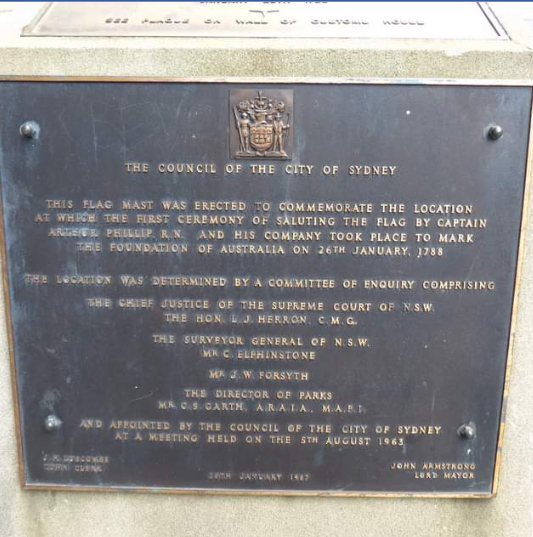
Together the customs house and woolstore tell Circular Quay’s shift from working port to civic waterfront. Soften any claim that a particular Loftus Street flagpole marks the exact 1788 flag-raising site — popular tradition varies; treat flag symbolism as commemorative unless a heritage panel is quoted. Photographs here cover Customs House, Hinchcliff House / the lane, and Circular Quay streetscape.







Customs house was where shipping was cleared and goods passing through the Port of Sydney will text for sale or export.
When the port was busy the house was crowded and noisy, a scene of raised tempers, delays in disputed dealings.

The six story colonnaded building you see today evolve through several phases of expansion between 1845 and 1917.
On Loftus Street alongside the house, union Jack flies permanently on the site where the first British flag was raised.


Wednesday, April 12, 2017

Alfred And Albert Streets - Semi Circular Quay


 Alfred & Albert Street's - Circular Quay East - 
Proclaimed January 7, 1845

 We must establish the perspective of today's Broadway roadway was in the beginning, the mud for tank stream Estuary. At the Western end with the overhead railway slips across Pete Street and George Street,  we are near enough to the location of the first, the Kings wharf, and afterwards, in the time of Queen Victoria, the Queens wharf.

Skinny pants artistic statement of 1842 holds a glimpse of and I'm getting the gateway to a future metropolis yet manages to convey some of the romance in a worthy way.

Around the south west corner of Sydney Cove Smugglers found that they could float contraband the tide before sunup or late in the climbing what's the builder of the little ships could launch his hopes up as far as Underwood Street and see them safely born to the bosom of Sydney Cove.

However, in 1845 Albert Street had crept hesitantly down to Phillip Street, and Alfred Street struggled to establish its personality in front of the-year-old Customs House. Those streets must've been very insignificant because the directory of 1851 speaks of Circular Quay, 

By 1855 in circular key could've been more accurate accurately describe the semi circular key, the two Street lights lined up to acceptable brokers in their stores it suitable neighbours for the customs, particularly as were was acting as vice Council for Denmark and Portugal and also looking after the concealer interests of Chile, Spain, Norway and Sweden. Might have him self in Australia more in mind.

About this time, when the stone wall is nearly completion to make the art of semi circular key self evident, the Halfpenny bridge - The Bon Accord, which has been made between what is now at the paragon in Pitt Street, became superseded by the filament. Pete Street flooded in the wake of the receding  tank stream below Hunter Street and made ready to gain access to the old Commiseriat stores and the western side of Sydney Cove.


However those only assisted Circular Quay to create a fame & fortune, and a great clippers instead of anchoring off Moore's Wharf as well for Millers Point now filled the canvas and lay at ease  in the Semi circular key. The figureheads peered into the dark and dank  of the Woolstore's and sought out the valuable cargo is which rolled from shore to  ship side along great spars of iron bark and turpentine


Friday, May 29, 2015

Sydney’s First Newspaper - The Sydney Gazette - George St Near Alfred St - Circular Quay


Australia's First Newspaper


George Street, Eastern Side, Near Alfred Street, Curcular Quay 


The First Jssue Of "The Gazette" Was Piblished On March 5th 1803.


Captain David Collins Wrote  "In November, 1795, A Small Printing Press Which Had Been Brought Into The Settlement By Mr Phillip (Governor Phillip) .. Was Found Very Useful


The "Sydney Gazette and New South Wales Advertiser" holds the distinction of being Australia's first newspaper. Its establishment and subsequent history provide a glimpse into the early colonial period of New South Wales. Here's an overview of the history of the Sydney Gazette:

Establishment and First Issue:

  • The "Sydney Gazette and New South Wales Advertiser" was first published on March 5, 1803.
  • It was established by George Howe, who arrived in Australia as a convict and became the colony's first printer.

Purpose and Content:

  • The newspaper served as a vital communication tool in the early colony, providing news, information, and announcements to the residents of New South Wales.
  • The content of the Sydney Gazette included local and international news, official government announcements, shipping information, advertisements, and commentary.

Role in the Colony:

  • In addition to disseminating news, the Sydney Gazette also played a role in shaping public opinion and conveying government policies and decrees.
  • It was seen as a vehicle for disseminating information that would aid in the administration of the colony.

Government Influence:

  • Given the newspaper's role and the early colonial context, it had close ties to the colonial administration.
  • George Howe was officially appointed as the government printer, and the newspaper received financial support from the colonial government.

Expansion and Change:

  • Over time, the Sydney Gazette expanded its coverage to include various topics, such as cultural events, literature, and societal issues.
  • It also covered the challenges and developments of the early colony, including issues related to transportation, convicts, and exploration.

Competing Newspapers:

  • While the Sydney Gazette held the distinction of being the first newspaper in Australia, it faced competition as other newspapers were established in the colony.
  • The early colonial period saw the emergence of several other newspapers, each with its own editorial stance and readership.

Legacy and Influence:

  • The Sydney Gazette holds immense historical significance as a primary source of information about the early colonial period of Australia.
  • Its publications provide insights into the social, political, economic, and cultural landscape of the time.

Cessation:

  • The Sydney Gazette continued to be published under various names and with different ownerships for many years.
  • The newspaper ceased publication in 1842, marking the end of an era in Australian journalism.

The Sydney Gazette's role as Australia's first newspaper and its coverage of the early colonial period make it an invaluable resource for historians and researchers interested in understanding the origins of Australian media, society, and government.


The Government Wharf - Circular Quay


Government Wharf - Circular Quay 

Alfred Street - Circular Quay, Near Loftus Street


In 1788, When The First Fleet Anchored In Port Kackson, The Head Of Sydney Cove Was V Shaped, Bisected By The Tank Stream, Which Entered The South Side Of The Cove Where Present Day Pitt Street Is. Surveyor James Meehan's Plan Of Sydney Showed Today's Alfred Street Covered With Water at HighTide. It Was Here That The Government Wharf Was Built On The Water Frontage Now Occupied By The Paragon Hotel. 


Friday, May 22, 2015

Sydney Police Court – Historical Marker Number 94

Sydney Police Court - Corner Of Phillip & Alfred Streets - Sydney 


Among the Royal Australian Historical Society’s Sydney Green Plaques, No. 94 is easy to walk past if you are racing for a ferry — and worth slowing down for. It marks “Police Court C,” the Police Court on Phillip Street that opened on 7 January 1886, on the Circular Quay side of the city between the older Water Police Court and the Water Police Station.

The courthouse was built of Pyrmont freestone to plans from the Colonial Architect’s office (James Barnet held that post) and was meant mainly as a summons and small-debts court, taking pressure off the older building next door. At the opening, Whittingdale Johnson — the first magistrate to sit there — remarked that the new rooms would let magistrates who had “suffered through the foul atmosphere of the old court” regain their health. Ventilation and windows got particular attention. The court closed in 1979. The building survives today as part of the Justice & Police Museum complex managed by Museums of History NSW, on Phillip Street near Circular Quay.

The green plaque belongs to the Bicentennial series (1984–1988) — 101 markers recalling vanished or layered city sites. Do not confuse this Phillip Street Police Court with the earlier Central Police Court / Market House site on George Street (now under the Queen Victoria Building), which has its own green plaques.

Image: RAHS / site marker for Police Court C / Phillip Street Police Court.