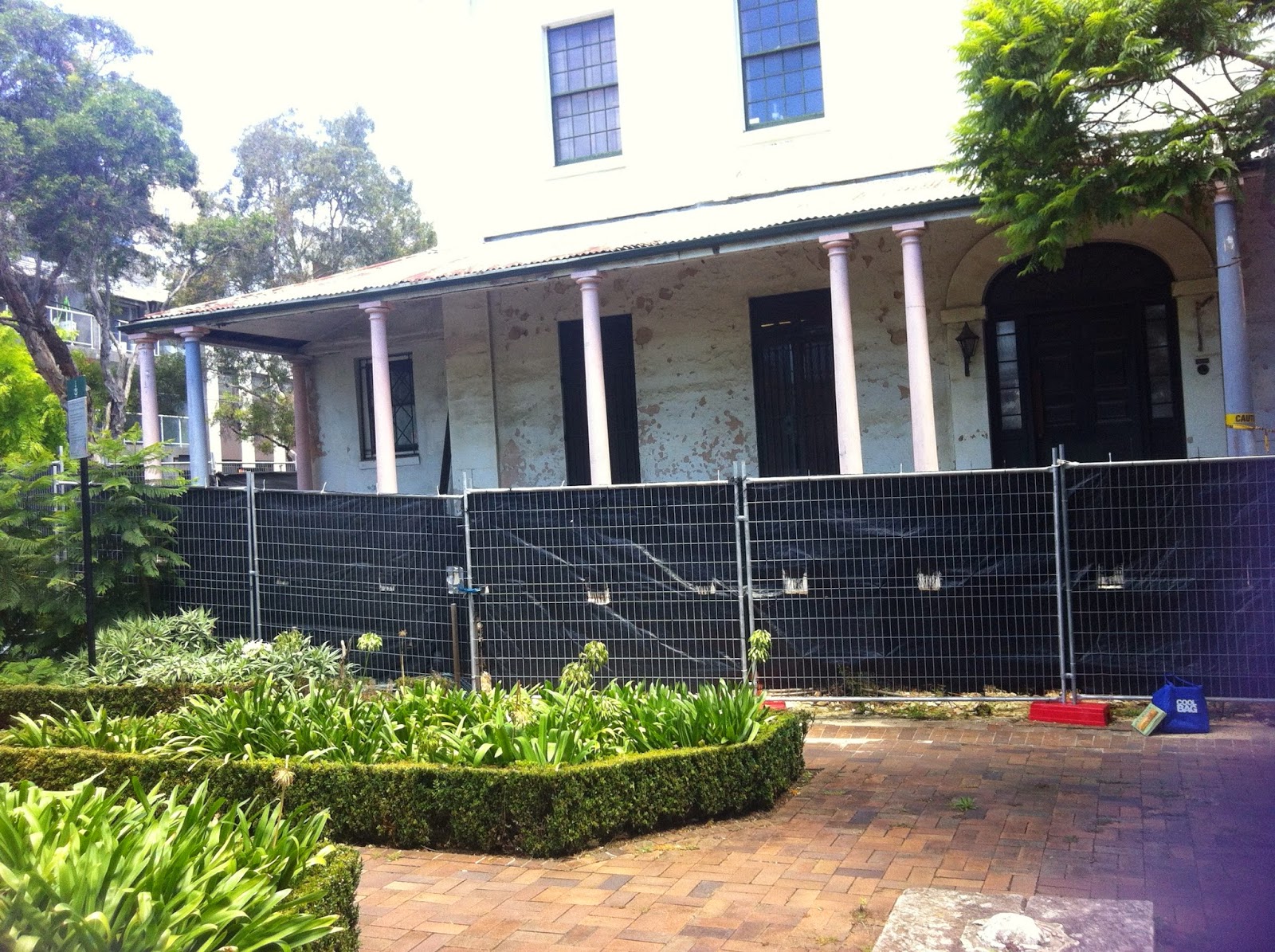
Cleveland House - Buckingham Street & Chalmers St - Central - Built Around 1823…
. It is Now 2023 So The House itself Is Approx 200 Yrs Old….
Cleveland House Is Situated On Part Of Section 408 Of The Parish Of Alexandria, Which Comprised Of 10 Acres Of Land Origianlly Granted To Charles Smith In 1809 And Came To Be Known As Cleveland Gardens.
From The Date Of The Original Grant Until The Subdivision Of The Cleveland The Only Roads Giving Access To The Boundaries Of Elizabeth Street South And Devonshire Street.
Historical Notes
Cleveland House was built in about 1823-4 for prominent emancipist merchant Daniel Cooper. The house was built on about twelve acres of land which was originally granted to Charles Smith by Governor Macquarie in 1809 (Annable, 1991:12). Smith used this land, known as Cleveland Gardens, as either a market garden or nursery. Upon his purchase of the land Cooper spent (Pounds)4000 on construction of the house, believed to be the work of architect Francis Greenway (Annable, 1991: 5). The Cooper family moved into the house in 1825 but only resided there until 1829 when Cooper separated from his wife. At the time the house was let to provide Mrs Cooper with a source of income. (Annable, 1991:6)
Until 1855 the house and its land was let out mainly to various families for residential purposes. However, in the 1830s the property was also used as a school. During this time the property is believed to have held prime views of the Darling Harbour and city areas. The decision in 1850 to build Redfern terminus brought industry to the area. This resulted in the subdivision of many of the gentlemen's estates in the neighbouring suburb of Surry Hills. This caused Surry Hills to be built out and changed its character from a picturesque 'village' to a high density suburb (Annable, 1991:6).
Daniel Cooper returned to England in 1831 and left the house in the trust of James Cooper on the death of his ex-wife, Hannah, in 1836. Daniel Cooper died in 1853 and James Cooper sold the estate, which now amounted to around 13 acres (Annable, 1991:22), jointly to Moorehead and Walker (Annable, 1991:14-15). In 1855 this estate was subdivide into eight sections as part of the redevelopment of Surry Hills. The section containing the house and the outbuildings, lots 7, 8 and 12, were sold as a single property to Isaac Levey and inherited by his son, Montague, in 1860. For a short time after the subdivision the property was used for residential purposes but from 1858 the uses were varied. Uses included a school, laundry, boarding house, gentlemen's apartment and a government labour bureau (Annable, 1991:6)
A further subdivision of land, lots 7 and 8, occurred in 1886. However, only 2 of these were purchased. From about the mid-1870s the outbuildings were used as a cordial factory, Barrett's. It is thought that some new buildings and extension of existing buildings took place to accommodate the factory. This use continued until it was sold to Peach and Jones bottle merchants in 1896 (Annable, 1991:6). At this time, the house was still owned by Levey (Annable, 1991:16).
In 1903, the Order of the Sisters of the Good Samaritan purchased the entire unit of the original 1855 subdivision, with the exception of the two lots that were purchased in the 1886 subdivision. The Order used the property as a receiving place in the city for its refuge. Cleveland House was used as a convent for the nuns. They built a large four-storey building to house the refuge and a commercial laundry which was opened in 1904 (Annable, 1991:8) In the late 1920s the refuge became a home for aged and infirm women (Annable, 1991:17)
In 1946 the property was sold to the Franciscan Missionaries of Mary who used it for the same purposes as the Good Samaritans (Annable, 1991:8)
In 1958 Cleveland House was purchased by the NSW Society for Crippled Children. The refuge, built in 1904, was used as a hospital, clinic and for administration. Cleveland House was also used for administration. The former convent garden was filled in to be used as a lawn area and later for parking. Additional small buildings were constructed on the site (Annable, 1991:8).
The property was sold in 1988 to Denerin Pty Ltd and all the buildings with the exception of Cleveland House were demolished and further subdivisions have occurred (Annable, 1991:8). Today there is a small garden at the front of the house and a grassed area between the side of the house and Chalmers Street. A large apartment complex is located at the rear (south) of the house.
The house has been in private hands throughout its 186 year history. It is today owned by LGS Enterprise, which runs a medical education business InViVo Communications from the building (Central Sydney magazine,
10/2/2010, 4).
Check out Cleveland House Part 2, Part 3 & Part 4