
History of convict colonial settlement from the beginnings of the First Fleet in 1788, and other significant parts of Old Sydney Town's heritage.
Showing posts with label Woolloomooloo. Show all posts
Showing posts with label Woolloomooloo. Show all posts
Wednesday, October 26, 2022
Friday, March 4, 2022
Crown Street - Woolloomooloo - Darlinghurst - Surry Hills
Crown Street is a roughly 2.3–2.4 km north–south thoroughfare through Woolloomooloo, East Sydney, Darlinghurst and Surry Hills — from near Sir John Young Crescent south to Cleveland Street. It sits on the sandstone plateau that Dictionary of Sydney writers treat as a spine of Surry Hills topography, between the Woolloomooloo valley and the old Sandhills toward Central, and became one of the main early north–south roads as the Riley and neighbouring estates were subdivided through the mid-nineteenth century.
Along the Surry Hills stretch it’s still a mixed retail and terrace corridor (Crown Street Public School, Surry Hills Library / Community Centre, corner pubs). Two landmarks bookend the story without owning the whole street: the Crown Street Reservoir block (completed 1859, bounded with Reservoir, Riley and Campbell Streets) and the former Crown Street Women’s Hospital at Crown and Albion — founded by Dr James Graham in Hay Street in 1893, moved to Crown Street in 1897, closed 31 March 1983 when maternity services shifted westward (including to Westmead). An electric tram once ran from Oxford Street to Cleveland Street until the late 1950s; traffic one-way patterns south of Campbell Street changed after the Eastern Distributor opened in 1999.
Treat this as a continuous inner-east spine rather than a single building note suburb segment and landmarks where they’re visible.
Saturday, April 24, 2021
Woolloomooloo Fish Markets
Before Blackwattle Bay and the tourist queues at today’s Sydney Fish Market, the city’s first purpose-built fish market sat hard against Woolloomooloo Bay. The City Council built it in the early 1870s (commonly dated 1871–72) to regulate a trade that had long mixed harbour-side hawking, boat sales and street cries of “Fish O!” with recurring complaints about quality and public health. The market stood in the Forbes / Plunkett / Bourke Streets precinct — a working harbour of fishers, coastal traders and timber yards.
The Eastern Fish Market (as Woolloomooloo became known) was extended in 1888 and 1893 until it covered the block bounded by Bourke, Plunkett, Forbes and Wilson Streets. A privately owned Southern Fish Market opened at Redfern in 1891; later the municipal City Fish Market at Haymarket drew trade away. The Woolloomooloo building was sold in 1911 and operations left the bay. The market structures were eventually demolished; the Astor apartments rose on the site in the 1960s. Fish marketing later centred on Haymarket and, from 1966, Blackwattle Bay — the lineage of today’s Sydney Fish Market — but Woolloomooloo remains where the city’s first formal fish market began.
Woolloomooloo Fish Markets - Woolloomooloo - NSW

Windmills of Old Sydney
Windmills Of Old Sydney
It’s Hard To Believe That Sydney Was Once The City Of Windmills. There Were More Than 7 Along The Darlinghurst Ridge, 3 In the Government Domain & 1 At Miller’s Point.
The Old Windmills of Sydney, also known as the Government Windmills, were a historic group of windmills that played a significant role in early colonial Sydney. Here's everything you need to know about the Old Windmills:
1. Establishment: The first windmill in Sydney was constructed in 1796 by convict labor. It was located on what is now Observatory Hill, near the current site of the Sydney Observatory. The windmill was built to meet the demand for flour in the growing colony.
2. Purpose: The windmills served as grinding mills for grain, primarily wheat, producing flour for the colony. At the time, grinding mills were crucial for food production, as they converted raw grain into a usable form.
3. Operations and Design: The windmills were traditional post mills, with a timber tower and a rotating cap that housed the grinding mechanism. They featured large sails attached to the cap, which were designed to catch the wind and turn the grinding stones inside.
4. Expansion: Over time, additional windmills were constructed near the original windmill on Observatory Hill. By the early 19th century, there were several windmills operating in the area, meeting the growing demand for flour.
5. Decline and Demolition: As the colony developed and technology advanced, the demand for windmills declined. The introduction of steam-powered mills and other industrial advancements made windmills less efficient and economical. By the mid-19th century, the Old Windmills had fallen into disrepair and were eventually demolished.
6. Legacy: Although the Old Windmills no longer exist, they hold historical significance as a reminder of the early colonial era and the importance of flour production in sustaining the colony. Observatory Hill, where the original windmill stood, is now a public park and offers panoramic views of Sydney Harbour.
7. Sydney Observatory: The site of the original windmill on Observatory Hill later became the location of the Sydney Observatory, which was established in 1858. The observatory played a crucial role in astronomical and meteorological observations and is still operational today.
While the Old Windmills of Sydney are no longer standing, their presence in the early years of the colony reflects the importance of food production and the influence of technology on the development of Sydney. Their legacy is remembered through historical accounts, images, and the site's transformation into Observatory Hill and the Sydney Observatory.

Boston's Windmill, also known as the Observatory Hill Windmill, is a historic landmark located in Sydney, Australia. It holds a significant place in the city's history and serves as a reminder of Sydney's colonial past and early industrial developments. Here's an overview of its history:
Construction and Purpose:
- Boston's Windmill was built in 1828 by ex-convict John Boston on the western side of what is now known as Observatory Hill.
- The windmill was constructed to meet the growing demand for flour in the colony. At the time, Sydney faced shortages of flour, and the windmill was intended to contribute to local food production.
Design and Operation:
- The windmill was a three-story structure with white-painted timber cladding.
- It was a smock mill, a type of windmill design with a sloping tower that could be rotated to face the prevailing wind direction.
- The windmill was equipped with millstones and machinery for grinding grain into flour.
Challenges and Decline:
- Despite its potential, Boston's Windmill faced challenges such as inconsistent wind patterns and competition from other mills.
- The mill's output did not meet expectations, and John Boston's financial difficulties led to its closure in 1836.
Later Uses and Preservation:
- After its closure as a working windmill, the structure was repurposed for various uses, including as a signal station for ships entering Sydney Harbour.
- In the 1860s, the windmill was incorporated into the establishment of the Sydney Observatory.
Sydney Observatory:
- The windmill tower was integrated into the design of the Sydney Observatory, which was established on Observatory Hill in the 1850s.
- The windmill tower was used as a telescope dome and observatory building, enhancing the historical and scientific significance of the site.
Heritage and Preservation:
- Boston's Windmill and the Sydney Observatory are recognized as heritage-listed sites.
- The windmill's incorporation into the observatory highlights its historical value and its contribution to Sydney's early industrial and scientific developments.
Today, Boston's Windmill and its integration into the Sydney Observatory continue to reflect the city's evolving history. The site stands as a testament to Sydney's colonial past, technological progress, and the efforts of individuals like John Boston who contributed to the development of the city's infrastructure and industry.
In colonial Sydney, windmills played a crucial role in food production, grinding grains into flour to meet the growing needs of the population. These windmills were significant landmarks of their time, contributing to Sydney's development and economy. Here's an overview of the history of windmills in old Sydney:
1. Boston's Windmill (Observatory Hill Windmill):
- Built in 1828 by ex-convict John Boston on what is now Observatory Hill.
- The windmill aimed to address the colony's flour shortages and contribute to local food production.
- It was a smock mill design with three stories and white-painted timber cladding.
- The windmill's operation faced challenges, and it closed in 1836.
- The windmill tower was later incorporated into the Sydney Observatory, enhancing its historical and scientific significance.
2. Rose's Windmill (Vaucluse Windmill):
- Constructed in the 1810s by James Squire, a former convict turned brewer.
- The windmill was situated in the Vaucluse area, in what is now Sydney's eastern suburbs.
- It was used to grind grains for brewing and flour production.
- The windmill was demolished in the 1850s, and the area's name, Vaucluse, is derived from the Latin "vallis clausa," meaning "hidden valley."
3. Greenway's Windmill (Mulgrave Windmill):
- Designed by Francis Greenway, the colonial architect, and constructed in the late 1820s.
- Located in the area known as Mulgrave Place (now Windsor), northwest of Sydney.
- The windmill was part of the government's efforts to promote local flour production.
- It was functional for several years but fell into disrepair and was eventually demolished.
4. Burnell's Windmill (Birkenhead Point Windmill):
- Located at Birkenhead Point on the shores of Iron Cove.
- Built by former convict John Burnell in the 1830s.
- The windmill contributed to local grain processing and flour production.
- The windmill's operation was short-lived, and it ceased functioning in the mid-1800s.
These windmills were important in ensuring a local supply of flour and grains in a growing colony, where imported goods were often scarce and expensive. Their historical significance lies not only in their practical role but also in their representation of Sydney's early industrial development and the efforts of individuals like John Boston, James Squire, and Francis Greenway who contributed to the city's growth. While most of these windmills no longer exist, they are remembered as important landmarks in Sydney's history.
Thursday, December 17, 2015
Riley Street – Woolloomooloo
Riley Street takes its name from the Riley Estate — the vast holding merchant Edward Riley assembled in the 1820s from John Palmer’s Woolloomooloo farm (bought 1822) and many smaller Surry Hills / Darlinghurst grants. After Riley’s death in 1825, conflicting wills locked the land in litigation for years; an 1844 Supreme Court partition laid out a street grid (still readable on the Riley Estate plan) that organises Woolloomooloo and adjoining Surry Hills blocks. Riley Street became one of the estate’s spine streets between the Domain edge and the ridge.
Nineteenth-century subdivision produced the close-set terraces and boarding houses that defined working Woolloomooloo beside the finger wharves; twentieth-century resumptions, industry and later residential towers layered over that grid. The street remains a piece of the 1840s estate survey even where individual houses have changed.
Good Old Riley Street - Woolloomooloo
I Spent Some Of The Best Years of My Life Living In Riley Street At Tue Woolloomooloo End.


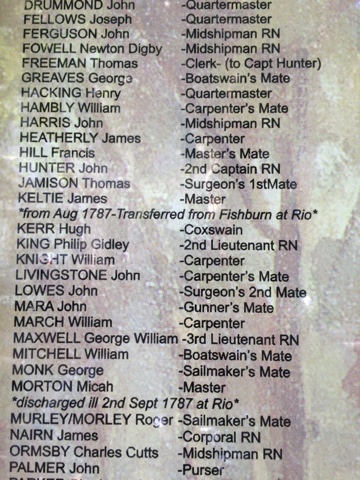
Convicts and Crew of the First Fleet – Fellowship of First Fleeters – Cathedral Street
The First Fleet arrived at Port Jackson in January 1788, carrying convicts, marines, sailors and officers who formed the first British settlement in New South Wales. The Fellowship of First Fleeters preserves the history and family connections of people associated with that voyage and the early colony.
Convicts And Crew Of The First Fleet 1788 -
Pictures Taken From The Front Of The Fellowship Of First Fleeters - Cathedral Street - Woolloomooloo



Thursday, May 28, 2015
Woolloomooloo Wharf - Woolloomooloo - Sydney
My 16th 2014
10 Things You May Not Have Known About......WOOLLOOMOOLOO WHARF
1. The Finger Wharf Or Woolloomooloo Bay Is The Longest Timber Piled Wharf In The World & The Longest Finger Wharf.
2. It Was Built By The Sydney Harbour Trust Between 1911 & 1915. It Was Designed By The Trusts Engineer In Chief... Henry Walsh
3. The Wharf Has A Length Of 410 Metres & A Width Of 64 Metres, & Is Composed Of Two Side Sheets Running Almost The Length Of The Jetty, Connected By A Covered Roadway.
4. The Finger Wharf Was An Operational Working Wharf For Much Of The 20th Century. During Its working Life, For About 70 Years, It Primarily Handled The Export Of Wool. It Took Overseas Shipping From Europe & America As Well As From The Pacific.
It Also Acted As A Staging Point For Troop Deployment To Both World Wars, As a Well As A Disembarking Point For New Migrants Arriving In Australia.
5. By The 1970's, New Container Ports With Larger Wharfing Facilities And Cruise Liner Terminals Around The City Meant The Use If The Wharf Declined.
By The 1980's The Wharf Lay Derelict & In 1987, The NSW Government Decided To Demolish it.
6. A New 440 Berth Marina & Resort Was Approved To Replace The a Wharf But When The Demolition Work Was Due To Begin In January 1991, Locals Blocked The Entry To The Site.
7. Public Sentiment Was For Retention, & A Host Of Public Meetings Were Held Before Unions Imposed A Green Ban Which Stopped Demolition Crews From Undertaking Work
8. Other Uses For The Site Were Canvassed & Included A Museum Of Work & Industry.
9. In 1999, The Walker Corporation & Multiplex Completed A 300 Million Makeover That Created 300 Apartments, A Hotel, & A Marina. The Development Has Attracted Famous Tenants... Among From Russell Crowe & John Laws.
10. Woolloomooloo Wharf Is Among One Of Sydney's Best Dining Strips With Otto, Manta & China Doll Among Those Restaurants To Call It Home. The Blue Hotel Is a operated By The Taj Hotel Group.
Subscribe to:
Posts (Atom)