
The Intercolonial Exhibition Building – Prince Alfred Park – Central – Sydney
Walk south of Central into Prince Alfred Park and the lawns feel like they are waiting for something bigger than a lunchtime kickabout. They were. Sydney’s first purpose-built exhibition hall stood here — in what had been Cleveland Paddocks — years before the Domain got its Garden Palace. The Intercolonial Exhibition Building opened on 30 August 1870 for the Intercolonial Exhibition of General Industries and Arts, organised by the Agricultural Society of NSW to mark the centenary of Cook’s landing at Botany Bay and to rehearse colonial displays for overseas shows. All the Australian colonies and New Zealand were invited.
The park had been gazetted in the mid-1860s and named for Prince Alfred after his 1868 visit. City engineer Edward Bell designed the hall; Benjamin Backhouse laid out the grounds — the first Australian park designed around a major exhibition, ahead of Barnet’s 1879 Garden Palace and Melbourne’s Royal Exhibition Building of 1880. After 1870 the hall stayed busy with shows, concerts and later uses, including the Australian War Memorial museum collections from 1925 until they moved to Canberra in 1936.
The building came down in 1954. The park is still public open space; some of the nineteenth-century planting, including boundary Moreton Bay figs from the early layout, is part of its heritage character. The photographs here remember the lost hall — different building, different park, nine years earlier than the Garden Palace.
The First Sydney Exhibition Building
Prince Alfred Park


To think, this was only demolished in the 1950’s.... to make way for a swimming Pool....
Those words and the two photographs above are from the existing page on My Australian History Journey, first published on 24 April 2021. What follows is a fuller illustrated history of the same building, keeping that text and those pictures in place. The second photograph is the well-known formal view of the main front, also held by the City of Sydney Archives.
Country, Cleveland Paddocks and a new park
The ground that became Prince Alfred Park lies in lower Surry Hills, bounded by Chalmers Street, Cleveland Street and the railway lands around Central. Before the colonial town pushed south, a tributary of Blackwattle Creek ran through the area. The City of Sydney’s park history records that this was a place where Aboriginal people could still camp in the early years of the settlement, and that they were later pushed out as the paddock was reduced. The Dictionary of Sydney places the park on land that had been known as Cleveland Paddocks, after Cleveland House, the colonial house still standing at the corner of Bedford and Buckingham streets and usually dated to the 1820s. [1] [2]
The first large colonial cut into the paddock was the railway, begun in 1850 and opened in 1855, with its early terminus near St Paul’s Square to the west of the present park. In 1856 more land was taken for Cleveland Street Public School. What remained, used as an uneven cricket ground from about 1850, was gazetted as a public reserve on 22 December 1865. [2]
The name Prince Alfred Park belongs to 1868, when Queen Victoria’s second son, Prince Alfred, Duke of Edinburgh, visited Sydney — the first member of the British royal family to come to Australia. He survived an assassination attempt at Clontarf on 12 March 1868, and colonial authorities moved quickly to attach his name to public places, including this park and the hospital later known as Royal Prince Alfred. Together with the new name, Sydney Municipal Council approved an early park design by Alderman John Sutherland MLA. Draining, fencing and putting the open watercourse into a sewer marked the start of the work. The site was still uninviting: in 1869 Jules Joubert, later the driving figure of the 1870 exhibition, called it “a quagmire with a filthy drain running across it, a plague spot.” [1] [2] [3]
Edward Bell’s hall and Benjamin Backhouse’s grounds
In May 1869, before any permanent hall was finished, the Agricultural Society of New South Wales held its first Metropolitan Intercolonial Exhibition at Prince Alfred Park. The following year, which marked a century since Cook’s landing at Botany Bay, the City of Sydney built a permanent Exhibition Building in the northern part of the park. It is the first purpose-built exhibition hall in Sydney, and it stood nine years before the Garden Palace in the Domain and a decade before Melbourne’s Royal Exhibition Building. [1] [3]
The designer was Edward Bell, the City Engineer. The City of Sydney Archives still hold a City Engineer’s memorandum submitting plans and elevations for the proposed building, and another estimating the cost at not more than £16,350. Those papers record the official estimate; they are not, by themselves, a statement of the final contract sum, and the builder is not named with the same certainty in the sources used here. [1] [4]
The architect Benjamin Backhouse redesigned the park around the new hall. The Dictionary of Sydney and the City of Sydney both treat this as the first Australian park laid out in connection with a major exhibition, and they point to the landscaping of the 1867 Paris Exhibition as the international model. Ground near the building was terraced and lower areas were infilled. Moreton Bay figs were planted as an informal row along the boundaries, in the manner promoted by Charles Moore, Director of the Botanic Garden; Queensland kauri, Port Jackson figs and coogera likely also belong to this early phase. Some of those boundary figs remain. [1] [2]


The landscaped park around the hall is also recorded in later nineteenth-century photographs held by the City of Sydney Archives: a formal three-quarter view dated about 1880, with the hall on open grass and a house to the right; and an undated view of a path and a bench, with two men and an umbrella, and a church at the right. [24]


The Intercolonial Exhibition of 1870
Advertisements in August 1870 announced the Metropolitan Intercolonial Exhibition in the “new Exhibition Building,” Prince Alfred Park, “in commemoration of the Anniversary of the first landing of Captain Cook in Australia,” commencing on Tuesday 30 August and closing about 30 September. The Dictionary of Sydney records the same dates and the same alternative name, and describes the event as the first major inter-colonial exhibition in the park, held to showcase agricultural produce, manufactures and fine arts. It gives the attendance as over 185,000. Jules Joubert, secretary of the Agricultural Society, ran the organisation; a report in the Evening News on 1 September called him the “mainspring of the Exhibition.” [3] [5] [6]
The opening day had fine weather. On the second day rain drove visitors into the hall, which looked nearly as crowded as it had the day before, while the livestock, machinery, implements and horticultural exhibits outside were almost deserted. A brass band played in a pavilion in the grounds; inside, Mr Packer performed on a large organ. Admission on the opening day was five shillings; later charges were usually one shilling, with higher prices on some Thursdays. Towards the end of the run the building was lit and opened in the evenings as well. Exhibitors were admitted early each morning to dust and arrange their stands. A later official volume, The Industrial Progress of New South Wales, published in 1871 by the Government Printer, gathered the report of the exhibition with papers on the colony’s resources. [5] [6] [7]

The hall itself was a great iron-and-brick exhibition room under a barrel roof, with a fan-shaped gable window in the main front, galleries along the sides, and a pair of corner towers with cupolas. Montagu Scott’s engraving of the interior, published in the Illustrated Sydney News, shows how that space was used in 1870: a fountain and plant beds down the centre aisle, flags hung from the roof, pictures and cases along the galleries, a dense crowd on the floor, and the organ standing in front of the great fan window. Newspaper reports of the opening week mention the same organ, the galleries, and a mixture of colonial manufactures, needlework, pictures, plaster busts and plants. Victoria was among the colonies that sent exhibits; the Australasian reported in early August that Victorian entries had closed with 278 certificates. [6] [8]

A photograph in the City of Sydney Archives shows the same interior in 1870, quieter than the crowd in Scott’s engraving: the fountain and plant beds down the centre aisle, pictures hung along the galleries, the iron roof and the great fan window at the far end, and a trade sign on the gallery. It is a rare photographic record of the hall as first used, not only an engraving of it. [24]

Outside the hall the 1870 exhibition was a small town of sheds, tents and special pavilions. A photograph attributed to Charles Percy Pickering, in the State Library of New South Wales, looks across the horticultural ground towards striped and conical-roofed buildings, with a flag, a church and a chimney on the skyline. The library’s catalogue notes the Wesleyan church and the Mortuary Station in the background, and the sign of the Australian Patent Tile Company can be read on one of the long sheds. John Sharkey, first official photographer to the New South Wales Government Printing Office, took a related view of the horticultural section in September 1870, and others of the farm machinery and livestock pens, the bookstall and office of the British and Foreign Bible Society, and a display of ornamental iron castings set against the brick wall of the hall itself. Those Sharkey plates survive as later Kodak presentation prints; the photographs on them are of the 1870 exhibition, and several are captioned in the negative “Exhibition Prince Alfred Park, Sept 1870.” [9] [10]


Two further City of Sydney Archives photographs, both dated 1870, show the hall from the street and from the railway side of the old paddock. One, captioned in the print “EXHIBITION PRINCE ALFRED PARK SYDNEY SEPTR 1870,” looks along a hoarding of posters towards a pay kiosk lettered “NEW ENTRANCE PAY HERE,” with a horse and cart in the roadway. The other, titled Cleveland Paddock and Exhibition Building, looks across railway sleepers and open excavation towards the hall and a church, with “REDFERN” written on the print. [24]


Sydney Punch kept an eye on the same ground the following year. Its cartoon “A Damper for Joubert,” published on 19 August 1871, shows the Exhibition Building in the background while the Mayor turns a hydrant on Joubert and his men, who have been painting an Agricultural Society advertisement on the pavement. The joke is about street publicity, but the hall is already a recognisable civic landmark. [11]

Annual shows until the move to Moore Park
The 1870 exhibition was the beginning of the building’s working life, not the end of it. The Agricultural Society held its yearly exhibitions in the hall and park until 1881, when it moved to Moore Park — the site that later became familiar as the Royal Easter Showground, before the Show itself moved again to Homebush. A plan issued as a supplement to the Sydney Mail on 20 April 1872, now in the Mitchell Library, shows how the park was arranged for that year’s Agricultural Society exhibition: the main building in the north, rings and sheds for stock, a circular judging or parade area, and an inset bird’s-eye view of the hall. The streets named on the sheet include Cleveland Street and Castlereagh Street, the latter later realigned as Chalmers Street when Central station and the city railway were rebuilt. [1] [2] [12]

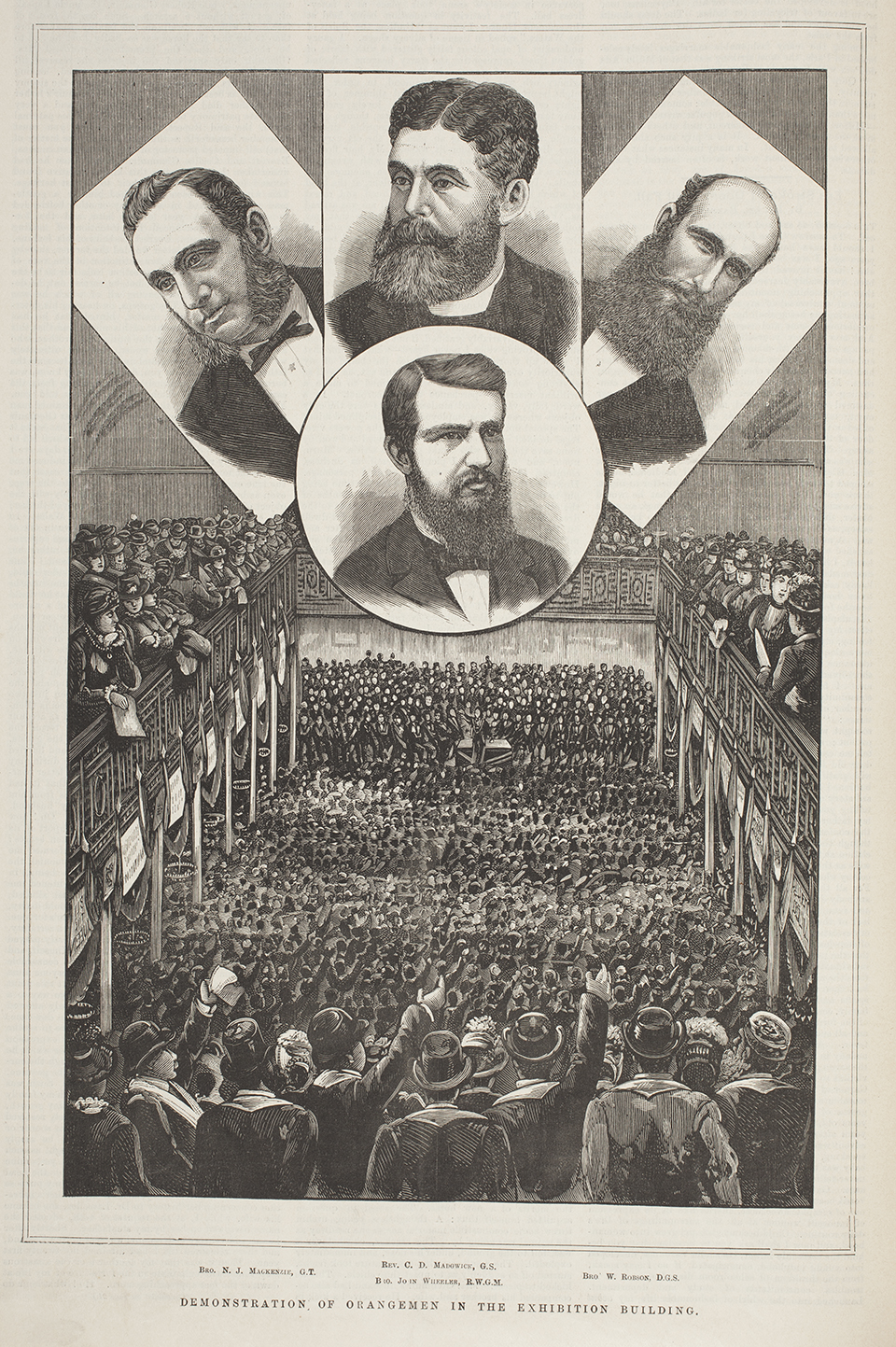
The hall also served as a large indoor meeting place. On 12 July 1886 it held a demonstration of Orangemen, recorded in an engraving in the Illustrated Sydney News of 14 August 1886: a packed floor and galleries, with portrait medallions of the officers above. It is a reminder that the building’s calendar was not only agricultural. [13]
Concerts, skating, wool and Hordern’s temporary store
After the Agricultural Society left for Moore Park, the building remained a public hall with a succession of other uses. The City of Sydney’s history of the park lists concerts and roller-skating among them, and the park itself continued to host circuses, open-air concerts and, in later years, buckjumping competitions. [1]
Roller skating is documented in the council’s own files. In August 1887, K. A. Skinner & Co., writing as the Columbia Skating Rink at the Exhibition Building, asked the Mayor for a long lease — from 1 April to 30 September, six consecutive months, for five years from 1888 — at the then rental of £30 a week, offering to give the building up for municipal meetings and pointing to money already spent on “beautifying” it. The application was not granted, but the letter is clear evidence that a rink was already operating in the hall that year. City records also refer to later rink names, including the Sydney Skating Rink from 1906 and the Exhibition Skating Rink in the 1920s and 1930s. A glass-plate photograph in the National Library of Australia, catalogued at about 1930 and now out of copyright as a pre-1955 photograph, shows the main front with large signs reading “Exhibition Rink” and “Roller Skating.” The corner towers are not visible in that plate. The catalogue date sits in the same decade as the War Memorial Museum’s occupancy of the building (1925–1935), and is best treated as an approximate date rather than a precise year. Photographs of the museum period, and City of Sydney photographs dated 1953, both show the towers still standing, so the skating plate should not be read as evidence that the towers were permanently removed. [14] [15] [16]

The hall was also let for storage. The City of Sydney Archives hold letters from Mort & Co., the wool brokers, about renting the Exhibition Building, including a confirmation of a lease for November and December 1879. That is firm evidence of a wool-trade tenancy in those months; it should not be stretched into a claim that the building was a permanent wool store for the rest of its life. [17]
A much more public emergency came in July 1901. On 10 July a fire destroyed Anthony Hordern & Sons’ Palace Emporium at the Haymarket. The Australian Dictionary of Biography records that Samuel Hordern leased the Exhibition Building and opened there the next day. A City of Sydney file from 15–23 July 1901 notifies the Finance Committee of the lease “as a result of fire in premises.” The arrangement was temporary. Hordern later built a new Palace Emporium on Brickfield Hill, opened in 1905 according to the same biographical entry, or in 1906 according to Museums of History NSW. The Prince Alfred Park hall was never itself the Palace Emporium; it was the firm’s emergency premises after the fire. [18] [19] [20]
The Australian War Memorial Museum
The building’s most solemn public chapter began in 1925. After the Australian War Museum exhibition in Melbourne’s Royal Exhibition Building closed in January 1925, the collection came to Sydney while a permanent memorial was being planned for Canberra. Senator George Pearce, as Minister for Home and Territories, negotiated a lease with Sydney Council for the Exhibition Building at Prince Alfred Park. The Australian War Memorial’s registry history records that the Sydney exhibition opened on 3 April 1925. A later Memorial account says it was officially opened by the Governor-General, Lord Forster, on 8 April 1925. While in Sydney the exhibition was known as the Australian War Museum Memorial, reflecting the official change of name from “Australian War Museum” to “Australian War Memorial” in October 1923. It drew large attendances from the first days and closed on 31 January 1935. Staff then packed the collection; the transfer to Canberra began in December 1935 and was completed in early March 1936. That is why some published summaries say the museum was in the building until 1936: the public exhibition ended in January 1935, and the collections finished leaving the following year. [21] [22]

A photograph in the Australian War Memorial shows the hall in that period with “AUSTRALIAN WAR MEMORIAL MUSEUM” painted in large letters along the barrel roof, the two towers still in place, and trees and a path in the foreground. It is one of the clearest images of the building’s interwar civic face, halfway between the agricultural shows of the 1870s and the empty storehouse of the 1940s.
The last years, demolition and the swimming pool
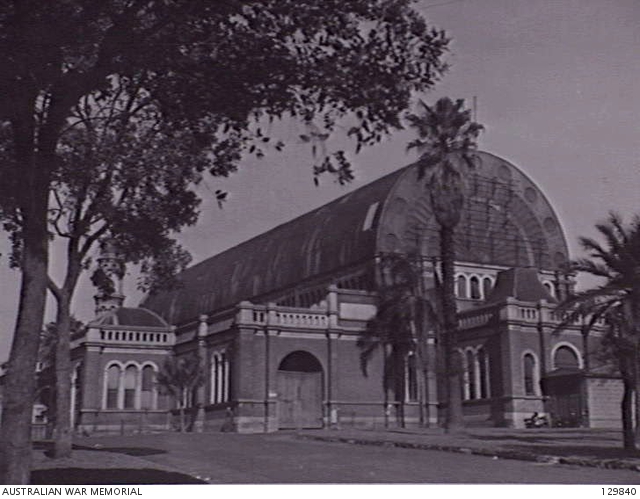
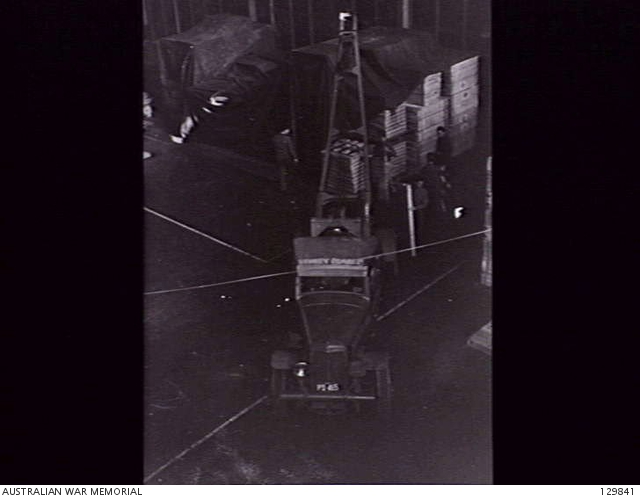
The hall had not yet reached the end of its government use. Australian War Memorial photographs from the 1940s show the building employed as a store for relics and paper by the Military History Section: one is an exterior view, with palms and fig trees around a still-recognisable side and end; the other shows a mobile crane stacking paper inside. [23]
City of Sydney photographs dated 1953 show the hall in its last months, and demolition already under way. In one view from Chalmers Street the building still stands, its fan-shaped gable and a corner tower intact, on cracked asphalt, with two figures in the middle distance. In others the roof cladding has already been stripped, leaving the iron barrel trusses and the fan gable as a skeleton, while both towers are still up. Close views look up through the exposed arches to the fan window, and into the gutted interior: debris on the floor, side galleries opened to the hall, a figure among the wreckage, and a painted mark on a broken wall. Those 1953 views are also the clearer evidence that the towers survived until demolition. The National Library’s roller-skating plate, catalogued at about 1930, does not show them, but it should not be read as proof that they were permanently taken down. [24]


Photographs dated 1954 show the site after the hall itself had come down. One of the corner towers stands alone among rubble and stacked timber, with a church behind the trees; another view records a remaining wall fragment with an arched opening, two men, and ladders among the debris. [24]


After the Second World War the demand for outdoor public swimming pools in metropolitan Sydney increased, and from 1944 learning to swim became compulsory for New South Wales primary-school children. In 1954 the Exhibition Building was demolished. The City of Sydney’s park history is the best guide to what replaced it: a swimming pool, a wading pool and later an ice rink. Prince Alfred Park Pool opened in 1958, the second post-war pool in the area after Victoria Park Pool in 1954. The Dictionary of Sydney’s shorter statement that “the swimming pool was built in 1954” is best read as a reference to the year of demolition and replacement, not as a record of the opening day. The ice-skating rink opened behind the pool in the winter of 1959, was in use until 1985, and was demolished in 1996–97. [1] [2]
Other familiar pieces of the present park are older than the pool. Tennis courts were built in 1924. The Coronation Playground, named for the coronation of King George VI, was built between 1936 and 1939 according to the Dictionary of Sydney; the City of Sydney’s history gives its opening as 1940. The central avenue of London plane and brush box, and the Washington and Canary Island date palms, are generally dated to the interwar years. [1] [2]
The park today
The pool remained in use until 2009, when it was closed for a major upgrade. The redevelopment added new tennis courts and a basketball court, and the redesigned pool opened in 2013. In 2018 the City of Sydney named the central lawn Equality Green, commemorating the marriage-equality campaign; thousands of people had gathered in the park on the morning of 15 November 2017 to hear the result of the postal survey. A rainbow path was added in 2019. [1]


None of that later landscape brings the Exhibition Building back. Its site is now the pool and the lawns at the northern end of the park, just south of Central. The fan-shaped gable, the organ, the fountain, the painted museum letters and the roller-skating signs survive only in pictures. What remains on the ground is the park that Backhouse and the fig planters shaped around the hall, and the fact — as the existing page already says — that this was Sydney’s first purpose-built exhibition building, demolished in the 1950s to make way for a swimming pool.
Related reading: the existing page, First Sydney Exhibition Building – Prince Alfred Park; The Garden Palace – The Sydney International Exhibition of 1879; Cleveland House, Surry Hills, on Historic Sydney Mansions; Devonshire Street Cemetery, under Central; and The Attempted Assassination of Prince Alfred, Clontarf, 12 March 1868.
Sources
- City of Sydney, “History of Prince Alfred Park,” 27 March 2013, cityofsydney.nsw.gov.au. Design by Edward Bell; grounds by Benjamin Backhouse; 1869 first Metropolitan Intercolonial Exhibition; permanent building 1870–1954; Agricultural Society exhibitions until the 1881 move to Moore Park; later concert, skating and other uses; War Memorial Museum; demolition in 1954 and the 1958 pool, 1959–1996/97 ice rink, and 2009–13 upgrade.
- Anne-Maree Whitaker, “Prince Alfred Park,” Dictionary of Sydney, 2008, dictionaryofsydney.org/entry/prince_alfred_park. Cleveland Paddocks, gazetteer date 22 December 1865, naming in 1868, Backhouse layout, War Memorial Museum, trees, tennis courts, Coronation Playground, pool and ice rink.
- Dictionary of Sydney, “Intercolonial Exhibition 1870,” dictionaryofsydney.org/event/intercolonial_exhibition_1870, and “Intercolonial Exhibition Building,” dictionaryofsydney.org/building/intercolonial_exhibition_building. Dates 30 August–30 September 1870; attendance over 185,000; constructed 1870, demolished 1954.
- City of Sydney Archives, memorandum of the City Engineer’s office submitting plans and elevations for the proposed Exhibition Building (node 1098772); memorandum estimating costs not exceeding £16,350 (node 1098771); memorandum by Edward Bell on the cost of changing wooden columns for iron ones (node 1098954).
- Advertisements for the Metropolitan Intercolonial Exhibition, including Sydney Morning Herald, 10 August 1870, and 20 September 1870 (evening opening and programme). Trove.
- Evening News (Sydney), 1 September 1870, “Metropolitan Intercolonial Exhibition,” Trove nla.news-article107128559. Weather, crowds, Joubert, Packer’s organ, indoor and outdoor exhibits.
- The Industrial Progress of New South Wales: being a Report of the Intercolonial Exhibition of 1870, at Sydney, Sydney, Thomas Richards, Government Printer, 1871.
- The Australasian, 6 August 1870, “Town News,” on the closing of Victorian entries. Trove nla.news-article138066307.
- Charles Percy Pickering (attributed), “Intercolonial Exhibition, Prince Alfred Park, Sydney, 1870,” State Library of NSW, SPF/161, digital order no. a089161, archival.sl.nsw.gov.au; Dictionary of Sydney media 3754.
- John Sharkey, Government Printing Office photographs of the Prince Alfred Park exhibition, September 1870, later issued in a Kodak Historical Photography presentation (Wikimedia Commons: horticultural section; farm machinery and livestock pens; British and Foreign Bible Society bookstall; exhibit of iron castings). Sharkey is identified on those mounts as first official photographer to the N.S.W. Government Printing Office, 1869–1896.
- “A Damper for Joubert,” Sydney Punch, 19 August 1871, p. 108, State Library of NSW, ML QA827/S; Dictionary of Sydney media 3179.
- “Plan of Prince Alfred Park, showing the position of buildings for the Agricultural Society’s Exhibition of 1872,” supplement to the Sydney Mail, 20 April 1872, State Library of NSW, a4996001 / XV1/Par/P Alf/2; Dictionary of Sydney media 3845.
- “Demonstration of Orangemen in the Exhibition Building,” Illustrated Sydney News, 14 August 1886, p. 20, State Library of NSW, TN115; Dictionary of Sydney media 4470. The demonstration was held on 12 July 1886.
- City of Sydney Archives, letter, K. A. Skinner & Co., Columbia Skating Rink, Exhibition Building, Prince Alfred Park, to the Mayor, 2–25 August 1887, unique ID A-00313415, node 1550372.
- City of Sydney Archives, “Skating Rinks” collection note, node 1941754, including later rink names associated with the Exhibition Building.
- “Roller skating rink in the Exhibition Building, Prince Alfred Park, Sydney, ca. 1930,” National Library of Australia, PIC/15611/15857, nla.obj-163085484, Fairfax archive of glass plate negatives. Catalogued as out of copyright (created before 1955); the Fairfax collection record also notes that restrictions on publication may apply.
- City of Sydney Archives, letters of Mort & Co., wool warehouses, regarding rental of the Exhibition Building, including confirmation of a lease for November and December (nodes 1089854 and 1084386).
- G. P. Walsh, “Hordern, Anthony (1842–1886)” (and the attached life of Samuel Hordern), Australian Dictionary of Biography, adb.anu.edu.au/biography/hordern-anthony-3796. Fire of 10 July 1901; lease of the Exhibition Building and opening there the next day; new Brickfield Hill premises, 1905.
- City of Sydney Archives, “Lease of Exhibition Building to Anthony Hordern, 1901,” unique ID A-00163839, node 806907, 15–23 July 1901.
- Museums of History NSW, “Anthony Hordern & Sons,” mhnsw.au/stories/department-stores/anthony-hordern-and-sons/, for the temporary move after the 1901 fire and the date 1906 for the new Palace Emporium.
- Australian War Memorial, “Australian War Memorial Museum, Sydney Exhibition registry files,” awm.gov.au/collection/C1377958. Opening 3 April 1925; closure 31 January 1935; transfer to Canberra, December 1935–early March 1936.
- Australian War Memorial, collection photograph P08655.003, “The Sydney Exhibition Building in Prince Alfred Park,” awm.gov.au/collection/C1243080; and the Memorial’s account of the official opening by Lord Forster on 8 April 1925.
- Australian War Memorial, 129840, exterior of the Exhibition Building used as a store for relics and paper by the Military History Section, C239903; and 129841, paper being stacked in the store with a mobile crane, C238482. Period 1940–1949. Public domain.
- City of Sydney Archives photographs of the Exhibition Building used in this history: unique IDs A-00008412, A-00033199 and A-00008434 (1870); A-00027413 (circa 1880); A-00008404 (undated); A-00042736, A-00008429, A-00042793, A-00008427, A-00008431, A-00008426 and A-00042812 (1953); and A-00042847, A-00042848 and A-00042849 (1954; A-00042849 is dated 1954 in the archives title, though the catalogue page itself does not display a year). Catalogue pages at archives.cityofsydney.nsw.gov.au. Rights as marked on each record: No Copyright for the nineteenth-century plates; CC BY-NC-ND 4.0 for the 1953–54 photographs.
No comments:
Post a Comment