
Mark Foy, the family fortune and the Hydro Majestic at Medlow Bath
A department-store fortune and a hotel on the mountainside
The name Mark Foy belongs to more than one man, and that is where this story needs to begin. The father established the family's retailing foundations in Victoria. His sons built the Sydney department store. One of those sons, also Mark, put his share of the family's commercial success into the extraordinary Hydro Majestic. The hotel is at Medlow Bath, west of Katoomba, not in Katoomba itself. Its great dome, long galleries and valley views belong to a story that joins immigration, shopkeeping, industrial labour, sailing, motor cars and the changing Australian holiday. 1, 2
The fortune did not begin with the hotel. It came from selling clothing and household goods to a growing population, then expanding the scale of purchasing, manufacturing, advertising and distribution. The Hydro was an ambitious use of that wealth, and a business that repeatedly had to reinvent itself. Behind both enterprises stood not only the Foy name, but generations of shop assistants, dressmakers, warehouse hands, builders, cooks, gardeners and hotel staff.

Photographer unrecorded; family-history photograph via Wikimedia Commons — source; Public domain.

Three Foys, not one
Mark Foy senior (1830–1884) was the Irish-born draper who came to Victoria and developed the Collingwood business associated with the beginnings of Foy & Gibson. He died before the Sydney store opened and two decades before the Hydro began receiving guests.
Francis Foy (c.1856–1918), his eldest son, was the driving commercial personality in the early Sydney business. He organised buying, enlarged the Oxford Street premises and helped shape the later Piazza store. The business was a family concern, not the achievement of the hotel-building Mark alone.
Mark Foy junior (1865–1950), Francis's younger brother, was the Bendigo-born businessman, yachtsman and motor enthusiast who created the Hydro Majestic. The portraits accompanying this page show this younger Mark, not his father. 1, 3, 4
Ireland, the Victorian goldfields and the first business
Mark senior had worked as a draper in Ireland before migrating to Victoria in 1858. He lived and worked in the Bendigo district during the goldfields period, when a swelling population needed clothing and everyday supplies. His lasting commercial opening was in serving that population. The family's subsequent wealth is better understood through expanding trade than through the familiar image of a lucky prospector finding a fortune in the ground. 3
In 1870 he established a drapery shop in Smith Street, Collingwood. It grew from a single shop into three by 1875 and six by 1880. Those adjoining premises show the practical beginnings of a department store: more stock, more departments and a broader claim on the household shopping budget. A shopkeeper could build a substantial business through repeated sales of useful goods, rather than relying only on expensive luxuries or a small circle of wealthy customers. 3
As Mark senior prepared to retire and travel, Francis acquired his interest and William Gibson joined the concern. The partnership was short-lived. After the older Mark's death, Francis and Gibson separated: Gibson retained the Melbourne business and its Foy & Gibson name, while the Foy brothers established their Sydney enterprise. The enormous Foy & Gibson manufacturing complex that later spread across Collingwood was largely a development of the Gibson era. It should not all be credited to Mark senior or treated as a business his Sydney sons continued to own. 1, 3

Cnwb — source; Public domain.

The elder Mark died in San Francisco on 14 January 1884. A family notice published in The Australasian on 23 February recorded the death there from Bright's disease and identified his Irish family connection with Moystown Mills in King's County. He therefore never saw the Sydney emporium bearing his name. His legacy was the accumulated experience and capital of the Victorian business, carried forward by his children. 5
How the Sydney store made its money
Francis and Mark opened Mark Foy's in Oxford Street, Sydney, in 1885, naming it in honour of their father. The location served the city and the expanding eastern suburbs. The store attracted a working-class clientele and customers from the Irish-Australian community, while its owners made their Irish connections part of the firm's public identity. It was not initially the grand Liverpool Street building that people now remember. 1
Expansion came quickly. The Oxford Street premises were enlarged in 1887; a London buying office followed in 1890; and further premises were acquired in 1894. Buying overseas put the firm closer to suppliers and fashion markets. The additional Sydney space accommodated furniture and carpets, while upstairs workrooms produced men's clothing and women's underclothing. Retailing and manufacturing were becoming connected parts of the same enterprise. 1
The twice-yearly Mark Foy's Fair helped turn discounted shopping into an event. Advertising, catalogues, conspicuous displays and the promise of choice brought customers through the doors. Museums of History NSW describes a surviving catalogue from about 1901 that offered the front and back doormats and virtually everything for the house in between: beds, furniture, carpets, linoleum, crockery, glassware, lamps, refrigerators and kerosene stoves. A household could return to the same store for a succession of purchases, not merely a dress or a length of cloth. 1, 6
This was the commercial engine of the family fortune: selling a great variety of goods, encouraging repeat custom, managing supply and developing property and manufacturing alongside the shop. The later assets were substantial, but a company's buildings, stock, capital and turnover were not the same thing as Mark junior's personal bank balance. Nor does the price paid for the Hydro many decades afterwards measure what its founder was worth. The important financial connection is that retail success supplied the means for his mountain venture.
The retail undertaking also developed a corporate life beyond the original family partnership. Mark Foy’s Ltd was incorporated in New South Wales on 12 November 1909, a date recorded in the Federal Court’s later account of the business. It became a public company, although Foy and Macken family members continued to dominate its board for decades. This helps distinguish three things that are easily conflated: the founders’ original trading enterprise, the later company and its assets, and the personal interests of individual family members. 1, 7
The Piazza: shopping as a spectacle
The move to Liverpool Street in September 1909 was a major statement of ambition. The new Piazza stood between Elizabeth and Castlereagh Streets and was designed by Arthur McCredie and Arthur Anderson. Francis travelled with Anderson to examine overseas commercial buildings, and the scheme drew partly on the great Bon Marché in Paris. The original low-rise composition, with its mansard roof and towers, was subsequently enlarged; it was not built all at once in its present form. 1, 7
A report in The Star on 15 September 1909 said the new building had already been open for several days, although finishing work was still under way. Customers entered from the broad piazza through mahogany doors into a long vista of decorated columns. This was architecture intended to make shopping impressive and pleasurable. The mosaic signs and coloured glazed finishes also advertised what could be bought inside, turning the exterior into a permanent shop window. 8

Hall & Co.; State Library of New South Wales collection — source; No known copyright restrictions.

The much-advertised travelling staircase carried shoppers between floors without their climbing. The Star called it the first of its kind in Australasia, adding the more tentative claim that it might be the first in the Southern Hemisphere. The contemporary excitement is clear, without needing to turn every promotional superlative into a worldwide first. Lifts, electric lighting and a conveyor carrying parcels towards the sorting and despatch rooms were other practical attractions. 8
The new store combined selling with services that encouraged customers to stay. There were books, jewellery, a chemist, a telephone bureau, a post box, iced drinks and a ladies' reading and writing room. A public dining room occupied part of the upper floor; staff had their own dining accommodation. Furniture, carpets, linoleum and groceries filled other departments. Deliveries and incoming goods were handled through adjoining receiving and despatch areas, so the elegant public rooms depended on a much less visible working system behind them. 8
The opening report also named people whose work can disappear behind the Foy name. A. C. F. Webb supervised the electrical installation. Standard Waygood supplied the lifts and arranged the moving staircase; its employee Gordon Bennett was praised for getting the machinery working successfully. Crisp Brothers undertook the decorative scheme and Wunderlich supplied ceiling work. The building was a collaboration of architects, engineers, tradespeople and manufacturers, not simply a wealthy proprietor's inspiration. 8
Decorative details of Mark Foy's
Look closely at the decorative details: patterned material above doorways, a ceiling and light fitting, and the surviving commercial lettering on the street frontage. They bring the story back from business names and dates to the small pieces of a building that people can actually notice.

Original photograph published on My Australian History Journey (2016); from the 2016 version of this post (source).

Original photograph published on My Australian History Journey (2016); from the 2016 version of this post (source).

Original photograph published on My Australian History Journey (2016); from the 2016 version of this post (source).

Original photograph published on My Australian History Journey (2016); from the 2016 version of this post (source).

Original photograph published on My Australian History Journey (2016); from the 2016 version of this post (source).

Original photograph published on My Australian History Journey (2016); from the 2016 version of this post (source).
The people who worked for the fortune
Low prices had a human cost. In his Dictionary of Sydney history, Michael Lech records that in 1885 Mark Foy's employees worked until 10 pm on weekdays and midnight on Saturdays. Protests from the Drapers' Association and damaging publicity helped bring changes. The 1907 Shop Assistants' Case exposed poor conditions and the firm's heavy employment of young women, who could then be paid less than men or more experienced workers. The bright shop floor and fashionable goods were only one side of the business. 1
A department store required sales assistants, buyers, milliners, dressmakers, packers, delivery workers, clerks and cleaners. The Foys' buying and promotional skill mattered, but so did these people's long hours and productive work. A staff-ball photograph offers a different glimpse of the same community, dressed for an evening away from counters and workrooms. It should sit alongside the trading history rather than allowing the family's wealth to eclipse everyone who helped create it.

Thomas Lennon Photographic Collection, Powerhouse Museum; individual photographer unrecorded — source; Public domain.

As the range of goods changed, so did the business. A furniture building opened in 1913, hardware premises followed in 1914, a knitting factory and bulk store were built in Goulburn Street in 1920, and the Target Woollen Mill at Mascot was established in 1921. The radio display pictured below belongs to a later generation of household consumption. The store's success depended on adapting to what customers wanted, not on remaining an unchanging Victorian drapery shop. 1

Sam Hood; State Library of New South Wales — source; Public domain.

Mark junior: boats, spectators and motor cars
Mark junior's interests help explain the character of his hotel. He liked movement, machinery, spectacle and an audience. Australian Sailing's Hall of Fame credits his foundation of the Sydney Flying Squadron in 1891 with helping transform open-boat racing into popular entertainment. Distinctive coloured sails and emblems made boats easier to recognise; handicapped starts and a course visible to spectators helped people follow the contest. It was a different social and visual experience from yacht racing reserved mainly for insiders. 4

Photographer unrecorded, via Wikimedia Commons — source; Public domain.

When coloured sails were excluded from the 1892 Anniversary Regatta, Foy supported an alternative event. His involvement was financial as well as sporting. The development eventually associated with Sydney's famous 18-footers took place over time: it is too simple to say that he invented the modern 18-footer in one stroke in 1891. Australian Sailing notes the later standardisation of the open boats during the 1920s. His 1898 attempt to race the 22-foot Irex in England also shows that enthusiasm did not guarantee success. 4

William Hall collection, Australian National Maritime Museum; individual Hall photographer not specified — source; No known copyright restrictions.

Cars offered another way to combine technology with recreation. A 1901 photograph shows Foy with a Panhard, before the Hydro opened. Motor vehicles later carried hotel guests on excursions to Jenolan Caves and other mountain destinations. They extended the resort beyond its rooms and dining tables, making a day's expedition something that could be purchased as part of the holiday. Keeping such vehicles running on mountain roads also required drivers, mechanics and a reliable supply of fuel and parts.

Photographer unrecorded, via Wikimedia Commons — source; Public domain.

Why Medlow Bath, and what was there before?
The Hydro occupies a dramatic escarpment above the Megalong and Kanimbla valleys. Medlow Bath lies beyond Katoomba towards Blackheath, with the railway and Great Western Highway close to the hotel. Its position made the grand landscape accessible to city visitors without abandoning the comforts they expected. The mountains were already an established destination for holidays and health-seeking travellers; Foy entered an existing hotel trade rather than discovering an empty district. 2
His resort joined earlier properties. They included the Belgravia Hotel, the country retreat of W. H. Hargraves, and a cottage associated with solicitor Alfred Tucker. The Hargraves connection is through William Henry, son of Edward Hargraves of the New South Wales gold-rush story. Long galleries linked the component buildings and the new domed entertainment hall. This explains the Hydro's unusual spread along the cliff and its mixture of architectural styles: it grew from an assembled estate, not a single uniform hotel block. 2

Photographer unrecorded; National Library of Australia, PIC/6015/31 — source; Public domain.

The Belgravia had opened in 1891 under the Ellis family. A contemporary opening report described a dinner attended by about 150 men and toasted the proprietor, T. S. Richardson, and architect Slatyer. A longer description reproduced with that report names Charles H. Slatyer and describes Queen Anne styling, red brick, terracotta decoration and French roof tiles. It also outlined water pumping and electric-lighting machinery. Modern comforts were already part of the site's appeal before Foy enlarged the enterprise. 9
Foy began acquiring land in 1901. Writing to Francis from London in November 1902, he sketched a sanatorium influenced by Smedley's Hydropathic Establishment in Derbyshire. Historian Julian Leatherdale quotes his acknowledgement that family and friends expected failure, alongside his expectation that it would not pay more than ten per cent on his outlay for the first three or four years. That was an entrepreneur's forecast, not evidence that the hotel actually earned that return. The project was intended as a business, even if its scale and extravagance later earned it the name of a folly. 2
Opening the hydropathic establishment, 1904
At Foy's request, the railway authorities added “Bath” to Medlow's name in November 1903. The Medlow Bath Hydropathic Establishment opened on 4 July 1904, with the opening party travelling through a snowstorm. The name deliberately connected the place with European and British spa resorts. The celebrated dome belonged to its Casino: in this setting the word meant a concert and dance pavilion, not proof that a gambling casino operated there. Leatherdale describes the structure as reportedly prefabricated and shipped from the United States. 2

Creator unrecorded; newspaper reproduction via Trove and Wikimedia Commons — source; Public domain.

The resort's electrical plant was an important part of its self-contained operation. It opened in the same year that Sydney's municipal power station at Pyrmont began generating electricity. That comparison concerns the development of municipal supply, not a claim that no one in Sydney had previously used an electric light. Indeed, the 1891 Belgravia account had already celebrated electric lighting on the Medlow site. Foy's achievement was to develop an elaborate, well-equipped resort on the escarpment. 2, 9, 10
An inspection published in The Mountaineer on 24 June 1904 gives a remarkable picture of the machinery behind the luxury. It described a 75-horsepower Robey engine and an auxiliary 100-horsepower John Fowler engine, Mather & Platt dynamos and a bank of 120 accumulator cells. The installation could keep hundreds of lamps glowing, while a rotating searchlight added an eye-catching flourish. Boilers, engines, pumping equipment and maintenance were as essential to the experience as the decorated public rooms. 11
A small town behind the guest rooms
The same report described about sixty bedrooms with individual colour schemes and painted friezes, and a covered promenade some 700 feet long. Telephones connected the bedrooms with one another and the outside world. A shop supplied forgotten necessities; there were books, billiards, pictures and comfortable places to pass the day. The kitchen was equipped to cater for about two hundred people, and a steam laundry supported the operation. The establishment was designed to keep guests comfortable without their needing to leave it. 11
Water was an engineering problem as well as a treatment. The report described a valley dam, pumps and elevated storage tanks giving gravity-fed supply. Roof water was collected separately for drinking and cooking. Produce from the valley farm travelled up an aerial tramway working on a counterweight principle. These arrangements linked the luxurious rooms to the difficult terrain below them. The hotel could display the valley as scenery while also depending on it for practical supplies. 11

W. H. Broadhurst / Broadhurst Post Card Publishers; State Library of New South Wales — source; Public domain.

The picture gallery included local artists as well as prints and sculpture. The 1904 visitor named works associated with Gladstone Eyre, Tebbitt and Neville Cayley. Rooms, corridors and recreation spaces were deliberately filled with things to look at. Foy was creating an experience that resembled his department store in one respect: an abundance of visual interest encouraged people to remain, explore and talk about what they had seen. 11
Water cures, and the change from health resort to holiday hotel
Hydropathy rested on the belief that carefully regulated water treatments, diet, exercise and fresh air could improve health. Dr Baur, recruited from a Swiss spa, supervised the Hydro's early treatments. The facilities offered different kinds of baths, sprays and steam treatments, rather than simply a modern leisure pool. The Mountaineer's enthusiastic account described electric, needle, spray, mud and other applications. Its claims belong to the medical and promotional culture of 1904, not to present-day medical advice. 2, 11
The health programme was not the enduring commercial attraction Foy had hoped. Leatherdale's account describes difficulties with the local spring and the unappealing taste of water brought from Baden-Baden. By 1906 the resort was being promoted as the Hydro Majestic, with greater emphasis on food, comfort, entertainment and recreation. The change was a practical response to customers: many preferred a holiday in beautiful surroundings to a disciplined course of treatment. It was a shift in emphasis, rather than evidence that every health-related activity stopped on one precise day. 2

Charles Henry Hunt (1857–1938); National Library of Australia, PIC S10736 LOC Q88 — source; Public domain.

The promotional world was expansive. Gardens, orchards, croquet, tennis, bowls, walking tracks and motor trips offered different ways of spending time. Activities extended into the valley, with sporting facilities and a farm associated with the estate. The grand resort depended on a wide range of people working out of the guests' sight, from laundry and kitchen staff to those tending gardens, supplying produce or maintaining paths. Its promise was freedom from daily chores, made possible by somebody else's daily work. 2, 11
Music, masquerades and excursions
The Casino gave the hotel a centre for concerts, dancing and elaborate social occasions. The 1904 inspection described a stage, electric lighting, stained glass and private boxes. It was a place to see and be seen, but also a practical venue that could change its entertainment as tastes changed. Its decoration was later reworked by cinema décor artist Arnold Zimmerman in 1925 and again in 1935. The surviving Hydro consequently contains layers of Edwardian and interwar design, not one intact decorative scheme from opening day. 2, 11

W. H. Broadhurst / Broadhurst Post Card Publishers; State Library of New South Wales — source; Public domain.

Foy himself joined the fun. Leatherdale records him appearing as Napoleon at a fancy-dress ball in 1908, and describes a 1909 photograph in which he wore his wife's gown and hat for a servants' ball. Guests and staff swapped roles for that evening. Such occasions give a glimpse of his theatrical personality, while remaining special events rather than a description of everyday relations between hotel guests and employees. 2
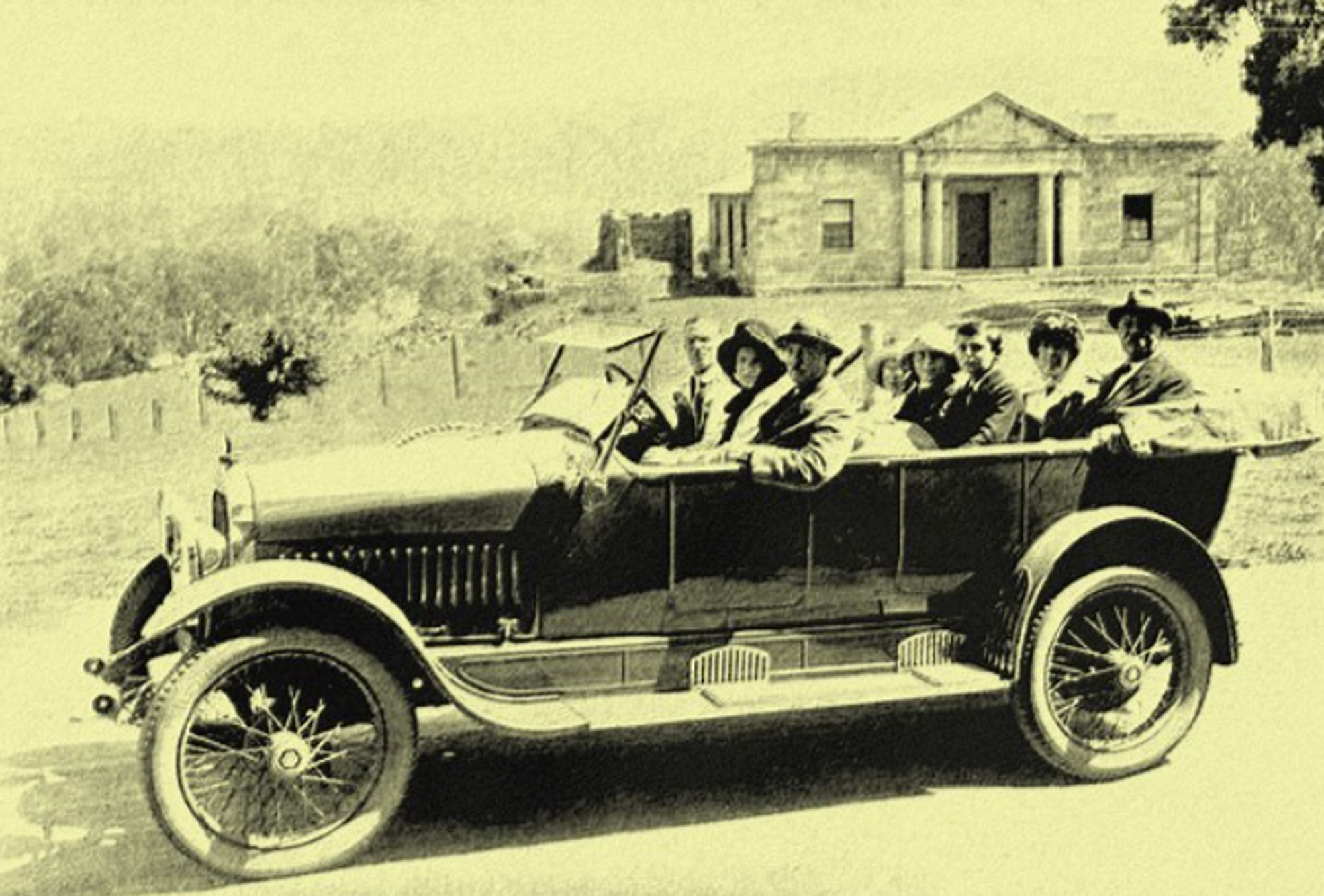
Motor excursions were part of the attraction from the beginning. The Mountaineer described a 22-horsepower Daimler intended for thirteen people but carrying twelve for greater comfort, alongside other vehicles. A journey to Jenolan Caves could combine hotel service, mountain-road adventure and a celebrated natural destination. The period photograph of guests and a wagonette captures a holiday culture in which the motor car itself was still part of the novelty. 11

Blue Mountains Local Studies; photographer unrecorded — source; CC BY-SA 2.0; resized.

Famous guests, and stories that grew around them
The Canadian boxer Tommy Burns stayed and trained at the Hydro in 1908 before his heavyweight title fight with Jack Johnson in Sydney. The hotel also entertained visitors associated with the American fleet, while the romance of the Rajah of Pudukkotai and Molly Fink added to its society reputation in 1915. These guests helped make the resort newsworthy, but they were only a small part of a much larger succession of holidaymakers. 2
Australia's first prime minister, Sir Edmund Barton, died at the Hydro on 7 January 1920, aged seventy-one. The National Archives records that he was holidaying there. By then he had long since left the prime ministership and was a justice of the High Court. 12
Arthur Conan Doyle's stay is unusually well documented because he wrote about it himself. In The Wanderings of a Spiritualist he called Medlow Bath a “little earthly paradise” and compared the art-filled hotel to “an Arabian Nights palace”. He admired the library and the long galleries, confessing that a series of prints could delay his arrival at meals. A photograph published in the book records his party's excursion towards Jenolan Caves on 20 January 1921. This is a visitor's own account, not simply a later celebrity list. 13
Photographer unrecorded; The Wanderings of a Spiritualist (1921) — source; Public domain.

Other celebrated stories are less secure. Leatherdale notes that the tale of Dame Nellie Melba performing in the Casino, and that of Bertha Krupp donating a grand piano, are difficult to substantiate in archival sources. They have become part of the Hydro's folklore, but should not be given the same certainty as Barton's death record or Conan Doyle's published recollection. The distinction leaves room for the hotel's legends without turning them automatically into established events. 2
The landscape outside the windows
The grounds and bush tracks were essential to the Hydro's appeal. Visitors could move from a carefully furnished gallery into a very different world of sandstone, eucalypts, fern gullies and broad valley views. Early photographs of the cliff walks and Ferny Fall show how strongly the place was marketed through the surrounding landscape. The hotel did not manufacture that scenery, but it built a network of hospitality and access around it. 2

Tyrrell Photographic Collection, Powerhouse Museum; photographer unrecorded — source; Public domain.

The contrast mattered. A guest could spend the morning walking and return to a prepared meal, a hot bath and evening entertainment. This was not a remote expedition requiring visitors to carry all their own provisions. The resort packaged a close encounter with the mountains alongside the comfort of a substantial staffed establishment. Its postcards made the relationship clear: the building and its surrounding walks were both reasons to come.

Tyrrell Photographic Collection, Powerhouse Museum; gift of Australian Consolidated Press, 1985; photographer unrecorded — source; No known copyright restrictions.

Lease, fire and a different kind of clientele
In 1913, while planning extended life abroad, Foy leased the Hydro to James Joynton-Smith, whose interests included the Carrington and Imperial hotels. A lease of the operation should not be confused with an outright sale of the property. Under this arrangement the Hydro sometimes closed for work. Then, on 18 August 1922, fire destroyed the old Belgravia Hotel, the Belgravia Wing and the art gallery, including its collection. A large part of the opening-era resort disappeared. 2
When the lease was not renewed, Foy returned to rebuilding and management. The market changed as well as the buildings. Leatherdale reproduces advertising offering a weekly tariff of £2 12s 6d and addressing “Ordinary Folk”, with plenty of food and no insistence on dressing for dinner. The exclusive health establishment had become a more broadly accessible family hotel. The surviving name can obscure how different these successive businesses were. 2

Photographer unrecorded; historical image sourced by the file record to Blue Mountains City Council — source; Public domain.

The Depression brought further pressures and opportunities. Some visitors used cheap railway fares; some better-off families took up hotel residence after closing or selling their Sydney homes. A new streamlined Belgravia Wing and lounge opened in the late 1930s. In 1936 Foy floated the hotel as a public company while retaining family management control. The development was no longer simply a private project paid for at the beginning of the century; its finances and organisation also evolved. 2
Wartime hospital and the return of guests
During the Second World War the Hydro was requisitioned for the United States Army's 118th General Hospital. The formal handover took place on 19 July 1942. Accommodation and recreation spaces had to serve medical needs, and the hotel temporarily ceased its ordinary role. A staff photograph with a “Closed for the Duration” placard captured the uncertainty of that change. 2
Later recollections of the American occupation disagreed. Family stories of destructive behaviour were disputed by the doctor involved in the conversion, F. Tremaine Billings. The disagreement is part of the record, rather than a reason to repeat the most colourful account as settled fact. The property was handed back in February 1943 and reopened to hotel guests about six months later. The wartime interruption was significant but much shorter than the original placard might suggest. 2
Naturalist Mel Ward opened his museum on the grounds in 1943, adding another attraction to the returning holiday trade. After the war, the Hydro continued to welcome families and honeymooners. New amenities, fashion events and altered decoration helped keep it in use. Repeated adaptation, rather than perfect preservation of the original sanatorium, was the reason it survived as a working hotel. 2
Mark's last years, and the store after the family
The family photograph below belongs to about 1915, many years before Mark's death. In November 1950, aged eighty-five, he fell in the garden of his Bayview home. The Sydney Morning Herald reported that he died in St Vincent's Hospital on Wednesday night, 15 November, following the fall early on Tuesday. His funeral was held on 17 November, with burial at South Head Cemetery. Sydney Flying Squadron boats were to carry black mourning ribbons when they raced. 14

Photographer unrecorded; family-history photograph via Wikimedia Commons — source; Public domain.

The department-store company had its own later history. Francis retired in 1915 and Hugh Victor Foy became managing director. Family and Macken relatives retained influence until a new board took over in 1962. The firm had enjoyed its most profitable year in 1954–55, but changing shopping patterns, suburban expansion and the difficulties of southern city retailing undermined its position in the following decade. Assets were sold or leased, and suburban stores were opened in an attempt to recover ground. 1
McDowells took over Mark Foy's in 1968; Waltons acquired McDowells in 1972. The Piazza continued under the Mark Foy's name until Grace Bros leased it in 1980, and retailing there ended in 1983. Its later life as part of the Downing Centre preserved a striking Sydney landmark for a very different public purpose. There is more about that building in The Downing Centre – Mark Foy's Piazza Store. 1, 7

g_kat26 — source; CC BY-SA 2.0; resized.

Decline, restoration and another reopening
By the 1970s the Hydro faced falling occupancy and expensive maintenance. Loyal guests and honeymoon memories could not, on their own, pay for a large ageing property. Sydney barrister John North bought it in 1984 and undertook renovations. The Mah family acquired it in late 1996, and management arrangements later included Peppers and Accor. A severe bushfire threat in December 2002 added another dramatic episode to a history already shaped by fire. 2

Grahamec — source; CC BY-SA 3.0; resized.

The Escarpment Group purchase in 2008 began another major transformation. An ABC report on the reopening identifies Huong Nguyen and George Saad as the purchasers, reporting an $11 million acquisition and a $35 million restoration. These were modern property and redevelopment figures, not sums paid to Mark Foy or measures of his original fortune. The restored hotel reopened on Friday 31 October 2014, more than a century after its first guests arrived. 15
The conservation work had to deal with a complex that had been enlarged, damaged, repaired and redecorated over many decades. Heritage 21 describes work associated with a 2013 conservation management plan, including the Casino, Billiards Room, Cat's Alley, Majestic Ballroom and Delmonte accommodation. Robert Costa of Space Architecture worked on the restoration, with interior designer Peter Reeve. The result combined conservation of significant surviving fabric with the needs of a functioning contemporary hotel. 15, 16

Ssp goldsworthy — source; CC BY-SA 4.0; resized.

The Hydro in 2026
Salter Brothers acquired the Hydro through the 2023 purchase of an Escarpment hotel portfolio. In August 2026 it was again publicly offered for sale. Reporting at the time described an operating eighty-four-room hotel and marketed the possibility of additional accommodation and event facilities. Those possible additions were future development opportunities in the sales campaign, not completed extensions to the hotel. The portfolio's reported total price must also not be mistaken for the price of the Hydro alone. 17, 18
The hotel's own present-day offering includes accommodation, dining in the Wintergarden, the Boiler House and Pavilion, events and history tours. Its address remains Medlow Bath, opposite the railway, with the valleys stretching behind it. The relationship between rail access and a mountain holiday is still visible in the station across the highway, even though the way people travel and the standard of comfort they expect have changed enormously since 1904. 19

Radiotrefoil — source; CC BY-SA 4.0; resized.

The Foy story joins two kinds of place: a city store built to bring goods and customers together, and a mountain hotel built to turn landscape, comfort and entertainment into an experience. The father's expanding shops laid the foundations; Francis helped make the Sydney retail enterprise formidable; Mark junior carried his share of that success into the mountains. Neither the store nor the hotel remained exactly as its founders left it. Their surviving buildings, photographs and decorative fragments let us follow both the making of a family fortune and the changing uses of the places it helped create.
Sources and further reading
- Michael Lech, “Mark Foy’s”, Dictionary of Sydney (2011)
- Julian Leatherdale, “Hydro Majestic”, Dictionary of Sydney (2016)
- Collingwood Historical Society, “Former Foy & Gibson Factory Buildings”
- Australian Sailing Hall of Fame, “Mark Foy”
- The Australasian, family notice, 23 February 1884, p.10
- Michael Lech, “Mark Foy’s”, Museums of History NSW
- Mark Foy’s Pty Ltd v TVSN Ltd [2000] FCA 692, paragraph 3
- “An Emporium of Commerce”, The Star, 15 September 1909, p.6
- Belgravia opening report, Nepean Times, 13 June 1891, p.6, and period descriptions transcribed by the Megalong community history site
- City of Sydney, “Inside Sydney’s story”, 9 June 2026 — municipal electricity history
- “Medlow Bath Hydropathic Establishment”, The Mountaineer, 24 June 1904, p.3
- National Archives of Australia, Edmund Barton: After office
- Arthur Conan Doyle, The Wanderings of a Spiritualist (1921), chapter XI
- “Death of Mr. Mark Foy”, Sydney Morning Herald, 17 November 1950, p.13
- Philippa McDonald, ABC News, Hydro Majestic reopening report, 30–31 October 2014
- Heritage 21, Hydro Majestic conservation and restoration case study
- Salter Brothers, announcement of the Escarpment hotel-portfolio acquisition
- Joseph Carbone, “Iconic Blue Mountains hotel the Hydro Majestic hits the market”, 20 August 2026
- Hydro Majestic, official hotel website
- Original My Australian History Journey page: Mark Foys – Liverpool And Elizabeth Streets (2016)
- My Australian History Journey: The Downing Centre – Mark Foy’s Piazza Store (2026)