Search This Blog

Showing posts with label Cathedral Street. Show all posts

Wednesday, October 26, 2022

The East Sydney Hotel - Cathedral Street - Woolloomooloo - East Sydney


The East Sydney Hotel - 1856 - Cathedral Street - Woolloomooloo - East Sydney


If you walk up Cathedral Street from the bay, the East Sydney Hotel sits on the Crown Street corner like it has always belonged there — which, for Woolloomooloo, is about as long as a working pub can manage. The house dates itself to 1856, and locals still sell it as Sydney’s last proper “country pub: wooden bar, copper-nailed boards underfoot, racing memorabilia on the walls, and blessedly — no pokies.

Call the suburb what it is. This is Woolloomooloo, not a vague “East Sydney” lifestyle brand. The hotel sits inside the wider East Sydney / Woolloomooloo heritage story: corner pubs that fed dock workers, boarding-house lodgers and anyone walking between the Domain and the bay. The fabric you see now is a Victorian / Federation-era corner hotel that has been patched, painted and loved rather than scraped clean for brunch Instagram.

What makes it worth a history stop is how little it pretends. Upstairs rooms still let travellers sleep over the bar; downstairs the front room still feels like a room people drink in, not a concept. Keep the copper nails and the wooden bar in the story if you like — theyre part of the lived fabric — but lead with the year, the address (111–113 Cathedral Street) and the suburb that actually owns it.

Historical Sydney Hotels


Tuesday, September 3, 2019

First Fleet House – Cathedral Street – East Sydney

Duck down Cathedral Street off the Domain / Crown Street edge of Woolloomooloo and you hit a modest two-storey building that punches above its weight in commemorative meaning. First Fleet House at 105 Cathedral Street is the headquarters of the Fellowship of First Fleeters — the volunteer organisation of descendants of people who arrived at Sydney Cove with the First Fleet in January 1788. The Fellowship formed in 1968; it bought the house in May 1988 and opened it that July with then Governor Sir James Rowland as Patron.

The Fellowship likes to note that the ground sits on land once tied to First Fleeter Commissary John Palmer’s Woolloomooloo Hill grant — landscape memory, not a claim that this brick building dates from 1788. Inside are the library and research rooms members use when chasing family lines. It is volunteer-run, so opening hours and temporary closures change; check fellowshipfirstfleeters.org before you turn up expecting a walk-in museum.

Keep the distinction clear: this post is about the Fellowship’s house and its commemorative purpose, not a First Fleet–era cottage on Cathedral Street.

First Fleet House - Cathedral Street, East Sydney 


The house stands in East Sydney, an area shaped by the growth of the colonial town beyond the original settlement. Cathedral Street forms part of the historic street network around central Sydney.


Thursday, December 17, 2015

Riley Street – Woolloomooloo

Riley Street takes its name from the Riley Estate — the vast holding merchant Edward Riley assembled in the 1820s from John Palmer’s Woolloomooloo farm (bought 1822) and many smaller Surry Hills / Darlinghurst grants. After Riley’s death in 1825, conflicting wills locked the land in litigation for years; an 1844 Supreme Court partition laid out a street grid (still readable on the Riley Estate plan) that organises Woolloomooloo and adjoining Surry Hills blocks. Riley Street became one of the estate’s spine streets between the Domain edge and the ridge.

Nineteenth-century subdivision produced the close-set terraces and boarding houses that defined working Woolloomooloo beside the finger wharves; twentieth-century resumptions, industry and later residential towers layered over that grid. The street remains a piece of the 1840s estate survey even where individual houses have changed.

Good Old Riley Street - Woolloomooloo 

I Spent Some Of The Best Years of My Life Living In Riley Street At Tue Woolloomooloo End. 


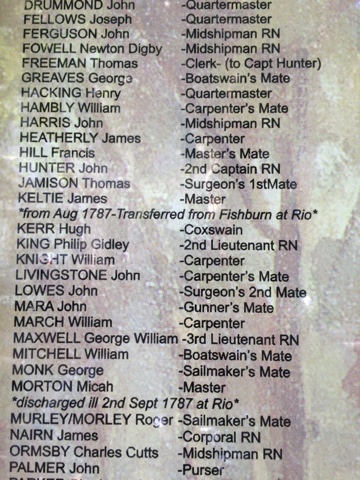
Convicts and Crew of the First Fleet – Fellowship of First Fleeters – Cathedral Street

Same house, different glass. The ships post on this blog is the window. These frames are the front of First Fleet House — 105 Cathedral Street, Woolloomooloo, headquarters of the Fellowship of First Fleeters since 1988 (the Fellowship itself from 1968). Descendants put names on a Victorian terrace. That is already a Sydney place: Woolloomooloo Hill, Cathedral Street off the Domain, a volunteer library in a building that is not a 1788 relic.

The Fleet those plaques are counting left Portsmouth on 13 May 1787 and came in to Warrane in January 1788: convicts, marines, sailors, officers, a handful of wives and children. Mustering totals wander; don’t chisel a single number onto a brass plate from a thumbnail. Caption what you can read. If a plaque names a ship or a family, say so. If it doesn’t, “Fellowship commemorative plaque, Cathedral Street” is more honest than a fake biography.


Convicts And Crew Of The First Fleet 1788 - 
Pictures Taken From The Front Of The Fellowship Of First Fleeters - Cathedral Street - Woolloomooloo


Thursday, May 28, 2015

St Mary’s Cathedral - College Street & Art Gallery Road


 ST MARYS CATHEDRAL 


Cnr Of College Street & Cathedral Street 


The dramatic beginnings of Roman Catholicism in Australia lie on Church Hill. Where St Patrick’s college stands, next to the old church of the same name, was the cottage of ex-convict William Davies, Irish rebel. For two years in 1818 to 1820, he secretly sheltered the sacrament consecrated by A priest deported from New South Wales for saying mass without permission.


There had Been Roman Catholics in New South Wales from the time of the first fleet, but their religion as prescribed. They were obliged, on penalty of flogging for absenteeism, to attend protestant services. Sacrament on Church Hill kept hope alive At a time when the felling of persecution Was intense. 


Macquarie had deported the unauthorised father Jeremiah Flynn as he feared  that designing artful priest might stir up a spirit of resentment among the Irish in the colony.
But it was Macquarie who, three years later, magnanimously laid the foundation stone of St Mary’s chapel, the first Roman catholic church in Australia.


This was on the side where the great basilica now stands, opposite Hyde Park. Macquarie, a mason of many years standing made a neat joke about the fact that he had trowellef the stone into  place.
St Mary’s Became A Cathedral after the first Bishop, Dr Polding arrived in 1835.


The enlarged Gothic building burnt down in
1865, and the temporary wooden church also destroyed by fire.
Another wooden pro cathedral  was built and was used until the first part of William Wardell’s Great perpendicular gothic Cathedral could be opened in 1882.
Work went on until 1928, but Unfinished Between spires  that were planned for it


The  First St Mary's Church Was A Much Smaller Building Than The One We Know Today. The First Mass Was Held In Its Simple Stone Structure In 1833. 
In the Years Later After A Bellflower. offices, Cloister & Library Were Added. 
4. The Church Was Destroyed Fire On June 29, 1865. Plans For The Construction of A New, Larger Cathedral Were Immediately Put Into Place.
Architect William Wardell, A Man With A Reputation For Building In The Gothic Revival Style, Designed The New Building. 
5. Archbishop Polding Had Given William Wardell A Completely Free Hand On The Design. "Any Plan, Any Style, Anything That Is Beautiful & Grand, To The Extent Of Our Power," The Archbishop Wrote To The Architect. 
The Cathedrals  Nave Was Completed In 1928, Which Ended The Construction Period which Had Taken 60 Years & Cost 700,000 Pounds. 


Yet For Almost Another 75 Years, st Mary's Cathedral Remained In Many Peoples Minds Unfinished. Two Squared Off Towers, Rather Than Wardell's Original Plans For Spires , Framed The Building.
With The Assistance Of A Grant From The NSW Government, The Spires Were Built In 2000. 


The Bells Of St Mary's Cathedral Were The Only Feature To Survive After The June 1865 Fire. Cast at The white Chapel Foundry In London, They Were Traded In For A New ring Of Eight Bells, Which Were Installed In1881. 


Three Popes Have Visited St Mary's Cathedral Including Pope Paul XI In 1980, Pope John Paul II In 1986 & 1995, & Pope Benedict XVI, As Part Of World Youth Day Celebrations Held In Sydney In 2008. 


A House For God In Old Sydney Town - Catholic Weekly