Search This Blog

Showing posts with label Railway Square. Show all posts

Tuesday, August 29, 2023

Marcus Clarke Building - Railway Squre - George Street And Pitt Street - Sydney - NSW


Marcus Clarke Building - Railway Squre - George Street And Pitt Street - Sydney - NSW


The Marcus Clarke Building, located in central Sydney, Australia, is a historic commercial building with a rich history. It stands as a testament to Sydney's architectural heritage and urban development. Here's an overview of the history of the Marcus Clarke Building:

Construction and Architectural Style:

  • The Marcus Clarke Building was constructed between 1926 and 1928. It was designed by architects John Van Der Meulen and Ludwig Becker.
  • The building is an excellent example of the Interwar Art Deco architectural style, characterized by its geometric shapes, decorative motifs, and emphasis on modernity.

Named after Marcus Clarke:

  • The building is named after Marcus Clarke, an Australian author and novelist known for his influential work "For the Term of His Natural Life." Clarke's literary contributions played a significant role in shaping Australian literature and culture.

Commercial Use:

  • The Marcus Clarke Building was initially used as commercial office space and was home to various businesses, including law firms, financial institutions, and other professional services.

Distinctive Features:

  • The building's façade features intricate decorative elements, including geometric patterns, sculptural reliefs, and stylized ornamentation, which are characteristic of the Art Deco style.
  • The use of contrasting materials, such as brickwork, rendered surfaces, and metal detailing, contributes to the building's visual appeal.

Surviving through the Years:

  • The Marcus Clarke Building has withstood the test of time and remains an integral part of Sydney's urban fabric.
  • Despite the changing architectural trends and urban development, the building's unique design and historical significance have ensured its preservation.

Heritage Status:

  • The Marcus Clarke Building is listed on the New South Wales State Heritage Register, recognizing its architectural and cultural importance.

Modern Use:

  • While the building was originally used for commercial purposes, its use has evolved over the years.
  • Today, the Marcus Clarke Building continues to be used for office and commercial space, providing modern amenities while retaining its historical charm.

The Marcus Clarke Building at Central Sydney stands as a fine example of Art Deco architecture and serves as a link to the city's architectural and cultural past. Its presence contributes to the diversity of architectural styles that define Sydney's urban landscape and reflects the dynamic evolution of the city over the years.


Saturday, March 20, 2021

Christ Church - St Laurence - Anglican Church - 814 George Street - Haymarket - Railway Square - NSW

 Christ Church - St Laurence - Anglican Church - 814 George Street - Haymarket - Railway Square - NSW

Christ Church St Laurence stands at 812–814 George Street, Haymarket, right beside Railway Square and Central Station — the sandstone tower and spire you clock when you come in from the south. The parish dates from 1838. Bishop William Grant Broughton laid the foundation stone on New Year’s Day 1840 and consecrated the church on 10 September 1845: the first Anglican church in the city consecrated by a bishop, and still among the oldest Anglican church buildings in Sydney in continuous use.

Henry Robertson began the design; money troubles stalled the build before Edmund Blacket — later Sydney’s leading Gothic Revival architect and a long-serving churchwarden here — finished the interior (ceiling, tracery, fittings) and, in the 1850s, the tower and spire. The church became a centre of Anglo-Catholic worship in a diocese that leaned the other way — ritual, music and social action rather than a plain “preaching box.” A fire in 1905 damaged the interior; John Burcham Clamp led the restoration.

The church, hall and rectory group is on the NSW State Heritage Register. From George Street the spire still marks the railway-age city edge for anyone walking up from Central — a continuous place of worship from convict-era neighbours to the present.

Wednesday, January 13, 2021

Mortuary Station – Central – Chippendale

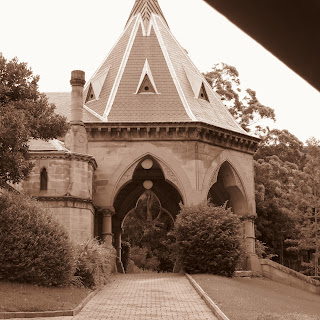
Most people rushing past Regent Street toward Central never look twice at the sandstone pavilion on the corner of Sydney Yard. That is Mortuary Station — James Barnet’s Victorian Free Gothic / Venetian Gothic funeral terminus, opened in 1869 as the city end of the specialised necropolis railway to Haslem’s Creek (today’s Rookwood). Hearse vans and mourning carriages left from here; families rode with the coffins to a matching receiving house inside the cemetery. Angels, cherubs and gargoyles by sculptors including Thomas Ducket and Henry Apperly give it a church-like solemnity — but it was never a place of worship. It was a railway station for the dead.

As motor hearses and better roads took over, the Regent Street funeral-terminus role ended in 1938; residual cemetery trains from Central wound down by the late 1940s. The Rookwood twin building was dismantled in the 1950s and rebuilt in Canberra as All Saints’ Church, Ainslie. Barnet’s Chippendale pavilion later did parcels and depot work, had a brief 1980s restaurant life, and has since been restored and heritage-listed. It is the only surviving purpose-built Victorian railway funerary station in Australia — usually closed except for special openings such as Sydney Open.

Photographs here document Barnet’s Mortuary Station and its Regent Street / Central setting.

Mortuary Station -  Central - Chippendale 


Chippendale station, sandwiched between Sydney’s Central Station and Railway Square, originally opened as Mortuary Station on June 29, 1869, and was used to transport the dead and their grieving relatives to their final resting place, Rookwood Cemetery. 


Adorned with angels, cherubs and gargoyles, the Venetian 13th century Gothic-style building was designed by James Barnet as a central stop to pick up the dead and their living families. Those families had to pay for their return tickets on the grave-y train, but the dead — I imagine due to their inability to access their wallet — generously rode free.

Apparently, the train timetable saw two trains leaving a day — one in the morning and one in the afternoon. On board, there were two types of hearse carriages used to transport the dead. The largest could hold up to 30 coffins, while the other could fit 10 at most. Mourners were held in a separate area of the train, and all disembarked at an almost identical station at the other end, aptly named Cemetery Station.

Mortuary Station

The station and train line were in use until 1947, when the last railway timetable was recorded. It read, “Sydney 2.17pm to Strathfield 2.33pm to Rookwood #1, 2.50pm." By that time, roads were in better shape and cars were a much more popular mode of transport. As such, most funeral processions travelled by car and the need for Mortuary Station was no more. It’s Rockwood sister, Cemetery Station, was dismantled in the '50s and actually rebuilt stone for stone in Canberra to become the All Saints Church. But good ol’ Morty still stands, and if its walls could talk, they’d have a lot to say about its colourful life since those dark early days.

In the 1950s, it became a depot to dispatch animals, namely horses, then moved into a new role as a parcel depot, before taking on its most ambitious role as a pancake restaurant in the '80s. That’s right, from 1986-89, two men by the name of Peter Shield and John McNally had the sweet idea of taking the original railway carriages and turning them into dining areas to eat breakfast. I don’t know about you, but nothing makes me hungrier than thinking about dead people. Know what I mean? Pass the syrup, please.

the restaurant flopped, and by 1989 it was a ghost town once more. Over the last 25 odd years, it’s been refurbished, heritage listed, vandalised and used as a wedding location. Because that’s the other thing thinking about the dead makes me want to do: marry the one I love


JANUARY 2022


The Redfern Mortuary Station, also known as the Mortuary Railway Station, is a historic railway station in Sydney, Australia. It served as a terminal station specifically designed for transporting the deceased and mourners to and from Rookwood Cemetery, one of the largest cemeteries in the Southern Hemisphere. Here's an overview of the history of the Redfern Mortuary Station:

Origins and Purpose:

  • The Redfern Mortuary Station was opened in 1869. It was built to cater to the growing need for a dignified and efficient means of transporting the deceased from Sydney to the more remote Rookwood Cemetery.
  • At the time, the state of urban cemeteries was becoming increasingly crowded and unsanitary, leading to the establishment of larger cemeteries outside the city.

Architectural Design:

  • The station was designed by colonial architect James Barnet, known for his role in designing many of Sydney's notable buildings.
  • The architectural style of the station was Gothic Revival, characterized by pointed arches, ornamental details, and other features reminiscent of medieval architecture.

Functionality:

  • The Redfern Mortuary Station featured covered platforms for the arrival and departure of funeral trains. It also included waiting rooms for mourners and facilities for the transfer of coffins.
  • The design aimed to provide a dignified and solemn atmosphere for the transportation of the deceased and their families.

Funeral Services:

  • The station was primarily used for funeral services and transporting the deceased to Rookwood Cemetery. Special funeral trains would carry coffins and mourners to the cemetery for burial.
  • The station's proximity to the main line ensured easy access to the cemetery, which was located a few kilometers away.

Decline and Closure:

  • With changes in funeral practices and urban development, the use of the Redfern Mortuary Station declined over the years.
  • The station officially closed to funeral services in 1938, as motor hearses became more common and modern transportation methods were preferred.

Preservation and Heritage Status:

  • The Redfern Mortuary Station was recognized for its historical and architectural significance. It was listed on the New South Wales State Heritage Register, ensuring its preservation for future generations.
  • The station's distinctive Gothic architecture and its association with Victorian-era funeral practices make it a unique and historically important site.

Modern Use:

  • While the Redfern Mortuary Station no longer serves its original purpose, efforts have been made to repurpose and restore the station for various uses.
  • The station occasionally hosts cultural events, exhibitions, and tours, allowing visitors to explore its architectural beauty and learn about its history.

The Redfern Mortuary Station stands as a reminder of a bygone era and provides insight into the customs and practices of the past. Its architectural significance, along with its association with Sydney's funeral history, adds to its cultural and historical value in the city's landscape.

Friday, June 17, 2016

The Old Toll Gate - Cnr George And Pitt Sts Railway Square


The Old Toll Gate
 - Cnr George And Pitt Sts Railway Square


  Toll roads and toll bridges are public roadways and thoroughfares which drivers must pay to use. They are believed to have existed in a variety of forms for around 2700 years, with the earliest known toll road thought to be the highway connecting Susa and Babylon. Toll roads and bridges continued to be used through the Middle Ages, in the Holy Roman Empire, as well as across Asia.  

As continents were colonised, the practice of implementing toll roads continued. When Governor Lachlan Macquarie arrived in New South Wales in 1810, he upheld high standards for the development of New South Wales from penal colony to free settlement, including improved infrastructure. Macquarie ordered the construction of roads, bridges, wharves, churches and public buildings and introduced a building code. Funds for road construction were to come from Government funds, public subscription and the establishment of toll roads. Private operators were permitted to construct roads and maintain them for ten years, under the colony's new, strict standards; in return, they collected the tolls to pay for their own costs. 

Australia’s first toll road was a newly constructed turnpike road from Sydney to Parramatta. It opened on 10 April 1811, with one toll bar positioned in George St, Haymarket and the other at the Boundary Road end in Parramatta. This was a successful arrangement, as a profit of $930 was made in 1815 alone from the tolls on the Sydney to Parramatta road


A Toll Gate Was Erected On This Spot By Governor Macquarie In 1811 And 1819 & An Elaborate Gothic Toll House  Was Erected Nearby To The Design Of Francis Greenway. Proceeds From The Toll Was Going To Pay For The Maintenance Of This 14 Mile Dirt Road To Parramatta. 


On The 6th October 1810 Governor Lachlan Macqaurie Proclaimed It Expedient

"To Give Regular & Permanant Names To All The Streets & Ways Leading Through  Town.... & To Order Posts & Finger Boards.... With The Names Of The Streets Painted On Them
To Ne Erected In Conspicuous Parts. 


For Instance - "The Principal Street In Town, & Leading Through The Middle Of It From Dawes Point To The Place Near The Brickfields, Being Upwards Of A Mile In Length, & Hitherto Known Alternately By The Names Of High Street, Spring Row, & Sergeant Majors Row Is Now Named George Street , In Honour Of  Our Revered & Gracious Sovereign" 


The First Toll Gates Were Opened On The 10th April 1811, & The Road From There To Parramatta, Fourteen Miles From Sydney, Qas Financed By A Levy Of 3 Shillings.

Monsieur Peron, The French Explorer Who Visited Sydney In 1802, After Travelling Over the Parramatta Highway Remarked........

  "This Grand Road Appears At A Distance like An Immense Avenue Of Foilage & Verdure. A Charming Freshness & An Agreeable Shade Always Prevail In This Continuous Bower, The Silence Of Which Is Interrupted Only By The Singing & Chirping Of The a richly Plumed Paroquets & Other Birds Which Inhabit It"


If Peron Could Return To Parramatta Road Again Today, He’d Get A Severe Shock

The Toll Gate Remained Until 1819, When It Was Replaced By A Greenway Designed Barricade. 


Commissioner Bigge Arrived In Sydney In September 1819 & He Described Francis Greenway’s Toll Bar As An

“Expensive Trifle, An Attempt At The Imitation Of Gothic:  Defective In Design & Execution. Whilst It Must Excite The Derision Of Everyone Acquainted With The Style In Architecture It Must Also Raise In Responsible Breasts A Strong Emotion Of Regret At The avast Disbursement On This Inelegant & Fugacoous Toy.”