
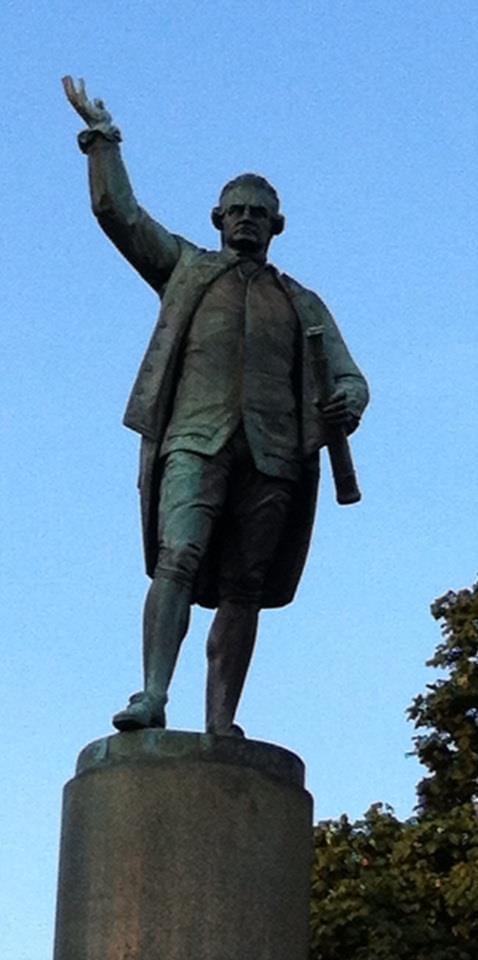
If you cut through Hyde Park South near Park and Elizabeth Streets, the bronze of Captain James Cook is hard to miss — larger than life, telescope in the left hand, right arm raised. English sculptor Thomas Woolner (1825–1892), a founding Pre-Raphaelite who had briefly tried the Victorian goldfields in the 1850s, designed the figure. It stands on a massive Moruya granite pedestal shipped to Sydney in 1878.
Commissioned in 1874 with public subscription and a New South Wales government grant, the statue was cast in England and unveiled on 25 February 1879 by Governor Sir Hercules Robinson. The day was a public holiday; contemporary reports described a huge procession (about 12,000) and a crowd estimated around 60,000. Pedestal inscriptions record Cook’s birth at Marton, Yorkshire (1728), the 1770 voyage of exploration, and his death at Hawai‘i (1779), together with the 1879 dedication.
It remains a City of Sydney public sculpture in the park’s southern formal landscape. Photographs here show the statue, pedestal and Hyde Park South setting.
The Captain Cook Statue - Hyde Park - Sydney - NSW


The Captain Cook Statue Is In The South Of Hyde Park
The Sculpture Stands On A Moruya Granite Pedestool.
This Work Was Commissioned On The 26th September 1874 & Was unveiled To The Public On The 25th February 1879
It Was Made By Thomas Woolner (1825 - 1892). He Was Born In Hadleigh, Suffolk, & Studied At The Royal Academy. He Travelled To Australia in 1852, & Went On To Have Limited Success On The Voctorian Goldfields.
The Day Of The Sculpture's Unveilling Was Declared A Public Holiday In Honour Of Cook & The Monument. It Was Estimated That 12,000 Joined The Procession To Hyde Park & 60,000 People Attended.
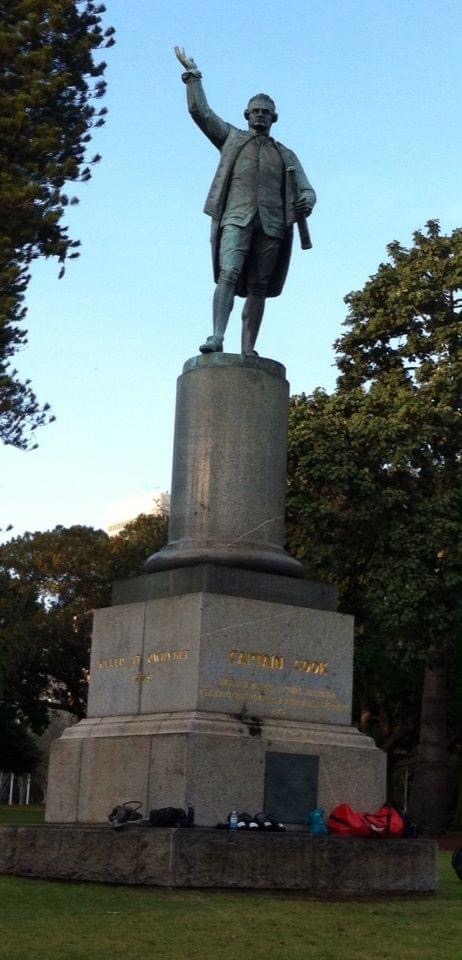

CAPTAIN COOK
THIS STATUE WAS ERECTED BY PUBLIC SUBSCRIPTION
ASSISTED BY A GRANT FROM THE NEW SOUTH WALES GOVERNMENT
1879


THE
CAPTAIN COOK STATUE.
It has been said that while public holidays are numerous enough in Australia they are too often meaningless, and are rarely directed to any specific useful purpose. That, however, cannot be said of the public holiday to-day which has been proclaimed by the Government, who have rightly interpreted the desire which exists on the part of the whole community to honour the memory of the illustrious sailor who discovered the eastern shores of this great south land. It is now nearly one hundred and ten years since the two ships under the command of Captain James Cook anchored in Botany Bay; and it is, therefore, but an act of tardy justice to his memory that we are about to consummate. It is, however, honourable to New South Wales that she has been the first to recognise the worth of one of the greatest naval discoverers belonging to our nation; for it will not be alleged that the value of Cook's discoveries are by any means confined to those who have found a home upon these shores. England herself owes a debt of lasting gratitude to him whose discoveries have enormously swollen the volume of her commerce and extended the bounds of her beneficent rule.
The life of Captain Cook having closed a hundred years ago, his career and his discoveries have long since drifted into the literature of the British nation, and are known to the people of to-day in part only, and as biographers and others may present to the reading public any particular events which at certain times are thought worthy of admiration or example. But on the present auspicious occasion his life and his services are full of interest to everybody, the circumstances of his career from his birth to his death possessing more attraction for Australians than ever they possessed before. Born on October 27th, 1728, at the village of Marton in Yorkshire, where his father was an agricultural labourer and farm bailiff, he commenced the business of life at the age of thirteen, by being apprenticed to a haberdasher, near Whitby. But not finding a haberdasher's business congenial to his tastes, and having quarrelled with his master, he was permitted to abandon his apprenticeship and went to sea, binding himself on board a collier. In this vessel his aptitude and ability soon raised him to the position of mate, but at the breaking out of war in 1755 he left the merchant service and joined a King's ship, the Eagle, of 60 guns, commanded by Captain Hamer, and afterwards by Sir Hugh Palliser. Cook was not slow to distinguish himself, and Sir Hugh Palliser, discovering his merit, he was raised to the quarter-deck and entrusted with the conduct of important services. On board the Mercury he was present at the capture of Quebec, and it was while in the St. Lawrence that he began to be employed in the services which afterwards he carried to such a successful and remarkable issue. After the capture of Quebec, he was engaged in surveying and sounding the river, and he published a chart of the channel from Quebec to the sea. Soon after this, and in the year 1758, he was transferred to the Northumberland, the flagship of Lord Colville, on board of which vessel he held the rank of master, and it was while serving in the Northumberland that he began to study mathematics and astronomy in the few intervals of repose which an active
war allowed him. His courage and tact during the war in conducting important services committed to his charge gained for him the warm friendship and patronage of the commanding officers, and at the termination of hostilities he was appointed to survey the Gulf of St. Lawrence and the coast of Newfoundland. In 1764 he was made Marine Surveyor of Newfoundland and Labrador, and while in that capacity he applied the results of his astronomical studies to the observation of an eclipse of the sun at one of the Burgeo Islands, and to the publication of an account of the phenomenon, the accuracy of his observation, as compared with similar observations in England, obtaining for him the character of an able astronomer. In the year 1767 a transit of Venus was expected, and Cook's astronomical talent being by this time well known, he was recommended for the command of an expedition it was determined to send to the South Seas for the purpose of taking observations of the transit of Venus, and for prosecuting geographical discoveries. For this purpose the ship Endeavour, a vessel of 370 tons, was fitted out, and Cook, with the rank of lieutenant, and accompanied by Sir Joseph Banks, Dr. Solander, and other scientific gentlemen, set sail on his first voyage of discovery, reaching Tahiti on the 13th April, 1769. At Tahiti the necessary observations of the transit of Venus were made with great success, and Cook then sailed to the coast of New Zealand, where he attempted several times to open friendly communication with the natives, and to penetrate into the interior of the country, but without succeeding, for he met with constant hostility, and was obliged to put to sea. Thwarted in his endeavours to make discoveries ashore, he determined to do what he could with regard to exploring the coast line of the strange islands, and during a voyage of six months' duration he proved the insularity of New Zealand, discovered the straits which separate the North from the Middle Island and named them after himself, and made an extensive coast survey. From New Zealand he steered to the coast of Australia, then known by the name of New Holland, and on the 28th April, 1770, discovered Botany Bay, where he landed and took possession of the country in the name of Great Britain. On the 6th May, following, he set sail from Botany Bay northward, exploring the coast-line on the way, and proving the complete separation of Australia from New Guinea. The perils of this voyage were very great, and so shattered and disabled was the ship from having run upon a rock, and been buffeted about by innumerable storms, that Cook found it necessary to run to Batavia for repairs. England was reached on June 11, 1771, and Cook was immediately rewarded for his services by the King conferring upon him the rank of Captain. The existence of a great continent in higher southern latitudes than Australia or Van Dieman's Land became a matter of renewed speculation soon after Cook's return to England, and he was appointed to the command of a second expedition to visit the south seas—two ships, the Resolution, 462 tons, and the Adventure, a vessel of about the same tonnage as the other, being given to him for the purpose. Leaving Plymouth on July 13, 1772, he sailed to the Cape of Good Hope, from which point he directed his course in search of the unknown Southern continent, but without discovering land; and being satisfied that no land existed within the specified latitudes, he abandoned the search, and sailed for the South Pacific, where he discovered New Caledonia; and thence returned to England, arriving there in July, 1774. This time he was promoted to the rank of Post Captain, and appointed to the position of Captain of Greenwich Hospital, and shortly afterwards he was made a member of the Royal Society. Geographical discovery was a subject which, during
Cook's life, frequently received the consideration of Government, and, attention having been drawn towards the benefits that might arise from the discovery of a north-west passage in the Arctic Seas, Cook was again selected as the man for the work. The command of the expedition was at once placed at his service, for everyone saw in the daring and successful navigator the man to brave the dangers of the Arctic regions, and do all that could be done towards effecting the object of the voyage; and, after the earnest persuasion of his friends, and stimulated by the great results expected to follow from the success of the undertaking, he volunteered to conduct the expedition, and he was immediately appointed to the command. The vessels fitted out for the service were the Resolution and the Discovery, the command of the latter being given to Captain Clerke, who was a second lieutenant during Cook's second voyage; and the expedition was directed to proceed to the Pacific Ocean and thence to make its way into the Atlantic along the Northern Coast of America. It was during this voyage that Cook met with his tragic end. He was unsuccessful in the object of the expedition, though he followed the American coast line northward as far as Cook's Inlet, and, after sailing for Behring's Straits, he returned to winter at the Sandwich Islands. There, at the island of Owhyhee, he met with his death. One of the boats of the Discovery having been stolen during the night of the 13th February, 1779, Cook determined to adopt his usual measures for obtaining a return of the stolen property, and for that purpose went on shore the next day and endeavoured to seize the person of the king as a hostage until the boat was brought back. In this proceeding Cook failed, and a serious collision with the natives occurred. "What followed," says the narrative of Captain King, who sailed with Cook on board the Resolution, "was a scene of the utmost horror and confusion. Four of the marines were cut off amongst the rocks in their retreat, and fell a sacrifice to the fury of the enemy. Three more were dangerously wounded, and the lieutenant who had received a stab between the shoulders with a pahooa, having fortunately reserved his fire, shot the man who had wounded him just as he was going to repeat his blow. Our unfortunate commander, the last time he was seen distinctly, was standing at the water's edge, and calling out to the boats to cease firing and to pull in. Whilst he faced the natives none of them had offered him any violence, but having turned about to give his orders to the boats he was stabbed in the back, and fell with his face into the water. On seeing him fall the islanders set up a great shout, and his body was immediately dragged on shore and surrounded by the enemy, who, snatching the dagger out of each other's hands, showed a savage eagerness to share in his destruction." The body of the slain commander was cut to pieces, and most of it burnt, only the bones being recovered by the ships.
Captain Cook is described as having been a man of plain address and appearance, but with a face full of expression, a nose well shaped, eyes small, quick, and piercing, with prominent eyebrows which gave his countenance an air of austerity. He was upwards of six feet in height, with a fine, well-developed figure, and in disposition was kind and humane, though on many occasions he appears to have found it necessary to use firearms against the natives of the islands he discovered or visited. As a navigator, his merits were of the highest order, and distinguished honours were paid to his memory in England and by foreign nations. When he set out on his last voyage his family consisted of his wife and three sons, two of whom were in the Navy; but, as though a strange fatality had come upon the family after the death of Captain Cook, one son was lost on board the Thunderer man-of-war, in a hurricane, six months after his father was killed, another perished at sea in a boat while attempting to get on board the Spitfire sloop-of-war, to which he had been appointed master and commander, and the third died suddenly of fever at Cambridge. The widow of Captain Cook lived to the age of 93, surviving her husband 56 years.
The proposal to erect a statue in honour of Captain Cook, if it did not originate in the brain of Captain Watson (for many years Harbour Master in Port Jackson) was first brought into a practical form by him. About the centenary of the discovery of this part of New Holland by Captain Cook, the gentleman we have named initiated a subscription with a view to procure some tangible representation of the people's gratitude to Cook; but the task was more than he could accomplish—he being already advanced in years, and it occurred to him to ask the co-operation of the Australian Patriotic Association, of which Mr. R. B. Smith (who has for some years past represented the electorate of the Hastings in Parliament) was then president, and Mr. G. H. Reid one of the most influential members. These gentlemen took up the project with patriotic ardour, and having enlisted the sympathetic interest of Sir Alfred Stephen (then Chief Justice), they lost no time in convening a meeting of the citizens to initiate a movement in a more public form. That meeting was held in the Victoria Theatre on the 15th February, 1869 (ten years and ten days ago), and of the gentlemen who took a prominent part in its proceedings as speakers no less than four have gone over to the majority. The gentlemen who spoke on that occasion were Sir Alfred Stephen, Mr. R. B. Smith, the Hon. T. A. Murray, Mr. Windeyer, M.L.A., Mr. R. M. Isaacs, M.L.A., the Hon. John Campbell, M.L.C., Mr. J. G. Raphael, the Hon. A. Campbell, Mr. G. H. Reid, the Hon. Saul Samuel, the Hon. John Sutherland, M.L.A., the Hon. R. Owen, M.L.C., and Mr. Bird.
An influential committee was chosen, of which Sir Alfred Stephen has remained the chairman, and of which Mr. R. B. Smith and Mr. E. W. Day have been respectively secretary and treasurer. Mr. John Alger, Mr. Reid, Captain Watson, Mr. F. Senior, Mr. G. M. Pitt, Mr. S. Bayliss, and Mr. John Davies, M.L.A., have been among its most indefatigable workers. They entered upon the business with spirit, and met with so much support that they were in a position to lay the foundation-stone of the pedestal during the ensuing month, and to ask the son of our beloved Queen to perform the ceremony, which took place on Saturday, the 27th March.
On that memorable occasion, Sir Alfred Stephen addressing the Duke of Edinburgh, said:—
"Your Royal Highness,—The colonists of New South Wales long desirous of commemorating, in the territory which he discovered, the name of our greatest navigator, rejoice in the opportunity afforded them by your presence of auspiciously commencing the realisation of that design. He would connect the monument which they are about to rear, with memories of their Fatherland, of their beloved Sovereign, and of that glorious flag which waves now over the Galatea as it did over the little craft that brought Captain Cook to these shores a hundred years ago. The son of the Queen, himself a British sailor, descended from a long line of royal ancestry, is here to assist in honouring the memory and rendering a tribute to the achievements of one who, self-taught, and rising to fame and rank in that profession by merit only,—sprang from the humblest grade among the people. The task thus at our request undertaken by you, while we thankfully acknowledge the kindness of your compliance, we are persuaded that you will, for that very reason, consider an appropriate and not unpleasing one. And in few things could elevated station be more gracefully or acceptably occupied."
The Duke of Edinburgh replied:—"Sir Alfred Stephen and gentlemen,—One of the happiest privileges which the members of the Royal family enjoy is that of being able to do honour to the memory of great men and of noble deeds, by their presence at such a ceremony as that which we are met to perform to-day. But when the man whose fame we desire to commemorate has by a life of great discoveries and of scientific researches, increased so materially the territorial extent of the Empire, and has conferred so great benefits upon the whole civilized world by his valuable additions to geographical knowledge, and when, by these noble actions he has shed a lustre upon the profession of which he belonged, and to which I am so proud to belong—I mean the maritime service of the greatest maritime nation of the world—then indeed I feel that a very high honour is conferred upon me in having my name associated with this memorial of his greatness. There is no one among the names of England's heroes more deserving of this recognition on your part, and none whose career could be held up as a brighter example to every Englishman than that of Captain Cook. Humble as his origin was, he possessed that true nobility of character which has for its object—not the aggrandisement of self, but the welfare of the nation. He is among the chief of those who, in making Englishmen proud of their name and of their mother country, have helped to cement in one powerful brotherhood the subjects of the British Empire in every part of the world. In conclusion, I trust that there are many among the sons of Australia who will emulate his example, and gild with noble deeds the name of this great country and the fame of England."
Although the committee prosecuted the work which they had undertaken with unselfish earnestness and vigour, they were unable to raise sufficient money to complete the statue. The amount of the subscriptions voluntarily given by the public was about £1800; but as the committee feared that the realisation of their most cherished hopes would have to be deferred indefinitely, they determined to appeal to the Government (of which Sir Henry Parkes was then the Premier and Colonial Secretary). Sir Henry (then Mr.) Parkes came to the help of the committee in their difficulties, and the Parliament with commendable liberality voted the £2000 which was the amount at first estimated to be required. Parliament subsequently voted a second £2000, at the instance of Sir John Robertson. The work of forming the statue was entrusted by Sir Henry Parkes to Mr. Thomas Woolner, a rising sculptor of considerable ability, and it is confidently expected that when the statue is unveiled to-day the artistic merit of the work will fully attest the wisdom of the choice.
The position of the statue on Hyde Park, opposite the Museum, is an extremely good one, for the form of Captain Cook will be one of the first objects which open to the view of persons coming by sea to Sydney. The site commands a splendid view of the North Head; and we hope the trustees of Hyde Park will lose no time in making this valuable recreation ground worthy of the historic associations which are becoming connected with it. The very excellent picture of the statue which was published by the Sydney Mail on the 14th of last September will have prepared the general public to form a just anticipation of the work itself. The statue, as it is now seen, though a most impressive figure, will certainly be much more imposing on the higher pedestal prepared for it. The attitude is striking and vigorous, with the right hand raised high in the air in a moment of immense delight at having caught sight of land after watching through the early dawn of morning, strong in his belief that land was there, the telescope being held in the left as no longer necessary. The fine head is most expressive and characteristic of the keen observer and dauntless discoverer, in the massive brow with deep furrows at the temple and strongly moulded nose and chin. There is no stronger point in the statue than this preservation of likeness on such a colossal scale; and so just are the proportions of the figure in the torso and the limbs that it looks the hero without being a giant. The dress, which is the well-known naval uniform of the day, with the open-breasted broad-tailed coat, the long flap waistcoat, and the knee-breeches, with shoes, is remarkable for good work, falling to the figure naturally and not ungracefully, the gold lace being to some extent represented by a lighter-coloured bronze. But all these points of detail are quite unobtrusive, and subservient completely to the noble air of brave self-confidence expressed in the intellectual countenance, the broad and vigorous frame, and the general action of the figure. The casting of the statue, which was rather an arduous work, was made by Mr. Cox, of Thames Ditton Works.
As far as can be judged the preparations which have been made by the Statue Committee are very complete and satisfactory; and yet the occasion is one which may require that the populace shall exercise considerable self-control. While the site is a most commanding one, still the peculiarities of the locality are such as to give comparatively little space for the vast concourse of spectators who will gather there to-day. Every effort has been made by the Government and the committee to increase the space by the erection of large stands to the east and west of the statue. These will accommodate upwards of 2000 persons, and they have been solidly constructed under the supervision of Mr. James Barnet, the Colonial Architect. They have been constructed by Messrs. Hudson Brothers, of Redfern, and it is in the highest degree creditable to the resources of that firm, that structures so large and massive should have been put together in eight days. These stands are connected with each other by a neat semi-circular railing having a gateway in the centre. Admission to the stands will be by ticket, and the committee have, we believe, been guided in their distribution of cards, largely by the fact, that subscribers to the fund were entitled to precedence. If they have not succeeded in satisfying everybody, they will have the gratification of having made the best possible attempt to do so, and we entertain, no doubt, that their endeavours will to-day be crowned with well-earned success. A raised platform, covered by an elegant canopy, has been placed on the north side of the statue, for his Excellency the Governor. Behind this again will be another stand, upon which Mr. Fisher and a choir of some two or three hundred children from the Public schools will sing the National Anthem; and on the northern boundary of the enclosure formed by Park-street will be stationed the Volunteers. A commanding position on the northern side of Park-street has been railed off for the members of the various friendly societies who may take part in the procession. The centre of the western stand has been reserved for the Captain Cook Statue Committee. The stands and enclosure will be surrounded by sixty-eight flagstaffs from forty to fifty feet high, which will be partly clothed with zamia leaves and foliage; and which will be festooned together by wreaths of evergreens. There will also be a central flagstaff seventy feet high. There is every reason to expect that the spectacle will be extremely picturesque and pleasing. The German Band will be placed on the ground, and will play from half-past 2 o'clock until the commencement of the ceremony.
Besides the National Anthem, two verses of "Rule Britannia" will be sung by the choir organised by Mr. J. C. Fisher. In honour of the occasion, Mr. Fisher has written the following additional verse, which will also be sung:—
With lion heart that nought could tame,
Our Hero sailed for shores unknown;
Crowned with the laurel wreath of Fame
He won these lands we call our own.
Hail, Australia, hail to thee!
Fairest Daughter of the Sea!
The following is the Programme of the proceedings:—
Unveiling of the Captain Cook Statue.
Procession and Ceremony
Tuesday, 25th February, 1879.
Mounted Police.
Band of H. M. S. Wolverene.
Sailors and Marines from Squadron.
Military Band.
N. S. W. Artillery and Volunteers.
Naval Brigade.
Insurance Companies' Fire Brigade.
Volunteer Fire Brigade, No. 3.
Woollahra Volunteer Fire Brigade.
Grand United Order of Oddfellows.
Ancient Order of Foresters.
Manchester Unity Independent Order of Oddfellows.
Holy Catholic Guild, St. Mary and St. Joseph.
Protestant Alliance Friendly Society of Australia.
Shipwrights' Provident Union.
National Divisions Sons of Temperance of Australia.
United Ancient Order of Druids.
Hibernian Australian Catholic Benefit Society.
Independent Order of Rechabites.
Sydney Marine Benefit Society.
Loyal Orange Friendly Benefit Society.
Independent Order of Oddfellows.
Independent Order of Good Templars.
Operative Stonemasons Society.
United Sydney Plasterers' Association.
Catholic Mutual Improvement Society.
The friendly societies and other public bodies taking part in the procession on foot will assemble at 2.45 p.m. in the open space in the Outer Domain, adjoining the cricket ground, from whence the order of procession will be formed six abreast.
The societies will march in the order stated above, the route to be by the avenue leading to Sir Richard Bourke's statue, thence by Macquarie-street North, Bridge, George, and Park streets, halting at the Town Hall to accompany the Right Worshipful the Mayor and Aldermen to the ground.
The friendly societies and other public bodies will enter Hyde Park by the steps north of Park-street to the enclosure assigned, where they will take up position as arranged.
No members of public bodies or societies taking part in the procession will be admitted to the reserved space in Hyde Park unless wearing their society badges.
Except such persons as are officially engaged in the ceremony (and naval or military officers in uniform), no one will be admitted to the statue enclosure without an admission card.
Carriages setting down ladies or gentlemen having tickets of admission to the stands, to drive by way of College-street from the south, setting down at entrance steps to Hyde Park opposite Museum; then to drive away by William-street, taking up positions to stand on the north side of that street, horses' heads west.
A guard of honour will be furnished by the Artillery, and be stationed at the gate of the enclosure, to receive the Governor at 4.30.
The Artillery, the Guard of Honour excepted, will, with the Marines, take up position within the semicircle behind the statue.
The Volunteers will be ranged along the fence south of Park-street—facing the statue.
The Military Band, with the bands of the Wolverine and Naval Brigade, will be placed in front of the Volunteers, and immediately behind the school children.
The sailors of the Squadron will be placed in front of stand B (east of the statue), and the Naval Brigade in front of stand A (west of the statue).
On the Governor's reception by the Statue Committee within the enclosure, the bands will play "God save the Queen." The school children and choristers will sing "Rule, Britannia," accompanied by the Artillery Band.
His Excellency will then deliver an address.
On its conclusion he will direct the unveiling of the statue, which will be performed by two sailors and two marines from one of her Majesty's ships, and two members of the Naval Brigade.
Cheers will be given for the Queen, for the Governor, and for the Royal Navy; after which the school children and choristers, accompanied as before, will sing the National Anthem.
The ceremonial being thus concluded, the bands will, on the Governor taking his departure, play "God save the Queen," and the assemblage will disperse.
Extremely handsome copies of the programme have been printed by Mr. Thomas Richards, the Government Printer. The copies for his Excellency the Governor and Lady Robinson have been mounted in an elegant morocco cover, and will have their names printed on them in letters of gold. On one page of the cover is the programme, and on the other there is a picture of Captain Cook, with a fac-simile of his signature, which has been produced in the most artistic style of photo-lithography by Mr. Sharkey. Captain Cook is represented as seated at a table, inspecting a chart, his glance being for the time averted as if from an effort to recall some fact or circumstance connected with the subject which is engrossing his thoughts. The pose of the figure is extremely pleasing and restful; but there is much shrewdness and penetration expressed in the calm and manly face. It will form a very charming souvenir of the occasion. We may also add that, with a view to commemorate this event, the proprietors of the Sydney Mail will publish a splendid lithograph of the Cook memorial, surrounded with an appropriate border, containing vignettes of the landing-place at Botany and the monument erected at Owhyhee, the place where Captain Cook was murdered by the blacks. At the foot of the picture is a vignette portrait of Sir Joseph Banks, the botanist to the expedition on the discovery of Botany Bay on these shores.
The present appears an opportune time for reproducing Mr. Yarrington's University prize poem, and it will, no doubt, be read with more than ordinary interest:—
"COOK MEDITATING ON AUSTRALIA'S FUTURE."
The stillness and the hush of evening lay
O'er sleeping nature; and the quiet bay,
Calmly reposing, as in tranquil sleep,
Stirred not; save, as the swellings from the deep
Came stealing o'er it—just as gentle breath
Lifts the soft bosom, that, in seeming death,
By passions all untortured, quiet lies,
Untorn by anguish—undisturbed by sighs.
So slept the waters, o'er whose face a beam
Of softest light, e'en as a living stream
Of purest silver, lay; and, from her throne
Amid the floating clouds, in beauty shone
The quiet moon:—a mild and holy calm
Hung o'er the scene; and, like an incense charm,
The fragrance that from woodland flow'rets swept—
Flow'rets that with the dews of evening wept—
Came o'er the waters with the gentle air,
Then rose to Heaven, like a hallowed prayer.
Resting upon the waters' surface lay
Two noble ships that, in that peaceful bay,
Sought from the ocean's fierce unrest repose.
And here their wand'ring found a happy close;
Here, where no more the angry billow rolls,
Nor lurking rocks are feared, nor treach'rous shoals
Hushed was each sound, nor heard the boatswain's call,
Nor hoarse command, for sleep was over all—
Sleep, peaceful sleep! The ships like spectres stood,
Floating, uncertain on the air or flood,
As, o'er the weblike rigging and the spars,
The moonlight brooded, and the twinkling stars
Were seen above. Is there no creature there?
And are these ships but phantoms of the air?
No. On the deck of one appears a form;
'Tis of a seaman, whom full many a storm
Hath tost. It is the form of him whose name
From age to age shall, with undying fame,
To every son of this bright land be taught—
'Tis Cook! who treads that deck in lonely thought.
Yes, there is he, of Britain's sons the first
Upon whose view, in all its beauty, burst
This sunny land where now we live! Yes, there
Gazing on all around, so still, so fair,
Into his soul he drinks the quietness,
And o'er his spirit dreamy thoughtfulness
Comes gently stealing; while his pensive mind,
Which to the past and present hour is blind,
Thinks on the future of this happy land—
Thinks, as he gazes on the wood-girt strand,
Upon the time when far and wide around
Those woods shall echo to the axe's sound;
Those groves, through time unmeasured, that had been
Of savage life the fruitless wasted scene;
Beneath whose spreading boughs—the opossum's home—
The kangaroo and stately emu roam—
Those woods, that oft the war cry wild had heard,
Which, like the screaming of some dreaded bird
Floating above, strikes terror to the weak,
Whose echo is the wailing wild death-shriek!
He sees the time when those primeval trees
Shall pass away, as, waving with the breeze,
In golden beauty, harvests rich appear,
To glad with bounty, and with plenty cheer.
He sees, with humble roof, the cottage rise
Where dwells the peasant who, industrious, plies
With toil the fruitful land; and there his mate,
The partner of his life, whose heart elate
With happiness, amid her children dwells:
Her's is the joy that with affection swells;
'Tis her's to soothe his mind when cares oppress,
And with her gentleness his home to bless,
There, happy dwell they, while, with plenty crown'd,
The village rises to the view around.
Thus, with her Pictures, Fancy doth beguile
The dreamy thoughts of him who prays the while
That, not delusive, what he sees may prove;
And that the scenes before his mind that move—
Of cities rising into pomp and power—
Of noble buildings that, with dome and tower,
Shall stand for ages, and, with solemn spell,
Recall their ancient majesty, and tell
When first to God, temples were high upraised,
And when, with lifted hearts, in hymns was praised
The goodness that did bless—tell of the time
When first, from belfry tower, was heard the chime
Of Sabbath bells; tell of the times gone by
When Austral's sons, with boldness, dared defy
All dangers that their onward course withstood,
Until they won whate'er was great and good.
Prayed he, these things, which were but of the brain,
Might, in reality, live o'er again.
And, as he looks and sees fair Learning's seats
Rise in their grandeur, joyfully he greets
The sight; and as an ernest [sic] sure, he prays
That these may be; and that in future days,
Sages and poets shall within those walls
Be nurtured; and from out those college halls
Men who, in wisdom learned, shall watchful stand,
And guard, with sacred care, their native land;
That thence shall come—Poets, with souls of fire,
Whom genius shall with burning thoughts inspire
To sing prophetic! Preachers, strong in God,
Who shall declare the truth of Him that trod
This earth; whose faith, through ages long, shall live
And, to all nations, the sweet bondage give
Of brother's love! Such are the thoughts of him
Across whose brain in shadowy outline dim
The future passes; such the fervent prayer
That, for this land so beautiful, so fair,
He offers up to God!—That it may be
For ever glorious, and for ever free!


