Search This Blog

Showing posts with label Redfern. Show all posts

Friday, October 16, 2026

Will Coles – Sydney's Concrete Street Sculptor – Cast TVs, Balaclavas, Skulls and Cans from Newtown to Paddington

If you've spent any time walking around Newtown, Enmore, Redfern or Paddington, there's a fair chance you've stepped right past a Will Coles and never known it. A grey TV remote glued to a wall with the word HATE cut into it. A squashed soft drink can on a kerb that says ETERNITY. A pair of gloves left on a ledge near Erskineville Oval with GONE on them. They look like rubbish until you get close, and then you realise somebody cast the thing in cement, carved a word into it and stuck it there on purpose, usually in the middle of the night.

This page is my go at pulling together what's actually been written about him: where he came from, how he makes them, what the words are about, where they turn up around Sydney, the gallery shows, and why so many of them don't last. He's a living artist, so I've stuck to what he and others have said in print and left his private life alone.

Concrete skull plaque inscribed LOL on a wall in Paddington
A cast skull plaque with LOL carved into it, Greens Road side of the old COFA art school, Paddington, 2026. Skull plaques and the word LOL are both listed among Will Coles's works, and this corner is a known spot for his pieces, though the photographer didn't name the artist. Xyxyzyz, CC0, via Wikimedia Commons

Who Is Will Coles?

On his own website Will Coles calls himself a "Sculptor, street artist and freelance European". He's English by birth. The German public-art register Kunst@SH says he was born in 1972 in Warwickshire and grew up in Suffolk, and that he spent several years at the Ravensbourne, Wimbledon and Glasgow schools of art before moving to Sydney in the early 1990s.

In a 2013 interview with the Sydney street art blog 2095 he described growing up "in a countryside outside a small village in England: very green & very quiet". He hated sport, liked reading, and said he spent a lot of his time in books. He's said he has "always sculpted", and the biggest influence on him was his grandfather, who he called "a sculptor of incredible skill".

That grandfather comes up again in a 2019 comment Will left on the Differentville blog. A reader asked if he was the grandson of the sculptor Norman Sillman, who'd made a bust of her mother in London in 1951. He wrote back that yes, he was, that his grandfather had died a few years earlier, and that he was "very good at bronze-look plaster".

He wasn't always a sculptor on the street. He told UP Magazine in 2025 that he did graffiti between 1989 and 1991, but admitted, "I was pretty basic, I'm colorblind, and I've always had a more three-dimensional mind." It was in Sydney that he worked out the style he's known for now. He also told UP Magazine he has never used a fake name: "I never hide from anyone or anything, so I'm not going to hide behind a fake name… yet."

Sydney Years and the Move to Europe

Sydney was his base for about twenty years. Honi Soit, the University of Sydney student paper, said in 2024 that he came to Sydney "sometime in the 1990s" and lived here until 2015. Helen Foster at Differentville also says he moved to Europe in 2015 and has since been gluing his work around Valencia, Barcelona, London and towns in Germany. Kunst@SH says he now lives and works in Valencia, Spain, and he told a reader in 2019 that he was "based in Spain these days".

How he's described depends on who's writing. The Sydney Morning Herald called him "an Australian-British artist" in 2023, and the Hamburg galleries that showed him in October 2026 called him an Australian sculptor and street artist.

How He Makes Them

The process is simpler than you'd think, and he's happy to explain it. He told the 2095 blog in 2013:

"I find the right object by: stumbling upon it, searching for it or occasionally I seem to will it in to existence (ie. it turns up in the road outside my studio and it's just what I was looking for). I then make a rubber mould then a plaster cast, carve in letters, then make a second rubber mould from that, then cast it in cement. Those are the small ones which I've done thousands of by now."

So the word isn't carved into each piece one at a time. It's carved once into the plaster, and the second mould carries it into every cement copy. That's how one design can show up all over the place. He told UP Magazine that each design is made in small editions, so "the same sculpture can turn up in ten different countries".

Why Cement?

He explained the choice of material in a 2012 interview with the Melbourne blog The Fitzroy Flasher. His grandfather taught him to cast in cement, which he called "a 'poor man's bronze'":

"It seems to be the natural choice for an urban setting. Resins & plastics seem too slick, too corporate, bronze reeks of officialdom & council-inflicted art. Cement is the same as the buildings, roads & pavements. It ages, discolours & grows old with its surroundings, if you let it."

He said he uses a harder French cement, ciment fondu, and that it's still "cheap & fast" enough to turn out fifty or more small pieces at a time. He also had a tip for anyone trying it: don't use quick-set cement, because "it's fragile salt-ridden junk".

The pieces are glued down, and the glue matters. The Herald said in 2023 that good glue is vital, because people keep trying to prise his work off. His website line about himself, quoted by both the Herald and Differentville, is that he "loves his wife, carbohydrates and strong adhesives".

Not everything is small concrete. His website lists a piece called Freedom made of glass-reinforced plastic with a gold leaf finish, and ArtsHub showed a resin sculpture, property (old), from his 2013 Brenda May Gallery show.

Cast concrete TV remote control inscribed HATE glued to a wall in Newtown
A cast TV remote with HATE carved into it, Newtown, March 2011. Wikipedia's article on Newtown street art names Will Coles as the maker of the remotes inscribed "fear" and "hate" around Newtown. Dunks58, CC BY-SA 3.0, via Wikimedia Commons

The Objects and the Words

He gave UP Magazine his own list: "TVs, remote controls, armchairs, cell phones, suitcases, washing machines, boomboxes, gloves, guns, dolls, teddy bears, shoes, handbags, jackets…". Honi Soit added balaclavas, guns with bent barrels, AK-47s, skull plaques and dead birds. The Herald says the best known are the "grimacing squashed balaclava-clad faces", along with skulls, mobile phones and sleeping birds. Differentville's list also has bent-barrelled guns, squashed cans, goon bags, the odd teddy bear or baby, and plaques reading WILL COLES WAS 'ERE.

The word is the point. He told The Fitzroy Flasher:

"My ideas grow out of messages, or are really messages condensed down to a word on an object. I try to create a metaphor by turning a common easily recognised item into a meaning by adding a word, hopefully the right word. Sometimes I find the object & it'll sit there bugging me for a year or more, other times it just clicks."

Some of the words that have been written down by people who found them:

  • FINITE – the full-size washing machine outside Newtown police station (Honi Soit; Jonathan Shaw's blog).
  • ETERNITY – on squashed soft drink cans. Jonathan Shaw noted it was done in Arthur Stace's script.
  • HATE and FEAR – on TV remotes and mobile phones in Newtown (Wikipedia; Jonathan Shaw).
  • FORGOTTEN – on cast shoes, including one on a pedestrian island in Enmore (Jonathan Shaw; Honi Soit).
  • GONE – on gloves near Erskineville Oval (Honi Soit).
  • FAKE – on a Louis Vuitton-style handbag at Oxford Street and Greens Road, Paddington (Differentville; Honi Soit).
  • NOTHINGNESS – on a dead bird near Redfern station (Differentville).
  • LIFE IS FLEETING and OBSOLESCENCE – on two full-size concrete TVs sitting on concrete VCRs, one on King Street and one on Gladstone Street, Enmore (Wikipedia).
  • DRINK TO GET DRUNK – on a cast wine cask bladder at Edinburgh and Victoria roads (a reader's comment on Jonathan Shaw's blog).
  • Titled pieces Jonathan Shaw found around Enmore and Marrickville: Man-Made, Sweet Tooth (a donut baring its teeth), Work, Laissez Faire and Tag.

I like the ETERNITY cans. They're a nod to Arthur Stace, who chalked that one word on Sydney's footpaths for decades, so a throwaway can ends up carrying the city's most famous bit of street writing. I've done a page on Stace too, linked at the bottom.

What He's Getting At

Consumerism and waste come up again and again. In 2012 he told The Fitzroy Flasher that capitalism "requires each product to have a shorter shelf life than the last, either by built in obsolescence… or by peer pressure (iPhone, say no more!)", and that "any logical reading of this makes you realise this is impossible on a finite planet with finite resources." Seen that way, FINITE on a washing machine and OBSOLESCENCE on a TV make sense.

In 2025 he gave UP Magazine the short version: "To make people think." He went on: "We're bombarded with thousands of ads, signs, and symbols telling us what to do, what to buy. I just want people to think more."

War and guns are the other big theme. ArtsHub said his 2013 Brenda May Gallery show "interrogates consumerism and war with a good dose of wit". His website has pieces called Police Special, ANZAC II (RSL), MAD AK and Hand gun, each with a short and pointed note.

He's named his influences as his grandfather, Rodin, the book Subway Art and the Scottish poet-sculptor Ian Hamilton Finlay, who also carved words into stone. In 2025 he added Francis Bacon, Hannah Höch, Lushsux, Futura and Martha Rosler.

Two small cast plaster faces fixed to a timber pole in St Peters
Cast faces fixed to a timber pole in May Street, St Peters, 2011. Wikipedia calls these concrete graffiti faces "based on medieval gargoyles" but doesn't say who made them, so I can't say for sure they're Coles's. Dunks58, CC BY-SA 3.0, via Wikimedia Commons

Where to Find Them in Sydney

Most people who write about him leave the exact spots out, and the Herald said in 2023 that the locations are "best kept secret". He told the 2095 blog that he does it both ways: some go in really obvious places where loads of people see them, and some are hidden in the hope they'll last longer. The Inner West and the inner east are his heartland, and these are the areas named in print:

  • Newtown – the FINITE washing machine outside the police station, which the Herald calls "now-removed". Honi Soit's writer found a yellow cube on its platform two years later. There's also a wall of skulls and balaclavas on Gladstone Street by the railway, an oil can and gloves at the crossing outside Newtown station, and the LIFE IS FLEETING TV on King Street.
  • Enmore – Enmore Road bus stops, the OBSOLESCENCE TV on Gladstone Street, a balaclava on a graffiti wall in Trafalgar Street, and Laissez Faire on the mural wall at Phillip and Gladstone streets.
  • Paddington – around the old COFA art school (now UNSW Art & Design) at Oxford Street and Greens Road: the FAKE handbag, a balaclava, a skull, and a washing machine on Selwyn Street that has since gone.
  • Redfern – Little Eveleigh Street beside the railway. Helen Foster once counted six pieces in about 100 feet there.
  • Erskineville – gloves around Erskineville Oval and the small park at Ashmore Street and Mitchell Road.
  • Waterloo – a few on Danks Street, the old gallery strip, including a teddy bear.
  • The CBD – a balaclava and gloves at Liverpool and Castlereagh streets, a plaque, gun and remote in Dungate Lane, and a balaclava on a transformer box opposite a Commonwealth Bank branch. A Differentville reader also mentioned one on Macquarie Street near the Cahill Walk stairs.
  • Marrickville, St Peters, Alexandria and Surry Hills – scattered pieces, including a street plaque near the Brett Whiteley Studio and squashed cans by bus stops in St Peters.
  • Further out – one balaclava on Cockatoo Island, gloves left outside the Art Gallery of NSW, a balaclava and two phones in Cessnock in the Hunter, and a balaclava found in Gadigal Reserve, Summer Hill, in September 2026, all reported by Differentville and its readers.
Close view of a cast skull plaque inscribed LOL
The same LOL skull plaque, Paddington, March 2026. Xyxyzyz, CC0, via Wikimedia Commons
Sandstone wall at night with a small skull plaque, COFA campus behind
Looking along the sandstone wall outside the old COFA campus, Paddington, at night. The skull plaque sits on the wall's top course. Xyxyzyz, CC0, via Wikimedia Commons

Beyond Sydney

Melbourne got him early. The Fitzroy Flasher wrote in 2012 about waking up to a Fitzroy that had been "bombed" with his pieces. On that trip he said he glued "about five milk crates of new & old works mostly over Brunswick, Fitzroy & the CBD". He liked it there, saying Melbourne's old bluestone lanes suited his work better: "Melbourne seems more natural for my work, like European cities it's older." In 2017 he said there were still a fair few left in Melbourne, and even in Canberra.

Since 2015 he's been working mostly in Europe. He's put pieces from London's South Bank Centre up through Brick Lane, and Differentville reports Valencia, Barcelona and German towns. Hamburg has taken to him in a big way. Kunst@SH says he did a long artist residency there in 2018, and the Urbanshit Gallery says he has been leaving his mark on the city since 2016. One of his best-known Hamburg pieces is Besinnungslosigkeit (roughly "senselessness" or "unconsciousness") on the Moorweide parkland. It's a cast of a discarded liqueur bottle with a stag's head on the label, and the words "produced & bottled to keep you numb".

Concrete bottle sculpture lying on a plinth in a Hamburg park
Besinnungslosigkeit by Will Coles on the Moorweide, Hamburg-Rotherbaum, photographed in June 2024. The Commons description dates the piece to 2018. Minderbinder, CC BY 4.0, via Wikimedia Commons
Close view of the cast bottle sculpture Besinnungslosigkeit
Close view of Besinnungslosigkeit, Hamburg, 2024. Minderbinder, CC BY 4.0, via Wikimedia Commons
White cement bottle sculpture on a grey base in a Hamburg park
The same Hamburg piece in March 2019. The Commons description gives white cement on a grey concrete base, about 100 cm long. Felistoria, CC BY-SA 4.0, via Wikimedia Commons

Galleries, Shows and Prizes

Even though he's made his name on the street, he has shown in galleries. In Sydney his gallery was Brenda May Gallery at 2 Danks Street, Waterloo.

  • March 2012 – Nihilist Archaeology, Brenda May Gallery, part of Art Month Sydney. He gave an artist talk on Saturday 10 March, there was an Art at Night event where he ran a cocktail bar, and the show ran until 24 March.
  • March 2012 – Hello Dollies, Penrith Regional Gallery, a group show with Fiona Fenech and Janet Parker-Smith.
  • October 2013 – Death Wish, Brenda May Gallery, covered by ArtsHub and the Street Fashion Sydney blog. Asked how he got a car into the gallery, he told ArtsHub: "On its side."
  • 2 to 18 October 2026 – WAIT | YOUR TURN, a joint show by the Oberfett and Urbanshit galleries at Urbanshit Gallery, Hamburg-Ottensen. Oberfett has worked with him for about ten years. The galleries say he calls his current approach "Degenerated Art".

On prizes, he was blunt in 2012: "I've been shortlisted for loads of art prizes but have never won once." I couldn't find a fetched source naming the shortlists, so I've left them out. He told the same interviewer that one art magazine refused to review his shows, even though it had bought a large sculpture of his for its foyer.

The galleries say his work is in many private and public collections.

Stolen, Defaced and Removed

These pieces are put up without permission. Honi Soit calls him "a guerilla artist, leaving his unsolicited works to be found by anyone and everyone". In his advice to young street artists in 2025, he listed the "unwritten rules", ending with "above all, don't get caught."

I couldn't find any source saying a Sydney council has taken a stand on his pieces in particular. What's on record is the City of Sydney's general line on graffiti: a council spokesperson quoted on Wikipedia said its approach is "to remove graffiti quickly and consistently". In the Hamburg caption for Besinnungslosigkeit he said: "Sometimes a council will embrace a sculpture of mine because they think it's official but will then remove it when they realise it isn't. On rare occasions like this they'll keep it even when they find out its unofficial."

He has his own gripes with councils too. He told The Fitzroy Flasher in 2012 that the City of Sydney's laneway art used "council-commissioned graphic designers & gallery rep'd artists in search of some cred" rather than real street artists. In 2025 he described most new murals as "bland, pretty, meaningless legal wallpaper commissioned by city councils".

More often, the people who take his pieces away are collectors. Jonathan Shaw, an Enmore blogger, wrote in 2013 that "the main damage to his work seems to come from would-be collectors and other street artists". He found Man-Made at an Enmore Road bus stop where "a would-be collector was defeated by the glue and left us with a relic". The FINITE washing machine had been tagged and painted over by another street artist. In 2015 Shaw wrote about a FORGOTTEN shoe on the pedestrian island outside his house. All that was left was a shoeprint, and he wrote that the sculpture "is now a prized – and prised – possession of a private art collector". Differentville says Coles tags himself on Instagram as the "most stolen artist".

He takes it in his stride. He told the 2095 blog his works are "like little children but also orphans, once they are done and then glued down or sold". Shaw notes that Coles, in a video interview, calls the damage part of the game.

Hunting and Collecting

For a lot of Sydneysiders, finding one is half the fun. He told the 2095 blog that people turn it into a treasure hunt: "If people know there are 10 remote control sculptures and they've seen 9, they will keep looking and others will give them clues." Honi Soit's writer called it "a kind of little treasure hunt to inject more colour into my university life". Helen Foster wrote that once you've seen one, every kerb looks different.

If you'd like to find some, the clues are out there. Differentville keeps a list and a map, and readers still add sightings in the comments. His Instagram, @mrwillcoles, gives hints about new spots. Please don't try to lever one off. They're meant to stay where he put them for everyone walking past, and they're glued down hard enough that people usually just break them.

If you want one of your own, buy it from him or a gallery that sells his work. Brenda May in Waterloo showed him in Sydney, and Oberfett and Urbanshit in Hamburg show him now.

Where He Fits in Sydney Street Art

Sydney's street art is mostly paint: the big Newtown murals like the 1991 Martin Luther King mural on King Street, stencils, paste-ups and tags. Wikipedia's article on Newtown street art lists "concrete graffiti" as its own style, "objects cast in concrete or a similar material, which are often glued into place on a footpath or against a wall", and says many of them around Newtown "appear to have been created by the same artist, Will Coles".

He calls himself a sculptor first. He told the 2095 blog: "I'm a sculptor, just to sum up that I am an artist that works in 3D. Everything else is labels." He put his work in a line of "art for the people" that "goes back beyond graff, beyond Social Realism, beyond Hogarth". Jonathan Shaw thought his works were "probably seen and enjoyed by more people on a daily basis than those of any other sculptor". The Herald put him first on its 2023 list of Sydney's best everyday street art, ahead of Thierry Noir, Fintan Magee and Tracey Emin's little birds in the CBD.

Large Martin Luther King mural on King Street Newtown
Andrew Aiken and Juilee Pryor's Martin Luther King mural on King Street, Newtown, 2014. It's the best-known piece of the painted street art that Coles's concrete work sits alongside. MediaServicesAP, CC BY-SA 3.0, via Wikimedia Commons
Great Wave graffiti mural in Newtown
The Great Wave mural by the Big City Freaks collective, Newtown, 2014. MediaServicesAP, CC BY-SA 3.0, via Wikimedia Commons
Free Speech stencil on a brick wall in Enmore
The Free Speech stencil, Enmore. Enmore's walls are where Coles's Laissez Faire and Tag sit among painted work. Hpeterswald, CC BY-SA 4.0, via Wikimedia Commons
Natural History Museum mural in Enmore
The Natural History Museum mural, Enmore, 2014. Hpeterswald, CC BY-SA 4.0, via Wikimedia Commons
Knitted yarn bombing on a pole in Enmore
Yarn bombing on Enmore Road, August 2009. It's another kind of street art that adds objects rather than paint. Dunks58, CC BY-SA 3.0, via Wikimedia Commons
Street artist painting a wall in St Peters
The street artist SMC3 painting a wall in St Peters, 2016. Hpeterswald, CC BY-SA 4.0, via Wikimedia Commons
Street artist Phibs painting a mural in Redfern
Phibs painting at Redfern, 2015. Redfern's back streets near the railway are also prime Coles territory. JAM Project, CC BY-SA 2.0, via Wikimedia Commons
Painted artwork at Newtown railway station
Art on the walls at Newtown station, 2015. Gloves and an oil can by Coles were reported at the crossing outside. N Chadwick, CC BY-SA 2.0, via Wikimedia Commons
Painted street art in Brougham Lane Potts Point
Street art in Brougham Lane, Potts Point, 2023. Shkuru Afshar, CC BY-SA 4.0, via Wikimedia Commons

Timeline

  • 1972 – Born in Warwickshire, England, and raised in Suffolk (Kunst@SH).
  • 1989–1991 – Does graffiti, by his own account (UP Magazine).
  • Before the early 1990s – Studies at the Ravensbourne, Wimbledon and Glasgow schools of art (Kunst@SH).
  • Early 1990s – Moves to Sydney. Honi Soit just says "sometime in the 1990s".
  • July 2007 – The Nosey in Newtown blog runs a post headed "Fear, hate, dumb and will", which Wikipedia cites for his Newtown pieces.
  • 2011 – Cast remote HATE photographed in Newtown (Wikimedia Commons).
  • March 2012 – Nihilist Archaeology at Brenda May Gallery, Waterloo, for Art Month Sydney, and the group show Hello Dollies at Penrith Regional Gallery.
  • 2012 – Big gluing trip to Fitzroy, Brunswick and the Melbourne CBD. Interviewed by The Fitzroy Flasher in October.
  • May 2013 – Interviewed by the 2095 street art blog.
  • October 2013 – Death Wish at Brenda May Gallery, covered by ArtsHub.
  • December 2013 – Jonathan Shaw photographs damaged pieces around Enmore, Newtown, Marrickville and Surry Hills.
  • 2015 – Moves to Europe (Honi Soit and Differentville). In March, a FORGOTTEN shoe is taken from a pedestrian island in Enmore.
  • 2016 – Starts working in Hamburg, according to the Urbanshit Gallery.
  • 2018 – Artist residency in Hamburg. Besinnungslosigkeit is installed on the Moorweide.
  • 2023 – The Sydney Morning Herald puts him first on its list of Sydney's best everyday street art.
  • August 2024 – Honi Soit runs "Sculptures by the Streets". The Newtown washing machine has gone.
  • December 2025 – Interviewed by UP Magazine.
  • 2–18 October 2026 – WAIT | YOUR TURN at Urbanshit Gallery, Hamburg, with Oberfett.

Where the Sources Disagree

  • When he came to Sydney. Kunst@SH says the early 1990s. Honi Soit only says "sometime in the 1990s".
  • When he left. Honi Soit and Differentville both say 2015. The Sydney Morning Herald said in June 2023 that he lived in Sydney "until about a decade ago", which would put it a bit earlier.
  • Australian, British or European? The Herald says Australian-British, the Hamburg galleries say Australian, Kunst@SH says born in England, and his own website says "freelance European".
  • Hamburg dates. The Urbanshit Gallery says he's been working in Hamburg since 2016. Kunst@SH puts his residency in 2018, and Commons dates Besinnungslosigkeit to 2018.
  • Was the Hamburg bottle official? A Commons photo description says the piece was funded by Hamburg's culture authority (Kulturbehörde) through a "streetart" project. In Coles's own words, quoted on Street Art Cities, it's one he installed "with a great accomplice" that the council kept "even when they find out its unofficial".
  • Plaster or concrete? Commons photographers called the Newtown pieces "plaster graffiti objects". He says the finished pieces are cast in cement, using plaster only for the master copy.

My Earlier Posts

Sources

Thursday, May 28, 2015

Cleveland House – 146–164 Chalmers Street – Surry Hills – NSW

I wrote about Cleveland House in four parts back in 2015 and 2016, so here they all are together in one place, Part 1 through to Part 4, with the rest of the story added at the bottom.

Cleveland House seen from Bedford Street, Surry Hills, 2019
Cleveland House from Bedford Street, April 2019. Collywolly, CC BY-SA 4.0, via Wikimedia Commons

Part 1

Cleveland House – Buckingham Street & Chalmers Street – Surry Hills – Built Around 1823


That Makes The House Itself Around 200 Years Old.


Cleveland House Is Situated On Part Of Section 408 Of The Parish Of Alexandria, Which Comprised About 12 Acres Of Land Originally Granted To Charles Smith In 1809 And Came To Be Known As Cleveland Gardens.

From The Date Of The Original Grant Until The Cleveland Estate Was Subdivided, The Only Roads Giving Access To Its Boundaries Were Elizabeth Street South And Devonshire Street.


Historical Notes 
Cleveland House was built in about 1823-4 for prominent emancipist merchant Daniel Cooper. The house was built on about twelve acres of land which was originally granted to Charles Smith by Governor Macquarie in 1809 (Annable, 1991:12). Smith used this land, known as Cleveland Gardens, as either a market garden or nursery. Upon his purchase of the land Cooper spent (Pounds)4000 on construction of the house, believed to be the work of architect Francis Greenway (Annable, 1991: 5). The Cooper family moved into the house in 1825 but only resided there until 1829 when Cooper separated from his wife. At the time the house was let to provide Mrs Cooper with a source of income. (Annable, 1991:6) 

Until 1855 the house and its land was let out mainly to various families for residential purposes. However, in the 1830s the property was also used as a school. During this time the property is believed to have held prime views of the Darling Harbour and city areas. The decision in 1850 to build Redfern terminus brought industry to the area. This resulted in the subdivision of many of the gentlemen's estates in the neighbouring suburb of Surry Hills. This caused Surry Hills to be built out and changed its character from a picturesque 'village' to a high density suburb (Annable, 1991:6). 

Daniel Cooper returned to England in 1831 and left the house in the trust of James Cooper on the death of his ex-wife, Hannah, in 1836. Daniel Cooper died in 1853 and James Cooper sold the estate, which now amounted to around 13 acres (Annable, 1991:22), jointly to Moorehead and Walker (Annable, 1991:14-15). In 1855 this estate was subdivided into eight sections as part of the redevelopment of Surry Hills. The section containing the house and the outbuildings, lots 7, 8 and 12, were sold as a single property to Isaac Levey and inherited by his son, Montague, in 1860. For a short time after the subdivision the property was used for residential purposes but from 1858 the uses were varied. Uses included a school, laundry, boarding house, gentlemen's apartment and a government labour bureau (Annable, 1991:6) 

A further subdivision of land, lots 7 and 8, occurred in 1886. However, only 2 of these were purchased. From about the mid-1870s the outbuildings were used as a cordial factory, Barrett's. It is thought that some new buildings and extension of existing buildings took place to accommodate the factory. This use continued until it was sold to Peach and Jones bottle merchants in 1896 (Annable, 1991:6). At this time, the house was still owned by Levey (Annable, 1991:16). 

In 1903, the Order of the Sisters of the Good Samaritan purchased the entire unit of the original 1855 subdivision, with the exception of the two lots that were purchased in the 1886 subdivision. The Order used the property as a receiving place in the city for its refuge. Cleveland House was used as a convent for the nuns. They built a large four-storey building to house the refuge and a commercial laundry which was opened in 1904 (Annable, 1991:8) In the late 1920s the refuge became a home for aged and infirm women (Annable, 1991:17) 

In 1946 the property was sold to the Franciscan Missionaries of Mary who used it for the same purposes as the Good Samaritans (Annable, 1991:8) 

In 1958 Cleveland House was purchased by the NSW Society for Crippled Children. The refuge, built in 1904, was used as a hospital, clinic and for administration. Cleveland House was also used for administration. The former convent garden was filled in to be used as a lawn area and later for parking. Additional small buildings were constructed on the site (Annable, 1991:8). 

The property was sold in 1988 to Denerin Pty Ltd and all the buildings with the exception of Cleveland House were demolished and further subdivisions have occurred (Annable, 1991:8). Today there is a small garden at the front of the house and a grassed area between the side of the house and Chalmers Street. A large apartment complex is located at the rear (south) of the house. 

The house has been in private hands throughout its 200-year history. It is today owned by LGS Enterprise, which runs a medical education business InViVo Communications from the building (Central Sydney magazine, 10/2/2010, 4).


Parts 2, 3 and 4 follow below.


Part 2

Cleveland House – 146–164 Chalmers Street – Surry Hills – NSW

Cleveland House sits at 146–164 Chalmers Street in Surry Hills, though you get the best look at it from Bedford Street. It was built about 1823–24 for Daniel Cooper, the ex-convict merchant, on land once known as Cleveland Gardens, which Governor Macquarie had granted to Charles Smith. Francis Greenway is said to have designed it, but nobody has found his signature on the plans. It's a two-storey stuccoed brick house with a verandah right round it, cedar joinery and cellars underneath. The Coopers only lived there a few years before they separated, and after that it was let out.

From the 1850s the estate around it was cut up as Surry Hills filled in around the railway at Redfern and later Central. Over the years the house and its outbuildings were a school, a boarding house, a laundry, a cordial factory and a bottle yard. From 1903 it was a Good Samaritan convent and refuge, then Franciscan aged care, and from 1958 the NSW Society for Crippled Children had it. Most of the later buildings came down after it was sold in the late 1980s. The house is still privately owned and on the State Heritage Register (no. 00065), and it's spent long stretches empty or waiting on repairs, hemmed in by apartments near Central.

These are my photos of the house and how tight its setting is now.


Part 3

Cleveland House hides at the back of its block on 146–164 Chalmers Street, Surry Hills, and you read it best from Bedford Street — a stuccoed two-storey Georgian villa that once looked over about twelve acres of Cleveland Paddocks toward the harbour. It went up in 1823–24 for emancipist merchant Daniel Cooper and his wife Hannah Dodd, both former convicts who had done rather well. The house is believed to be the work of Francis Greenway, and it is one of the few private residences still standing that can carry that claim.

The State Heritage Register (no. 00065, gazetted 2 April 1999) calls it a rare surviving gentlemen’s residence of the 1820s. After Cooper’s death in 1853 the estate was cut to pieces as Surry Hills urbanised; railways and Redfern Terminus ate the paddocks; later lives included hospital, convent and aged care. Until 1991 it had been continuously inhabited. The verandah, cedar stair and basement are the bits to look for in this photo set.

Here Are Some
of the Pictures Cleveland
house Over The Years 
Transcription: Map labels include: Hyde Park, Sheriff's Garden, Donaldson's Farm, Hay & Corn Market, Cattle Market, Carters' Barracks, Benevolent Asylum, Devonshire Street Cemetery, Fosterville, Surrey Hills Farm, Albion Estate, George Farm, Brooke's Subdivision, Nichols's Subdivision, Victoria Barracks, Exhibition Building, St. Paul's Church, Cleveland, T. H. James's Strawberry Hill Estate, Marylebone Estate, Nobbs's Garden, Moore Park, Moore Park Zoological Garden, Redfern Park.
Transcription: New Streets across the Cleveland Estate ... Cleveland Street
Transcription: Lord Henry Douglas Scott-Montagu 'Cleveland House', 1853 [Dixson Galleries - reproduced in S. Evans Historic Sydney as seen by its early artists, 1983, pl. 111]
Transcription: Headline: THE GREATEST CITY LAND SALE ... THE CLEVELAND PADDOCKS, sub-divided into Building Allotments ... CLEVELAND HOUSE ... [the body of the advertisement is too small to read at this size]. Caption: Advertisement for the sale of Cleveland House and the Cleveland Estate subdivision [Sydney Morning Herald 1 October 1855 p7d]
Transcription: Fig. 12 Subdivision of the Cleveland Estate by Reuss and Brown, as offered for sale in 1855 [LTO FP 939724]
Transcription: Fig. 13 Trigonometric Survey of Sydney Section S1, 1865 [Water Board - Historical Research Unit.] ... BELVOIR STREET
Transcription: Fig. 14 Hunt & Stevens Map of Sydney 1868 [AONSW Map No. 389] ... REDFERN


Transcription: Prince Alfred Park - Intercolonial Exhibition 1870 with Cleveland House in the background [Mitchell Library, Small Picture File, Sydney - Exhibitions]
Transcription: Prince Alfred Park - Exhibition Building showing Cleveland House in the background c. 1870s [?] [Mitchell Library, Small Picture File, Sydney - Public Buildings - Exhibition Building]


Part 4 – Two Years Later

February 2016 — back to Cleveland House on the Chalmers / Bedford Street corner of Surry Hills, two years on from earlier visits on this blog. Same stuccoed Georgian villa that once looked over Cleveland Paddocks: built 1823–24 for emancipist merchant Daniel Cooper, long attributed to Francis Greenway, and one of the rare 1820s gentlemen’s residences still standing in the inner south (SHR 00065).

This time I walked round to see how it was holding up. The verandah, the block at the rear of Chalmers Street, the sense of a paddock estate swallowed by railways and terraces — that’s what the photographs are for. For the Cooper / Greenway chronology and the longer heritage note, see Cleveland House – Part 3.

CLEVELAND HOUSE 2 YEARS ON 

FEBRUARY 26th 2016 
Cleveland House is a historic stuccoed brick residence in Surry Hills, Sydney. The building is associated with early nineteenth-century development around the city’s southern outskirts.


The Rest of the Story

A Convict Who Made His Fortune

The man who built Cleveland House started out about as low as you could go in the colony. The Australian Dictionary of Biography says Daniel Cooper was born at Bolton in Lancashire around 1785, was convicted of stealing at Chester in 1815 and got transportation for life. He landed in Sydney in January 1816. Two years later he had a conditional pardon, and by 1821 an absolute one.

On 6 January 1819 he married Hannah Dodd at St Philip's. She'd been sentenced at Chester too, to fourteen years, and the ADB notes that both of them put themselves down as widowed. Cooper ran a store in George Street, held the licence of the pub next door from 1818 to 1822, and opened the Australian Brewery in 1824.

The big money came through the Waterloo Company. Cooper became a partner in Hutchinson, Terry & Co. in 1821, and by 1825 he and Solomon Levey owned the lot. As Cooper & Levey they milled flour, issued their own bank notes, sent ships to Van Diemen's Land, New Zealand, India and Mauritius, went whaling and sealing, and helped pioneer the shipping of Australian wool to England. They also bought Captain John Piper's estate, more than 1100 acres at Woollahra and Rose Bay. The State Library says their Waterloo Warehouse in George Street was described as "one stupendous mass of elegance, convenience and durability".

So when Cooper put £4,000 into a gentleman's house on the hill above the Devonshire Street burial ground, as the State Heritage Register puts it, he was building it as one of the richest men in Sydney, and an ex-convict to boot.

Charles Smith's Garden

The land had a story before Cooper got it. The Dictionary of Sydney says Charles Smith was a convict who came out on the Scarborough in 1790, and that his grant between the Devonshire burial ground and Surry Hills, known as Cleaveland Gardens, became a nursery and market garden. The State Heritage Register says Governor Macquarie granted it to him in 1809.

The Dictionary of Sydney also says Cleveland Street took its name from Cooper's house. Back then Surry Hills was still sand, scrub and swamp on the town's southern edge, and the gentry who built out there liked the breezes and the views.

Portrait of the architect Francis Greenway
Francis Greenway, the convict architect long said to have designed Cleveland House. Unknown author, public domain, via Wikimedia Commons

Was It Really Greenway?

Francis Greenway's name has been tied to Cleveland House for a long time, but nobody has turned up a signed plan. The State Heritage Register only goes as far as "believed to be the work of" Greenway, and Wikipedia's list of his buildings marks Cleveland House "contribution uncertain".

The timing fits, though. Greenway was a forger transported in 1814. Macquarie gave him the Macquarie Lighthouse, Hyde Park Barracks and St James' Church, then Governor Brisbane dismissed him in 1822, the year before Cleveland House went up. So he was out on his own looking for private work.

Hyde Park Barracks, Macquarie Street, designed by Francis Greenway
Hyde Park Barracks, one of the Greenway buildings Macquarie did put his name to. Sardaka at en.wikipedia, CC BY-SA 3.0, via Wikimedia Commons

The House Itself

The heritage listing describes a two-storey stuccoed house of brick on stone foundations, in the Colonial Georgian style. A verandah on stone pillars ran right round all four sides. When it was described in 1886 it had ten large rooms, six of them bedrooms, four big cellars underneath, and two staircases, one of them an outside stone stair. Out the back the outbuildings made an inner and an outer courtyard.

The roof was slate in 1840 and 1886, but a 1902 report called it a "very old iron roof", and said the verandahs were in very poor repair. When the National Trust listed the house in 1973, the Sydney Morning Herald says, it was called an excellent example of colonial Georgian domestic architecture, with two "curious entrance doors", a "splendid exterior staircase" and plenty of cedar joinery.

Cleveland House seen from Chalmers Street
Looking in from Chalmers Street, 2019. Collywolly, CC BY-SA 4.0, via Wikimedia Commons
The verandah of Cleveland House from Bedford Street
The verandah side from Bedford Street, 2019. Collywolly, CC BY-SA 4.0, via Wikimedia Commons

The Railway Comes Next Door

What really changed the neighbourhood was the railway. The NSW State Archives description of the old station says the first Sydney terminal opened in September 1855 on the Cleveland Paddock, between Devonshire and Cleveland streets. Everyone called it Redfern Station, and it was a single 30-metre wooden platform in a corrugated-iron shed. That's the same year the Cleveland Estate went under the hammer, as you can see in the 1855 Herald advertisement in Part 3.

S. T. Gill sketch of the first Sydney railway terminus, 1856
The first city railway terminus on the Cleveland Paddocks, sketched by S. T. Gill in 1856. Samuel Thomas Gill, public domain, via Wikimedia Commons
The first Sydney terminal railway station in 1871
The same station in 1871, just before it outgrew itself. NSW State Archives and Records, public domain, via Wikimedia Commons

Just to the north was the Devonshire Street Cemetery. The Dictionary of Sydney says it opened in 1820, closed in 1867 and was resumed in 1901 so Central Station could be built on it. That's why the Sandhills and Devonshire Street cemeteries keep popping up in my labels for this house.

Old photograph of Devonshire Street Cemetery
Devonshire Street Cemetery, the old burial ground just north of Cleveland House. Dixson Library, State Library of NSW, merged by Wayne Hill, CC BY-SA 2.0, via Wikimedia Commons
Central Railway Station site around 1901
Central Railway Station going up around 1901. Governor Macquarie (Flickr), CC BY 2.0, via Wikimedia Commons
Cleveland Street Public School around 1925
Cleveland Street Public School around 1925. The Dictionary of Sydney says it began on the Cleveland Paddocks in 1856 in a prefabricated iron building. State Records NSW, no known copyright restrictions, via Wikimedia Commons

Nuns, Bottles and Crippled Children

From the mid-1870s Barrett's cordial factory worked out of the old outbuildings, and in 1896 the business went to Peach and Jones, bottle merchants. In 1903 the Sisters of the Good Samaritan bought the place. The nuns lived in the house and in 1904 opened a four-storey refuge and a commercial laundry beside it. By the late 1920s the refuge had become a home for aged and infirm women.

The Franciscan Missionaries of Mary carried that on from 1946. Then in 1958 the NSW Society for Crippled Children bought it and used the old refuge as a hospital and clinic. After the 1988 sale everything but the house itself came down, and the Heritage Register says Cleveland House had been lived in continuously right up to 1991.

Cleveland House photographed in 2011
Cleveland House in 2011. Sardaka, CC BY 3.0, via Wikimedia Commons
Cleveland House from an old colour slide
Cleveland House from one of Sardaka's old Fujichrome slides, uploaded in 2013. Sardaka, CC BY 3.0, via Wikimedia Commons

Stuck in Limbo

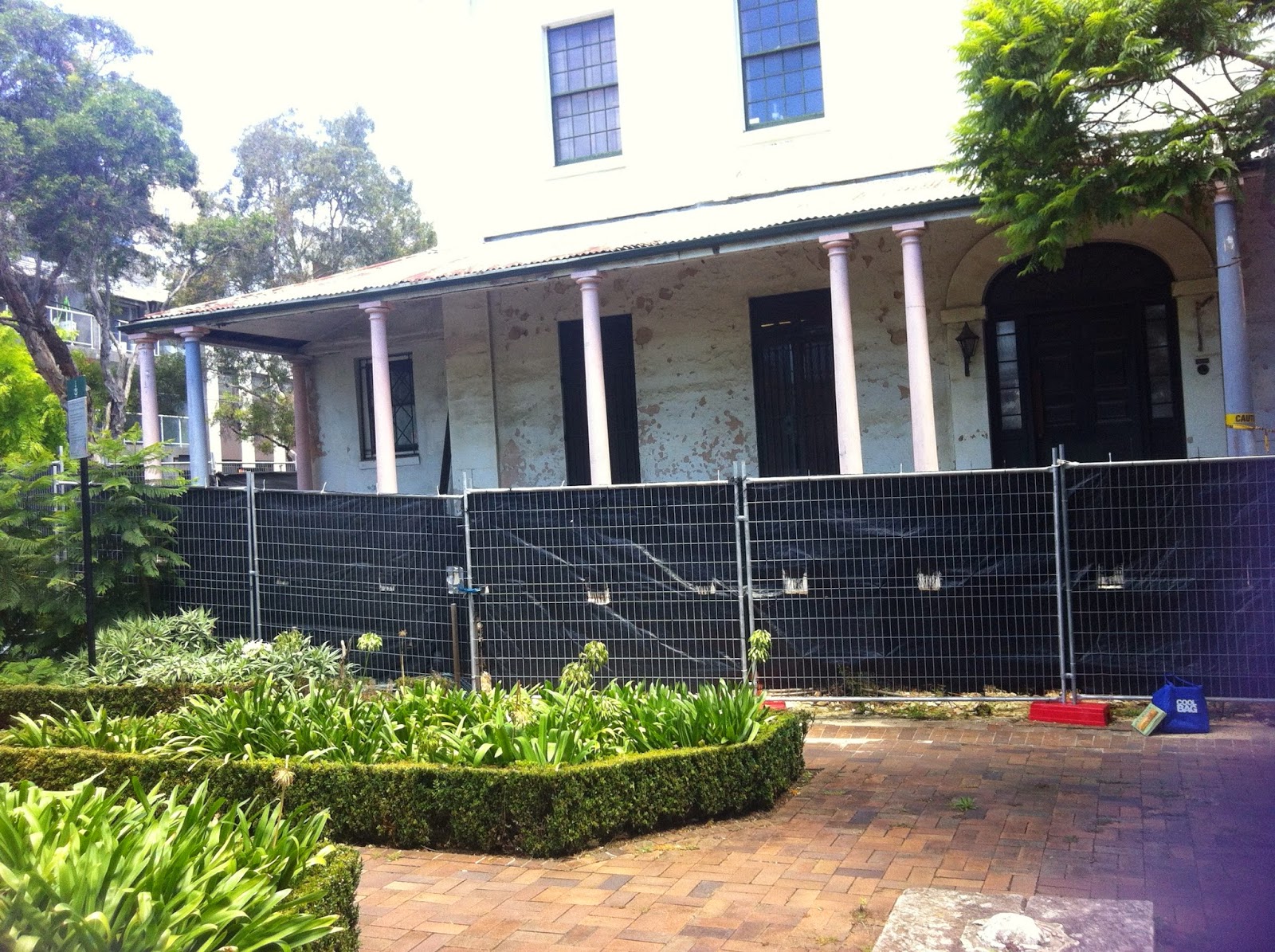
Anyone who walks past knows the house has been fenced off and under tarps for years, and my own photos in Parts 2 and 4 show it. In July 2025 the Sydney Morning Herald called it Sydney's oldest colonial home and said neighbours reckoned it was "dying before their eyes". The paper named the owner as Brian Vincent of LGS Enterprises, and said he'd bought it in 1988.

According to the Herald, the City of Sydney put a stop-work order on the site in August 2023 after work started on a verandah awning without consent. The owner's own website puts it down to a complaint about roof repairs that Heritage NSW had already approved. Both agree the house got a $30,000 heritage grant for the re-roofing in the 2023–25 round.

The owner's site says that in August 2025 the stop-work order was lifted, but the grant was terminated and the house was made ineligible for future grants. In March 2026 Heritage NSW refused an application to strip the external render. The latest news there, from May 2026, is that a DA for a new toilet block has been approved. That would let the 1940s toilet block come off the back of the house and the courtyard verandah go back the way the owner says Greenway meant it. Two hundred years on, it's still waiting for someone to look after it properly.

Cleveland House behind its fence, 2019
Behind the fence, April 2019. Collywolly, CC BY-SA 4.0, via Wikimedia Commons
Side view of Cleveland House, 2019
Another 2019 view of the old house. Collywolly, CC BY-SA 4.0, via Wikimedia Commons

Timeline

  • 1790 – Convict Charles Smith arrives on the Scarborough (Dictionary of Sydney).
  • 1809 – Macquarie grants Smith the land known as Cleaveland Gardens (State Heritage Register).
  • 1815 – Daniel Cooper convicted at Chester and transported for life.
  • January 1816 – Cooper arrives in Sydney.
  • 6 January 1819 – Cooper marries Hannah Dodd at St Philip's.
  • 1821 – Cooper's absolute pardon, and partnership in the Waterloo Company.
  • 1822 – Governor Brisbane dismisses Francis Greenway.
  • About 1823–24 – Cleveland House built for Cooper, for about £4,000.
  • 1825 – The Coopers move in.
  • 1829 – Cooper separates from Hannah and the house is let.
  • October 1831 – Cooper sails for England.
  • June 1836 – Hannah Cooper dies.
  • 3 November 1853 – Daniel Cooper dies at Brighton, England.
  • 1855 – Estate subdivided into eight sections; the first Sydney railway terminal opens on the Cleveland Paddock.
  • 1860 – Montague Levey inherits the house from Isaac Levey.
  • Mid-1870s – Barrett's cordial factory in the outbuildings.
  • 1896 – Sold to Peach and Jones, bottle merchants.
  • 1903–04 – Sisters of the Good Samaritan buy the site and open their refuge and laundry.
  • 1946 – Franciscan Missionaries of Mary take over.
  • 1958 – NSW Society for Crippled Children buys the property.
  • 1973 – Listed by the National Trust.
  • 1988 – Sold, and every building except the house demolished.
  • 1991 – End of continuous habitation.
  • 2 April 1999 – Listed on the State Heritage Register (no. 00065).
  • August 2023 – City of Sydney stop-work order.
  • August 2025 – Stop-work order lifted and heritage grant terminated (owner's website).
  • May 2026 – New toilet block DA approved (owner's website).

Where the Sources Disagree

  • How much land. The State Heritage Register says Cooper's house went up on about twelve acres granted to Charles Smith, and that the estate came to around thirteen acres when it was sold. The Dictionary of Sydney gives Smith's grant as 10 acres and says Cooper bought 19 acres from him.
  • Oldest or just rare? The Heritage Register's statement of significance calls it "a rare surviving gentlemen's residence of the 1820s", but its criteria call it "the oldest surviving residence in Sydney". The Herald calls it "Sydney's oldest colonial residence". Plenty of older buildings survive around Sydney and Parramatta, so the claim depends on how you count.
  • Greenway. The Heritage Register says the house is "believed to be" Greenway's work, Wikipedia lists his contribution as "uncertain", and the owner's website talks about the courtyard verandah "as originally intended by Francis Greenway".
  • Who bought it in 1988. The Heritage Register says it was sold to Denerin Pty Ltd in 1988 and is now owned by LGS Enterprise. The Herald says Brian Vincent of LGS Enterprises bought it in 1988.
  • Why the work stopped. The City of Sydney told the Herald the stop-work order followed verandah awning work done without consent. The owner says it came from a public complaint about approved roof repairs.

My Earlier Posts

Sources