Search This Blog

Showing posts with label Stories Of Sydney's Growth. Show all posts

Sunday, October 11, 2026

Sydney Past & Present - The City Of Sydney - The Stories Of Its Growth - The Rocks Resumptions


- Sydney Past & Present - 
- The City Of Sydney - 
- Stories Of  Its Growth - 

________________________________________________________________________________________________________________________________________________________________________________________________________________________________________________________________________________________________________________

The Rocks Resumptions.


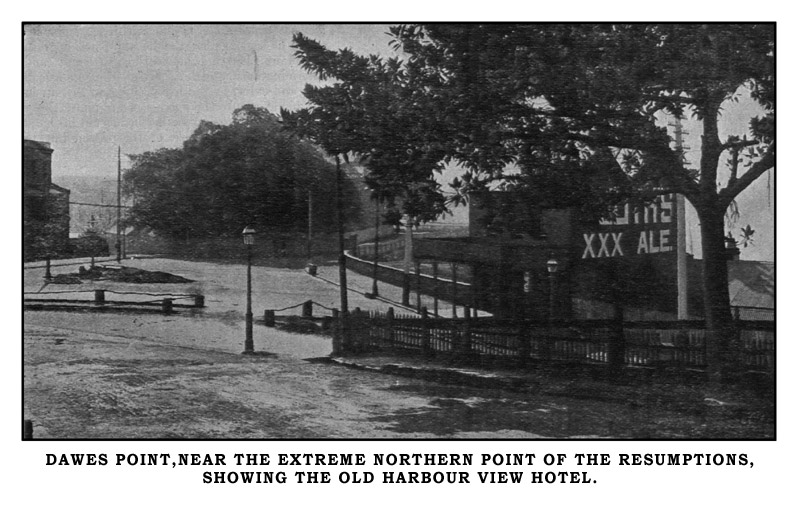
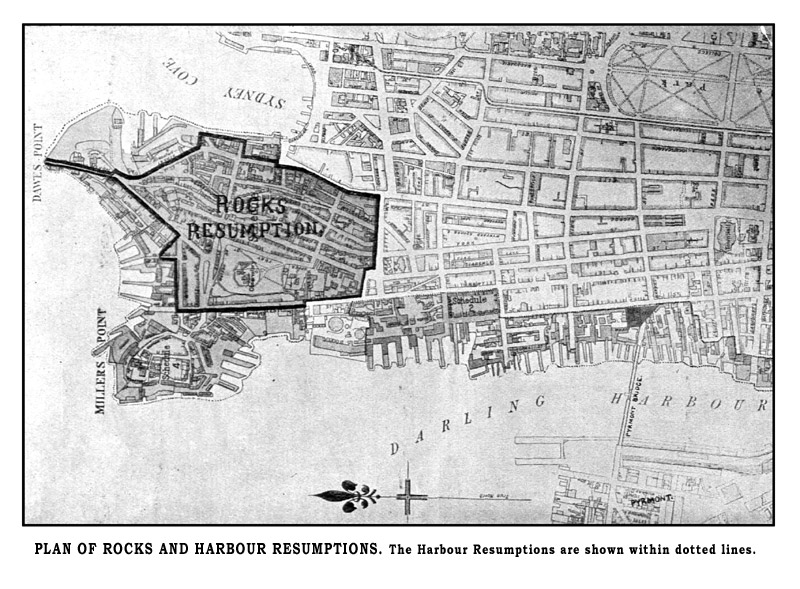
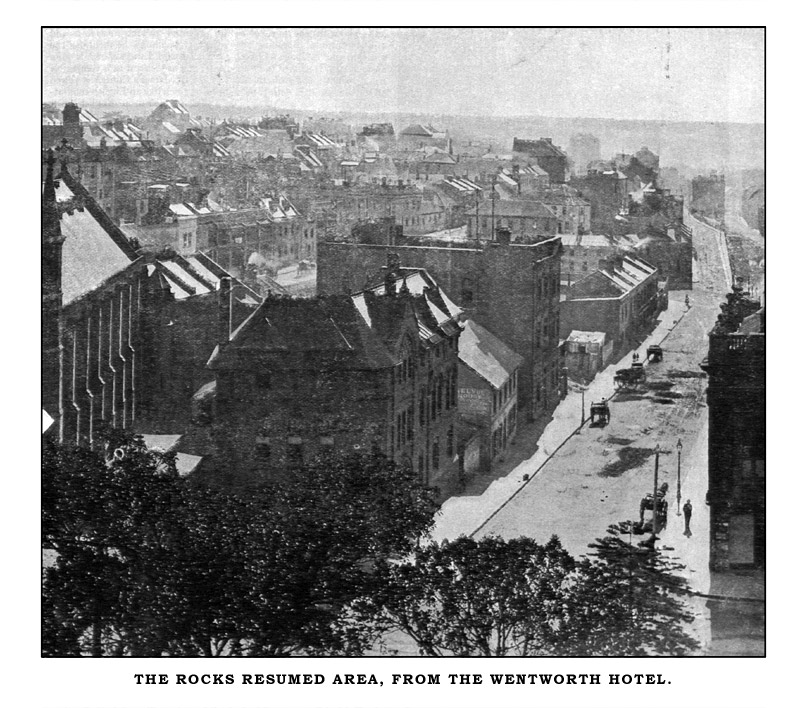
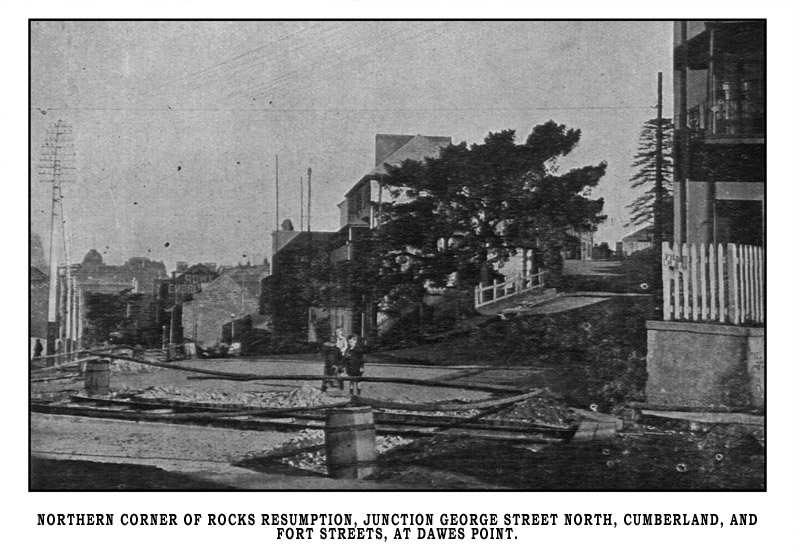
 One of the oldest & most picturesque portions of Sydney will soon be a thing of the past; & before such is the case a visit to “The Rocks” would well repay many of our citizens who, except by name, know nothing of the neighborhood, & would care to see how our ancestors, both rich & poor, builded in those far-off days. Hence it is thought the locality calls for more than the passing notice given to it in the foregoing pages. They still stand those wonderful old houses; the mansion of the merchant with massive walls, four square, staring out of shadeless windows over the little cottages perched in all manner of nooks & corners, weather worn & scarred, their sandstone steps hollowed by the feet of three generations, but, nevertheless, crouching, sturdy & grimly defiant of the modern city, scarce a stone’s throw away. Reminiscent, these old mansions, of the time when Dawes Point & its neighborhood was accounted one of the best residential quarters of the city; the cottages, higher up on the ridge, of the earliest settlement, when, as a writer remarks: “The Rocks was a term synonymous with St. Giles & Wapping in one.” In those days the place seems to have been a mixture of Sailor Town & Alsatia, studded thickly with the most nefarious dens & low pot-houses boasting such expressive names as the “Black Dog,” the “Sheer Hulk”, the “Whaler’s Arms,” the “Struggler,” “Evening Gun,” & the “Sailor’s Return”—this last one still in Cumberland-street.


Describing Gloucester-street in the early fifties, a visitor says: “It struck two as we crossed the high bare green by the windmill above St Phillip’s & walked, or rather tumbled & climbed, along Gloucester-street to our destination. At this time there could hardly be said to be a street; it was merely the space between two straggling lines of houses ranged along the side of a very rough, rocky declivity, & these were turning their backs or their sides or their faces to each other.” A description that, even at the present day, fits aptly enough more than one street on the Rocks, if the ground vacant then be filled in with hovels of a later growth; with a maze of blind allies, lanes, courts & passages, squalid backyards; children by the legion & goats by the score. But, presently, there will be no more Gloucester-street, no more Cambridge-street either. Light & air will be let into spots where they have been long strangers, & one of the finest portions of the city redeemed from insignificance & decay. Traversing the whole of the resumed area will be three main thoroughfares. New Harrington-street, 80ft wide, Princes-street 130ft in width, & New Cumberland-street 80ft wide, whilst George-street north will be broadened from its present 40ft to 100. The extra space given to Princes street is to allow for an elevated railroad connected with the North Shore extension scheme, as also for the proposed bridge over the harbor. Essex-street is to be widened to 70ft, & half way between it & Argyle-street a new one is to be formed.


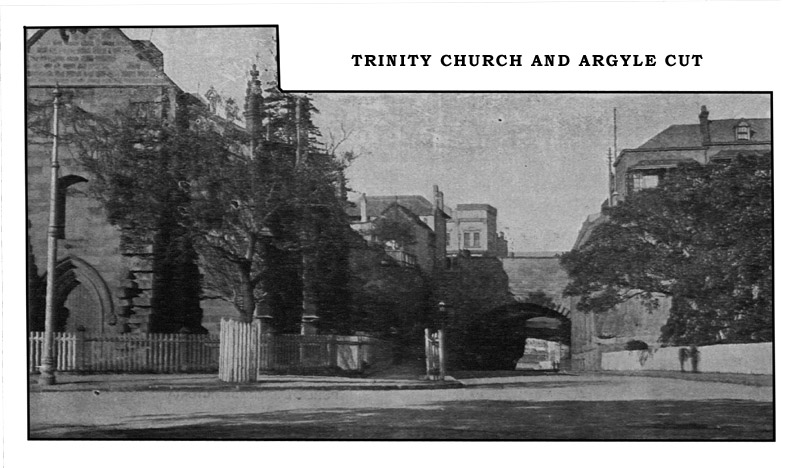
All these streets will be wood-blocked; & under them it is proposed to construct tunnels to accommodate the sewers, water, gas, electric wires, etc., etc. Argyle Cut will also probably be widened; several bridges built here & there at intersecting streets in order to make the ascent easy for traffic, & practically the whole of the ridge from the Observatory downwards will be cut away to a gentle slope. At least one gathers so much from the official plan. But, of course, this will be subjected to many changes, so much so indeed, that it would take a seer to forecast with certainty the appearance of the big contract at its finish, years hence.


No mention of the resumed area would be complete without some allusion to the notable scheme propounded by the Advisory Board for the housing of the men who work along the wharves, & who reside mainly on or around “The Rocks,” in buildings five stories in height, & containing between them some five-hundred families, or, say, between three & four thousand souls. One will have frontages to Kent, Windmill, & Argyle streets. The other will be in Kent-street, somewhere at the foot of the Observatory Reserve. Each “tenement” will consist of from two to five rooms, lit by electricity, reached by lifts; & as sanitarily perfect as science can make them. In the great basement there will be a library, baths, & probably shops. The square will enclose a courtyard common to the use of all. Such, taken as a whole, is the gist of the plans put forward. Whether the Australian working-man himself will approve of the scheme has yet to be discovered. In London, tenement houses are common enough, & are thoroughly appreciated by the classes for whose benefit they were built.


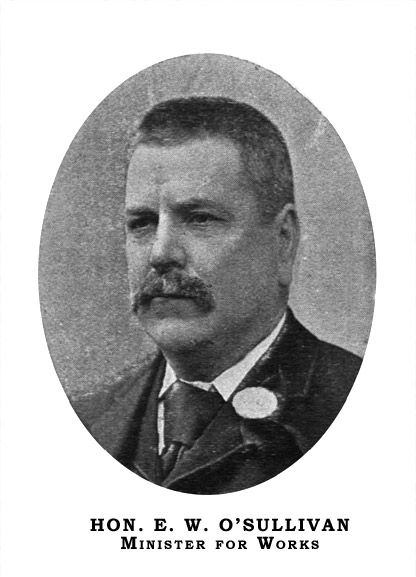
Within the Rocks area are two historical churches St. Phillips & St. Andrews (the “Scot’s Church,”) besides Trinity Church, the fine Roman Catholic one of St. Patrick’s, & many large & important buildings, such as warehouses, hotels, etc., etc., that the path of improvement will most likely be conducted so as to spare. Probably, owing to the proximity of wharves along the foreshores of the resumed area, it will always be in great measure a workingman’s quarter, so far, at least, as residence is concerned, although, certainly, an ideal one, & possessed of some of the finest views in Sydney. A great commercial quarter it is sure to become, when the energetic Minister for Works has transformed the place from the mere congerie of rookeries that it now mostly consists of into one of broad streets & open spaces, whereon will presently rise piles of warehouses, offices, handsome shops, & either neat terraces of houses for the working men of the district or the tenement buildings already spoken of. The public, it is considered, owe a considerable debt of gratitude to Mr. O’Sullivan for his courage & patient persistence in promoting a scheme by which one of the finest parts of our city, hitherto hidden in squalid seclusion, will be thrown open & utilised for the lasting benefit of the community at large, & the commercial prosperity of Sydney in particular. Like all men, the Minister is liable at times to err; but in this particular instance he has made no mistake, & his wide grasp of affairs, his uncompromising energy & determination, together with the no small amount of business ability & enterprise he has brought to bear upon this resumption scheme, should ensure the success of an undertaking which, perhaps, in a greater measure than any other he has put his hand to, must appeal not only to the general public of the present but to posterity.


FINISH


THE END


________________________________________________________________________________________________________________________________________________________________________________________________________________________________________________________________________________________________________________


Sydney Past & Present - The City Of Sydney - The Stories Of Its Growth - Chapter 16 - The Sixties & Seventies - Conclusion


- Sydney Past & Present - 
- The City Of Sydney - 
- The Stories Of Its Growth  -  

________________________________________________________________________________________________________________________________________________________________________________________________________________________________________________________________________________________________________________

Chapter XVI.
The Sixties And Seventies—(Conclusion).


In the early sixties occurred the largest and most disastrous fire that had ever taken place in Sydney, and which resulted in the total destruction of St. Mary’s Cathedral. Says a newspaper of the day: “The intelligence of this deplorable catastrophe will cause a thrill of sorrow in the hearts of the Roman Catholic population throughout the country, and must excite feelings of the deepest regret in the minds of the community in general The cost of the building, it is thought, could not be less than £50,000; but from its hallowed associations and sacred memories it was of priceless value to thousands of Worshippers of the Roman Catholic communion.”


Besides the building itself, there appears to have been an immense amount of valuable property destroyed, not only in the shape of paintings in the church—one picture representing the death of St. Benedict was alone valued at £1000—but in the beautiful furniture of the Archbishop’s and other residences belonging to the high dignitaries of the cathedral. “Myriads of sparks ascended high into the air, and fell in showers in the direction of Woolloomooloo Bay, whither, for a considerable distances they were driven by the wind. From the top of the cathedral cloud, of yellow flame and smoke issued, which shed a lurid lustre on all around; and, at times, so bright was the glare, that the minutest objects in the remotest parts of Hyde Park, could be seen almost as distinctly as by daylight.”


As showing the magnitude of the illumination, it may be mentioned that Captain Hesselton, now residing in Balmain, but then in command of the steamer You Yangs, saw the reflection of the fire when off Port Hacking, and is of opinion that the glare must have been visible over twenty miles out at sea. A noteworthy incident of the fire was the fortunate escape from a horrible death of an old man named Anthony Brady. Brady was, it is said, 108 years of age, and stone blind. He slept under the sacristy, but was rescued just in time to save him perishing in the flames.


That the Roman Catholics were, if dismayed, still not disheartened by their losses can be shown in no better way than by the noble pile that now stands on the site of the destroyed church, of which Father Therry laid the foundation-stone in 1829.


Three years after the destruction of the Roman Catholic place of worship, the slow-moving church of England gathered in thousands to witness the consecration of St. Andrew’s Cathedral, of which, as far back as 1819, Governor Macquarie had laid the foundation-stone. But, and it is important that this should be remembered when the story of our city comes to be written more in detail, during the long time the project remained in abeyance, a change of site was for some reason or other decided upon, which, many years afterwards, necessitated a relaying of the stone.This ceremony fell to Sir Richard Bourke on May 6, 1837, on which date the old foundation stone was removed and placed in its present position. But, even then, not until January, 1856, was the grant from the Crown finally procured. Nor, stranger still, did the church authorities take it up until 1865. The structure seems to have made a little progress after the re-inception of the undertaking in 1837. But for years the building remained a mere unsightly shell, unroofed and devoid of any architectural beauty. But, at last, after all these tedious years, the end came, and assisted by a large body of bishops and clergy, the Metropolitan (the Right Rev. Dr. Frederick Barker), opened the building for the performance of Divine service. This was in December 1868, and it seems to have been a very solemn and impressive ceremony indeed, although, even then, the building was not nearly completed. But, as at the “sumptuous luncheon” which took place afterwards at the Masonic Hall, and which was attended by all the most eminent, both of the laity and the clergy in these colonies, the Earl of Belmore said: “It was now an edifice of noble proportions, and it had progressed at least so far as to be available for the worship of God. A great deal remains to be done to finish the exterior, but he had no doubt that ere another generation passed away the topmost stone would be laid.” A hope that we have seen happily fulfilled.


In these later sixties, and in the beginning of the seventies, we had the Duke of Edinburgh with us, and we made much use of him in laying foundation stones and opening public buildings before the unfortunate occurrence at Clontarf. Among other ceremonies of the kind in which H.R.H. took a prominent part was that of the inauguration of the long-deferred statue to Captain Cook. The papers of the day were, of course, full of the ceremony, which seems to have been attended by all in Sydney. In the cavity of the stone was placed a bottle containing copies of the “Sydney Morning Herald” and “Empire,” together with the cards of the officers of the Australian Patriotic Association. With these, was also a facsimile of Captain Cook’s handwriting, being a lithographed transcription of his log, containing the great navigator’s observations on the transit of Venus in 1769.


Referring to the occasion, a newspaper of the same date as the ceremony says:


“It is a curious fact that, although the landing place of Captain Cook in Botany Bay is not more than six or seven miles from Sydney, but very few persons have ever visited that secluded spot, or have even a definite idea where it is. This probably arises from the fact that it lies on the southern shores of Botany Bay; at the head of which great inlet from the ocean are two large rivers, terminating in a wild and almost impassable country.”


And, as we are aware, up till within a year or two, what was thus written over thirty years ago might have still stood good. But most people now know all about Kurnell, and the dedication of a public park there to the memory of the discoverer—even if they seldom visit it.


In these sixties and seventies, Sydney was progressing at such a rate that to keep in touch with a tithe of the buildings of importance, both public and private, that sprung up almost as if by magic, would reduce this chapter to a mere record of architectural dates and details; moreover, most of these improvements are well within the memory of thousands of citizens still among us. Nor did the social characteristics of our city apparently differ much from those of the present. It is most edifying and instructive, for instance, to note the fashion in which the story of our city Council was reproduced in one essential particular three generations ago. And the following description might have been written to-day. Indeed, during the existence of the Citizens’ Vigilance Committee, at the time of the plague, such reports were common enough:


“A butcher’s shop was visited in William-street last week by the Inspector of Nuisances and the Acting-Health Officer conjointly. The time was half an hour past noon, The back premises were found in a filthy condition. The dung-heap contained a quantity of hair, etc., and was alive with maggots. There were also a quantity of bones and meat in a state of putrefaction in the shed. The shed itself was filthy, and the premises generally dirty. The duty of the two officers was obviously to proceed, according to the law, against a person, who, by his uncleanliness, was perilling the lives of his fellow-citizens; and it was the duty of all aldermen, whose servants in the interests of the public these officers were, to support them in the execution of their duty.”


But, then, no more than nowadays, were things managed in that style. The butcher cleaned his premises, knowing that an information was sworn against him. Then, quite according to our best modern traditions, he got two aldermen to inspect his premises, and one of them to write to the magistrates at the Water Police Court, saying that he had found the place perfectly clean, while the other alderman attended at the court to depose to the same fact. And the testimony of the aldermen carried the day against the public officials. Mr. Dansey was the Health Officer of the period, and the newspaper calls upon him to do his duty in such instances without fear of aldermen who may prefer to “patronise stinks.” Of what effect the remonstrance was, so far as that particular City Council was concerned, as well as its immediate successors, may be judged from the plague revelations of 1900, and the accumulated masses of filth to which it was principally due.


In 1788, there were landed in Sydney some 200 marines; in 1790 the first detachment of soldiers arrived; and in 1870, Sydney saw the permanent departure of British soldiers from Australian territory. Although the crowd that witnessed their embarkation on the Silver Eagle was a large one, it watched the proceedings in silence, and with an entire absence of enthusiasm. The troops comprised only two companies of the 18th Line Regiment, and about 70 rank and file of the Royal Artillery, who had been hitherto stationed at Dawes Point. They boarded the Silver Eagle at Circular Quay, to the music of the band of the Naval Brigade, stationed in the Ordnance Yard. But though the crowd had increased to vast dimensions there was not the slightest demonstration. Perhaps the people felt that in some way the departure of these soldiers of the Queen typified an approaching severance from the mother country. And yet, of those silent, and perhaps doubtful, spectators, the majority must have lived to see native-born Australians in their thousands embarking to fight oversea for that same Queen.


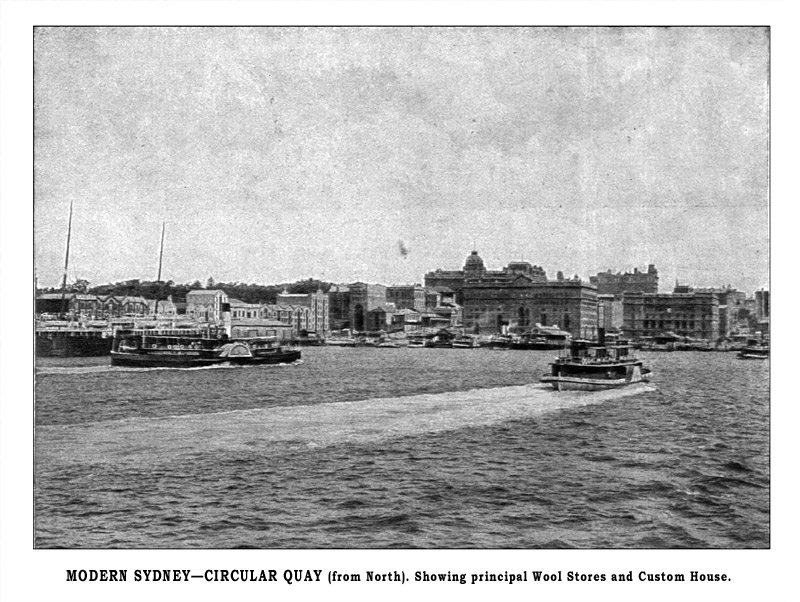
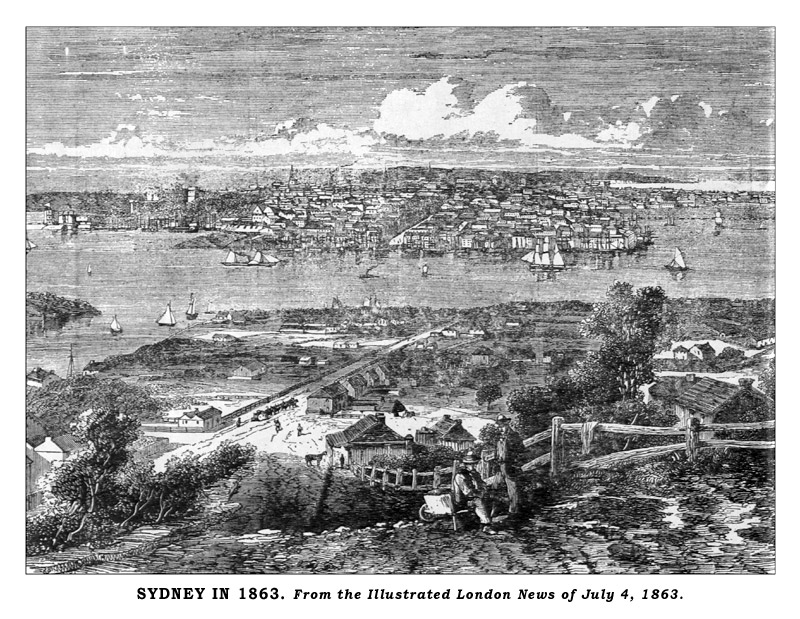
In these days—the early seventies—our present post office had been begun; and the Town Hall, of which Prince Alfred had laid the foundation-stone, was in course of erection; Circular Quay was a quay in reality, although not, of course, equalling its present condition, susceptible of much bettering as that is. Endless improvements were going on everywhere. Prince Alfred and Belmore Parks had been formed, and were being beautified. Moore Park was under process of reclamation. Hyde Park, so long known to us as the Racecourse, bare and uninviting, now possessed an avenue of well-grown trees half a mile long, and was dotted with plantations; the Domain had been landscape-gardened out of all knowledge. We had newspapers by the dozen, churches by the hundred, banks and other financial institutions by the score; and over 100,000 inhabitants.


Besides constant steam communication with England and the sister colonies, Sydney steamers traded regularly to California, New Caledonia, and the Fijis; whilst “sailers ” hailing out of the port dotted every sea from the North Pacific to the Indian Ocean.


At Miller’s point there was a yard capable of turning, out ships of 500 tons burden; and many steamers, both screw and paddle, Gunboats, and dredges, had been built there. The native timber used was, for beams, the iron-bark, blackbutt, and the flooded, blue, red, and spotted gums; and for fittings, the tea-tree, iron-bark, blackbutt, and bungally. And as showing the wonderful excellence of some of these colonial timbers, may be instanced the case of the Fanny Fisher, built on the Manning River in 1847, and by turns whaler, passenger-packet and mail-carrier; and now, after her fifty-three years of service, still afloat as a collier, and in better preservation than many a comparatively new boat. She should be preserved intact when her time comes, and the surveyors shake their heads over her, as a specimen not only of what Australian hardwood is capable of, but as the oldest Australian-built vessel.


As to education in these years, it flourished mightily, and spread all over the colony, in the shape of 807 schools and 600,000 pupils with 1093 teachers—an eloquent commentary on the success of the public school system controlled by the Council of Education. Writing of the Sydney University, a visitor said:


“The glory of Sydney, in the way of education, is its University, and certainly a great deal of spirit has been shown by the colony in the creation of the institution and in the erection of the building. As regards the building, I think no one will dispute the assertion when I say that the college hall—or public room, for it is put to none of the comfortable festive uses for which college halls have been built at our universities—is the finest chamber in the colonies. If I were to say that no college either at Oxford or Cambridge possesses so fine a one, I might possibly be contradicted.”


In these days, however, from a financial point of view, the University was not a success. The people seemed satisfied with a primary education for their children, and did not yearn after a university one. Thus, in 1870, the total cost of the establishment, consisting chiefly of professional salaries, was £5938, of which £5000 was paid out of the taxes of the colony. There were 41 scholars, paying a little over £22 per annum each. As for the resident pupils at the affiliated colleges, there was one, and only one, at St. John’s, and but two or three at St. Paul’s. With as yet a very sparse population, we went in for such a scholastic luxury rather too soon. All young communities are apt to do the same, although not necessarily in the shape of a University. To quote Anthony Trollope: “There is no institution in the colonies which excites and deserves the sympathies of an English traveller more completely than does the Sydney University”—this, of course, applying to the time in which he wrote.


But of all our educational establishments, the celebrated novelist appears to have been most impressed with the Fort-street school, where for his edification some of the pupils were “put through their facings”—


“And certainly one little girl whom I questioned myself must have understood what she was saying (Anthony had just been astounded by a small boy’s feat in mental arithmetic, and jokingly professes a doubt as to whether there might not be collusion with the teacher). A passage in Shakespeare had been read, in which the word ‘strategy’ is used in its secondary, and not in its technical, sense. I asked the meaning of the word, and the little girl said that strategy was the art of military manoeuvering. She was a very nice little girl, and I hope she may live to be the wife of the first Commander-in-Chief of the forces of New South Wales.” In which case, by the way, the “nice little girl” would have had to marry the Right Hon. Sir Augustus William Frederick Spencer Loftus, PC:, G.C.B., who was the first to assume the title. Let us hope, that Trollope’s little girl is still flourishing and happy, although probably in a less exalted position. But to return: “The girls,” says he, “in some of these public schools are more wonderful even than the boys. They read better, and seem to have a clearer perception of things in general. I remember at such an exhibition in New York, hearing a roomful of girls questioned by the mistress. She asked why the Romans ran away with the Sabine matrons. One girl suggested that it was because the Sabine matrons were pretty; but she was soon taken down by a clearer-headed maiden, who told us that it was done for the sake of the population. The young girls at Sydney were perhaps not quite so far advanced as this; but, nevertheless, their condition amazed me. Putting aside all joking, I profess that the excellence of the teaching in the Fort-street school, at Sydney, was very high.”


Could our good-natured visitor leave his appointed place and return to us once more, and inspect the old school, he would probably be more astonished than ever at the advance that has been made there, both  in the number of pupils, and in the quality of the teaching, during his absence.


It will be of interest to see what we could do in these years towards raising money for Imperial charitable purposes. There was then a “Patriotic Fund for the Relief of Widows and Orphans of soldiers and Sailors who fell in the Crimean War.” To that fund New South Wales gave £64,916 6s 6d; Tasmania, £28,375 5s 7d; Victoria, £47,711 10s 3d; and South Australia, £6297. But while the whole of our contributions was voluntary, £40,000 of the Victorian amount was voted by the Legislature.


In the Indian Mutiny Fund, Victoria comes first, with a level £25,000; New South Wales, £5821; and South Australia, £2803. Then comes the Cotton Famine Fund, with New South Wales to the front again with £21,311; Victoria, £5000; and West Australia, £603 11s 5d. In addition “Australia” is credited with a lump sum of £15,739 12s 1d, which amount was forwarded to the Lord Mayor’s Relief Fund.


 It will thus be seen that this colony, to the extent of £92,048, had, up to the last months of 1870, responded with splendid liberality to all appeals for help from Great Britain—and has been doing so, at intervals, ever since then. Still, alongside the Cotton Famine figures just quoted, those of the late Indian Famine Fund look poor enough. We have now, however, more calls on our purse. It is doubtful whether to-day, backed even by the aegis of a Royal Prince, we could, in a very short time, gather £28,000, as was done to commemorate the visit of the Duke of Edinburgh by building a new hospital.


Trollope came to us in the early seventies, and fell desperately in love with the city, its people, and its surroundings. Unlike some of the latter day “trotters,” who have said nice things whilst partaking of our too-ready hospitality, and then gone away and mercilessly abused us. Anthony, although at times he poked a little mild fun at certain of our peculiarities, was, on the whole, very fair and impartial in his comments upon what he saw. In the light of recent events, one in particular of his utterances sounds curiously prophetic. He had been viewing the defences of the harbor, and was impressed, not only with the different batteries, but with the evident readiness of their defenders to use them in case of need:—


“I hope,” says he, “that New South Wales may never have to fight for England, and certainly that she may not have to fight America. But the feeling of loyalty in the colony is so strong that were there a fight on hand, she would be unhappy not to be allowed to take some share in it.”


A remarkable saying, when we consider it as made so many years before the spirit of Imperialism had been fostered and worked up to its present high pitch; when the sentiment was even discouraged by the British powers that were. It is a pity that Trollope did not live to see how completely his forecast had been justified by the sight of not only New South Wales, but Australasia, raising and equipping an army of 20,000 men to fight for the Empire oversea. Moreover, he appears to have visited us with the hope of being pleased, and not with the hope of cavilling at and picking holes in us and our institutions. Speaking about the city buildings, he mentions the Hospital and St. James’s Church: “The hospital, I was assured, is quite antiquated. It seemed to be airy, easy, and as pleasant as is compatible with the nature of such an institution. St. James’s Church is pewed all round with high, dark panels, and is as much like an English comfortless church of the last century as though it stood in an English town in an eastern county. I went there once, and found it impossible to hear a word from the gentleman who read the lessons, or from him who preached. But it is a fashionable church, and is supposed to be that at which the Governor and his family should say their prayers.”


Well, if our visitor could return, he would find something worthier of the name in place of the old hospital; and though the church still stands externally much as it did what time it dominated the Sydney landscape, internally the old things have given way to much that is new.


One more remark of Trollope’s must be quoted, because, although uttered so many years ago, it stands as good to-day as it did then. Speaking of the Legislative Assembly, he compares it to a pudding. Says he: “In the house of Assembly, at Sydney, there was a sufficiency of farinaceous matter to prevent the plums from clogging the appetite and hurting the digestion.”


In drawing this series of articles to a close at this particular epoch in the history of the city, it may be thought necessary to explain that such a fact is not due to want of material respecting the newer Sydney; but because old Sydney and its story having been fairly well exploited, that of the more recent capital would be lacking in interest for the general reader. Besides, during the last couple of decades or so, there is nothing doubtful, nothing that cannot be verified by a few minutes’ search, whether as to the acts of an individual, the age and position of a building, or the site of a celebration. On the other hand, some of the best authorities differ widely regarding the happenings of those old dark days of storm and stress, through which the infant settlement passed, only to emerge triumphant—the great capital city that we see it to-day. And if in this little book any new light, no matter how small, has been let in on the doings of those far off times, if any disputed point, no matter how apparently trivial, has been advanced towards assurance, then it will not have been written in vain.

________________________________________________________________________________________________________________________________________________________________________________________________


Sydney Past & Present - The City Of Sydney - The Stories Of Its Growth - Chapter 15 - Thie Fifties & Sixties

 
- Sydney Past & Present - 
- The City Of Sydney - 
- The Stories Of Its Growth  - 

________________________________________________________________________________________________________________________________________________________________________________________________________________________________________________________________________________________________________________

Chapter XV.
The Fifties And Sixties.

August 3, 1852, was a day remarkable in the history of Sydney as that upon which the first mail steamer arrived in port. Her name was the Chusan, an iron screw-steamer, of 720 tons, barque-rigged—a beautiful model, and with more the look of a man-of-war than a merchant vessel. She was rather heavily armed, too, carrying a long 32-pounder aft, an 18-pounder forward, and a 12-pounder amidships. Even under canvas alone, the Chusan had often done her 14 knots. Melbourne was her first port of call, and off Cape Otway a seaman was lost overboard and drowned, notwithstanding a plucky attempt at rescue by two passengers, Lieutenant Pasco, R.N., and Mr. Bencraft, who, with four of the crew, got into one of the quarter-boats, and put off in a very heavy sea. But their efforts were in vain; indeed, it was with much difficulty and not until two hours had elapsed, that the steamer was able to pick them up. The Chusan brought a heavy mail and £70,000 in sovereigns. In Melbourne—then all excitement with the gold fever—a special armed guard was placed on the steamer in order to prevent the crew deserting, as so many others had done. Before the Chusan sailed for Sydney the Governor and some other officials visited her, together with the leading merchants of the city, when champagne was opened, speeches made, and the commander, Captain Henry Down, heartily congratulated on being the pioneer of steam communication between Australia and the old country.


Vessels of the British Navy were, of course, frequent visitors to Sydney; in 1851 there arrived a crack frigate called the Calliope, of 26 guns, besides the Pandora and the Fantome. In 1853 came H.M.S. Herald, 22 guns, with, among her officers, Mr. F. Hixson, afterwards so well known as president of our late Marine Board The fifties, too, were the years of many of the celebrated clippers whose names are historical, and will live as long as those of the colony whose wool they bore so swiftly to the little island standing far away in northern seas. Precursor of these was the barque Phoenician, which, in 1849, came out in 91 days, followed by the Walter Hood; and, later on, by a whole fleet of fast and noble clippers—the Centurion, Omar Pasha, Harlaw, Star of Peace, Maid of Judah, and others whose tall spars lined the sides of Circular Quay, now growing into something worthy of its name. But, though to George Thompson’s White Star line must be given pride of place in the work of developing our early commerce, there were vessels besides the Aberdeen clippers who traded regularly between Sydney and other Australian ports to and from British ones. There were, for instance, the Kate, Eliza, and George Marshall, belonging to the firm of Marshall and Eldridge; the Dunbar, wrecked in the later fifties near the Gap; the Duncan Dunbar, Dunbar Castle, and Phoebe Dunbar; together with the numerous family of Duthies—all vessels of note in their day, and all in time to give way before such flyers as the Thermopylae, the Salamis, Samuel Plimsoll, and the Patriarch—all Aberdeen clippers; and the last named, of which made the trip from Sydney to London in 68 days.


The inception of our steam fleet has already been referred to; and by now the vessels of the Australasian Steam Navigation Company were rapidly increasing in number. Still, in 1845, freight to Melbourne was £3 per ton; and passengers for saloon £10 10s., intermediate £7, and steerage £4 10s. In 1857, the A.S.N. vessels consisted of the City of Sydney, Wonga Wonga, Telegraph, Governor-General, Boomerang, Yarra Yarra, Waratah, Shamrock, Illalong, Collaroy, Thistle, Tamar, Ballarat, Samson, Eagle, Rose, Ben Bolt, Brisbane, and the City of Melbourne. Some of these are still keeping the sea, old and dirty and rusty, and smothered fore and aft in coal dust, it is true, but, still to all appearance, fit to last for many more years. When people built ships in those times, they put work into them that was meant to last, and disdained the jerry business that later became so common in-the trade.


By this time the whale and seal fisheries were becoming diverted from Sydney control into the hands of the Americans. But what with our land products fast increasing in value and quantity, we could well afford to let the somewhat precarious fisheries go.


Intimately bound up with the shipping and produce trade of the city, there is one street that more especially demands a brief notice. At the time of the Queen’s Accession, Sussex-street was a long rambling thoroughfare full of gaps. In 1853 nearly all the produce came there from the Hunter River. Dealers in wheat, poultry, potatoes, etc., secured premises as convenient as possible to the wharves, and thus gradually the street grew in size and importance as a market centre. In the fifties, there were still but a few houses in it; but it was noted for several big flour mills. Even then, butter came in large quantities from the South Coast. Mr. John Pemell at that time was the principal miller. He used to buy for cash, kept no books, and the receipts were torn up and thrown away. Bullock drays thronged “the Street.” even as horse teams do now. Butter and flour were sent in large parcels to Melbourne and the north; and, ever as trade increased, new business-men arrived, and set up in the centre of it, until today the commission and produce houses number considerably over a hundred. And the members of them have always prided themselves on the establishment of an honorable code in their dealings, in which each one’s word is his bond. In the making of a bargain between themselves neither sale-note nor witness to the transaction is considered necessary. They also pride themselves on having fewer law actions than any other branch of trade in the southern hemisphere.


In 1846 the first movement had been made with respect to railway communication inland. At a meeting in Sydney it was decided to survey a line from Sydney to Goulburn. Not for two years, however, did the scheme take practical shape by the formation of the Sydney Railroad and Tramway Company, capital £10,000. The object of the company as expressed in its circular, was to, at the present, construct railways to Parramatta and Liverpool, with, later on, extensions to Bathurst and Goulburn. Mr. Charles Cowper, afterwards several times Premier of New South Wales, was the first manager. On July 3, 1850, the first sod of the new enterprise, was cut by the Hon. Mrs. Keith Stewart, daughter of Governor Sir Charles Fitzroy. The spade with which this ceremony was performed was made in Sydney, out of Australian iron and is said to be still in possession of the Government.


But for some time little or no progress was made. Public opinion did not seem particularly stirred by the notion, for one thing, and for another, money did not come in as it had been expected to do. Later on, however, the Government took the business in hand. In August, 1852, a start had been made by the contractor, Mr. W. Randle, who afterwards completed the line. He began operations in Cleveland paddock, close to where Mrs. Keith Stewart had performed with the Australian spade nearly two years before. The first gang consisted of only five men; but presently more were put on, and the company imagined they were beginning to make headway. Then, as mentioned above, the Government stepped in, and pushed on the work quite vigorously, compared with the moribund S.R, and T. Company.


In May, 1854, the first cargo of iron rails came to hand, and the work progressed rapidly, because, hitherto, only wooden ones, which required renewing every two months, had been used. But at last the Parramatta portion of the line, or, more correctly speaking, the portion as far as the spot where the Southern line now branches off, was finished. This was, much to the disgust of the inhabitants, at the junction of the Dogtrap and Liverpool roads, fully a mile from the centre of the town.


And now that the work was actually completed, people seemed doubtful about travelling on the railway, and nervous fears were expressed as to the security of the bridges, rolling stock, etc., etc. A board was then appointed to report upon the work; and, accordingly, five gentlemen tested the line with two first-class carriages, and twelve waggons loaded with sand—the whole outfit, with engine and tender, weighing 130 tons. Then the five duly certified that things were safe, and invited the public to roll up. To make assurance doubly sure, Sir William Denison and his wife and family took a trip to and fro, and finally the opening day was fixed for September 26, 1855.


On that date, proclaimed a public holiday, the largest crowd yet seen in the colony assembled at the railway station to witness the starting of the train; volunteers and Friendly Societies escorted the Governor; and to the sound of a salute of 21 guns and the waving of flags and handkerchiefs was inaugurated the beginning of our present railway system of some 3000 miles. Parramatta, much to the surprise of many people, was reached without any accident; and here the Governor lunched and congratulatory speeches were made.


During the day 2000 passengers travelled to and fro by the novel means of locomotion. Six trains a day were run, with fares in three classes, for the single journey, 4s, 3s, and 2s respectively. Said a contemporary newspaper:—


“The event of yesterday was the triumph of science, not only over natural difficulties, but of the spirit of enlightenment and civilisation—over prejudice and worldly-mindedness. The great agent of civilisation, the best and most effective servant of progress, has been retained by the antipodean colonies of Australia within the same quarter of a century to which it became the liveried vassal of civilised Europe.”


The plant was moderate enough consisting, as it did, of only four engines; eight first-class, twelve second, and twelve third-class carriages; with six brake vans and sixty waggons.


At the present date, or rather at the last returns, the rolling stock of the colony’s railways included 494 engines, 419 tenders, 1050 passenger carriages, 9429 goods vehicles, and 1041 stock trucks.


It is noteworthy that by the failure of private individuals in the first attempt at railway construction in the colony any private ownership of such undertakings seems to have received its deathblow, and thus, with very few exceptions, all railways in these colonies, are owned by the State. Possibly the original pioneers might have been more fortunate in their adventure but for the gold discoveries, which, as already shown, simply paralysed almost every description of industrial enterprise. An interesting fact in connection with the first attempt is that Sir Alfred Stephen was the first citizen to take shares in the company, an example followed by other leading men, including Messrs. Charles Kemp and John Lamb—the last named the president of the board of directors.


What with the gold discoveries, the bringing of railway communication, and ocean mails; the finishing for all time of transportation to New South Wales; the granting in full of representative Government, well these years be called the “Fruitful Fifties!” Literature and art, too, flourished mildly. A curious incident in connection with the former was the publication, in 1854, in Sydney, of a book entitled “The Diary of a Visit to England.” Dr. Campbell the author, was an Irish clergyman of some note in his day as a writer on the history and the Church of his country, who visited England at various times during the years 1775-92. “He made,” says Mowbray Morris, in his introduction to Boswell’s “Life of Johnson” (Globe edition), “what may be called the provincials ‘grand tour’ of London; visited the theatres, coffee houses and auction rooms, heard all the popular preachers, and was introduced to the studios of Reynolds and Gainsborough; he met Johnson at the Thrales’s and elsewhere, besides visiting him at his own house, and, though they seem to have been good friends enough, his portrait of the doctor is certainly not flattering. In directness and vivacity he sometimes even runs Boswell close, and his diary often supplies an interesting commentary on the biography.”


The story of how such a work came to be published in an Australian city is interesting. Its existence even, it would appear was not generally known in England until the publication of an article in the “Edinburgh Review,” and which was written in 1859, at the instance of and partly from materials supplied by Macaulay “The manuscript” says Morris, “had been discovered in one of the offices of the Supreme Court at Sydney, behind an old press which had not been moved for years. Its authenticity has fortunately been placed beyond suspicion, and its strange hiding place has been explained by the fact that one of its author’s nephews was Sheriff and Provost-Marshal of the capital of New South Wales.”


The stage flourished freely in the fifties. In 1854 Miss Catherine Hayes took the city by storm with her voice, as two years later did G.V. Brooke by his acting. At the close of the great tragedian’s first engagement he was presented at Petty’s Hotel with a testimonial in the shape of a solid silver candelabrum and plateau, with 220 gs; whilst Miss Fanny Cathcart, the “principal lady” who supported him, came in for a diamond bracelet, valued at 70gs. To those who succeeded in pleasing them, the citizens of those years were nothing if not liberal.


In the fifties, too, Sydney had a patriotic fund. The Crimean War was raging, and money flowed freely in for the relief of the British soldiers fighting in the east. On two successive nights at the Victoria Theatre during July, 1855, the proceeds of the performances were devoted to the patriotic fund, and towards the erection of a monument to Captain Cook.


A but-little-heard-of contemporary of the Victoria Theatre in these days was the City, which stood in market-street, exactly opposite the office of the “Town and Country Journal.” Melodrama of the strongest type used to be played there, and the “leading man” was an actor who bore the illustrious name of Kemble. Other theatres, too, notably the Prince of Wales’s, were now in existence; and what with such vocalists as Catherine Hayes, Mme. Anna Bishop, and Sara Flower, and June Mathews, and such actors as G. V. Brooke, Nesbitt, Coppin, and Rogers, it will be seen that Sydney was far from being badly catered for in respect of amusements.


On the night of August 20, 1857, the passenger ship Dunbar was wrecked at the foot of the cliffs near the South Head Signal Station. The occurrence has so often been described as to render more than a passing reference to it needless. One curious incident, connected however, with the sad affair may not be generally known, Among the Dunbar’s passengers were a Mrs. Egan, her son, and daughter. Mr. Egan was a well-known citizen of Sydney, a member of the Legislative Assembly, and an ex-Postmaster-General. His wife and children had been “home” for a pleasure trip; meanwhile, he had built a fine house for their reception at Watson’s Bay, and not far from the fatal Gap itself. And there they perished, almost within sight of their new home. Then, as if that were not enough, thirteen years later, Mr. Egan, apparently in his usual good health, drove out to the Gap on a Saturday afternoon, put up at a hotel there, was found during the night in a comatose condition, and died the next day, nearly, one might say, on the site of the loss of his family so many years before. Besides the Egans, many well-known colonists were lost in the Dunbar, she being a favorite trader, and full of passengers. In all 120 souls perished, and, as will be recollected, only one man, Johnson, a member of the crew, escaped. He was for many years, and until quite lately, keeper of the Nobbys Lighthouse, at Newcastle.


In 1857 municipal government was re-established. It will be remembered that, although so far back as 1843 a municipal council, headed by a mayor, had been formed, so badly did the plan work, that, after something of like an eleven years’ failure, they had been superseded by three commissioners, appointed to look after the interests of the citizens of Sydney. They held office for three years, and it was during this period that the city waterworks were established at Botany, in place of Busby’s Bore and the old Hyde Park-Lachlan Swamp scheme; a system of underground sewerage was also began by the commissioners; the outlet was to be at Fort Macquarie, through a great valve of gun-metal. The late Hon. George Thornton was the first Mayor of the re-constructed council, which at that time sat in what is now the Oxford Hotel; and a memento of his term of office may still be seen in the big ventilator to the sewers in Hyde Park—Thornton’s Smelling Bottle. This upcast shaft was fitted with a furnace for establishing a draught; it is, however, doubtful whether, after it was handed over by the contractors to the council, a fire was ever lit in it.


Of all the stirring events of these well-named “Fruitful Fifties” the discovery of gold was, of course, the most important as affecting Sydney; it created a demand for all sorts of wares whose uses were undreamt of hitherto, or regarded as unnecessary; it introduced capital and immigrants into the colony; it opened up the interior, and encouraged the making of roads and railways; and, above all, it increased to a wonderful extent the value of property. Indeed, the accumulation of wealth in these years became so real, industrial development, both in city and country, so extensive, and the transformation of the social conditions of the people so amazing and complete, that the phases of life as witnessed in the colony during the fifties resembled more the imaginary scenes of Eastern fable than the prosaic realities of everyday existence.


Among other matters closely connected with the story of the now rapid growth of our city in these times were the inauguration and endowment of the University, with its affiliated colleges; the laying the first stone of the Fitzroy Dock, and the establishment of the Sydney branch of the Royal Mint.


Mention has already been made of the “Constitution of ‘56. And the efforts made by Parkes, Wentworth, Deas-Thompson, and others to guard against any undesirable amendments whilst passing through the English Houses were so practical and energetic that the two last named politicians actually travelled to England for that purpose. They were, however, unsuccessful. Lord John Russell had returned to the Colonial Office, and he, unlike Mr. Chamberlain and our Federation Bill, simply riddled the measure with amendments. The most important of these was one enabling a bare majority of members in both Houses, instead of a two-thirds majority, to alter the Constitution as they might please. Such a provision, of course, was more than likely to operate as a standing invitation to alter it; and subsequent events very soon showed the truth of this. Strangely enough, the one feature in the Constitution which provoked the greatest opposition—that of a nominee House—has never since been touched; although, as we are well aware, much discontent has often been expressed with it, right up to date, and in very strong terms, too.


The Draft Bill, however, passed through both Houses in ‘55, and became law in that year as a schedule to an Imperial Act. It was sent on to Governor Young, with a dispatch, in which Lord John Russell mentions, among other matters, that he had considered the expediency of inserting clauses to provide for a federal union of the Australian colonies; but had not been able to satisfy himself that the time had come for it.”


Well, the time has arrived now—nearly half a century later! Also the fact! But it seems remarkable that, even then, when the younger Colonies were still in the throes of their new birth, the federal idea should have crossed the mind of the great British statesman.


________________________________________________________________________________________________________________________________________________________________________________________________


Sydney Past & Present - The City Of Sydney - The Stories Of Its Growth - Chapter 14 - Sydney In The Fifties


- Sydney Past & Present - 
- The City Of Sydney -
- The Stories Of Its Growth -    

________________________________________________________________________________________________________________________________________________________________________________________________________________________________________________________________________________________________________________


Chapter XIV.
Sydney In The Fifties.


Is June, 1849, the ship Hashemy arrived in Sydney with 212 convicts, and immediately the capital was thrown into a state of the greatest excitement, it being looked upon as an attempt of Earl Grey’s to revive transportation. “Public meetings were held in the open air,” says one writer, “close to the gates of the present Government House, and on the very site of the old Government House where Governor Macquarie, whose policy it was to create an upper class from among a population nearly exclusively convict, entertained at his table guests from this order. Under the splendid old Scotch firs planted by Captain Phillip, the first importer of convicts to these shores—on the very spot where the first convict camp was pitched—their descendents, their compeers, and a few of the free class who had grown rich upon the system, now assembled to launch and listen to anathemas against it.”


Contemporary newspapers of even date, i.e., June 18, 1849, however, without fixing the spot so exactly as does our author, are content with simply saying that the meeting took place at Circular Quay. There were at this particular one some 7000 people present, with Mr. R. Campbell in the chair. The purpose of the meeting was not only to petition the Queen that Earl Grey should be removed from the head of the Colonial Department, but also to ask that responsible government should be granted to the colony; also to pass a vote of censure on the Governor himself.


Let us see how vice-royalty in those days could receive, if it so pleased, a deputation of the lieges. Mr. Aaron said that the committee did not charge the Governor with actual discourtesy, “but it was of the cold repulsive chilling feeling with which he had received them, that he had acted discourteously,” they complained—two statements that, although somewhat at variance, seem to imply that Sir Charles Fitzroy was rude. The speaker, continuing, said, “He (the Governor) had first affronted the deputation by refusing to see the whole of them, and he had afterwards kept up the affront by the increasing chilliness of his manner and the deeper sinking of his brows, as he gradually retreated from them, although he stood strongly entrenched behind a table, where he had stationed himself to receive them. For the truth of this description he, Mr. A., could vouch, and he would ask the meeting if this was such a reception as should have been given by a Governor to the delegates of those from the produce of whose labours he was paid, fed, and clothed?”


At the same time, it must be remembered that the deputation came to Sir Charles with rather a large order, including in it the removal from office of his (Sir Charles’s) own chief. Earl Grey had promised to send out emigrants and convicts in a certain proportion; but he had only sent the last, and thus was “guilty of faithless and arbitrary conduct;” and this same speaker, already quoted, demanded at the meeting “that Earl Grey should be at once dismissed her Majesty’s service, and without a character, too.”


There was much talk, also, about the squatters, and much abuse of them; and someone suggested the formation of a colonial nobility, and proposed that “William Charles Wentworth should be raised to the first rank, under the title of ‘Duke of the Lash and Triangle.’ “


Mr. Parkes also addressed the meeting. Said he, among other things: “All they now sought to do, however, was so to reform and remodel the Government of the colony that it should live in the affections of the people —a game at which, as we all know, the speaker subsequently took many a hand himself, and with no small measure of success.


Mr. Lowe (afterwards Lord Sherbrooke) at this same gathering made a long and violent speech: “Was the Governor afraid of his spoons,” he asked; “or did he fear that some of them (the delegates) might sneak into his cellar and drink his claret; or did he dread them lest they should take Government House by storm; or did he think that six pairs of dirty shoes were quite sufficient at one time to soil the Vice-regal carpet?”


And Sir Charles really seems to have been afraid of a general rising, “for the kitchen was garrisoned with infantry, the stables were filled with cavalry, all ready prepared at the first signal to dash out upon the people; and this because the colonists had come humbly and quietly to remonstrate against an act of injustice.” All of which reads very curiously to-day. Nothing, however, could have been more decorous or orderly than the conduct of the great meeting we have been speaking of, which finally separated with three cheers for the Queen, three cheers for Mr. Lowe, a groan for Mr. Wentworth, and a groan for the Governor. Strange how that name of Wentworth, once synonymous with all that represented freedom and progress, should now have so lost its former power, and be held up to obloquy and contempt!


And, after all, the Hashemy’s crowd was simply rushed. Reports the Principal Superintendent of Convicts on June 24, 1849:—”After the completion of the muster of the prisoners… the men were permitted to make engagements with those persons who were allowed to go on board for the purpose by an order from me; and it seems worthy of remark that, although at the time of the Hashemy’s arrival there were four emigrant ships in the harbor, containing about a thousand souls, all these men, with the exception of 59, who were removed to Moreton Bay and Clarence River, where labour was urgently required, were hired to respectable householders and sheep farmers within six days of their being ready to engage, at wages varying from £12 to £16 a year, and some mechanics at £28 per annum, the boys receiving from £8 to £11 per annum. Besides which there are at my office applications from private individuals and others in different parts of the colony, for a larger number of this class of labourers than can be supplied by the arrival of several convict ships.” Which statement placed side by side with those made by the speakers at the representative meetings on Circular Quay, seems, to say the least of it, anomalous.


Among the applicants for ticket-of-leave labour, it was alleged that the Bathurst Bench of Magistrates alone applied for no less than 350 of them! Yet, it is said that fifteen out of the nineteen magistrates composing it signed the petition against the arrival of transportation!


A poet of the day, respecting the burning question, sings:—


“Turn to the Spot. An infant nation pleads;
Pleads for its Rights and injuries unredressed;
Beware, stern parent, lest Oppression’s deeds,
The arm of retribution should arrest;
Rouse all the alien in its gentle breast,
Till freedom’s spirit spurns its chains of clay—
Shade of departed Graecia here attest,
How in thy rugged straits, Thermopylae!
The Spartan Patriots bled and died for liberty!”


Many of these patriots, evidently, were more prepared to foster transportation than to do any bleeding or dying for the suppression of the system,


And thus ended, for a time, the excitement caused by the advent of the Hashemy.


Speaking of Parkes, and addressing the meeting, reminds one that in the “Atlas” of 1849, appears the following advertisement:


“PARASOL AND UMBRELLA REPAIRS.


“The Subscriber having Received a Complete assortment of parasol and umbrella furniture from the first house in London, begs to state, that in all repairs entrusted to him, only new articles will in future be used. Handles, hooks, pen-rules, eta, in ivory, coquilla, pearl, horn, and bone, to match any kind of furniture, fitted at ten minutes’ notice. Henry Parkes, Ivory Turning Manufactory and Toy Warehouse, No. 20 Hunter-street.” “No. 20” is the shop now occupied by Mr. M’Carthy, the well-know chemist.


But Parkes never seems to have been much of a business man, although he certainly advertised very freely in the newspapers of the period. Politics and shopkeeping, in a small way, as a rule, do not thrive in company, especially when represented in the guise of such an ardent, impatient, turbulent, ambitious soul as that of our own “Sir Henry.”


Auction sales seem to have been a feature, even as is the case now, of those times in Sydney. And some of the announcements are amusing. For instance: “Messrs. Brown and Jones, at their mart, at 11 o’clock, 150 dozen kangaroo skins, a second-hand gig, ship-biscuit, baby-linen, damaged ironmongery, bottled fruits, castor oil, canary birds, Bohemian glass, accordians, and the effects of a deceased clergyman, comprising robes, etc.”


Again:


“Mr. Robinson will have the honor to offer to public competition on Monday, the 4th instant, the Crow’s Nest Station, in the district of Moreton Bay, with 10,000 sheep; after which arrowroot, blacking, lime-juice, lozenges, ladies’ companions, jams, bathbricks, damaged gunny-bags, Turkey figs, toothbrushes, 12,000ft of prime cedar plank, a four-roomed house, an anchor and chain, a mare, a horse, and twenty pigs.”


One more:


“At 3 p.m. precisely, the newly-rigged, copper-bottomed clipper Mary Anne, well known in the trade: One gross of egg spoons, a bass, viol, a superior Europe feather-bed, two lots of land, two bales of super-calico, Old Tom, soup and bouilli, toys, cutlery, and a cottage piano.” If the framer of these advertisements had purposely tried his hardest to do so, he could scarcely have got together a more incongruous selection of articles.


During these later years we get glimpses of the social life of the city lacking in the earlier ones. For instance, one visitor, writing of the theatre, says:


“In decency of demeanor the audience of the Sydney Theatre Royal is a prodigy compared with that of similar establishments in the seaport towns of the old country. The ‘gods’ are particularly well-behaved The dress-boxes are always unpeopled unless an impulse be given by a bespeak or by the benefit of a favorite. These appeals act as a sort of mental gadfly in society. The herd rushes together with one consent, and disports itself with crowded discomfort; and, once more for a month, perhaps, the playgoer, whom a love of drama only attracts, has the house to himself. In the pit of the Sydney theatre one misses the numerous bald heads of an European parterre, for the people of New South Wales have not yet had time to grow old. On the other hand the eyes of the stranger wander with surprise over the vast numbers of new-born babies—three or four dozen little sucklings taking their natural refection—whilst their mothers seem absorbed in the interest of the piece; their great long-legged daddies meanwhile sprawling over the benches in the simplest of costumes—a check shirt, for instance, wide open at the breast, moleskins, and a cabbage-tree hat.”


Well, could the writer revisit Sydney now, and enter one of the theatres he would see enough bald heads, in all conscience; indeed, well-thatched ones are the exception. We are growing old ever so much too quickly. Nor would he be troubled by the presence of “children in arms,” or by “moleskin trousers and cabbage tree hats.”


As a specimen of the entertainment provided for theatrical patrons in the late forties at the Royal Victoria Theatre, one taken at random from an old paper will give the reader some idea of what used to amuse our citizens and country visitors of half a century ago. It was on the occasion of a benefit to Mr. J. Thomson, and, by the kind permission of Colonel Despard, “the excellent band of H.M. 99th Regiment will be in attendance, and perform several of their most favourite pieces.” The first item on the programme was “the celebrated and much-admired classical delineation of Ancient Sculpture, the Death of Abel, and the Roman Gladiators, by Masters F. and W. Thomson.” Then came the solid part of the performance, in the shape of Luder’s much-admired opera in three parts, entitled “The Night Dancers.” A farce called “No Followers” concluded the entertainment. No prices were mentioned; but tickets were to be had at many shops, and “boxes may be secured at the Victoria Hotel.”


Bushranging was still rife throughout the colony, and in a Sydney paper of 1850 a writer, commenting on the fact, states that the nursery for such desperadoes may possibly exist in the capital itself. The young idlers of the city, it seemed, formed themselves into gangs, and took up positions on the roads leading to the interior. A favourite haunt of theirs, by the way, was the bridge, already mentioned in a previous article as crossing the creek running into Rushcutter’s Bay. And here these youngsters used to he in wait and “stick up” smaller boys who had been out in the bush gathering “five corners,” a wild berry of the scrub. Says a writer who had personal experience of one of these “pushes:” “A knife is held out, and under threats and oaths that would disgrace Norfolk Island the juniors were compelled to ‘dub up,’ or are seized and robbed by force. I myself witnessed and enacted Quixote in an act of puerile bushranging of the above nature—a case of robbery with violence.” “Hurrah for the road!” was the motto of these promising youngsters. “Spicers” was the name they were known by, but the origin of the word appears to be doubtful.


On May 15, 1851, the papers make an announcement of most vital importance to the future of the colony and the city. This was nothing less than the discovery by Mr. Hargraves of payable gold in the Bathurst district. The story has too often been told to need dilating on here;


But a short description of how Sydney took the news may not be out of place. Says one who was on the spot:


“The shops put on entirely new faces. Wares suited to the wants and tastes of general purchasers were thrust ignominiously out of sight, and articles of outfit for gold hunting only were displayed. Blue and red serge shirts, Californian hats, leather belts, “real gold-digging gloves,” mining boots, blankets, white and scarlet, became the show goods in the fashionable streets. The pavements were lumbered with picks, pans, and pots; and the gold-washing machine or Virginian “cradle,” hitherto a stranger to our eyes, became in two days a familiar household utensil, for scores of them were paraded for purchase “from 25s to 40s” in front of stores and stalls, so that a stranger or an absent-minded person who had not yet heard the gathering cry of “Gold, gold!” might have imagined that a sudden and miraculous influx—a plague, in short—of babies had been poured upon the devoted city.”


Many folk for some time refused to believe the news, and persisted in calling it a hoax, and a “cruel” one at that. But when from Summer Hill Creek (Ophir), Turon, and other places, the virgin ore began to flow into Sydney, then indeed, the most incredulous were forced to give in and join in the excitement that literally seethed throughout the city.


The newspapers teemed with advertisements and notices with the description: “Waterproof tents for the El Dorado;” “Quicksilver for amalgamating gold-soil” “Superfine biscuits, packed in tins;” “Wines, ales, and spirits, ready for carriage;” “Spring-carts for the diggings;” “Single and (double guns and pistols for self-defence;” “Conveyance to Ophir, etc.”


Nostrums and quack medicines took unto themselves a local habitation and a name. Thus we read that: “No one who values his health or comfort should proceed to the goldfields without a supply of Laver and Company’s Ophir cordial,” Also: “As the colony is now advancing to a state of unprecedented richness, and the Empire of Australia will yet rival the age called the golden, Leopold Morgan and Company offer their recently-compounded cordial, the Elixir of Life, which will expand the benumbed veins of the gold washers.”


Parties innumerable were made up to journey to the new finds, and such advertisements as the following studded the newspapers:—”Two strong, able young gentlemen are desirious of joining some respectable parties in making up a proper number for the gold fields. They are prepared to contribute a reasonable sum. Address, etc.”


Presently a nugget was found, and we read under the heading of “The Great Goliath of the Australian Diggings”:—“This magnificent specimen of virgin gold, just arrived from the Ophir mines, near Bathurst, weighing about four pounds troy, will be on view this day in the window of Messrs. Brush and Macdonald, jewellers, George-street, prior to its shipment for London, for the great Exhibition of All Nations.” But this was only a baby nugget compared with other finds later on. As might be expected, Sydney, during the first feverish weeks, talked of nothing but gold, and of the curious effects upon society that its discovery had given rise to. And everywhere there fell upon the ear bits of conversation that ran: “Are you going to the diggings? I’m off to-morrow.” “Have you seen the big nugget? They say you can pick ‘em up all over the place out yonder.” “Servants? No; I haven’t got one left. Coachman cleared out last night,” etc.


In a week the streets of the city showed a very perceptible thinning, as people literally stampeded across the Blue Mountains into the land of Promise beyond. The Government, taken by surprise, at such a rapid development, had made no provision to meet it in the way, among others, of police protection, in the big mining camps. To make matters worse, the 150 mounted police had recently been disbanded, and the greatest difficulty was experienced in getting a score or two of them together again for service on the gold fields.


Towards the end of May, Mr. Hudson, of Sydney, merchant, returned from the diggings with about £1000 worth of gold including a 46oz nugget. This was afterwards exhibited at the Crystal Palace, London, and did much, we may be sure, towards advertising the colony and its new and valuable product. New, however, only in the sense, of its being publicly worked, inasmuch as it was well known to many people that for some years past gold in its virgin state had been finding its way into the hands of the city jewellers, who, however, could never be brought to believe that it was indigenous. And so far back as 1823, it is said that a member of a chain-gang, working on the roads near Bathurst, was mercilessly flogged because he was found in possession of a piece of rough gold, which the overseer felt certain was obtained from melted jewellery.


Here is the description of a scene on the road to Homebush, where the writer was going to attend the races, during the early days of the rush:—


“Driving on those two days to Homebush—the Epsom of Sydney—I counted nearly sixty drays and carts heavily laden, proceeding westward, with tents, rockers, flour, tea, sugar, mining tools, etc—each accompanied by from four to eight men, half of whom bore firearms. Some looked eager and impatient, some half ashamed of their errand others sad and thoughtful… They must have thrown all they possessed into the adventure, for most of their equipments were quite new—good stout horses, harness fresh from the saddler’s hands, gay-coloured woollen shirts and comforters, and Californian sombreros of every hue and shape. It was a strange sight—a strange jumble of images. The mind could hardly reconcile a thoroughly English high-road, with toll-bars and public-houses—thoroughly English figures travelling on it to a country racecourse—stage-coaches and four, omnibuses, tandems, scores of neat, private equipages and hack-carriages; sporting butchers and publicans, in “spicy Whitechapels,” Sydney cockneys on square-tailed hacks; “happles and horanges,” “cards of the horses,” etc., with the concurrent stream of oddly-loaded drays, and other slow-moving vehicles piled with business-like stores and unfamiliar utensils, and escorted by parties, no less Englishmen, armed to the teeth, clad in a newly-adopted dress, utterly indifferent to, and apart from the merry scene of the racecourse… One’s mental obfuscation was hardly cleared up by the reflection that these British men, on this British-looking turnpike road were simply journeying some 150 miles—the distance from London to Manchester—for the purpose of digging gold!”


As may be imagined, this sudden and wholesale emigration of all sorts and conditions of men from the capital, affected almost every industry more or less adversely. And none, perhaps, more so than the building trade; indeed, works of this description, both public and private, almost all came to a standstill for lack of skilled and other labour; and, in some cases, their completion was delayed for years. Thus, architecturally speaking, the gold outbreak at first benefited Sydney in very small measure. But later on she reaped the full benefit of it.

________________________________________________________________________________________________________________________________________________________________________________________________