Search This Blog

Showing posts with label 1917. Show all posts

Saturday, April 5, 2025

1917 - From The War Front

1917 is the year Australian families learned new place-names the hard way: Bullecourt, Messines, Passchendaele, Beersheba. On the Western Front the AIF was deep in the British offensives; in Palestine the Light Horse rode into the legend books. This folder is wartime photographs and reproduced pages from that year faces, mud, horses, kits — not a claim that every frame is one named action. Read the captions on the prints before you hang a battle on them.

A Sydneysider opening the set now is looking at the same year the Cenotaph generation never quite left. Recruiting was harder, the conscription votes of 1916 and late 1917 had already split the country, and the casualty lists were a weekly civic ritual. Dont turn the gallery into a second conscription essay; do say enough that “1917” is not a vague synonym for “the war.

If a print is clearly marked Egypt, France, Flanders or Palestine, keep that geography. If it isnt, call it Australian service, 1917, and stop. The companion scrapbook is 1917 – From The Australian Frontline — same year, same impulse; point readers there rather than inventing two histories.


1917 - From the War Front

This post brings together wartime images and material from 1917, offering a glimpse of the Australian experience during the First World War. The photographs and reproduced sources show the people, places and military life associated with the Australian front.


Transcription (From the Australian Front, Cassell and Company, 1917, p. 9)

FROM THE AUSTRALIAN FRONT

The Leader: A Winter Snapshot of General Birdwood and his Chief of Staff.


Transcription (From the Australian Front, Cassell and Company, 1917, p. 17)

In the Peaceful Line.

No-Man's-Land in the Peaceful Line.
It was across exactly such a spot, but wider, that the Australians charged when first they entered heavy fighting in France before Fromelles, on July 19, 1916.


Transcription (From the Australian Front, Cassell and Company, 1917, page number not shown)

Where the Mud was a Tragedy: The Carriage of the Wounded.

The First Immense Alleviation: Tramways.


Transcription (From the Australian Front, Cassell and Company, 1917, page number not shown)

The Cemetery at Pozières.


Transcription (From the Australian Front, Cassell and Company, 1917, p. 38)

Officer: "Why do you not salute?"
Anzac: "Well, to tell you the truth, digger, we've cut it right out."

[Drawing signed: Picking, Field Amb.]


Transcription (From the Australian Front, Cassell and Company, 1917, Introduction)

INTRODUCTION

At Christmas, two years ago, as a result of the hard work of its Editors and other members of the A.I.F., we were presented with an excellent production in the form of the "Anzac Book." That was our second Christmas at war. We are now approaching our fourth, and let us hope it may be the last one during which we shall find ourselves fighting. Our kind friends have again come forward and presented us with a book, not quite so ambitious as the "Anzac Book" was, but one which we hope will convey to those whom we left behind in Australia, and who we know are thinking of us, some idea of our surroundings on the battle fronts of the Australians, and which carries with it our whole-hearted hopes and good wishes for those at home.

With it, I feel I have the privilege of sending my most grateful thanks to all for their past work, and my best of good wishes to every member of the A.I.F. for the future.

[Signature: W. R. Birdwood]

France,
28th September, 1917.


Transcription (From the Australian Front, Cassell and Company, 1917, p. 42)

A Cook-house in Montauban.


Transcription (From the Australian Front, Cassell and Company, 1917, page number not shown)

One of the "O.G." Lines near Pozières Windmill.
They were blotted out here by bombardment.


Transcription (From the Australian Front, Cassell and Company, 1917, page number not shown)

The Field Cooker in a Winter Billet behind the Somme.


Transcription (From the Australian Front, Cassell and Company, 1917, p. 14)

One of the Early Billets: A Bomb School in Flanders.

Snapped in a Farm in Flanders.


Transcription (From the Australian Front, Cassell and Company, 1917, front cover)

FROM THE AUSTRALIAN FRONT
XMAS. 1917.

[Badge:] Australian Commonwealth Military Forces
[Artist:] Fred Leist, France

Cassell and Company, Ltd.


Transcription (From the Australian Front, Cassell and Company, 1917, page number not shown)

"What! Last another five years?'


Transcription (From the Australian Front, Cassell and Company, 1917, page number not shown)

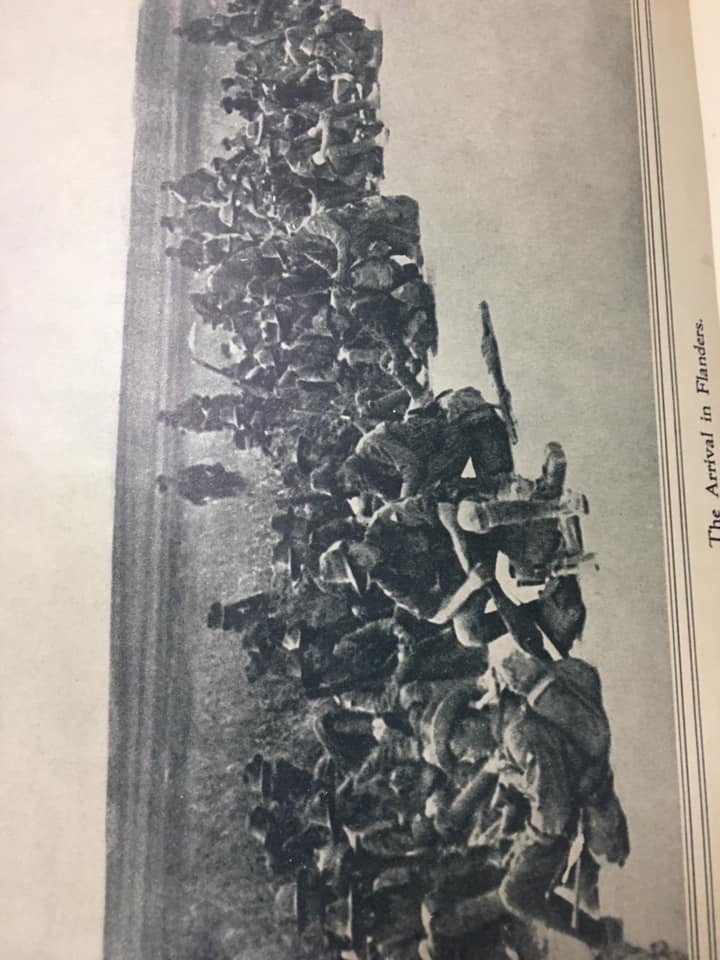
The Arrival in Flanders.


Transcription (From the Australian Front, Cassell and Company, 1917, page number not shown)

The Shell-holes of Pozières Village during the following Winter.


Transcription (From the Australian Front, Cassell and Company, 1917, p. 11)

Winter in France.
The Jock: "Weel, Anzac. and what are ye going to do when the war's ower?"
Frozen Bill: "Me? I'm goin' to the centre of Australia for two bloomin' years to thaw out."


Transcription (From the Australian Front, Cassell and Company, 1917, p. 41)

Australians Re-entering the Somme in the Autumn, 1916. Mud-splashed Gun-teams along the road to Montauban.


Transcription (From the Australian Front, Cassell and Company, 1917, p. 20)

Sausage Valley: The Busiest Thoroughfare in the Australian World in those Days.

A Famous Staff at Breakfast in Sausage Valley.


Transcription (From the Australian Front, Cassell and Company, 1917, p. 39)

Remembrances?
"What does that noise remind you of?"
"'Ome on a Saturday night."


Transcription (From the Australian Front, Cassell and Company, 1917, p. 16)

The Dug-outs which we used to build

The Trenches amongst the Summer Flowers.


Transcription (From the Australian Front, Cassell and Company, 1917, p. 21)

Fatigue Parties in the Moonlight.


Transcription (From the Australian Front, Cassell and Company, 1917, p. 44)

Fritz's Folly: Scene of a Winter Fight on the Somme.

The Somme Mud: In the Trenches.


Transcription (From the Australian Front, Cassell and Company, 1917, page number not shown)

Ammunition Wagons galloping past the Long Guns in Sausage Valley.


Transcription (From the Australian Front, Cassell and Company, 1917, p. 10)

The Abbey de Bertin, St. Omer.


Transcription (From the Australian Front, Cassell and Company, 1917, p. 15)

The Headquarters Cook-house in the Peaceful Line.

In the Early Days: An Estaminet reached by jumping out of the Communication Trench within 800 yards of the Front Line.


Transcription (From the Australian Front, Cassell and Company, 1917, page number not shown)

The Main Street of Pozières from Centreway Trench.


Transcription (From the Australian Front, Cassell and Company, 1917, page number not shown)

"Cook."
Drawn by Will Dyson.


Transcription (From the Australian Front, Cassell and Company, 1917, page number not shown)

Unveiling the Memorial put up to one of the Australian Divisions which fought at Pozières.


Transcription (From the Australian Front, Cassell and Company, 1917, p. 37)

In the Field Dressing-station.
The Padre: "Are you an R.C., my lad?"
The Hard Case: "No, I'm a machine-gunner."

[Drawing signed: John P. Davis, A.I.F.]


Transcription (From the Australian Front, Cassell and Company, 1917, page number not shown)

The Church at Pozières.


Transcription (From the Australian Front, Cassell and Company, 1917, page number not shown)

One of the Earliest Battalions to enter the Trenches in France.


Transcription (From the Australian Front, Cassell and Company, 1917, p. 40)

Shell- and Mine-torn Ground at Hill 60, Ypres.

The same: Very Extensive Defensive Works were undertaken by the Australian Troops at Ypres in 1916 during the short time within which they stayed there.


Transcription (From the Australian Front, Cassell and Company, 1917, page number not shown)

A Victorian Brigade straight out of Pozières passing another Victorian Brigade on its way in.


Transcription (From the Australian Front, Cassell and Company, 1917, p. 36)

Hymn Titles Adapted.
[Cartoon panels, signed W. L. King, A.I.F.:]
Brother dost thou see them
A soldier of the cross (Iron)
Come let us join our cheerful songs
He liveth long who liveth well (the Battalion Q.M.S.)
Throw out the life-line
One there is who loves thee
Knocking knocking who is there
Where is my boy tonight
What means this eager anxious throng (The Rum Ration)


Transcription (From the Australian Front, Cassell and Company, 1917, p. 25)

Pozières Windmill: The Summit of the Somme.
Captured on August 4 after two heavy fights.

Centre Way, near Pozières Church.


Transcription (From the Australian Front, Cassell and Company, 1917, p. 19)

"Gibraltar."
A reinforced concrete entrance to a cellar and German dug-out. The surrounding house had long been blown away.

One of the old 5·9 Howitzers taken in the First Assault.


Transcription (From the Australian Front, Cassell and Company, 1917, page number not shown)

Machine-gunners coming out past Casualty Corner: Contalmaison in the distance.


Transcription (From the Australian Front, Cassell and Company, 1917, p. 18)

Pozières.
Just after midnight on July 23, 1916, those Australians who had been brought South and put into the Great Battle of the Somme, attacked and took this village. A few walls and rafters were then remaining.

The Chalk-pit past which they approached.


Transcription (From the Australian Front, Cassell and Company, 1917, title page)

FROM THE AUSTRALIAN FRONT

The Net Profits from Sales will be devoted to Australian Soldiers' Patriotic Fund

Cassell and Company, Ltd
London, New York, Toronto and Melbourne
1917


Thursday, March 27, 2025

1917 - From The Australian Frontline


1917 is the year Australian families learned new place-names the hard way: Bullecourt, Messines, Passchendaele, Beersheba. On the Western Front the AIF was in the thick of the British offensives; in Palestine the Light Horse charged into the legend books. This post gathers wartime photographs and reproduced pages from that year — faces, mud, horses, kits.

A Sydneysider opening this set now is looking at the same year the Cenotaph generation never quite left. Recruiting was harder, the conscription votes of 1916 and 1917 had already split the country, and the casualty lists were a weekly civic ritual.

Transcription (From the Australian Front, Cassell and Company, 1917, p. 9)

FROM THE AUSTRALIAN FRONT

The Leader: A Winter Snapshot of General Birdwood and his Chief of Staff.


Transcription (From the Australian Front, Cassell and Company, 1917, page number not shown)

The Cemetery at Pozières.


Transcription (From the Australian Front, Cassell and Company, 1917, Introduction)

INTRODUCTION

At Christmas, two years ago, as a result of the hard work of its Editors and other members of the A.I.F., we were presented with an excellent production in the form of the "Anzac Book." That was our second Christmas at war. We are now approaching our fourth, and let us hope it may be the last one during which we shall find ourselves fighting. Our kind friends have again come forward and presented us with a book, not quite so ambitious as the "Anzac Book" was, but one which we hope will convey to those whom we left behind in Australia, and who we know are thinking of us, some idea of our surroundings on the battle fronts of the Australians, and which carries with it our whole-hearted hopes and good wishes for those at home.

With it, I feel I have the privilege of sending my most grateful thanks to all for their past work, and my best of good wishes to every member of the A.I.F. for the future.

[Signature: W. R. Birdwood]

France,
28th September, 1917.


Transcription (From the Australian Front, Cassell and Company, 1917, page number not shown)

One of the "O.G." Lines near Pozières Windmill.
They were blotted out here by bombardment.


Transcription (From the Australian Front, Cassell and Company, 1917, p. 14)

One of the Early Billets: A Bomb School in Flanders.

Snapped in a Farm in Flanders.


Transcription (From the Australian Front, Cassell and Company, 1917, front cover)

FROM THE AUSTRALIAN FRONT
XMAS. 1917.

[Badge:] Australian Commonwealth Military Forces
[Artist:] Fred Leist, France

Cassell and Company, Ltd.


Transcription (From the Australian Front, Cassell and Company, 1917, page number not shown)

"What! Last another five years?'


Transcription (From the Australian Front, Cassell and Company, 1917, page number not shown)

The Arrival in Flanders.


Transcription (From the Australian Front, Cassell and Company, 1917, p. 11)

Winter in France.
The Jock: "Weel, Anzac. and what are ye going to do when the war's ower?"
Frozen Bill: "Me? I'm goin' to the centre of Australia for two bloomin' years to thaw out."


Transcription (From the Australian Front, Cassell and Company, 1917, p. 20)

Sausage Valley: The Busiest Thoroughfare in the Australian World in those Days.

A Famous Staff at Breakfast in Sausage Valley.


Transcription (From the Australian Front, Cassell and Company, 1917, p. 16)

The Dug-outs which we used to build

The Trenches amongst the Summer Flowers.


Transcription (From the Australian Front, Cassell and Company, 1917, p. 21)

Fatigue Parties in the Moonlight.


Transcription (From the Australian Front, Cassell and Company, 1917, page number not shown)

Ammunition Wagons galloping past the Long Guns in Sausage Valley.


Transcription (From the Australian Front, Cassell and Company, 1917, p. 10)

The Abbey de Bertin, St. Omer.


Transcription (From the Australian Front, Cassell and Company, 1917, p. 15)

The Headquarters Cook-house in the Peaceful Line.

In the Early Days: An Estaminet reached by jumping out of the Communication Trench within 800 yards of the Front Line.


Transcription (From the Australian Front, Cassell and Company, 1917, page number not shown)

The Main Street of Pozières from Centreway Trench.


Transcription (From the Australian Front, Cassell and Company, 1917, page number not shown)

"Cook."
Drawn by Will Dyson.


Transcription (From the Australian Front, Cassell and Company, 1917, page number not shown)

The Church at Pozières.


Transcription (From the Australian Front, Cassell and Company, 1917, page number not shown)

One of the Earliest Battalions to enter the Trenches in France.


Transcription (From the Australian Front, Cassell and Company, 1917, p. 25)

Pozières Windmill: The Summit of the Somme.
Captured on August 4 after two heavy fights.

Centre Way, near Pozières Church.


Transcription (From the Australian Front, Cassell and Company, 1917, p. 19)

"Gibraltar."
A reinforced concrete entrance to a cellar and German dug-out. The surrounding house had long been blown away.

One of the old 5·9 Howitzers taken in the First Assault.


Transcription (From the Australian Front, Cassell and Company, 1917, p. 18)

Pozières.
Just after midnight on July 23, 1916, those Australians who had been brought South and put into the Great Battle of the Somme, attacked and took this village. A few walls and rafters were then remaining.

The Chalk-pit past which they approached.


Transcription (From the Australian Front, Cassell and Company, 1917, title page)

FROM THE AUSTRALIAN FRONT

The Net Profits from Sales will be devoted to Australian Soldiers' Patriotic Fund

Cassell and Company, Ltd
London, New York, Toronto and Melbourne
1917