
Sunlight is the soap that taught a generation of Australian kitchens what a brand looked like — a wrapped bar with a name stamped on it, not a greasy slab from the grocer. William Lever built that habit at Port Sunlight in the 1880s; the Australian chapter is a Balmain waterfront story. Lever Brothers were selling into Sydney by the late 1880s, put a copra mill on White Bay in 1897, and poured the first locally made Sunlight bar in 1900. By the time the works closed in 1988 the plant had stretched along the bay, and the apartments that replaced it still sit on a soap-and-glycerine shoreline.
This A–Z is advertising, not a factory tour. Alphabet cards, wrappers, the cheerful hard sell that made “Sunlight” a household verb. These are phone photographs of the printed cards. The Balmain works made the soap. Port Sunlight invented the pitch.

JACKO AND FAMILY
Off came his hat! The surprised young man scarcely had time to replace it when a whirring of wings and some angry cries warned him that the magpie was in fighting mood. The warning was effective, the man disappeared, and Jacko returned to his nest in the gum tree. His mate was sitting on their brood of three prettily marked eggs, of light green, blotched with purple and red—not a very comfortable looking nest to look at, to be sure. It was made of old sticks and bits of wire, but a peep inside shewed that Jacko and his mate had an eye to comfort when they lined it so carefully with strands of hair, silk, and bits of grass, wool, and small feathers. Jacko fed his mate with tender morsels for the three weeks of incubation, for his wife left the nest only a few minutes morning and night during that three weeks. Ugly little chickens they were. They looked pink and naked and all beak, but Dad and Mum thought them the pride of the country. Jacko worked early and late with his mate looking for grubs, lizards and scraps to feed their babies. One did not grow very fast, so it was pushed out of the nest and so the other two had extra food and throve on it. Jacko would mash the grubs up well before dropping them into the gaping beaks of his young son and daughter. Strenuous times for the parents, as their offspring clamoured for more and more to eat and it must have been a relief when about a month after emerging from the shell, the chicks ventured from the nest to a near by branch and afterwards spent only part of the day in the nest.
A few days afterwards they were able to fly, and the son followed Jacko in his search for food under bits of bark, etc., while his sister, who was quarrelsome, learned the same lessons from her mother. Jacko's son started to pipe at four months old, and he certainly made a better attempt at his first song than our young rooster did with crowing. He was a sleek young fellow now—his black became glossy and deep and his white pure as snow, while his eyes were bright and knowing—and now—with tremendous noise and celebration—Jacko Junior finds a bride. It was a great wedding and lasted for days. The happy young couple returned to his father's nest; their welcome was a warm one—for father and mother beat them off unmercifully. Junior with his young bride soon found a comfortable fork in a lofty gum tree and there they built their nest while Junior's song rose with praise. His rich warble was sustained long after his mate had ceased. Life was full of joy for Junior, even when the advent of four clamouring beaks made him bustle for food and growing bolder, he is not satisfied with robbing the fowls, but must make flying excursions to the kitchen for scraps.
His sister who found a mate at the same time as Junior, fell a victim to the pea rifle of a farmer's young son whose ignorance robbed the farm of a valuable asset, an insectivorous bird.

Avocets.
The Avocet nests on bare, damp soil, just using a little vegetation as lining. The four eggs are olive-stone, with dark-brown markings, and measure about 2 inches x 1 inch. Its total length is 15½ inches.
The Ant Eater or Echidna, a land animal armed with spikes like a Porcupine. In daylight it shelters in holes or under rocks. Feeds chiefly on ants, licked up on long slender tongue. It lays eggs, then hatches them in a pouch
Ant Eater.
A LAUNDRY TREASURE—SUNLIGHT SOAP

BRIGHTER WASHING DAYS WITH SUNLIGHT SOAP
Bandicoot, 11 kinds. Size from rat to rabbit. Spoils gardens by digging seeds and eating root crops. The Bandicoot has not many friends owing to its habits of burrowing.
Bandicoot
Bustard or Plain Turkey; a splendid bird, lives on insects, etc., on the great plains, attains a weight of 18 lbs. Becoming rare owing to foxes, cats, and hungry people. One or two eggs, on bare ground in open country, olive color with bluish tint.
Bustard.

Cockatoo (Leadbeaters)
This beautiful bird is sometimes called the "Major Mitchell Cockatoo" or "Weejuggler." They generally go in pairs all over the interior of Australia. Its total length is 16 ins., and it lays 2 to 4 eggs.
COCONUT OIL—THE SECRET OF GOOD SUNLIGHT SOAP
The Native Cat is hated by all poultry keepers. It is much smaller than the domestic cat. Is a wonderful climber, and its nocturnal habits make it difficult to capture. The Native Cat is the rabbit's enemy; but without appreciable effect on the increasing numbers of that pest.
Cat (Australian Native)

Duck (Shoveller)
The Shoveller Duck here illustrated, nests usually in a depression amidst thick vegetation, lined with a little grass and down, and occasionally in a hollow tree. Eggs are of pale cream, 7 to 9 in number.
Australia's wild dog. The Dingo will not become domesticated, it howls but does not bark, hunts singly and in packs, is a nuisance to sheepbreeders, but rarely dangerous to man.
Dingo
DIRT QUICKLY DISPELLED—SUNLIGHT SOAP

EASY DAYS FOR MOTHER—SUNLIGHT SOAP
Australia's largest bird, like the Ostrich it cannot fly, but can outpace many a horse. Both parents share the hatching duty. Eggs measure about 5¼ x 3½ inches, and in number from 6 to 22. The period of incubation is three months.
Emu.
A beautiful bird threatened with extinction to supply a fashion in Osprey plumes. The parent birds are killed in nesting time, and the young die of starvation. The nest is nearly flat and made of sticks on a tree overhanging water—4 eggs, bluish green.
Egret

Flying Fox.
The Flying Fox is really a bat, with the same naked flying membrane connecting the prolonged fingers with one another, and the forearm itself with the side of the body; when sleeping they hang themselves head downward by their hinder claws Nocturnal. Food consists of insects and fruit, chiefly the latter
Fairy Martin
Migratory, nest composed of mud or clay. Eggs, four to five, white, plain, or spotted blotched with red. Measure, ¾ x ½ ins.
FOR THE LAUNDRY GOOD SUNLIGHT SOAP

The Grebe.
The Grebe is a swimming bird, closely related to the Loons, but having the toes lobate instead of webbed. The tail is rudimentary, and the legs narrow and blade-like, enabling it to swim long distances under water. Nest floating low in water, and built of water weeds near shelter such as rushes. Eggs, four to six, covered with thin coating of white lime, which soon becomes stained and shiny. Does not sit on eggs during heat of day, but covers with weeds to prevent scorching by sun.
GOOD SUNLIGHT SOAP-SAVES THE CLOTHES
The Goanna.
Goanna, properly called Monitor Lizard, has a long, smooth, protractile tongue, split to the middle. Attains length five to seven feet. Strong and rapacious. Carnivorous, living chiefly on eggs and wild birds. Abounds throughout the Commonwealth. Arboreal and semi-aquatic.

The Blue Crane of the country dwellers is the "White Fronted Heron" of the bird lover. Herons are valuable birds to the farmer and irrigationist, for in addition to insects and snails, they eat yabbies which bore into the banks and bed of channels, and thus cause much loss of water by soakage.
Heron
Honeyeater Regent's
The Honey Eater (Regent) is differently known as "Turkey Bird" "Mock Regent" and "Flying Coachman." It is one of the most beautiful of birds, rare and nomadic; female is similar to male.
HARD WORK MADE LIGHT—SUNLIGHT SOAP

Straw-necked Ibis.
An invaluable protector of crops and wholesale destroyer of insects. Ibis will clear the land of every trace of locust, cricket or caterpillar. Nest, an almost flat structure of green twigs and rushes in swamp. Three eggs, white in colour.
I KNOW SUNLIGHT SOAP IS BEST!

Jabiru
Nest a bulky affair made of sticks lined with softer material, builds on trees growing in swamps. Four eggs, white with pitted surface.
JUST A LITTLE SUNLIGHT SOAP FOR A BIG WASH
Jacky Winter.
Jacky Winter is the term of affection for the Brown Flycatcher. We all know this sociable fearless little chap, he keeps us company in the garden. Nest, small, slight, and nearly flat, of grass or fibre with bits of bark or lichen outside. It is placed in the fork of a tree. Eggs—two or three, bluish-green, spotted and blotched with purplish brown.

KEEP SMILING WITH SUNLIGHT SOAP
Kingfisher.
The Sacred Kingfisher appears all over Australia, coming to the south for summer when it breeds. It readily devours small snakes, crabs, caterpillars, etc. Nests in hollow of gum trees. Eggs, four or five, pinky white.
The Koala is a marsupial, which spends most of its time in gum trees. The fur is thick and valuable. The Koala lives on gum leaves and young roots, and is most active during evening. Its young is carried in a manner similar to a 'possum, but for a much longer time. It is tailless.
Koala (Native Bear)

Lyrebird
The Lyre Bird is closely protected by law. They are very shy, and run very swiftly along rough broken ground, rarely flying. It is a confirmed mimic and possesses a sweet song of its own. Nest is large dome-shaped structure, not far from ground, with side opening. One egg, dark purplish grey with chocolate spots. Incubation, seven weeks.
Lorikeet
Lorikeets usually live in flocks. They fly very fast and are extremely noisy birds. Their food consists principally of honey, and the "Little Lorikeet" often hangs head downward on the branches to obtain its food from the flowers. Nest usually in hollow trees. Two eggs, white.
LIGHTER LABOUR WITH SUNLIGHT SOAP

Pouched Mouse.
The Pouched Mouse, a little creature about three inches in length, yet with a distinct pouch; it is an insect eater. The Jumping Pouched Mouse is a graceful little thing which hops like a kangaroo.
"Maggie" is the most valiant of our Australian birds. Famous vocalists they are, and mischievous pets. There are five species, all of which are properly protected. Nest in forked branch of a tree, with dead sticks and twigs, lined with grass, hair, feathers, etc. Eggs, three to five, bluish-grey ground colour, smudged with drab or brown. Breeding season, July to October.
Magpies
MORE COMFORT WITH SUNLIGHT SOAP

Nuthatch
The Nuthatch is a tree runner, running down the trunk of the tree, in contrast to the tree creeper, which runs upwards. Insectivorous. Nest on bark of upright dead limb, cup-shaped, composed of downy substances, extremely difficult to detect. Eggs, three, smooth, whitish, mottled all over with slate-colored or greenish spots, measure .67 in. x .54 in.
Like all cranes, the Native Companion is a stately bird. It indulges in extraordinary dances. Easy to tame, but rather treacherous. Feeds on lizards, insects, edible roots, etc. In flying they soar to great heights. Nest made of vegetation raised above swamp level. Eggs, two, drab, with brownish blotches, and measure abont [sic] 3½ in. x 2⅓ in.
Native Companion.
NEVER ACCEPT A SUBSTITUTE FOR SUNLIGHT SOAP

Oyster Catcher.
The Pied Oyster-catcher nests in a depression in the sand, while the Black Oyster-catcher uses a depression in seaweed or other dead vegetation on the rocks. Two eggs, greyish stone color, with dark brown blotches, measure about 2¾ in. x 1¾ in.
OIL FROM THE COCONUT IN GOOD SUNLIGHT SOAP
Owl
A sub-species of the old-world Barn Owl. This is the "Delicate Owl." The Boobook Owl is responsible for the melancholy "more pork" cry which can be heard in the stillness of the night. Owls are nocturnal, and enjoy a diet of rats and mice. Females are larger than the males. Nest in holes in trees. Eggs, two to four, white.

PUREST SOAP IS SUNLIGHT SOAP
Possum
The 'Possum is found in all timbered parts of Australia. It feeds principally on leaves, and lives in hollow trees. When the young 'Possum leaves the pouch, it clings to the back of its parent, until able to take care of itself. The skins of 'Possums found in the cooler parts of Australia are of much more value than those from hotter climates.
Platypus.
The Platypus is probably the most extraordinary animal known. It lays one or two eggs in a self-constructed chamber (lined with leaves) at the end of a long tunnel from the river bank; the tunnel has one entrance above water level and another below. The egg (about ¾ inch long) is white, and the young Platypus emerges naked, and is fed by milk exuded from the mother's milk glands; nipples are absent, but the little ones are strong enough to lick the milk from the fur. Nocturnal in habits.

QUICKEST WORKER—SUNLIGHT SOAP
Great Grey Kangaroo
Queer Australian Fauna—We all know these two favourites, although to folk in other parts of the world they appear very queer specimens. The young Kangaroo is born in the usual way, and immediately transferred to the pouch by the mother, being then about an inch long and quite helpless. We have no space to speak about the Kookaburra (or Laughing Jackass) except that he is the largest of three species of Kingfisher found in Australia. He is worth some study, so read about him and go to the zoo.
Kookaburra or Laughing Jackass.
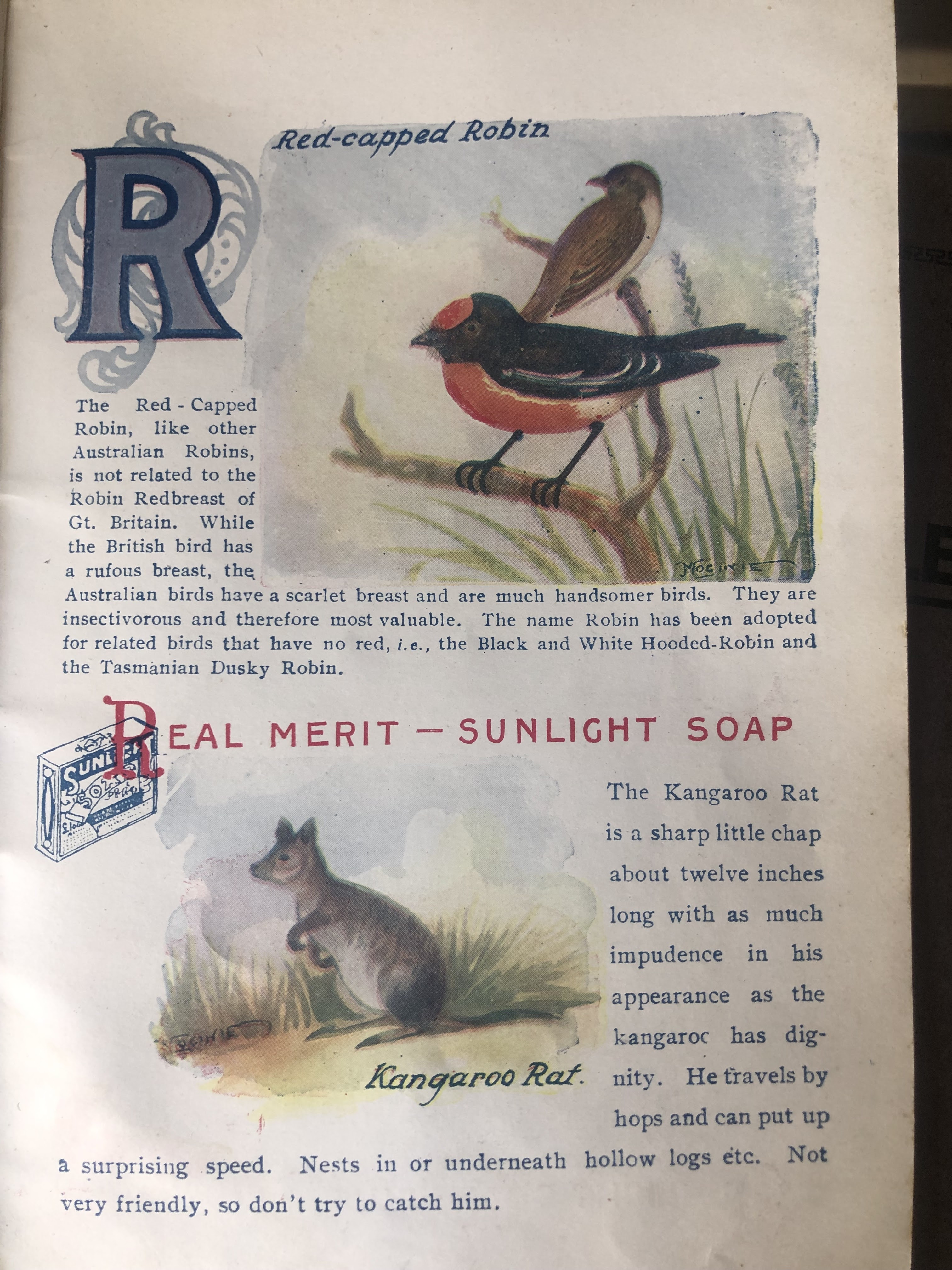
Red-capped Robin
The Red-Capped Robin, like other Australian Robins, is not related to the Robin Redbreast of Gt. Britain. While the British bird has a rufous breast, the Australian birds have a scarlet breast and are much handsomer birds. They are insectivorous and therefore most valuable. The name Robin has been adopted for related birds that have no red, i.e., the Black and White Hooded-Robin and the Tasmanian Dusky Robin.
REAL MERIT—SUNLIGHT SOAP
Kangaroo Rat.
The Kangaroo Rat is a sharp little chap about twelve inches long with as much impudence in his appearance as the kangaroo has dignity. He travels by hops and can put up a surprising speed. Nests in or underneath hollow logs etc. Not very friendly, so don't try to catch him.

Black Swan
The Black Swan has been a great advertisement for Australia. Our land is full of paradoxes and contradictions, and at one time the existence of a Black Swan was considered impossible. In habits and appearance (excepting colour) is identical with the White Swan. It lives on water plants, grass etc. Nest, a bulky structure of sticks, bark, reeds etc. in swamps, occasionally floating; four to six eggs, greyish green.
Black Snake
Tiger Snake
Carpet Snake.
Most of us dread snakes and yet they are not all poisonous. They are worth studying if only to distinguish between venomous and non-venomous and how to treat snake bite. The young of the Black Snake, Tiger Snake and Copperhead are born alive, but the Brown Snake lays eggs. All have large families—between 20 and 30. Treatment of snake bite:—At once tie a cord an inch or two above the wound, screw up the cord with a stick, cause bitten part to bleed freely, pinch up flesh and cut around marks of fangs, suck vigorously, wash cut well with Condy's Fluid, give alcohol or hot strong coffee, keep patient warm—get a doctor at once.
SUNLIGHT SOAP—GUARANTEED PURE

Tasmanian Tiger or Wolf
The Tasmanian Wolf is a carnivorous marsupial, and but for the presence of the pouch in the female, and a tail very thick at the root, might easily be mistaken for a member of the wolf family. The number of young found in the pouch is often four. Strong and savage, this animal lives in caves among the rocks, and goes forth in the evening to seek its prey. It never hunts in packs. Confined to Tasmania.
THE LAUNDRY SOAP—SUNLIGHT SOAP
Teal Duck
The Australian Teal Duck is closely similar to the Teal of Europe. A grass feeder and a good table bird. The female is very different from the male. It is common on swamps. Unlike most other birds, ducks lose all their wing feathers at once, so that for a short time they cannot fly.

Cassowary.
The Australian Cassowary is a shy bird living in the dense scrub of North Queensland coastal districts. The peculiar helmet helps to protect the head when the bird is dashing through the scrub. They grow about five feet high. The sexes are similar in plumage when adult. Eggs, 3 to 6 in clutch, are granulated and of delicate pale green colour.
Bell-bird
The Bellbird is a good ventriloquist, and sometimes puzzles the 'bullocky' who mistakes it's [sic] clear bell-like note for the sound of the bells on the necks of his bullocks. It is insectivorous and seeks its food at the tops of tall gums. Usually nests not far from the ground on the top of a stump hidden by suckers. Nest is of strips of bark, leaves etc., lined with fine grass. Eggs, 3 to 4, bluish white, boldly marked with dark sepia blotches.
UNEQUALLED ALWAYS—SUNLIGHT SOAP

Valuable Birds:—The White-fronted Chat feeds on caterpillars and other soft-bodied insects. They feign distress to divert attention from their nest. Eggs, 3-4, white, spotted with red. The Kestrel is found in forest and scrub and feeds on lizards and insects. Eggs placed in hole of tree, four in number, freckled with red on pale ground. The Pacific Gull is an excellent scavenger. Nests on outlying reefs or islands among grass tussocks. Eggs 2-3, olive brown with dark brown blotches. The Spur-winged Plover nests on damp bare ground near swamp. The eggs are of same color as ground and four in number. The Pee-wee (Magpie Lark) is a most valuable bird. Tame and friendly, it feeds on insects in gardens and orchards without interfering with fruit crops. The nest is a substantial structure of mud held together with grass and lined with grass. Placed on a swaying branch at the top of a tall tree. Eggs 2-5, reddish white with purplish brown blotches.
VOUCHED FOR BY MILLIONS—SUNLIGHT SOAP

WISE MOTHERS USE SUNLIGHT SOAP
Wombat
The Wombat is about two feet long, massively built and powerful, with flat, broad body, short thick legs, and short tail. It is an expert digger. The animal remains in its burrow by day, and feeds on roots and plants by night. This member of the marsupial family is found only in South-Eastern Australia and Tasmania.
Willie Wagtail.
The Black and White Fantail (Willie Wagtail), runs along the ground and manipulates its black tail from side to side, not up and down like the Wagtail. Very tame, and a real friend to gardeners; it is insectivorous. Eggs, two or three, white, blotched with brown; nests on high branch of tree.

Xerophila or White-faced Warbler
Xerophila (Genus Aphelocephala): Whitefaces. The Whitefaces are met with in small flocks, and are sociable in their disposition. They are more frequently seen on the ground than in trees, as their food consists of seeds and small plants. On the approach of man they just flit into the nearest bush without alarm. The nest is large and domed, with an entrance hole near the top; it is composed of dried grasses, moss, wool, cobwebs and dead leaves, lined with grass or feathers. Eggs, four or five, pinkish white, thickly spotted and smudged with chocolate. There are four varieties: the Whiteface, the Chestnut-breasted Whiteface, the Black-banded Whiteface, and the Chestnut-bellied Whiteface
XCELLENT WAY—THE SUNLIGHT SOAP WAY

[handwritten owner's inscription, top of page: Dorothy Yates, Class 8 C., R. D. S. S., Randwick, Sydney]
Yellow-eared Cockatoo.
The Yellow-eared or Funereal Black Cockatoo is very different to its brother the Banksian Cockatoo, both in the formation of the bill and in colouring—the latter is a sooty black with yellow markings on the tail only. The Yellow-eared Cockatoo is not at all common but is found in the wilder parts of South Queensland, New South Wales, Victoria, South Australia and Tasmania. Their principal food is grubs, and these they obtain by tearing holes in trees. Nests in hole in tree very high from the ground. Eggs, two, white. Breeds May and June in Queensland and December and January in the South.
Yellow-breasted Robin
The Yellow Breasted Robin is really a Shrike-Robin. They are not found in the hotter parts of Australia: they are striking looking birds, the yellow breast is very conspicuous from below. Insectivorous, they get their living by hunting over the bark and the foliage of trees. Do not handle one if you can help it, because they are savage little customers and very strong in the mandible. The nest is an inverted cone-shaped one, composed of fibres of bark bound together and held with spider's webs like that of a fantail. The inside is lined with very fine grass and thin strips of bark. Eggs, white, minutely dotted with slatey-black markings.
YEAR IN, YEAR OUT, USE SUNLIGHT SOAP

[handwritten at top: Dorothy Yates; handwritten down right margin: KOALAS, Yellow Eared Cockatoo.]
This is another instance where we are obliged to fall upon the scientific name of a popular little bird in order to complete our alphabet. Zosterops is the genus to which the "Silver Eye" belongs. They do an immense amount of good, by clearing fruit trees of pests in winter and early in spring and consume a great many insects, but they demand high rates of pay for their work, and take their toll of ripe fruit in such quantities that there is jolly little left for the rightful owner. The nests are round, deep, cup-shaped and composed of dry grass, moss and wool, lined with fibres of reeds and grasses. They build among small branches of trees and bushes. Eggs, three, pale blue colour.
Zosterops (Silver-eye)
ZENITH OF QUALITY—SUNLIGHT SOAP

MONKEY BRAND WON'T WASH CLOTHES
—but keeps the home bright
[On the pictured packet:] BROOKE'S SOAP. MONKEY BRAND [illegible] FOR SOILED HANDS [rest of packet wording illegible]
Sunlight Soap A-Z