Search This Blog

Showing posts with label Second Fleet. Show all posts

Wednesday, November 18, 2026

Lady Juliana – The Women's Convict Ship of the Second Fleet – Sydney Cove – 1789–1790

Lady Juliana was the first convict transport to reach Port Jackson from Britain after the First Fleet, and she came carrying women convicts — more than two hundred of them, sent out while the colony waited, half-starved, for news and supplies from home.

She left Plymouth on 29 July 1789 and came into Port Jackson on 3 June 1790 after 309 days. Five women died on the passage. Two hundred and twenty-two were landed. That record stands in hard contrast to Neptune, Scarborough and Surprize, which arrived three weeks later.

The Lady Juliana in tow of the Pallas Frigate after lightning shattered the mainmast, 1783
Robert Dodd (artist/engraver); John Harris; published by Robert Sayer & J. Bennett, 17 February 1783. Royal Museums Greenwich PAH8432. Vessel catalogued as Lady Juliana (1777). Public domain. Licence: public domain. Source: record. Also collection page.

Royal Museums Greenwich catalogues this 1783 print’s vessel as Lady Juliana (1777). Dictionary of Sydney gives a Whitby build year of 1769. The museum catalogue identity is followed for the print; the later convict voyage used the same named transport in the secondary literature.

The ship and the charter

In late 1788 Home Secretary Lord Sydney told Treasury he wanted at least two hundred female convicts sent to New South Wales. Women could not legally be held on the prison hulks used for men. By mid-November William Richards junior — the London shipbroker who had chartered First Fleet ships — was contracted to provide a vessel.

The ship was surveyed at Deptford and approved. George Aitken (also Aitkin) was appointed master. Richard Alley sailed as surgeon. Lieutenant Thomas Edgar, who had been master of Discovery on Cook’s last voyage, was naval agent. Steward John Nicol, whose 1822 memoir is the fullest insider account of the voyage, called Edgar a decent, kindly man and Aitken an excellent humane man who did all in his power to make the convicts as comfortable as their circumstances would allow.

Nicol had been offered a berth in either Guardian or Lady Juliana. He chose the transport because he meant to leave the sea afterward and settle in Scotland.

John Nicol, aged 67
John Nicol, aged 67
Drawn and engraved by W. H. Lizars. Frontispiece to The Life and Adventures of John Nicol, Mariner (William Blackwood, Edinburgh; T. Cadell, London, 1822). Public domain. Scanned from the 1822 edition microform (Internet Archive / Canadiana, identifier cihm_41947). Licence: public domain. Source: record.

Embarkation

Portsmouth Point
Portsmouth Point
Thomas Rowlandson. Metropolitan Museum of Art. CC0 1.0. Licence: CC0 1.0. Source: record. Also collection page.

The ship lay about six months in the Thames while women were gathered from gaols across England. Nicol wrote that all the jails in England were emptied to complete the cargo. Four women escaped the night before the vessel left London waters. After further delay Lady Juliana sailed from Plymouth on 29 July 1789 with over 220 female convicts on board.

Numbers need care. At Tenerife on 21 September 1789 the agent certified 226 women and six children. Nicol’s memoir speaks of 245 when they sailed. Bateson and later historians usually settle on about 226 convict women embarked and five deaths, with 222 landed at Sydney.

Among those on board were Mary Wade, about eleven, convicted at the Old Bailey of assault and robbery; Elizabeth Steel, described at trial as mute by visitation of God; Rachel Turner, who later lived with First Fleet surgeon John White and then married boatbuilder Thomas Moore; Eleanor Higgins, later a settler around Ryde/Epping; and Ann Mash (Marsh), transported for stealing a bushel of wheat.

Old Newgate Prison, London
Historical view. Wikimedia Commons. Public domain. Licence: public domain. Source: record.

The long voyage

Lady Juliana called at Tenerife, Rio de Janeiro and the Cape of Good Hope. She was a poor sailer and needed repairs. The long stops meant fresh meat and vegetables. Women were allowed on deck. The ship was cleaned and fumigated. Tea, sugar and soap were issued. Mortality stayed low — about two per cent.

Nicol wrote: “When we were fairly out at sea, every man on board took a wife from among the convicts, they nothing loath.” He courted Sarah Whitlam (also spelled Whitelam in some later works), a Lincoln woman he said had been transported for a mantle borrowed from an acquaintance who then prosecuted her. He lived with her on the voyage and wrote that she bore him a son at sea. He claimed he would have married her had there been a clergyman on board, and that he meant to return for her when her time was out.

The women were prisoners. The crew and officers held the keys, the food and the discipline. Nicol presents the partnerships as willing. Later historians, including Siân Rees, have stressed that “nothing loath” is a sailor’s claim, not proof of free consent. Food, protection, better quarters and relief from irons could all hang on a man’s favour. Calling every woman a prostitute, or every partnership free romance, both flatten the record. Nicol himself said there were not a great many very bad characters; the greater number were for petty crimes, and a great proportion for only being disorderly — that is, street-walkers — the colony at the time being in great want of women.
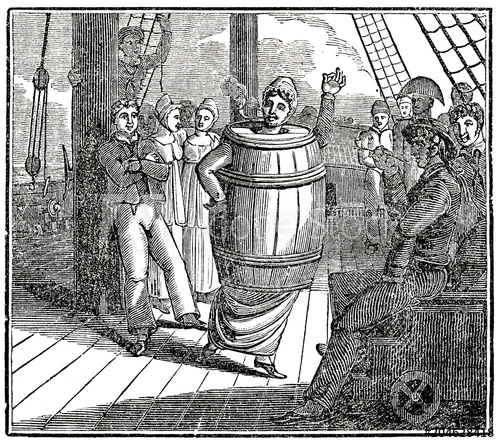
Punishment of a female convict on Lady Juliana — later illustration
Unknown artist, from Das Heller-Magazin, 13 November 1834, after Nicol’s memoir. Public domain. Nineteenth-century dramatisation, not a 1789 sketch. Licence: public domain. Source: record.
View of the land round the harbour of Rio de Janeiro
Period print (British Library Mechanical Curator collection / Wikimedia Commons). Public domain. Licence: public domain. Source: record.

At Rio the ship stayed about seven weeks. At the Cape she stayed about a month. There the women learned of Guardian’s disaster. Lady Juliana took on provisions and five men who had been bound for New South Wales as superintendents in Guardian. Surgeon Alley partnered with Ann Mash.

Cape of Good Hope / Cape Town, 1763
Jacques-Nicolas Bellin. Geographicus Rare Antique Maps / Wikimedia Commons. Public domain. Licence: public domain. Source: record.
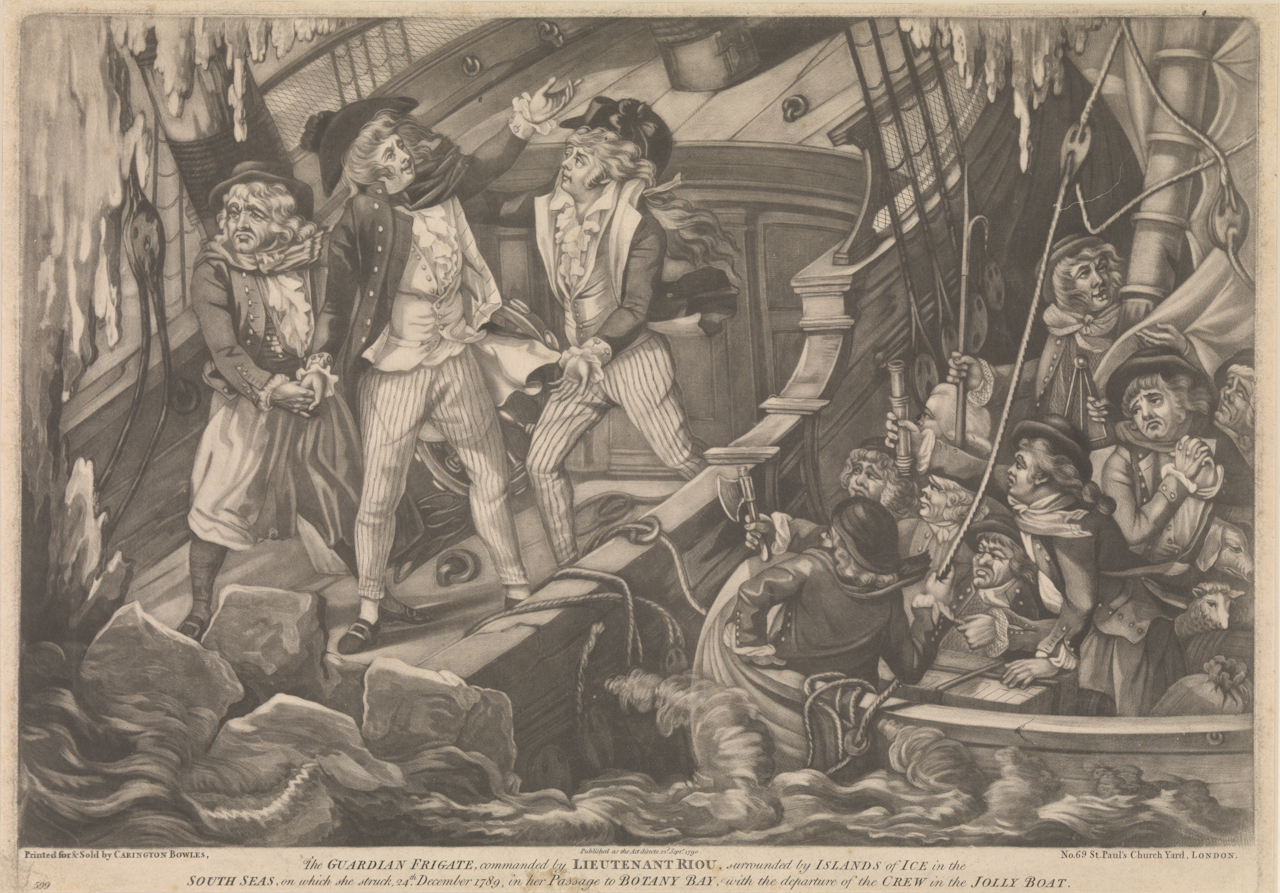
HMS Guardian among islands of ice, 24 December 1789
Print published by Carington Bowles, 22 September 1790 (Royal Museums Greenwich). Public domain. Licence: public domain. Source: record. Also collection page.

The “floating brothel” label

In 1959 maritime historian Charles Bateson wrote that Lady Juliana was “nothing more than a floating brothel.” The phrase stuck. It catches one truth — sexual relations between crew and convict women were open and common on this voyage — and buries others. Many women were thieves, receivers or disorderly persons, not professional prostitutes. Some were girls. Edgar’s and Aitken’s management kept rations and cleanliness far above the Death Fleet standard. An anonymous woman’s letter printed in London on 4 August 1791 thanked “our good agent on board, and the gentleman in England who sent us out,” and said provisions were good.

Arrival at Sydney Cove

Lady Juliana made Port Jackson on 3 June 1790. Bad weather delayed anchoring in Sydney Cove until 6 June. The women landed on 11 June. Watkin Tench wrote that news burst upon the settlement like meridian splendour upon a blind man. A seaman who saw them land said they were all fresh, well looking women.

Michael Flynn’s Dictionary of Sydney entry states that they raised the ratio of women in the colony from about 20 per cent to 40 per cent, a level not equalled for decades. That proportion is Flynn’s figure, cited here as such.

Phillip’s colony was starving. Collins recorded the mortification of finding, in the first ship that arrived, a cargo so unnecessary and unprofitable as more than two hundred females instead of provisions. Two weeks later Justinian brought real relief. Then Neptune, Scarborough and Surprize arrived with the sick and dying. The Juliana women helped nurse them. The anonymous letter drew the contrast: what a difference between us and them.

A Direct North General View of Sydney Cove, 1794
Thomas Watling. Public domain (Wikimedia Commons). Licence: public domain. Source: record.
Arthur Phillip
Arthur Phillip
Francis Wheatley, c.1786. State Library of New South Wales, ML 124. Public domain. Licence: public domain. Source: record.

Assignment and Norfolk Island

Many of the women were soon sent on to Norfolk Island. On 1 August 1790 Surprize sailed with provisions and about 150 female and 35 male convicts; three-quarters of those women had come in Lady Juliana. William Bradley’s watercolour of Justinian and Surprize standing into Sydney Bay, Norfolk Island, on 23 August 1790 records that arrival. Mary Wade and Elizabeth Steel were among those sent. Catherine Crowley, who had arrived in Neptune and was pregnant to D’Arcy Wentworth, also went; their son William Charles Wentworth was born at sea off the island in August 1790.
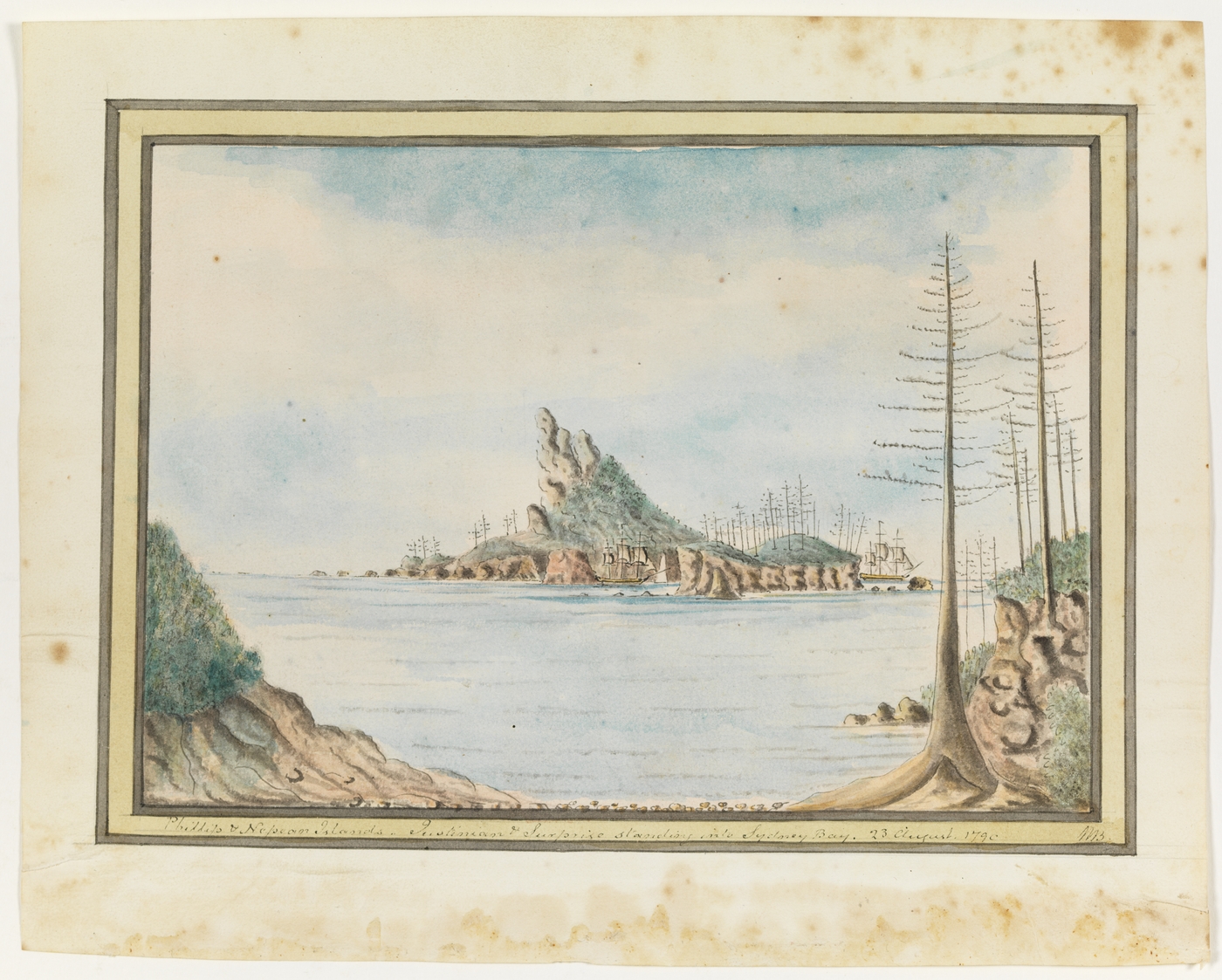
Justinian and Surprize standing into Sydney Bay, Norfolk Island, 23 August 1790
William Bradley. State Library of New South Wales, Safe 1/14. Public domain. Licence: public domain. Source: record.
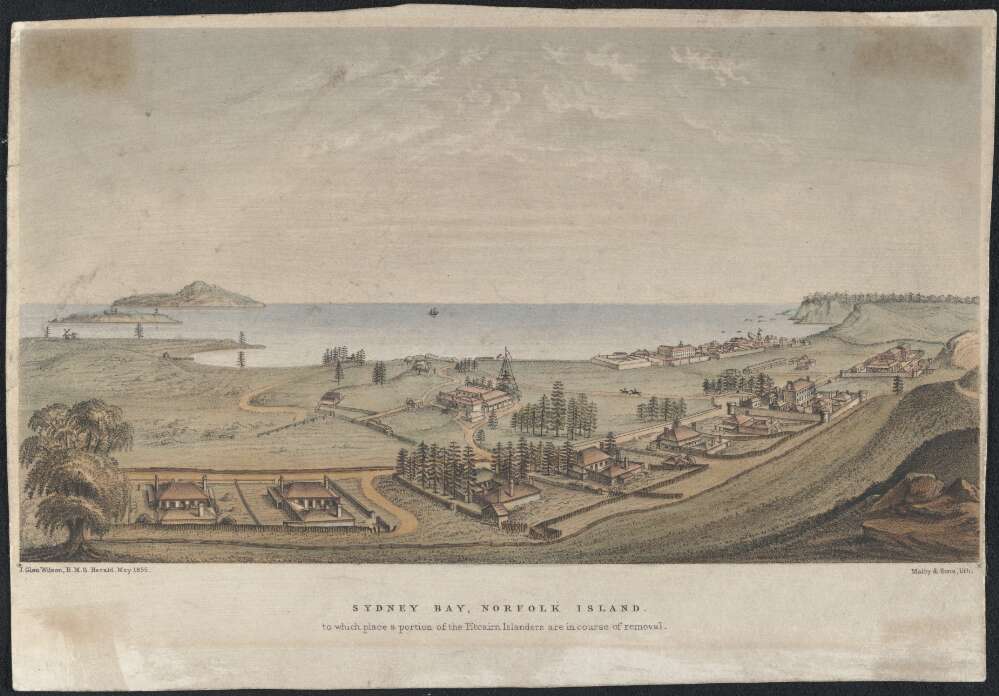
Sydney Bay, Norfolk Island
James Glen Wilson (1827–1863). National Library of Australia. Public domain. Licence: public domain. Source: record. Also collection page.

Sarah Whitlam and John Nicol

Nicol was in Sydney only about six weeks before Lady Juliana sailed for Canton on 25 July 1790. He left promising to return when Sarah’s sentence expired. He never did. Dictionary of Sydney notes that Sarah married a fellow convict and was sent to Norfolk Island, and later left for Europe; what became of her afterward is unclear. Nicol’s memoir says he did not know whether she was dead or alive. The relationship produced a child on the outward passage; the child’s later life is not securely traced in the sources used here.

Other women’s later lives

  • Mary Wade — among the youngest on board; Norfolk Island; later the Hawkesbury and Illawarra; a large colonial family.
  • Ann Mash (Marsh) — partnered with surgeon Alley on the voyage; later shopkeeper, publican and Parramatta–Sydney boat operator.
  • Rachel Turner — relationship with John White; marriage to Thomas Moore; Moorebank takes its name from Moore’s grant.
  • Elizabeth Steel — Norfolk Island; later Sydney; buried at the Old Sydney Burial Ground; her headstone was found under Sydney Town Hall in 1991.
  • Eleanor Higgins — married David Kilpack; farmed at the Field of Mars / Ryde.

Lady Juliana went to Canton, returned to England with other Second Fleet ships in October 1791, and was offered for auction at Greenland Dock on 14 December 1791.

Cadman's Cottage, Circular Quay West — modern photograph
Photograph by Julioenrekei. Wikimedia Commons (own work, released as public domain / PD-self). Licence: public domain. Source: record.

1790 and later telling

The voyage of 1789–90 is one thing. Bateson’s label, Rees’s The Floating Brothel, novels and screen versions are another. They can point readers back to Nicol, the Old Bailey sessions, Collins, Tench and the Dictionary of Sydney entries — or they can turn two hundred women into a single scandal.

Related stories

Read next: Second Fleet – Neptune, Scarborough and Surprize; Trail, Shapcote and Hill.

Sources

  • Penny Edwell, “Lady Juliana,” Dictionary of Sydney, 2016 — dictionaryofsydney.org/entry/lady_juliana
  • Michael Flynn, “Second Fleet,” Dictionary of Sydney, 2016 — entry
  • John Nicol, The Life and Adventures of John Nicol, Mariner (1822) — Project Gutenberg Australia
  • Siân Rees, The Floating Brothel (2001)
  • Charles Bateson, The Convict Ships, 1787–1868
  • David Collins, An Account of the English Colony in New South Wales
  • Watkin Tench, accounts of Port Jackson
  • Old Bailey Proceedings Online — trial of Mary Wade, 14 January 1789, t17890114-58 — oldbaileyonline.org
  • Michael Flynn, The Second Fleet (1993/2001); John Cobley, The Crimes of the Lady Juliana Convicts, 1790
  • Anonymous woman’s letter, Morning Chronicle, 4 August 1791
  • Royal Museums Greenwich, PAH8432 — Lady Juliana 1783 print

Donald Trail, Lieutenant John Shapcote and Captain William Hill – Neptune and Surprize – Second Fleet – 1790

Three men stand out in the paperwork and testimony around the Death Fleet of 1790: Donald Trail (sometimes Traill), master of Neptune; Lieutenant John Shapcote, naval agent in Neptune; and Captain William Hill of the New South Wales Corps, who commanded the military guard in Surprize. They were not all in the same ship. Hill was not in Neptune.

A companion article covers the three transports and mortality figures. This one follows who these three men were, what each could see, what each wrote or was said about them, and what courts and later research have established.

A Direct North General View of Sydney Cove, 1794
Thomas Watling. Public domain (Wikimedia Commons). Licence: public domain. Source: record.

Names and roles

  • Donald Trail — also spelled Traill in some papers. Former navy master; had commanded a slave ship for Camden, Calvert & King. First assigned to Surprize, then moved to Neptune after Thomas Gilbert was removed. Master of Neptune for the voyage to New South Wales.
  • Lieutenant John Shapcote — naval agent for the three contractor transports, embarked in Neptune. Flynn’s Dictionary of Sydney entry records him as aged 50. His duty was to monitor compliance with the Navy Board contract. Not the ship’s master. Collins and the Dictionary of Sydney record his sudden death at sea on 12 May 1790. His son Peter John Shapcote came out in Justinian and learned of the death on arrival.
  • Captain William Hill (1760–1793) — second captain in the New South Wales Corps; commander of the Corps detachment in Surprize, under master Nicholas Anstis. His letter from Sydney Cove, 26 July 1790, to Jonathan Wathen (copy in the State Library of New South Wales) is firsthand for Surprize and secondhand for the fleet as a whole.
Portsmouth Point
Portsmouth Point
Thomas Rowlandson. Metropolitan Museum of Art. CC0 1.0. Licence: CC0 1.0. Source: record. Also collection page.

Authority at sea

Before the ships cleared England there was a fight over who controlled the convicts. Army officers of the new Corps wanted the keys and the discipline. The masters had signed bonds and answered to the Navy Board through the agent. On Surprize, Hill went on board while Trail was still that ship’s master and claimed the convicts as his prisoners. Trail refused to hand over the keys and pointed to Shapcote’s authority. Similar quarrels broke out in Neptune between Macarthur, Nepean and first master Thomas Gilbert, ending in a bloodless duel and Gilbert’s replacement by Trail.

Elizabeth Macarthur, who sailed first in Neptune, was glad to see Gilbert go, then decided Trail was of a “much blacker dye” and called him “a perfect sea-monster.” The Macarthurs transferred to Scarborough about a month out. Her journal and letters are passenger evidence about Trail’s manner, not a court finding about convict deaths.

Shapcote’s position was awkward. He was one agent for three ships. Hill later argued that government should lodge a controlling power in each ship — preferably in army officers — because one agent could only see what went on in his own vessel. Edward Riou of Guardian, meeting the fleet at the Cape, thought Shapcote foolish and beholden to Trail. Those are contemporary judgments by gentlemen who disliked the contractors’ men.

Elizabeth Macarthur
Elizabeth Macarthur
Unidentified painter; Dixson Galleries, State Library of New South Wales, DG 221. Public domain. Licence: public domain. Source: record.

Donald Trail and Neptune

Trail’s Neptune carried about four hundred and twenty male and seventy-eight female convicts, the naval agent, surgeon William Gray, and a large Corps party. Male convicts were held mainly on the orlop deck. After a mutiny scare on Scarborough in February, male convicts across the three ships were kept longer in irons. Women in Neptune were unironed on the upper deck under Navy Board orders that they not be abused.

By Cape Town, Flynn’s figures give 45 men and one woman already dead on Neptune. Fresh food was taken on. Some salvaged Guardian stores and about twelve Guardian convicts were crowded in. The ships sailed again on 29 April.

On return to England, Neptune seamen gave depositions alleging short rations, brutal irons, beatings by Trail and chief mate William Ellerington, and sales of leftover provisions in Sydney. Lawyer Thomas Evans pushed a private prosecution. The Admiralty case that went to trial in June 1792 charged Trail and Ellerington with the murder of the ship’s Portuguese cook. They were acquitted on that charge. The acquittal did not amount to a judicial finding that every allegation about convict treatment was false.

Gary L. Sturgess, in a 2025 Botany Baymen essay drawing on Neptune crew depositions in UK National Archives TS 11/381, has argued that a printed “convict letter” under the name Thomas Milburn was fabricated for Evans’s campaign, and that some deposition language is formulaic across witnesses. That is Sturgess’s secondary research conclusion.

Phillip, writing officially, blamed overcrowding and confinement. He told London he first learned of some alleged remarks attributed to him from the newspapers themselves. Neptune left Sydney in August 1790, loaded tea at Canton, and reached England in 1791. The ship burned at Cape Town in 1796. Trail’s later life after the acquittal is thinly documented in the open sources used here. No reliable portrait of him has been identified for this set.

Cape of Good Hope / Cape Town, 1763
Jacques-Nicolas Bellin. Geographicus Rare Antique Maps / Wikimedia Commons. Public domain. Licence: public domain. Source: record.
HMS Guardian among islands of ice, 24 December 1789
Print published by Carington Bowles, 22 September 1790 (Royal Museums Greenwich). Public domain. Licence: public domain. Source: record. Also collection page.

Lieutenant John Shapcote

Shapcote was the Crown’s eyes on the contract. He investigated complaints about irons before sailing and cleared the officers. At the Cape he obtained fresh supplies and accepted some Guardian stores. He died suddenly in the early hours of 12 May 1790, two weeks out from the Cape, in his cabin. Collins records the fact; Dictionary of Sydney follows it. Contemporary sources used here do not give a detailed medical cause.

Because Shapcote died before Port Jackson, he never answered Phillip and never gave evidence in London. Trail later found it useful to blame the dead agent for some missing convict property. Crew gossip later tied him to a convict mistress; that appears in secondary narratives of the depositions and remains allegation, not a court finding.

Arthur Phillip
Arthur Phillip
Francis Wheatley, c.1786. State Library of New South Wales, ML 124. Public domain. Licence: public domain. Source: record.

Captain William Hill and Surprize

Hill was baptised at Stroud, Gloucestershire, in 1760. As second captain of the Corps he sailed in Surprize with Ensign John Thomas Prentice and a smaller guard than Neptune carried. His quarrel with Trail over the keys happened while Trail was still Surprize’s master. At False Bay, tensions between Hill and Prentice ended with Hill’s arrest.

On 26 July 1790, a month after Surprize anchored (26 June), Hill wrote to Jonathan Wathen of Bond Court, Walbrook. A 1791 copy is in the Mitchell Library (MLMSS 6821). He said he had also written to William Wilberforce. Passages that bear on the fleet include:

  • He sailed from Cowes on 17 January and reached False Bay on 13 April; left the Cape 29 April; anchored in Port Jackson 26 June.
  • The misery of the voyage was “render’d so by the Villiany, oppression and shameful Peculation of the masters of the Transports.”
  • Of Surprize herself: unfit in make and size; in a trifling gale she shipped so much water that from the Cape the convicts were considerably above their waists in water; when gales abated, no fumigation or vinegar was used.
  • Fleet-scale figures in his letter — 370 of 900 male convicts already dead, 450 landed sick — are round numbers. They differ from Flynn’s reconstructed voyage deaths and should be read as letter testimony, not as a ledger.
  • He called the irons barbarous, said the contractors had used Guinea Trade shackles with a short bolt, and wrote: “the slave trade is mercifull, compar’d with what I have seen in this Fleet.”
  • He urged a controlling power in each ship over “low lif’d barbarous masters,” instead of one agent who could only see his own ship.

What Hill described from direct experience was Surprize and the landing of the sick in the cove. What he wrote about the masters’ bookkeeping and about the fleet as a whole was accusation across ships. Both layers are historical evidence; they are not the same layer.

Justinian and Surprize standing into Sydney Bay, Norfolk Island, 23 August 1790
William Bradley. State Library of New South Wales, Safe 1/14. Public domain. Licence: public domain. Source: record.
Watkin Tench
Watkin Tench
Attributed to Frederick Buck. State Library of New South Wales. Public domain. Licence: public domain. Source: record.

Hill after the letter

Marine diarists record quarrels in the colony, including a duel with Major Ross and attempts to court-martial Nepean. He was critical of Phillip’s land and exploration policy in the same Wathen letter. He left Sydney in the early 1790s and in April 1793 sailed for India in Shah Hormuzear. On 1 July 1793, at Erub (Darnley Island; called Tate’s Island by the ship’s master) in Torres Strait, a shore party seeking water and refreshment was attacked. Hill and a seaman were found dead on the beach. He was about thirty-three. No portrait is included here; none with clear free licence and firm identification was located for this set.

Allegations, testimony and findings

ClaimWho says soStatus
Trail a “sea-monster,” harsh to gentlemen passengersElizabeth MacarthurContemporary passenger opinion
Barbarous irons; short rations; masters’ peculation; Surprize floodedHill’s letter (Surprize firsthand; fleet figures estimated)Testimony
Overcrowding and too much confinement caused the hospital scenePhillip to GrenvilleOfficial judgment
Starvation, beatings, withheld dead men’s rations, and related claimsNeptune crew depositions via Thomas EvansAllegations; some language formulaic per Sturgess; cook-murder trial did not convict
Trail and Ellerington murdered the cookAdmiralty prosecution, June 1792Acquitted on that charge
“Thomas Milburn” convict letter from NeptunePublished in London campaignSturgess concludes fabrication
Shapcote incompetent / beholden to TrailRiou; Hill’s structural criticism of one agentOpinion; Shapcote dead before inquiry
Shapcote died 12 May 1790Collins; Dictionary of SydneyAccepted fact; medical cause not detailed in those sources
Cadman's Cottage, Circular Quay West — modern photograph
Photograph by Julioenrekei. Wikimedia Commons (own work, released as public domain / PD-self). Licence: public domain. Source: record.

Related stories

Read next: Second Fleet – Neptune, Scarborough and Surprize; Lady Juliana.

Sources

  • Penny Edwell, “Neptune,” “Surprize,” Dictionary of Sydney, 2016 — neptune, surprize
  • Michael Flynn, “Second Fleet,” Dictionary of Sydney, 2016 — entry; The Second Fleet (1993/2001)
  • William Hill to Jonathan Wathen, 26 July 1790, SLNSW MLMSS 6821 — transcript
  • Dictionary of Sydney person entry: Hill, William 1760–1793
  • David Collins, An Account of the English Colony in New South Wales
  • Elizabeth Macarthur, journal and letters, in Sibella Macarthur Onslow (ed.), Some Early Records of the Macarthurs of Camden
  • Gary L. Sturgess, “Australia’s Death Fleet – New Sources,” Botany Baymen, 2025 — article
  • UK National Archives TS 11/381 — as cited by Flynn and by Sturgess
  • House of Commons, Accounts and Papers relating to Convicts, 1791–92

The Second Fleet – Neptune, Scarborough and Surprize – Sydney Cove – 1790

In late June 1790 three convict transports dropped anchor in Sydney Cove within two days of each other: Surprize on 26 June, then Neptune and Scarborough on 28 June. They carried most of the convicts in what later came to be called the Second Fleet. What came off those ships shocked a colony already on short rations. Chaplain Richard Johnson went below on Surprize and wrote that he beheld a sight truly shocking to the feelings of humanity. On Neptune he would not even go on board.

This account is about those three contractor transports. The women’s ship Lady Juliana had a different charter, a longer voyage and a far lower death rate; a companion article tells her story. The storeship Justinian and the naval storeship HMS Guardian belong in the same wider relief of the colony and are treated here as context. A third article follows Donald Trail, Lieutenant John Shapcote and Captain William Hill.

A Direct North General View of Sydney Cove, 1794
Thomas Watling. Public domain (Wikimedia Commons). Licence: public domain. Source: Wikimedia Commons / collection record.

What “Second Fleet” means

The phrase was applied later. In 1789–90 Britain sent a second wave of ships to New South Wales after news arrived that the First Fleet settlement had survived. Michael Flynn’s Dictionary of Sydney entry counts six vessels in that wave:

  • Lady Juliana — female convict transport, chartered by William Richards junior; sailed from Plymouth 29 July 1789; reached Port Jackson 3 June 1790
  • HMS Guardian — naval storeship under Lieutenant Edward Riou; struck an iceberg on Christmas Eve 1789 and never reached Sydney as a working storeship
  • Justinian — private storeship; arrived 20 June 1790 with food and a portable hospital
  • Neptune, Scarborough and Surprize — convict transports chartered from Camden, Calvert & King; left English waters 17 January 1790; arrived 26–28 June 1790

Their voyages, contracts and death rates were not the same. Lady Juliana lost about five women in nearly ten months at sea. On the three Camden ships the death rate was of a different order.

Arthur Phillip
Arthur Phillip
Francis Wheatley, c.1786. State Library of New South Wales, ML 124. Public domain. Licence: public domain. Source: Wikimedia Commons / collection record.

The contract and the contractors

William Richards junior, who had handled First Fleet shipping, was displaced. The Navy Board accepted a lower tender from Camden, Calvert & King, a London firm with a large shipping business that also included slave trading. The change coincided with Lord Sydney’s replacement as Home Secretary by William Wyndham Grenville, and with illness and deaths among experienced officials who had managed the First Fleet arrangements.

Under the August 1789 contract the firm was to supply three ships for about a thousand convicts, their guard and stores. Payment was £17.7.6 for each convict embarked: £5 when the ship was fitted, £10 when stores were loaded, and the balance when the New South Wales commissary certified that the stores had been delivered. The contract therefore paid for embarkation and for landing stores. It gave no separate incentive for landing convicts alive and healthy. Later reforms introduced payments tied to numbers landed alive.

Donald Trail (also spelled Traill), a former navy master who had commanded a slave ship for the contractors, became master of Neptune. Nicholas Anstis, who had sailed as first mate of Lady Penrhyn in the First Fleet, commanded Surprize. John Marshall, who had taken Scarborough out with the First Fleet, commanded her again. The naval agent for the three ships was Lieutenant John Shapcote (Flynn records him as aged 50), sailing in Neptune. Authority at sea between masters, the agent and officers of the new New South Wales Corps was disputed from the start.

Portsmouth Point
Portsmouth Point
Thomas Rowlandson. Metropolitan Museum of Art. CC0 1.0. Licence: CC0 1.0. Source: Wikimedia Commons / collection record. Also collection page.

The three ships

Neptune

Built on the Thames in 1779 and about 809 tons, Neptune was the largest of the three. Flynn’s Dictionary of Sydney synthesis gives about 424 male and 78 female convicts embarked (about 502 in one tally; the Neptune entry uses 421 men and 78 women — small differences between contemporary lists and later reconstructions). She carried surgeon William Gray, Shapcote, and a New South Wales Corps party including Captain Nicholas Nepean and Lieutenant John Macarthur with his wife Elizabeth and son Edward. Free passenger and surgeon D’Arcy Wentworth also sailed in her. Neptune was the only one of the three to carry women convicts. Navy Board orders required the women to be kept separate and not abused; they were housed on the upper deck without irons. The men were confined mainly on the orlop deck.

Before sailing, Macarthur fought a bloodless duel at Plymouth with Neptune’s first master, Thomas Gilbert. Gilbert was replaced by Trail, who had been intended for Surprize. Elizabeth Macarthur later called Trail “a perfect sea-monster.” After further quarrels the Macarthurs transferred to Scarborough about a month into the voyage.

Scarborough

About 418–430 tons, built at Scarborough in Yorkshire in 1782, she had already brought male convicts with the First Fleet under Marshall. In 1790 she embarked about 253 men, with surgeon Augustus Jacob Beyer. On 12 February, after convict Samuel Burt warned of a planned rising, Shapcote came across from Neptune. Seventeen convicts were punished. Burt was later rewarded with store work and a pardon. The First Fleet and Second Fleet Scarborough voyages should not be conflated.

Surprize

Surprize (the historical spelling) was about 400 tons, built at Shoreham. She embarked about 254 male convicts under Anstis, with surgeon William Waters. Captain William Hill of the New South Wales Corps commanded the military guard on Surprize — not on Neptune. Hill’s letter from Sydney is one of the sharpest contemporary criticisms of the masters. He wrote that in a trifling gale the convicts were considerably above their waists in water.

Elizabeth Macarthur
Elizabeth Macarthur
Unidentified painter; Dixson Galleries, State Library of New South Wales, DG 221. Public domain. Licence: public domain. Source: Wikimedia Commons / collection record.

Guardian and the Cape

Guardian left England in September 1789 with stores Phillip had requested. On 24 December 1789 she struck ice in the Southern Ocean. Riou got her back to the Cape, where she was beached. The colony did not receive that cargo as a full storeship delivery. At False Bay in April 1790, however, Shapcote accepted some salvaged Guardian stores onto the three crowded transports, together with surviving Guardian convicts (about twelve to Neptune and eight to Scarborough). The main relief the colony had expected from Guardian was lost; a fraction of what could be saved was forwarded on already overloaded decks.

When the three transports reached False Bay on 13 April 1790, about sixty-eight people (mostly convicts, mainly from scurvy) had already died on the Atlantic leg. Fresh food was taken on. The ships left on 29 April. Shapcote died suddenly in the early hours of 12 May and never saw Port Jackson. His son, who had come out in Justinian, learned the news when he boarded Neptune in Sydney Cove.

HMS Guardian among islands of ice, 24 December 1789
Print published by Carington Bowles, 22 September 1790 (Royal Museums Greenwich PAH7976 / PW7976). Public domain. Licence: public domain. Source: Wikimedia Commons / collection record. Also collection page.
The distressed situation of the crew of the Guardian Frigate
After Charles Benezach; engraved/published with Stratford and Warren (Royal Museums Greenwich). Public domain. Licence: public domain. Source: Wikimedia Commons / collection record. Also collection page.
Cape of Good Hope / Cape Town, 1763
Jacques-Nicolas Bellin. Geographicus Rare Antique Maps / Wikimedia Commons. Public domain. Licence: public domain. Source: Wikimedia Commons / collection record.

Mortality — a sourced table

Counts depend on whether the source means initial embarkation in England, numbers after Cape transfers from Guardian, deaths at sea only, or deaths within months of landing. Flynn’s Dictionary of Sydney synthesis is used here as the main fleet-level account; ship entries in the same Dictionary give rounded ship-level estimates that do not always add to the same total.

MeasureFigureSource / definition
Male convicts on the three ships928Flynn, Dictionary of Sydney, “Second Fleet”
Male convict deaths on the voyage (three ships)256Flynn, “Second Fleet” — about a quarter; the entry itself gives “26 per cent”
Female deaths on the voyage (fleet)11Same entry (Neptune carried the women)
Convicts hospitalised on arrival (three ships)124Flynn, “Second Fleet”*
Dead within eight months of arrival (males)nearly 40%Flynn, “Second Fleet”
Neptune voyage deaths (ship entry)about 150 men and 11 womenEdwell, “Neptune”
Scarborough voyage deaths (ship entry)about 73 of 250+Edwell, “Scarborough: Second Fleet”
Surprize voyage deaths (ship entry)36 convicts and 1 soldierEdwell, “Surprize”
Surprize “required hospitalisation”126Edwell, “Surprize”*
Anonymous Lady Juliana letter (printed 1791)Neptune 183 men + 12 women; Scarborough 67; Surprize 85Morning Chronicle, 4 August 1791 — contemporary testimony, higher than ship reconstructions for some ships
Hill letter, 26 July 1790370 of 900 males already dead; 450 landed sickSLNSW MLMSS 6821 — round figures in a private letter
Rocks plaque traditionabout 267 dead; 488 of 759 landed sickDictionary of Sydney plaque entry

* The two Dictionary of Sydney entries, both citing Michael Flynn’s The Second Fleet, disagree here: the fleet entry gives 124 hospitalised on arrival from all three ships, while the Surprize entry gives 126 for Surprize alone. Both figures are shown as published. The Dictionary’s own summary note says “over half required hospitalisation on arrival”, so the number of sick was clearly far higher than either count of hospital admissions suggests. The ship-level death estimates (about 150, 73 and 36) add to 259, close to the fleet total of 256.

Watkin Tench
Watkin Tench
Attributed to Frederick Buck. State Library of New South Wales. Public domain. Licence: public domain. Source: Wikimedia Commons / collection record.

Arrival at Sydney Cove

Justinian had arrived on 20 June with stores and the portable hospital. Lady Juliana’s women had already been in the cove for three weeks.

Johnson’s account of the landing remains the clearest. Many convicts could not walk. Some were slung over the side like casks. Some fainted or died on deck or in the boat. Some crawled ashore on hands and knees; others were carried. Collins wrote that both the living and the dead exhibited more horrid spectacles than had ever been witnessed in the country. An unnamed woman from Lady Juliana wrote that they were obliged to fling them as you would goods, and that the Governor was very angry and said it was murdering them.

Phillip wrote to Grenville that duty required him to say the hospital scene was occasioned by the contractors having crowded too many on board and by too much confinement on the passage.

Cadman’s Cottage, Circular Quay West — modern photograph
Photograph by Julioenrekei. Wikimedia Commons (own work, released as public domain / PD-self). Licence: public domain. Source: Wikimedia Commons / collection record.

Inquiries, prosecutions and reform

When the ships returned toward England, newspapers took up the mortality. Lawyer Thomas Evans collected seamen’s statements against Trail and chief mate William Ellerington (spellings vary). A private prosecution over the death of Neptune’s Portuguese cook was taken up as a public Admiralty case. Trail and Ellerington were tried in June 1792 on that charge and acquitted. The acquittal decided the cook-murder indictment; it did not judicially clear every allegation about convict treatment. Evans’s publicity methods damaged his own case; he was recommended to be struck off.

Gary L. Sturgess, working from Neptune crew depositions in UK National Archives TS 11/381 and related papers, has argued that a printed “convict letter” circulated under the name Thomas Milburn was fabricated for Evans’s campaign, and that some deposition language is formulaic. That reading is Sturgess’s research conclusion, cited here as secondary analysis.

The lasting reform was the move toward incentive payments for convicts landed alive.

People who survived

  • George Salter (Neptune) received thirty acres at the Crescent, Parramatta, in 1796. His brick house survives as Dairy Cottage in Parramatta Park.
  • Molly Morgan (Neptune) escaped, was transported again, and later became a landholder and publican around Maitland.
  • Catherine Crowley (Neptune) and D’Arcy Wentworth became parents of William Charles Wentworth, born at sea off Norfolk Island in August 1790 while Surprize was carrying many Lady Juliana women to the island.
  • From Surprize: Joseph Wilson, James Morley and Edward Merrick later held land or trades around the Hawkesbury and Sydney.
  • From Scarborough: Jonathan Griffiths became a shipbuilder and farmer; James Larra a Parramatta trader and innkeeper.
Dairy Cottage, Parramatta Park — modern photograph
Photograph by Maypm, 2014. Wikimedia Commons. Creative Commons Attribution-ShareAlike 4.0. Licence: CC BY-SA 4.0. Source: Wikimedia Commons / collection record. Also collection page.
Justinian and Surprize standing into Sydney Bay, Norfolk Island, 23 August 1790
William Bradley. State Library of New South Wales, Safe 1/14. Public domain. Licence: public domain. Source: Wikimedia Commons / collection record.
Sydney Bay, Norfolk Island
James Glen Wilson (1827–1863). National Library of Australia. Public domain. Licence: public domain. Source: Wikimedia Commons / collection record. Also collection page.

Related stories

Read next: Lady Juliana; Trail, Shapcote and Hill.

Sources

  • Michael Flynn, “Second Fleet,” Dictionary of Sydney, 2016 — dictionaryofsydney.org/entry/second_fleet
  • Penny Edwell, “Neptune,” “Surprize,” “Scarborough: Second Fleet,” Dictionary of Sydney, 2016
  • Hugh Tranter, “Second Fleet commemoration plaque, The Rocks,” Dictionary of Sydney, 2016 — entry
  • Michael Flynn, The Second Fleet: Britain’s Grim Convict Armada of 1790 (Library of Australian History, 1993/2001)
  • David Collins, An Account of the English Colony in New South Wales, vol. 1 (1798)
  • Watkin Tench, A Complete Account of the Settlement at Port Jackson (1793)
  • William Hill to Jonathan Wathen, 26 July 1790, State Library of NSW MLMSS 6821 — transcript
  • Gary L. Sturgess, “Australia’s Death Fleet – New Sources,” Botany Baymen, 2025 — article (secondary analysis of TNA TS 11/381 depositions)
  • Charles Bateson, The Convict Ships, 1787–1868
  • Historical Records of New South Wales, vol. 1 part 2
  • House of Commons, Accounts and Papers relating to Convicts, 1791–92