SYDNEY 1848 - JOSEPH FOWLES
The First part came out on July 14th 1848, & was issued from his Harrington Street Address - Twenty Fortnightly parts followed, so the whole run stretched into 1849
He wrotet this book, to correct the Erroneous & Discreditable notions people in England held about Sydney -
- The idea that it was a rough penal colony of mud huts & convicts. His stated aim was to show Sydney as it really was :-
Gaslit Streets, crowded by a thriving population, with Public Buildings & Shops that could hold their own agianst London's. He wanted the Colony to be taken seriously as a place of civilisation, not a dumping ground.
He Dedicated the whole work to Governor Fitzroy, Praising him as a patron of the fine arts, & it was published by Subscription., so he was courting the Colony's elite as nuch as the English Public
Becase this was a city of fifty thousand with gas lamps & stone buildings. He felt England still pictured it as a convict dump, & he wanted to prove otherwise.
________________________________________________________________________________________________________________________________________
JOSEPH FOWLES

SYDNEY
In 1848:
ILLUSTRATED BY COPPER-PLATE ENGRAVINGS
OF THE
PRINCIPAL STREETS, PUBLIC BUILDINGS, CHURCHES, CHAPELS, ETC.,
from Drawings by
JOSEPH FOWLES.
SYDNEY:
PRINTED BY D. WALL, 76 YORK STREET,
AND PUBLISHED BY J. FOWLES, 5 HARRINGTON STREET.
INTRODUCTION
The principal object of this Work is to remove the erroneous and discreditable notions current in England concerning this City, in common with every thing else connected with the Colony. We shall endeavour to represent Sydney as it really is--to exhibit its spacious Gas-lit Streets, crowded by an active and thriving Population--its Public Edifices, and its sumptuous Shops, which boldly claim a comparison with those of London itself: and to shew that the Colonists have not been inattentive to matters of higher import, we shall display to our Readers the beautiful and commodious Buildings raised by piety and industry for the use of Religion. It is true, all are not yet in a state of completion; but, be it remembered, that what was done gradually in England, in the course of many ceuturies, has been here effected in the comparatively short period of sixty years. Our object, in setting forth this Work, is one of no mean moment; and we trust that every Australian, whether this be his native or adopted country, will heartily bid us "God speed!"
Sydney, July 14, 1848.
DEDICATION.
TO
HIS EXCELLENCY SIR CHARLES AUGUSTUS FITZROY, K.G.H,
Captain General and Governor-in-Chief of New South Wales
and its Dependencies, etc. etc. etc.
SIR,
When I reflect what a warm friend you have ever shewn yourself to this Colony and its Institutions,--and how generous a Patron of the Fine Arts--till Your Excellency's arrival, unnoticed and neglected; I may, without suspicion of flattery, confess myself proud in being permitted to inscribe to you this Work: the first whose sole object has been to delineate Sydney as it really is, and not as some of our friends in England evidently imagine it to be. And though I sincerely wish that its merit could be such as might fairly claim the encouragement and support with which Your Excellency has favoured me, I am not yet without hopes, that in accuracy and execution it will not suffer by a comparison with any similar work in the Mother Country; especially when the peculiar disadvantages under which we labor are taken into consideration. Nevertheless, so general is the apathy evinced at the bare mention of publishing in Australia, that I should scarcely have ventured on so perilous an experiment without the sanction of Your Excellency's name, in itself an unquestionable recommendation, enshrined as it is in the unexampled affection and respect of an intelligent people.
And that we may long continue to rejoice under the superintending care of one who participates in our hopes, and sighs over our difficulties and sorrows, is the hearty and unceasing prayer of
SIR,
Your very faithful Servant,
JOSEPH FOWLES.
________________________________________________________________________________________________
LIST OF PLATES
BUILDINGS
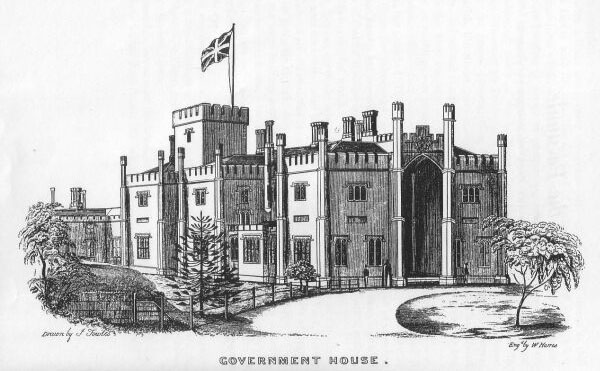
Government House, (Frontspiece)
St Phillps Church, Plate 10B
Australian Library, Plate 14A
St Patricks Church, Plate 18A
The Post Office, Plate 24A
St James Church, Plate 28A
Royal Victoria Theatre (interior), Plate 32A
The Free Presbyterian Church Pitt Street, Plate 36A
The Congregational Church Pitt Street, Plate 38A
The Union Bank of australia, Plate 42A
The Royal Hotel, Plate 50A
The Police office, Plate 56B
St Andrews Scots Church, Plate 58A
Wesleyan Centenary Chapel, Plate 62A
The Jews Synagogue, Plate 64A
St Mary's Cathederal, Plate 72A
Supreme Court, Plate 74A
Hyde Park Barracks, Plate 76B
Legislative and Executive Council Chambers, Plate 76B
Museum, Plate 82A
National School, Plate 86A
________________________________________________________________________________________________
STREETSCAPES
[Also see Key to the Street Plates, following this list]
Each plate is given the number of the preceding text page, plus a letter, as 10A, 40A.
There are four lines of drawings on most pages. Number each line consecutively, taking the word SYDNEY as the top of the page. These numbers are given in parentheses after the page numbers, as 40A(1).
'Left to right' or 'right to left' is the direction in which the particular line of drawing should be read to follow the course of the street. The inverted image should be used if necessary to bring the line of drawing upright.
['Letterpress' refers to the pages which have commentary on the plates.]
GEORGE STREET AND CHARLOTTE PLACE, Plate 10A
CHARLOTTE PLACE (northern side--right to left)
George Street to Church Hill, Plate 10A (4)
CHARLOTTE PLACE (southern side--left to right)
George Street to Church Hill, Plate 10A (3)
CHARLOTTE PLACE Letterpress p. 11
GEORGE STREET (eastern side--left to right)
Bridge to Hunter Street, 10A (2),
GEORGE STREET (western side--right to left)
Charlotte Place to Jamieson Street, Plate 10A (1)
GEORGE STREET Letterpress pp. 10, 12, 13, 16, 21, 23, 54, 66
GEORGE STREET AND BRIDGE STREET, Plate 12A
BRIDGE STREET (northern side--left to right)
George to Pitt Street 12A (3)
BRIDGE STREET (southern side--right to left)
George to Pitt Street 12A (4)
BRIDGE STREET Letterpress p. 13
GEORGE STREET (eastern side--left to right)
Queen's Wharf to Queen's Place 12A (2),
GEORGE STREET (western side--right to left)
Essex Street to Charlotte Place 12A (1)
GEORGE STREET Letterpress pp. 10, 12, 13, 16, 21, 23, 54, 66
LOWER GEORGE STREET, Plate 16A
GEORGE STREET (eastern side--left to right)
Queen's Wharf to Queen's Place 16A (2 and 4)
GEORGE STREET (western side--right to left)
Queen's Wharf to Essex Street 16A (1 and 3)
GEORGE STREET Letterpress pp. 10, 12, 13, 16, 21, 23, 54, 66
GEORGE STREET AND HUNTER STREET, Plate 20A
HUNTER STREET (southern side--right to left)
HUNTER STREET George to Pitt Street 20A (4)
HUNTER STREET (northern side--left to right)
HUNTER STREET George to Pitt Street 20A (3)
HUNTER STREET Letterpress pp. 21, 44
GEORGE STREET (eastern side--left to right)
Bridge to Hunter Street, Plate 20A (1)
GEORGE STREET (western side--right to left)
Jamieson Street to Barrack Wall 20A (2)
GEORGE STREET Letterpress pp. 10, 12, 13, 16, 21, 23, 54, 66
GEORGE STREET, Plate 22A
GEORGE STREET (eastern side--left to right)
Hunter to King Street 22A (4, 3, and 1)
GEORGE STREET (western side--right to left)
Barrack to King Street 22A (2)
GEORGE STREET Letterpress pp. 10, 12, 13, 16, 21, 23, 54, 66
KING STREET, Plate 26A
KING STREET (northern side--left to right)
KING STREET George to Pitt Street 26A (1)
KING STREET (northern side--left to right)
KING STREET Pitt to Castlereagh Street 26A (3)
KING STREET (southern side--right to left)
KING STREET George to Pitt Street 26A (2)
KING STREET (southern side--right to left)
KING STREET Pitt to Castlereagh Street 26A (4)
KING STREET Letterpress p. 28
PITT STREET, Plate 30A
PITT STREET (eastern side--left to right)
King to Market Street 30A (2 and 4)
PITT STREET (western side--right to left)
King to Market Street 30A (1 and 3)
PITT STREET Letterpress pp. 31, 35, 41
PITT STREET, Plate 34A
PITT STREET (eastern side--left to right)
Market to Park Street 34A (2 and 4)
PITT STREET (western side--right to left)
Market to Park Street 34A (1 and 3)
PITT STREET Letterpress pp. 31, 35, 41
PITT STREET AND HUNTER STREET, Plate 40A
HUNTER STREET (northern side--left to right)
HUNTER STREET O'Connell to Bligh Street 40A (4)
HUNTER STREET (southern side--right to left)
HUNTER STREET Pitt to Castlereagh Street 40A (3)
HUNTER STREET Letterpress pp. 21, 44
PITT STREET (eastern side--left to right)
Hunter to King Street 40A (1)
PITT STREET (western side--right to left)
Hunter to King Street 40A (2)
PITT STREET Letterpress pp. 31, 35, 41
PITT STREET, Plate 40B
PITT STREET (eastern side--left to right)
Hunter to King Street 40B (3 and 1)
PITT STREET (western side--right to left)
Hunter to King Street 40B (4 and 2)
PITT STREET Letterpress pp. 31, 35, 41
GEORGE STREET, Plate 54A
GEORGE STREET (eastern side--left to right)
King to Market Street 54A (1 and 3)
GEORGE STREET (western side--right to left)
King to Market Street 54A (2 and 4)
GEORGE STREET Letterpress pp. 10, 12, 13, 16, 21, 23, 54, 66
GEORGE STREET, Plate 56A
GEORGE STREET (eastern side--left to right)
Market to Park Street 56A (1 and 3)
GEORGE STREET (western side--right to left)
Market to Druitt Street 56A (2 and 4)
GEORGE STREET Letterpress pp. 10, 12, 13, 16, 21, 23, 54, 66
KING STREET AND YORK STREET, Plate 60A
KING STREET (northern side--left to right)
KING STREET York to George Street 60A (2)
KING STREET (southern side--right to left)
KING STREET York to George Street 60A (1)
KING STREET Letterpress p. 28
YORK STREET (eastern side--left to right)
Barrack to King Street 60A (3)
YORK STREET (western side--right to left)
Barrack to King Street 60A (4)
YORK STREET Letterpress pp. 60, 66
YORK STREET, Plate 64B
YORK STREET (eastern side--left to right)
Market to Druitt Street 64B (3 and 1)
YORK STREET (western side--right to left)
Market to Druitt Street 64B (4 and 2)
YORK STREET Letterpress pp. 60, 66
YORK STREET, Plate 66A
YORK STREET (eastern side--left to right)
King to Market Street 66A (1 and 3)
YORK STREET (western side--right to left)
King to Market Street 66A (2 and 4)
YORK STREET Letterpress pp. 60, 66
HYDE PARK AND ELIZABETH STREET, Plate 68A
ELIZABETH STREET (western side--right to left)
King to Liverpool Street 68A (4, 3, 2, and 1)
ELIZABETH STREET Letterpress p. 77.
LIVERPOOL STREET (designated 'Hyde Park')
LIVERPOOL STREET (southern side--right to left)
Elizabeth to Oxford Street 68A (1)
HYDE PARK AND LYON'S TERRACE AND BURDEKIN'S TERRACE, Plate 70A
COLLEGE STREET (designated 'Hyde Park')
COLLEGE STREET (eastern side--left to right)
Between Stanley Street and Liverpool Street 70A (2)
COLLEGE STREET Letterpress p. 70
LIVERPOOL STREET (designated 'Hyde Park')
LIVERPOOL STREET (southern side--right to left)
Elizabeth to Oxford Street 70A (1)
ELIZABETH STREET, Plate 76A
ELIZABETH STREET (western side--right to left)
Hunter to King Street 76A (3 and 1)
ELIZABETH STREET (eastern side--left to right)
Hunter to King Street 76A (4 and 2)
ELIZABETH STREET Letterpress p. 77.
MACQUARIE STREET, Plate 80A
MACQUARIE STREET (western side--right to left)
Near Bridge Street to Bent Street 80A (4)
Bent to Hunter Street 80A (3)
Hunter to King Street 80A (2 and 1)
MACQUARIE STREET Letterpress p. 79
HARRINGTON STREET AND JAMIESON STREET, Plate 84A
JAMIESON (NOW JAMISON) STREET (westerly from George Street)
JAMIESON (NOW JAMISON) STREET Northern side--right to left 84A (4)
JAMIESON (NOW JAMISON) STREET (westerly from George Street)
JAMIESON (NOW JAMISON) STREET Southern side--left to right 84A (3)
HARRINGTON STREET (northerly from Charlotte Place)
HARRINGTON STREET Eastern side 84A (2)
HARRINGTON STREETWestern side 84A (1)
KEY TO THE STREET PLATES
Each plate is given the number of the preceding text page, plus a letter, as 10A, 40B.
There are four lines of drawings on most pages. Number each line consecutively, taking the word SYDNEY as the top of the page. These numbers are given in parentheses after the page numbers, as 40A(1).
'Left to right' or 'right to left' is the direction in which the particular line of drawing should be read to follow the course of the street. The inverted image should be used if necessary to bring the line of drawing upright.
['Letterpress' refers to the pages which have commentary on the plates.]
BRIDGE STREET
(northern side--left to right)
George to Pitt Street 12A (3)
(southern side--right to left)
George to Pitt Street 12A (4)
Letterpress p. 13
CHARLOTTE PLACE
(northern side--right to left)
George Street to Church Hill, Plate 10A (4)
(southern side--left to right)
George Street to Church Hill, Plate 10A (3)
Letterpress p. 11
COLLEGE STREET
(designated 'Hyde Park')
(eastern side--left to right)
Between Stanley Street and Liverpool Street 70A (2)
Letterpress p. 70
ELIZABETH STREET
(western side--right to left)
Hunter to King Street 76A (3 and 1)
King to Liverpool Street 68A (4, 3, 2, and 1)
(eastern side--left to right)
Hunter to King Street 76A (4 and 2)
Letterpress p. 77.
GEORGE STREET
(eastern side--left to right)
Queen's Wharf to Queen's Place 12A (2), Queen's Wharf to Queen's Place 16A (2 and 4)
Bridge to Hunter Street, 10A (2), Bridge to Hunter Street, Plate 20A (1)
Hunter to King Street 22A (4, 3, and 1)
King to Market Street 54A (1 and 3)
Market to Park Street 56A (1 and 3)
(western side--right to left)
Queen's Wharf to Essex Street 16A (1 and 3)
Essex Street to Charlotte Place 12A (1)
Charlotte Place to Jamieson Street, Plate 10A (1)
Jamieson Street to Barrack Wall 20A (2)
Barrack to King Street 22A (2)
King to Market Street 54A (2 and 4)
Market to Druitt Street 56A (2 and 4)
Letterpress pp. 10, 12, 13, 16, 21, 23, 54, 66
GROSVENOR STREET
(See Charlotte Place)
HARRINGTON STREET
(northerly from Charlotte Place)
Eastern side 84A (2)
Western side 84A (1)
HUNTER STREET
(northern side--left to right)
George to Pitt Street 20A (3)
O'Connell to Bligh Street 40A (4)
(southern side--right to left)
George to Pitt Street 20A (4)
Pitt to Castlereagh Street 40A (3)
Letterpress pp. 21, 44
HYDE PARK
(See Liverpool Street, College Street)
JAMIESON (NOW JAMISON) STREET
(westerly from George Street)
Northern side--right to left 84A (4)
Southern side--left to right 84A (3)
KING STREET
(northern side--left to right)
York to George Street 60A (2)
George to Pitt Street 26A (1)
Pitt to Castlereagh Street 26A (3)
(southern side--right to left)
York to George Street 60A (1)
George to Pitt Street 26A (2)
Pitt to Castlereagh Street 26A (4)
Letterpress p. 28
LIVERPOOL STREET
(designated 'Hyde Park')
(southern side--right to left)
Elizabeth to Oxford Street 68A (1)
Elizabeth to Oxford Street 70A (1)
MACQUARIE STREET
(western side--right to left)
Near Bridge Street to Bent Street 80A (4)
Bent to Hunter Street 80A (3)
Hunter to King Street 80A (2 and 1)
Letterpress p. 79
PITT STREET
(eastern side--left to right)
Hunter to King Street 40A (1)
Hunter to King Street 40B (3 and 1)
King to Market Street 30A (2 and 4)
Market to Park Street 34A (2 and 4)
(western side--right to left)
Hunter to King Street 40A (2)
Hunter to King Street 40B (4 and 2)
King to Market Street 30A (1 and 3)
Market to Park Street 34A (1 and 3)
Letterpress pp. 31, 35, 41
YORK STREET
(eastern side--left to right)
Barrack to King Street 60A (3)
King to Market Street 66A (1 and 3)
Market to Druitt Street 64B (3 and 1)
(western side--right to left)
Barrack to King Street 60A (4)
King to Market Street 66A (2 and 4)
Market to Druitt Street 64B (4 and 2)
Letterpress pp. 60, 66
SYDNEY.
CHAPTER I.
SITUATION--EXTENT--POPULATION--AND GENERAL DESCRIPTION.
Sydney, the capital of New South Wales and Metropolis of Australasia, is situated on the southern shore of Port Jackson, at the distance of seven miles from the Pacific Ocean, in lat. 33° 55' S. and long. 151° 25' E. It is built at the head of the far-famed "Cove;" and, with Darling Harbour as its general boundary to the west, extends, in an unbroken succession of houses, for more than two miles in a southerly direction. As a maritime city its site is unrivalled, possessing at least three miles of water frontage, at any part of which vessels of the heaviest burden can safely approach the wharves. The stratum on which it stands is chiefly sandstone; and, as it enjoys a considerable elevation, it is remarkably healthy and dry. The principal thoroughfares run north and south, parallel to Darling Harbour, and are crossed at right angles by shorter streets. This, at first, gives the place an air of unpleasing sameness and formality, to those accustomed to the winding and romantic streets of an ancient English town; but the eye soon becomes reconciled to the change, and you cease to regret the absence of what is in so many respects undesirable.
Sydney occupies a space of more than two thousand acres; but from this must be deducted fifty-six acres, reserved for recreation and exercise, and known as Hyde Park or the Race Course. By the Census taken in 1846, the number of houses in the city was seven thousand one hundred; there are now, at least, two hundred more. But, independently of the city itself, the suburbs have, during the last few years, steadily increased {page 6} in size and importance. To the eastward is Wooloomooloo; to the southeast, Paddington and Surry Hills; to the south, Redfern and Chippendale; to the south-west, Camperdown, Newtown, and the Glebe; to the west (across Darling Harbour), Balmain; and, to the north, the township of St. Leonard's. All these, except the two last, are more or less connected by streets with the parent city; and, in 1846, contained one thousand seven hundred and fifteen houses: they now probably number two thousand.
Sydney is divided into four Parishes--St. Philip's, St. James', St. Andrew's, and St. Lawrence's; and was, in 1842, incorporated by Act of, Council, and municipally divided into six Wards: viz. Gipps Ward, Bourke Ward, Brisbane Ward, Macquarie Ward, Cook Ward, and Phillip Ward. Each of these divisions is represented by four Councilmen and an Alderman, of whom one retires annually by rotation. The Mayor is chosen from their own number, by the Aldermen and Council.
The Population of the city, in 1846, was 38,358; and, adding the average annual increase, taken from the five years previous to that year, must now be 41,712. The suburbs also, in 1846, returned as 6832, from their very rapid extension may be safely stated at 7500--making a total of 49,212.
The Public Institutions are numerous and flourishing; but as we purpose to describe them at length, as opportunity offers in the course of this Work, we shall content ourselves with briefly enumerating them in the present chapter. There are four Banks of Issue--the Bank of New South Wales, and the Commercial Bank, both Colonial; and the Union Bank of Australia, and the Bank of Australasia, Anglo-Australian. Besides these, there are--the Savings' Bank, the Royal Bank of Australia, the British Colonial Bank and Trust Company, the Scottish Australian Investment Company, the Bank of Australia, and the Loan Company. We have also an Australian Gas Light Company, an Australian Sugar Company, a Sydney Fire Insurance Company, and a Sydney Marine Insurance Company. {page 7} The Literary and Scientific Institutions are--the Australian Subscription Library, the Mechanics' School of Arts, the Australian Museum, the Society for the Promotion of the Fine Arts, and the Floral and Horticultural Society. In connexion with the last-named Institution, it may not be irrelavent to allude to the Botanical Gardens, which are subject to the management of the Government, and are kept up at the public expense. Besides these, there are numerous Lodges of Free Masons and Odd Fellows, and several Religious, Social, and Benefit Societies.
Education, though not regarded with all the attention it demands, is nevertheless not wholly neglected; for we have, in Sydney, a very fair proportion of well frequented Academies, although the majority are of a private nature. Those considered as public, are--the Sydney and Australian Colleges (each a School under the control of a Committee), the Anglican College at Lyndhurst, the St. James' Grammar School, the Archiepiscopal Seminary at St. Mary's, and the Normal Institution. Of Schools, of somewhat humbler pretensions, such are known as Parochial, we have--six Anglican, seven Presbyterian, six Roman Catholic, and one Wesleyan: all of these are assisted by Government. The Independents and Baptists have also their corresponding Schools; but, from conscientious motives, decline any assistance from the State.
________________________________________________________________________________________________________________________________________________
CHAPTER II.
EARLY HISTORY--GOVERNMENT HOUSE--GEORGE STREET.
It became necessary, after the rebellion of those Colonies now known as the United States, for Britain to send her convicts elsewhere; and the wide, distant, and almost totally unknown regions of Australia, were adjudged most suitable for the purpose. Accordingly, eleven ships, since {page 8} known in Colonial History as the "First Fleet," sailed for New Holland on the 15th of May, 1787, under the command of Captain Arthur Phillip, and arrived in Botany Bay on the 20th day of January in the following year. Finding the spot in many respects unfit for an infant settlement, and but scantily supplied with water, Captain Phillip determined to explore the coast; and proceeded northward, with a few officers and marines, in three open boats. After passing along a rocky and barren line of shore for several miles, they entered Port Jackson, which they supposed to be of no great dimensions, it having been marked in the chart of Captain Cook as a boat harbour. Their astonishment may be easily imagined when they found its waters gradually expand, and the full proportions of that magnificent harbour (capable of containing the whole navy of Britain) burst upon their view. The site of the intended settlement was no longer a matter of doubt; and, after first landing at Manly Beach (so named on account of the behaviour of the natives), they eventually selected a spot on the banks of a small stream of fresh water, falling into a Cove on the southern side of the estuary. Having returned to Botany Bay with the news of their discovery, the whole fleet was soon anchored in this creek, which, in compliment to the Secretary of State, they named Sydney Cove. On the 26th of January (a sufficient space for the military and convicts to encamp upon having been previously cleared) they were all landed, near where the Obelisk now stands, and the National Flag was hoisted. The succeeding days were, of course, spent in active employment; and the woods, soon to be replaced by a large and flourishing city, everywhere resounded to the woodman's axe. Some were clearing the ground for cultivation, some busily erecting the tents and huts, and some engaged in landing the necessary supplies.
The Canvas House of the Governor (Captain Phillip), and the tents of the Officers, were placed on the east of the Tank Stream above-mentioned, with the flag-staff in front of them; and near them were planted the various {page 9} fruit trees procured for this purpose at Rio and the Cape. The marines, and the convicts under their charge, were on the west side of the Cove, on a spot which may now be described as between George-street and Harrington-street, south of the site of the old Gaol; and the hospital for the sick was yet another collection of huts, where the old Custom-house now stands. Such was Sydney in the first year of its existence, sixty years ago.
To detail the hardships and privations of the founders of this Colony, though a task not unworthy of an historian, is not consistent with our present intention. But neither the sterility of the soil, the intense heat, nor drenching rains, could damp the ardour of Captain Phillip and his friends, though these disadvantages temporarily protracted their success. As an instance of what they had to contend against, we may remark that, for the six months after their landing, only four of the Officers had wooden huts; and, when the rest could be provided for, was uncertain. The hard wood of the gum trees blunted the tools of the convicts; and the cabbage palm, they had first availed themselves of, was no longer plentiful.
In July, 1788, the first civil cause was tried, and the Town planned out, and, in the September following, on a census being made, the population was found to consist of 933 persons, of whom a very large proportion were males.
Building went on very slowly, partly for want of mechanics and partly for want of lime, which they could only procure by burning shells. For two years the scarcity of provisions almost amounted to an actual famine, and but for the strict discipline maintained and opportune arrivals from England, the most serious consequences might have supervened. In spite of all difficulties, however, a large brick store was at length built, and the foundation of a Government House laid with all due formality. Though rambling and irregular, the latter was not an unpleasing building, and, with various additions and improvements, served as the Viceregal residence for nearly forty years. It was commenced on the 15th of May, 1788, and {page 10} pulled down on the completion of the present splendid mansion, which is much better adapted to the purposes of its less ambitious predecessor.
Government House (with a view of which we present our readers) is an elegant stone edifice, in the style usually termed Elizabethean or Tudor Gothic. It was designed by E. Blore, Esq., of London, and erected under the careful superintendence of Mr. Lewis, the Colonial Architect. It is about 170 feet long and 40½ feet high, with a large addition at the northern end containing apartments for the domestics. The Halls and State Rooms are spacious and lofty, and of these the Ball Room alone measures 150 feet in length and 28 in width, exclusive of the orchestra. The staircase is formed of highly wrought Australian cedar, and the chimney pieces of Colonial marble. Altogether, it is one of the most imposing buildings we have; and whether viewed from the adjacent Domain, the Harbour, or the City, its tall chimnies of elaborately carved stone, white turrets and numerous windows, render it a conspicuous ornament to our metropolis.
It is interesting to contrast such a building as the above with the poor sheds which appear in Collins' Plates as the nucleus of Sydney. They were chiefly formed of rough boards nailed to a few upright posts, shabbily covered with bark; and are, now, everywhere replaced by unbroken lines of well built houses. In our first engraving of the Streets, we have given an accurate idea of both sides of George Street, from Mr. Lyons' Mart to the entrance of Jamison Street; and the same, also, of Charlotte Place. In this range of buildings, the Bank of Australasia, and the Auction Mart above-mentioned, are equally deserving of notice. The former is a plain but commodious edifice, and consists of two wings and a centre; having fifteen windows and three doorways facing the street. There are six Branch Banks in Australia in connection with this Establishment, which is under the control of a Superintendent, Manager, and Board of Directors. It was incorporated by Royal Charter in 1835, and possesses a capital of one million sterling.
________________________________________________________________________________________________
George Street and Charlotte Place, Plate 10A
.jpg)
.jpg)
_______________________________________________________________________________________________________________________________________________

St Phillps Church, Plate 10B
For a long time (as late as 1828) this part of George Street formed the general boundary line of a large garden, which reached back to the summit of the hill;--and on the opposite side, as far down as the Tank Stream, was the Lumber Yard, which was not sold in separate allotments until the year 1830. Charlotte Place was originally the Parade Ground, and the Guard House stood on the site of the present splendid dwelling-house of Mr. Cleeve.
CHAPTER III.
EARLY HISTORY--ST. PHILIP'S CHURCH--GEORGE STREET.
In the early days of the Colony, Divine Service was performed in the open air, soon after sun-rise, wherever a shady tree could be found. Great irregularity was the consequence, and notwithstanding the punishments by which the attendance of the prisoners was enforced, the congregations appear to have been very thin. Those who obstinately persisted in their recusancy were deprived of a portion of their rations. This state of affairs continued until 1793, when a temporary Church was erected at the back of the huts on the east side of the Cove, near to what is now the corner of Hunter and Castlereagh Streets. It was built at the expense of the Chaplain--the Rev. Mr. Johnson--of strong posts, wattles, and plaster, and was finished August 25th, 1793,--enjoying an honourable distinction as the first Christian Church in this portion of the globe. In 1798 it was burnt down--apparently by some incendiary, probably one of those who had been compelled to attend, and who thus hoped to escape the infliction for the future. Such hopes, however, were vain; for the brick store above-mentioned had just been completed, and was immediately fitted up {page 12} as a Church. This building, which appears to have been the first house in the Colony, stood a little behind the site of the present Bank of Australasia. On the completion of the Orphan School (founded October 1st, 1800), the fittings were taken thither, and that building continued to be used for the performance of Divine Service until the removal of Governor Bligh. One consequence of that event was, an entire suspension of Public Worship from January, 1808, until August, 1809.
That part of St. Philip's first built was the clock tower, which was of brick, and finished in 1797; this however having fallen in June, 1806, it was rebuilt of stone in the same year. The Church itself was commenced in 1800, but not ready for use until 1809, when the Rev. W. Cowper officiated therein for the first time. It was completed about a year afterwards, and a handsome Altar Service of silver presented to it by His Majesty King George III. Such is a brief outline of its history. As a building it is confessedly somewhat unecclesiastical, and singular; but has, nevertheless, a sort of traditional claim to our respect, from its connection with so early a period in the annals of the Colony. For nineteen months previous to the opening of St. Philip's Church for Divine Worship, (August, 1809,) there was no minister of the Church of England officiating in the Colony. Since that date, astonishing progress has been made. Sydney now holds the rank of Metropolitan City in the sixth Province of the Anglican Church; having, in connection with it as many as five suffragan bishoprics, while the number of clergymen in this diocese alone amounts at the present time to fifty. Connected with this most gratifying church extension, is a work just commenced, with such energy and zeal as to ensure a speedy attainment of the end in view. This is no other than the erection of a new and magnificent Church for the Anglicans of this Parish, of which the foundation has been laid at the back of the present edifice, on the top of the hill.


George Street and Bridge Street, Plate 12A
Our second Descriptive Engraving represents the continuation of George {page 13} Street northward to Essex Lane or Gaol Hill. The four first houses in the plate, as far as Mr. Dawson's, stand upon what was originally the eastern limit of the Parade Ground before noticed; and near the corner of it was the entrance and eastern end of the Old Government Spirit Store, which extended backwards in an oblique direction towards St. Philip's Church. Of this Store nothing now remains, its site being completely occupied as in the engraving. The houses opposite, from Mr. Gaunson's--formerly the Bank of Australia--to the "Herald Office," are generally known as Underwood's Buildings; having been erected by Mr. James Underwood on his grant of land, which reached from the street in front to the water's edge. It was here that the first Colonial ship, named the King George, was built by that spirited proprietor, and launched on the 19th of April, 1805. The space intervening between the "Herald Office" and Bridge Street, had previously been enclosed as the Garden of the Female Orphan School, which stood nearly in the centre of it. This Garden also fronted that part of Bridge Street, often called the Colonnade, which appears in the lower part of the plate. Bridge Street contains, as may be observed, many respectable buildings, but, from a variety of contingent circumstances, remains as yet in an unfinished state.
There is nothing in this immediate vicinity calling for particular notice, except the Office of the Sydney Morning Herald. This newspaper, the "Times" of Australia, is conducted with much ability, but at the same time with such a careful abstinence from all political and party feeling, that it generally pleases all by displeasing none. In those articles, however, which touch upon religion, it is decidedly, though not violently, Protestant. As a commercial and daily paper, it ranks deservedly very high. It was established in the year 1831, and first came out as a daily paper in October, 1840. Its circulation is 3000; and it furnishes constant employment to nearly sixty men.
Governmmmment House

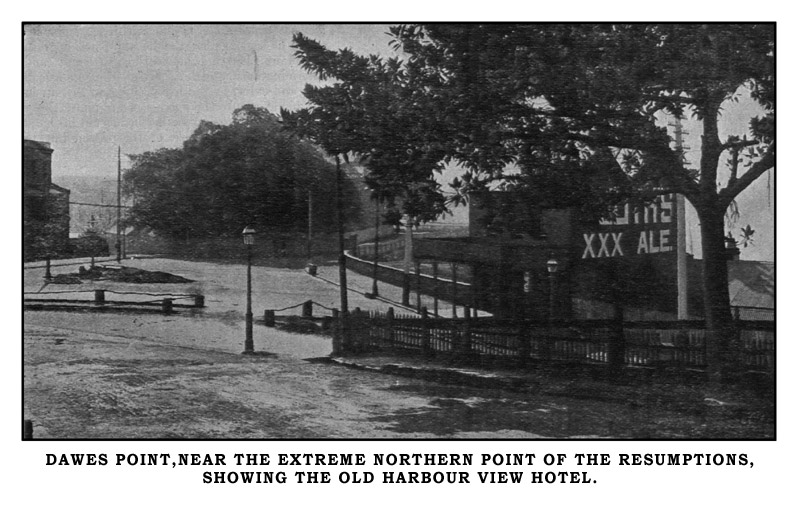
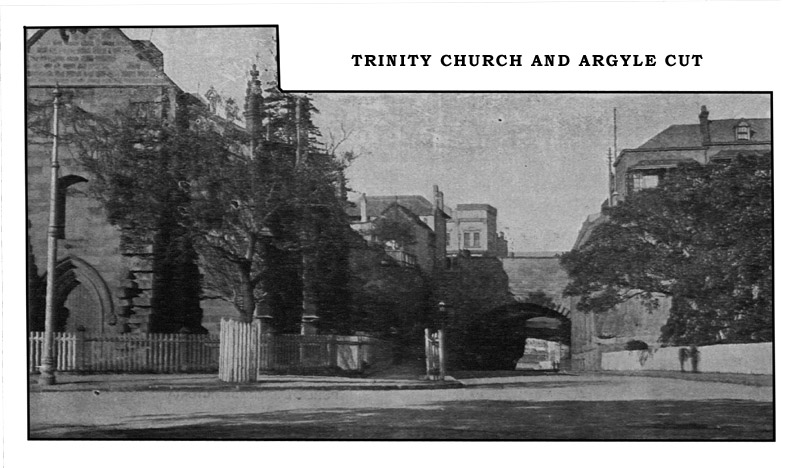
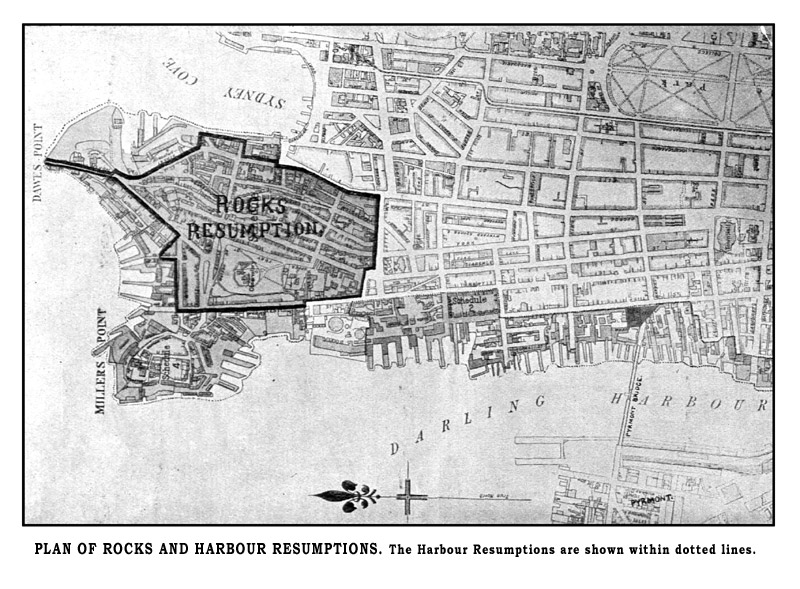
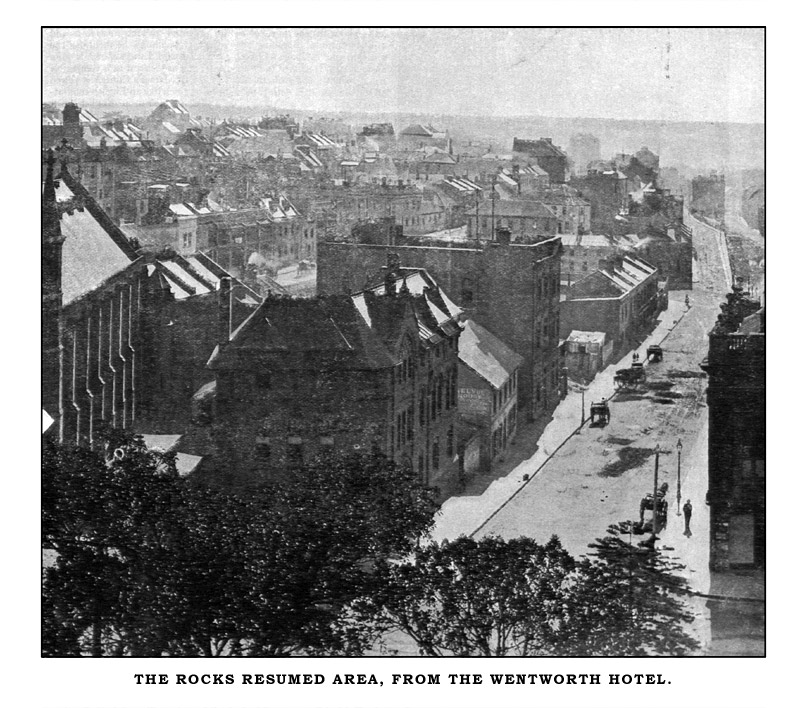
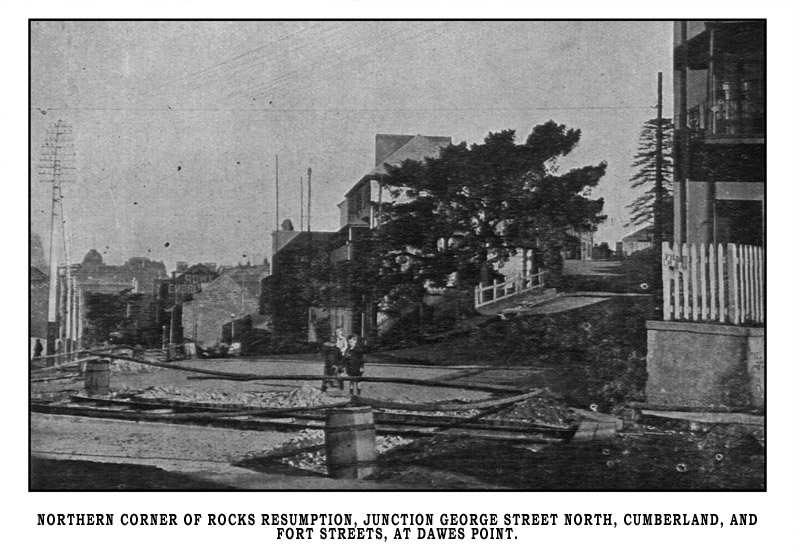
 No mention of the resumed area would be complete without some allusion to the notable scheme propounded by the Advisory Board for the housing of the men who work along the wharves, & who reside mainly on or around “The Rocks,” in buildings five stories in height, & containing between them some five-hundred families, or, say, between three & four thousand souls. One will have frontages to Kent, Windmill, & Argyle streets. The other will be in Kent-street, somewhere at the foot of the Observatory Reserve. Each “tenement” will consist of from two to five rooms, lit by electricity, reached by lifts; & as sanitarily perfect as science can make them. In the great basement there will be a library, baths, & probably shops. The square will enclose a courtyard common to the use of all. Such, taken as a whole, is the gist of the plans put forward. Whether the Australian working-man himself will approve of the scheme has yet to be discovered. In London, tenement houses are common enough, & are thoroughly appreciated by the classes for whose benefit they were built.