Search This Blog

Showing posts with label Heritage. Show all posts

Wednesday, November 18, 2026

Lord Howe Island – Its History and Place in New South Wales – NSW

Lord Howe Island sits in the Tasman Sea, a crescent of volcanic rock, palm forest and lagoon roughly 600 kilometres east of Port Macquarie and about 700 kilometres north-east of Sydney. It is not an Australian external territory like Norfolk Island or Christmas Island. It is part of New South Wales — brought within the colony’s boundaries by Imperial statute in 1855, still under NSW law today, and run day to day by a statutory Board that answers to a NSW minister. That constitutional fact shapes almost everything that follows: land tenure, elections, tourism limits, and the way World Heritage duties sit on a small island community.

This page gathers the documented story from volcanic origins and the 1788 sighting by HMS Supply, through whaling-era settlement, Kentia palms, flying boats and the 1974 airstrip, to the Lord Howe Island Act 1953, World Heritage listing in 1982, rodent eradication, and the pressures that still sit on the southernmost coral reef.

Volcanic island group and Ball’s Pyramid

Map of Lord Howe Island, 1952. Public-domain cartography of the main island settlement area and surrounding features. The map predates the 1974 airstrip. Credit: New South Wales. Department of Lands. Source: Wikimedia Commons. Licence: Public domain.

The Lord Howe Island Group is the eroded remnant of a large shield volcano. Federal heritage material published by the Department of Climate Change, Energy, the Environment and Water (DCCEEW) summarises the geology in plain terms: nearly seven million years ago, movement of the underwater Lord Howe Rise helped build a shield volcano on its western edge; over time the sea removed about ninety per cent of that volcano, leaving the islands that remain. The main island is dominated at its southern end by Mount Gower (about 875 metres) and Mount Lidgbird (about 777 metres), with a lowland saddle and settlement area between the northern hills and those peaks.

Lord Howe Island looking toward Mount Lidgbird and Mount Gower from Mount Eliza. Modern photograph of the volcanic southern peaks that dominate the island’s skyline. Credit: EmGer7. Source: Wikimedia Commons. Licence: CC BY-SA 3.0.
Mount Gower, southern Lord Howe Island. Modern photograph. The summit cloud forest is one of the habitats that helped justify World Heritage listing. Credit: HeijiD. Source: Wikimedia Commons. Licence: CC BY-SA 4.0.

Offshore lie the Admiralty Islands, the Mutton Bird Islands, smaller stacks and reefs, and — south-east of the main island — Ball’s Pyramid, a sheer volcanic pinnacle often described as the tallest volcanic sea stack of its kind. UNESCO and Australian heritage statements treat the whole group, including reefs and surrounding marine environments, as one World Heritage property. The terrestrial area is only about 1,540 hectares; the inscribed property including marine waters is far larger (on the order of 146,300 hectares in the Outstanding Universal Value summary).
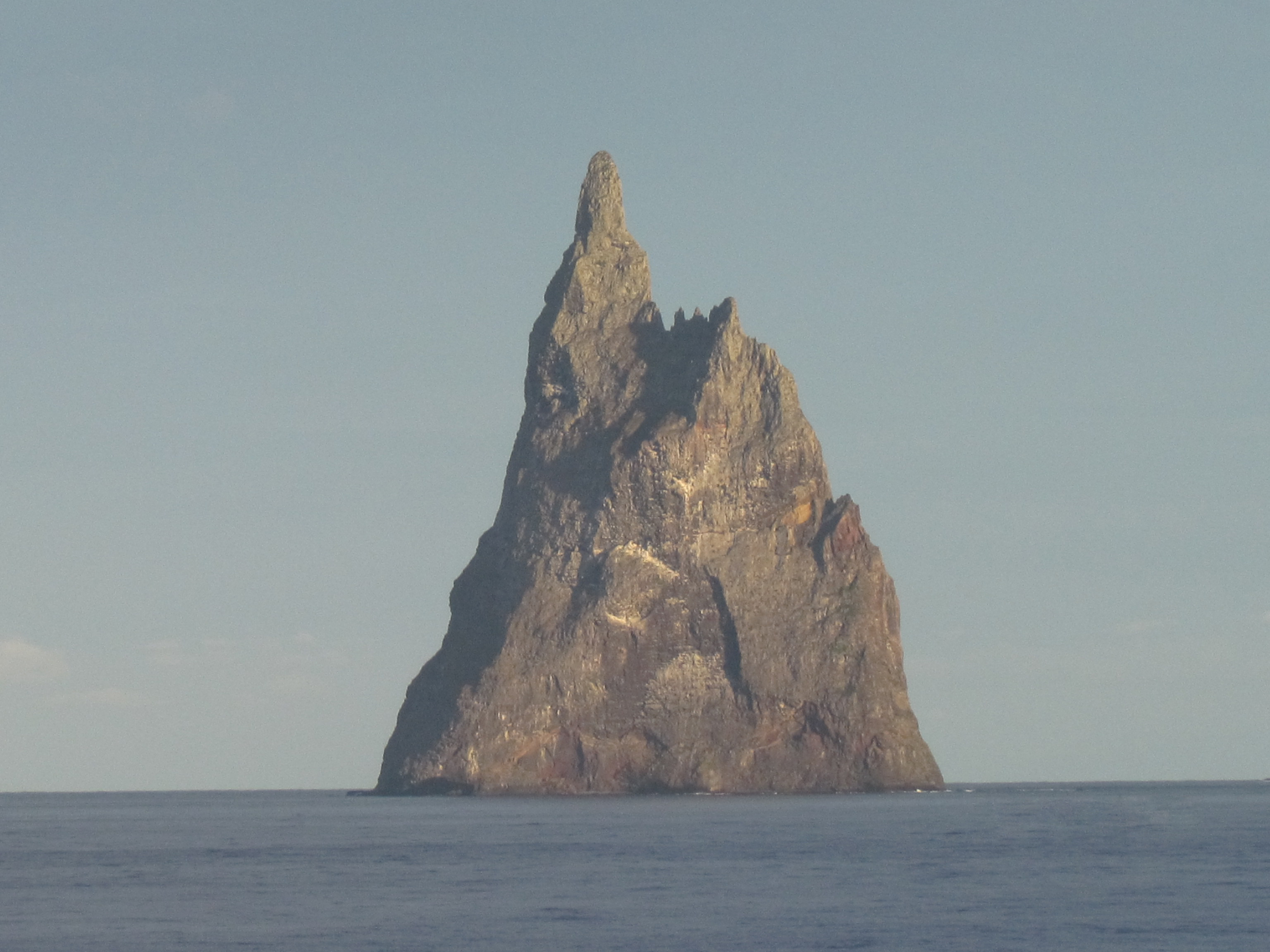
Ball’s Pyramid, the sheer volcanic stack about 23 km south-east of Lord Howe Island. Modern photograph. Named after Lieutenant Henry Lidgbird Ball. Credit: JillBBruce. Source: Wikimedia Commons. Licence: CC BY-SA 4.0.
Ball’s Pyramid in the South Pacific, from Captain Henry Mangles Denham’s mid-nineteenth-century survey work (period illustration; later published). Credit: Henry Mangles Denham (1800–1887). Source: Wikimedia Commons. Licence: Public domain.

About three-quarters of the land is managed as the Permanent Park Preserve under the Lord Howe Island Act. The preserve takes in the northern and southern mountains of the main island, the offshore islets, and Ball’s Pyramid. That park status matters later in the legal story: it is not a mainland national park created under a different Act so much as a preserve created inside Lord Howe’s own statute, with the Board required to manage it in a way aligned with national-park standards.

Before 1788: what is and is not documented

There is no documented permanent human community on Lord Howe Island before European sighting in 1788. Museum and heritage accounts treat the island as uninhabited when Ball’s party arrived. That is not the same as claiming no human being ever touched the place. Pacific voyaging left traces on many islands; for Lord Howe the careful wording is that permanent pre-1788 settlement has not been demonstrated in the archaeological and historical record so far assembled. Where older speculation appears in secondary writing, it should be read as speculation unless archaeology or contemporary records say otherwise.

Discovery, 17 February 1788

Chart of Lord Howe Island after the February–March 1788 discovery and landing voyage of HMS Supply under Lieutenant Henry Lidgbird Ball. Period chart published by John Stockdale (1789), not a modern survey; Stockdale is the publisher named on the Commons and Royal Museums Greenwich record rather than the voyage draughtsman. Credit: Published by John Stockdale (Royal Museums Greenwich collection). Source: Wikimedia Commons. Licence: Public domain.

On 17 February 1788 Lieutenant Henry Lidgbird Ball, commanding the First Fleet armed tender HMS Supply, sighted the island while sailing from Sydney Cove to found the Norfolk Island settlement. The Lord Howe Island Museum’s discovery notes, written by naturalist and local historian Ian Hutton, give the sequence clearly: sighting on the outward Norfolk voyage; landing on 13 March 1788 on the return, when men from Supply came ashore to explore and claim the island in the name of the Colony of New South Wales.

Document signed by Lieutenant Henry Lidgbird Ball of the armed tender Supply, Sydney Cove, 7 April 1788. State Library of New South Wales. Contemporary paperwork from the discoverer’s hand; not a portrait. Credit: Blackburn family (Ball, Henry Lidgbird, d.1818; Phillip, Arthur, 1738–1814). Source: Wikimedia Commons. Licence: Public domain.
HMS Supply off Lord Howe Island, from George Raper’s voyage drawings (period drawing, dated in the Commons description to about 1790–1792). Identified on the file page as His Majesty’s Brig Supply off Lord Howe Island. Credit: George Raper (Lieut. RN). Source: Wikimedia Commons. Licence: Public domain.

Ball named the island after Lord Howe — Richard Howe, then First Lord of the Admiralty. Mount Lidgbird and Ball’s Pyramid take Ball’s own names. Other First Fleet ships visited the same year; sailors left diary notes and sketches of birds that had never met people with guns. Those early natural-history images matter because several of the tame island birds would not survive the nineteenth century.

Admiral Richard Howe, 1st Earl Howe (1726–1799), First Lord of the Admiralty when the island was named. Portrait by John Singleton Copley, about 1794, in the Royal Museums Greenwich collection (BHC2790). Howe did not visit the island. Credit: John Singleton Copley. Source: Wikimedia Commons. Licence: Public domain.
White swamphen (Porphyrio albus), an extinct Lord Howe Island bird. Contemporary voyage drawing by Arthur Bowes Smyth from his 1787–1789 journal of the Lady Penrhyn (State Library of New South Wales; Commons date 1788). No living birds remain. Credit: Arthur Bowes Smyth (1750–1790). Source: Wikimedia Commons. Licence: Public domain.

The white swamphen (Porphyrio albus), known from early voyage illustrations including Arthur Bowes Smyth’s 1788 journal drawing, is among the island birds that later disappeared. “Discovery” for the British state was also the opening of a hunting ground. Settlement would deepen that pressure.

Whaling stopover and settlement from the 1830s

From about 1800 the island became a known provisioning stop for whaling and Pacific trading ships needing water, vegetables, fish and meat. Permanent settlement followed in the early 1830s. The Lord Howe Island Museum’s settlement account names three men — Ashdown, Bishop and Chapman — arriving from New Zealand on the barque Caroline with Māori wives and two Māori boys, settling at Hunter Bay (Old Settlement) to supply ships. The museum dates that arrival to 1833; other accounts date it to 1834.

In 1841 Captain Owen Poole and Richard Dawson bought the earlier settlers’ holdings. Other families followed, including Thomas and Margaret Andrews in 1842. Dr John Foulis arrived in 1844. In 1847, after failing to secure a lease from the NSW Government, Poole, Dawson and Foulis abandoned their venture; employees could leave or stay as independent settlers. Andrews descendants through the Nichols line remain part of island genealogy. In 1853 Nathan Chase Thompson, a rigger from the American whale ship Belle, settled with partners and women from the Gilbert Islands (Kiribati). Later Thompson–Wilson marriages knit much of the modern island kinship network. By the 1880s the museum describes a small, stable, multicultural community.

Life was market gardening, fishing, trade with passing ships, and hard work at the edge of the Pacific. Introduced pigs and goats, useful as food, later went wild and damaged habitat — a pattern repeated on many islands. Endemic birds that had no fear of people were easy to kill. Extinction and decline are part of the settlement record, not a side note.

Part of New South Wales, not an external territory

The 1855 boundary wording

Lord Howe Island is often described as a dependency of New South Wales — a phrase that captures its distance from the mainland and its special administrative arrangements. Legally, though, the island is part of New South Wales itself rather than an Australian external territory. The Lord Howe Island Board’s plain-language guides put the point directly: the island “was included as part of the Colony of NSW in 1855 and the laws of NSW continue to apply on the Island today.”

The Imperial New South Wales Constitution Act 1855 (18 & 19 Vict. c. 54), given Royal Assent on 16 July 1855, set the colony’s limits. Section XLVI expressly included “Lord Howe Island, being in or about the Latitude of Thirty-one Degrees Thirty Minutes South and the One hundred and fifty-ninth Degree of East Longitude, reckoning from the said Meridian of Greenwich,” within the boundaries of New South Wales. That clause is why the island sits inside the State’s legal map even though it lies east of the ordinary mainland longitude limit stated in the same section.

So Lord Howe is inside New South Wales. It is not administered as an Australian external territory under Commonwealth territories law in the way Norfolk Island has been. NSW Acts apply generally, with special island legislation layered on top. The Board’s Information Sheet 2 explains that NSW laws apply as they do elsewhere in the State, except where they do not apply or apply in a modified way; the Crown Lands Act regime that governs much mainland Crown land does not govern Lord Howe in the ordinary way because the Lord Howe Island Act 1953 occupies that field.

Early officials, Forest Reserve and the first Board

Distance meant light government at first. The museum’s administration notes say the island was proclaimed a Forest Reserve and that Captain Armstrong arrived in 1878 as the first resident government official — forest ranger, magistrate, postmaster and registrar rolled into one. Conflict with some residents led to inquiry and his removal, later tempered by parliamentary committee findings. Visiting magistrates followed; a Government House for officials was built about 1890. Through the late nineteenth century the island remained a tiny, remote settlement whose practical contact with Sydney came by sailing vessel and later steamship rather than by any continuous mainland bureaucracy.

Royal Commission inquiries into island affairs around 1911–12, tied in part to palm-seed marketing, led to a Board of Control appointed in 1913: three mainland public servants in Sydney, advised by a local residents’ committee. The Board’s early powers sat in the terms of appointment rather than a dedicated Act. For decades residents held only permissive occupancies over Crown land. Palm-seed bonuses helped fund local services until that trade slumped in the Second World War, while postwar air travel increased tourism pressure.

Lord Howe Island Act 1953

The Lord Howe Island Act 1953 created a statutory authority to care for, control and manage the island, its trade and the welfare of residents, subject to the NSW minister’s direction and control (except when making a report or recommendation). The 1953 version set up a mainland-appointed Board and an elected Island Committee. It confirmed that all land remained vested in the Crown — no freehold — and provided for leases in perpetuity (originally up to five acres) for Islanders’ homes, plus shorter special leases for agriculture and similar uses. Transfer and price rules were designed, at Islanders’ urging, to stop homes being priced out of local hands.

Amendments in 1981–82 restructured representation so elected Islanders sat on the Board itself, abolished the separate Island Committee, adjusted who counted as an “Islander,” and dedicated the northern and southern ends of the main island and the adjacent small islands, including Ball’s Pyramid, as a permanent park reserve. Further 2003–04 amendments expanded the Board to seven members — today’s pattern of four Islanders elected by the community and three members appointed by the minister — strengthened governance standards along local-government lines, promoted ecologically sustainable development, and ended the Board’s old monopoly on Kentia gathering and sale.

Detailed election, lease, environment, anchoring and alcohol rules are set out in regulations under the Act. The Lord Howe Island Board identifies the Lord Howe Island Regulation 2014 as the instrument that gives effect to those provisions.

Who is an Islander, and who may lease

Board Information Sheets summarise how “Islander” status works under the Act: it carries priority for leases and eligibility for elected Board seats. Broadly, a person may qualify by ten years’ continuous residence as a genuine home, or under older “1981” pathways tied to pre-1954 permissive occupancy families. The Minister, on Board recommendation, can confer status in special cases. Perpetual leases stay Crown leases, not freehold titles. Non-Islanders can take a lease only in limited circumstances, typically where no Islander is willing and able. Inheritance rules favour Islanders and lineal descendants; the Board keeps a public register of leases. Those rules help explain why Lord Howe still feels like a closed land market even while it welcomes capped tourism.

As described on the Board’s About page, the Board remains responsible to the NSW Minister for the Environment, with staff employed under the NSW Government and a chief executive on the island. It performs local-government-like functions — roads, power, aerodrome, planning consents, business licensing, biosecurity controls on animals, plants and vehicles — with extra custodial duties over Crown land and tourism that go beyond an ordinary mainland council.

Kentia palms, ships and scientific visitors

Howea forsteriana, the Kentia (thatch) palm. Modern photograph of a cultivated plant. Seed and later seedling exports from Lord Howe Island became a major island industry from about the 1870s. Credit: Krzysztof Ziarnek, Kenraiz. Source: Wikimedia Commons. Licence: CC BY-SA 4.0.

Four palm species are native to Lord Howe. Howea forsteriana, the Kentia or thatch palm, became a global indoor plant. From about 1870 seed exports fed nurseries in Europe, America and Australia. The museum notes that houses were thatched with it locally, while overseas it filled hotel lobbies and parlours — the Savoy in London appears in the museum’s palm-industry retelling. Seed marketing disputes helped trigger the early Board. After the Second World War the trade shifted; by 1981 seed exports had given way to live seedlings, and the Board nursery later passed to private operators. The palm story is both livelihood and landscape: pure stands of Howea still shape the lowland forest.

Allan Riverstone McCulloch of the Australian Museum with a cine camera on Mount Gower, Lord Howe Island. Photograph by Frank Hurley, 1921 (Australian Museum / Wikimedia Commons). Credit: Frank Hurley, 1921. Source: Wikimedia Commons. Licence: Public domain.

Scientific visitors kept coming. Australian Museum ichthyologist Allan McCulloch filmed and collected on the island in the early twentieth century; Frank Hurley’s 1921 photograph of McCulloch with a cine camera on Mount Gower is one of the clearer period images of that scientific traffic. Later generations of biologists would chase woodhens, phasmids, land snails and reef ecology. Shipping underpinned it all: Burns Philp steamers such as SS Morinda (1932–52 in museum notes) and, in recent decades, the Island Trader freight run from Port Macquarie.
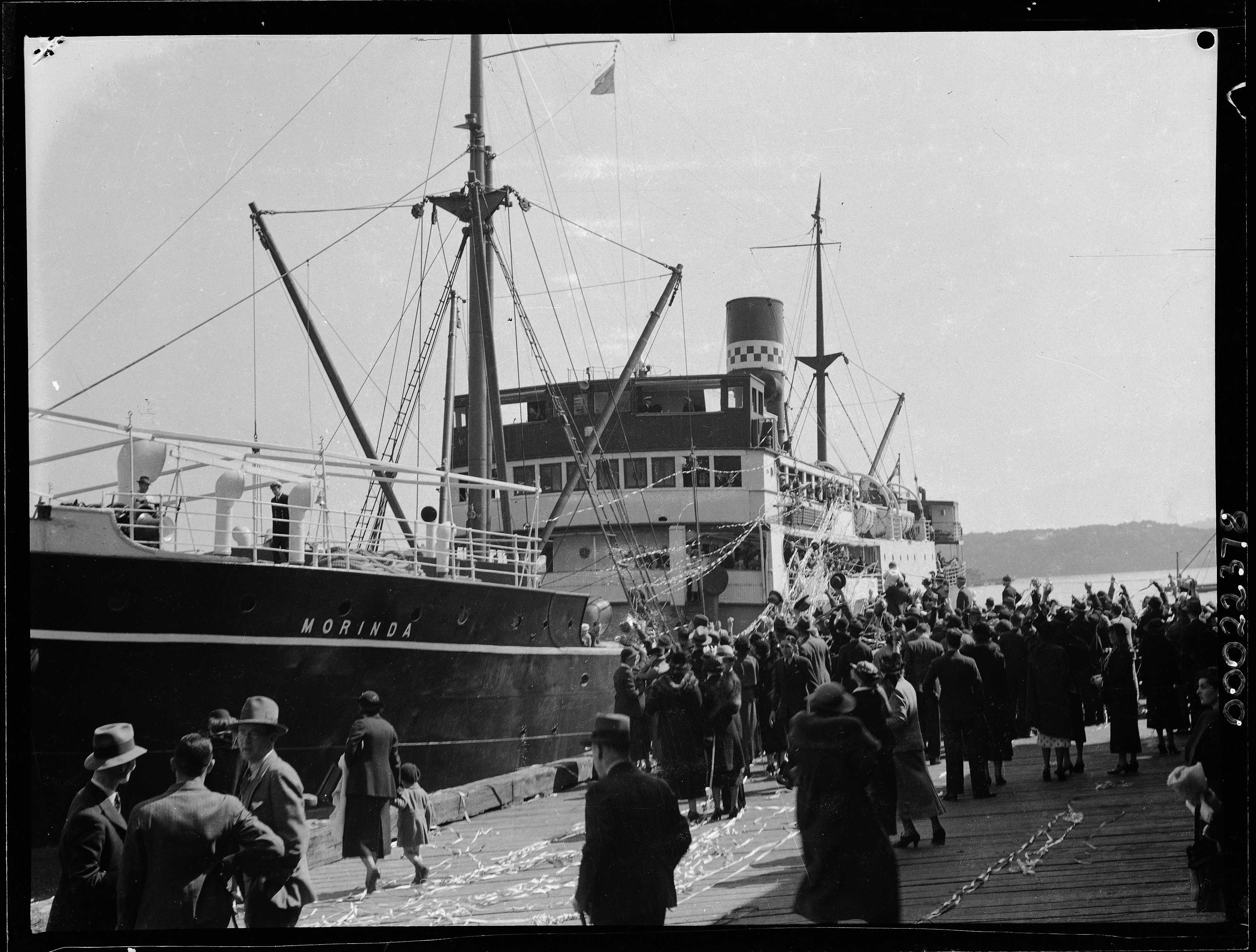
SS Morinda departing No. 10 wharf, Walsh Bay, Sydney, 5 September 1936. Burns Philp steamer used on the Lord Howe run; this photograph shows cast and crew of the film Mystery Island boarding for Lord Howe Island. Credit: Australian National Maritime Museum on The Commons (Samuel J. Hood Studio Collection). Source: Wikimedia Commons. Licence: No known copyright restrictions.
Lord Howe Island jetty and lagoon shore. Modern photograph. Freight still arrives by sea; the Island Trader service continues the island’s shipping link. Credit: Inas66. Source: Wikimedia Commons. Licence: CC BY-SA 3.0.

Flying boats, war links and the 1974 airstrip

Francis Chichester landed on Lord Howe Island for fuel in 1931 during his solo east–west Tasman crossing in the Gypsy Moth seaplane Madam Elijah. Island-hopping via Norfolk Island and Lord Howe was part of the planned route because the aircraft could not carry enough fuel for a nonstop crossing. Overnight a storm flipped the seaplane at its lagoon mooring; with local help he spent about nine weeks rebuilding engine and wings before flying on to Jervis Bay. The Lord Howe Island Museum’s aviation notes tell the story in those terms.

Flying boat at Lord Howe Island during the Second World War era. Historic photograph associated with naval service notes for Sub-Lieutenant N. C. Howard; illustrates wartime flying-boat presence at the island. Credit: Aussie~mobs (Flickr Commons upload of period photograph). Source: Wikimedia Commons. Licence: Public domain.

During the Second World War the RAAF operated Catalina flying boats to the island in connection with a meteorological station and radio base.

Commercial flying boats followed. Trans Oceanic Airways began scheduled passenger services in 1947; Qantas followed a few months later using Catalina and Sandringham aircraft; Ansett took over in the early 1950s and ran Short Sandringhams from Rose Bay on Sydney Harbour. Aircraft such as Beachcomber (VH-BRC) and Islander, each able to carry about forty-two passengers on the museum’s account, were timed to tide for lagoon landings, with up to six flights a week in the busy season. The three-hour trip from Sydney Harbour became the romance of postwar island travel until economics and ageing airframes forced a change. The last Ansett Rose Bay–Lord Howe passenger service ran on 10 September 1974. Beachcomber survives today at Solent Sky Museum in Southampton, still finished in Ansett colours.

Short S.25 Sandringham VH-BRC of Ansett Flying Boat Services at the Rose Bay terminal, Sydney, 3 October 1970. Beachcomber later operated the final Rose Bay–Lord Howe passenger service on 10 September 1974. Credit: RuthAS. Source: Wikimedia Commons. Licence: CC BY 3.0.

By 1974 the operation had become uneconomic. After years of debate, Australian Army engineers built a roughly 1,000-metre airstrip at the former Mosely Park swamp. Construction plant arrived by Navy landing craft in early March 1974; Army personnel themselves still came in by flying boat. The first landing on the new strip was a RAAF Caribou used for a medical evacuation. The last scheduled flying-boat passenger service followed on 10 September 1974, after which small land aircraft took over the link. In September 2024 the island marked fifty years since that construction, with Army and Navy veterans returning and presenting material to the museum. Today’s flights from the mainland are the ordinary door to a place that once arrived by sail, steamer and flying boat.

A low-flying-aircraft warning sign near Lord Howe Island Airport. Modern photograph. The island’s airstrip was built in 1974 by Australian Army engineers; the last scheduled Rose Bay flying-boat passenger service ran on 10 September 1974 as land aircraft took over the link. Credit: Fanny Schertzer. Source: Wikimedia Commons. Licence: CC BY 2.5.

World Heritage, Permanent Park Preserve and Marine Park
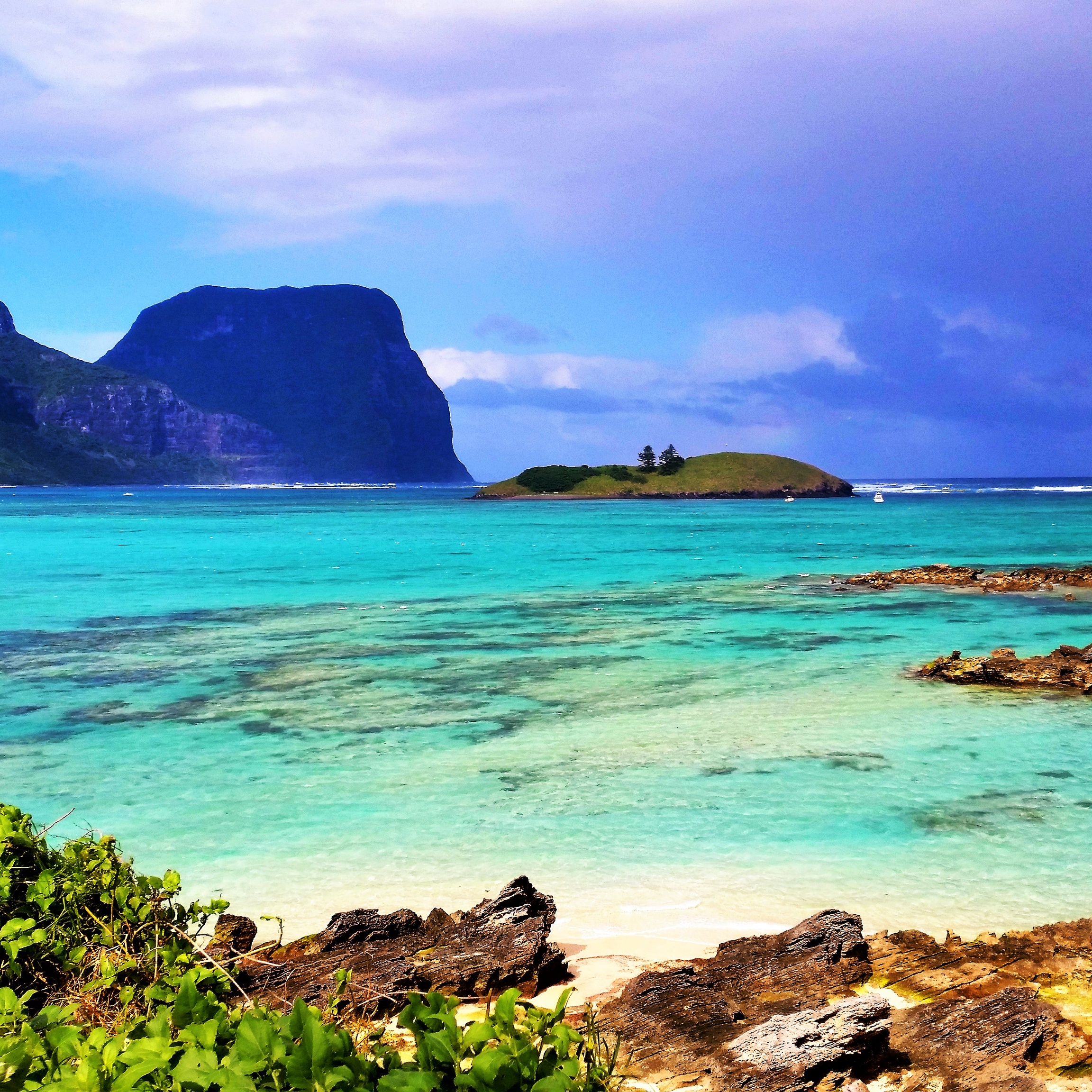
Lord Howe Island lagoon and fringing reef. Modern photograph. The lagoon holds the world’s most southerly true coral reef system. Credit: Rocketrod58. Source: Wikimedia Commons. Licence: CC BY-SA 4.0.

The Lord Howe Island Group was inscribed on the UNESCO World Heritage List in 1982 for natural criteria that stress spectacular volcanic scenery, the world’s most southerly true coral reef, high endemism, and outstanding habitat for threatened species. It entered Australia’s National Heritage List on 21 May 2007. Iconic species named in the Outstanding Universal Value text include the flightless Lord Howe woodhen and the Lord Howe Island stick insect (phasmid), feared extinct until rediscovery on Ball’s Pyramid. The listing covers the main island, Ball’s Pyramid, associated islets and surrounding marine areas as one property — a reminder that the legal island group and the ecological island group are larger than the settlement saddle where most visitors sleep.

Subtropical forest on Lord Howe Island. Modern photograph. Rainforest and palm forest cover much of the Permanent Park Preserve. Credit: Fanny Schertzer. Source: Wikimedia Commons. Licence: CC BY 2.5.
Giant banyan trees on Lord Howe Island. Modern photograph of living trees in the settlement and forest edge landscape. Credit: HeijiD. Source: Wikimedia Commons. Licence: CC BY-SA 4.0.

NSW created marine park protection in the late 1990s (heritage summaries commonly cite 1998–99 for the State marine park). Commonwealth waters beyond three nautical miles later gained additional marine reserve protection. Board Information Sheet 2 notes NSW waters to three nautical miles and Commonwealth waters from three to twelve, with the Environment Protection and Biodiversity Conservation Act 1999 applying to World Heritage impacts. Climbing on Ball’s Pyramid is tightly controlled; recent World Heritage outlook writing treats scientific and management access as the usual basis for permits.

Woodhen, phasmid, rats and recovery

Lord Howe woodhen (Hypotaenidia / Gallirallus sylvestris), the endemic flightless rail. Modern photograph. Numbers recovered after captive breeding and, more recently, rodent eradication. Credit: Toby Hudson. Source: Wikimedia Commons. Licence: CC BY-SA 3.0 au.

The woodhen was driven to a handful of breeding pairs by the late twentieth century. Captive breeding and predator control pulled it back from the brink; federal heritage text still remembered populations around a couple of hundred in older summaries. The Board’s post-eradication ecological reporting is more recent and more hopeful: the annual survey in late 2024 counted at least 1,638 woodhens, up from 1,147 in 2022 and from 208 birds in 2019 when birds were released from captive management around the Rodent Eradication Project.

Lord Howe Island stick insect (Dryococelus australis), photographed in captivity. Modern photograph. The wild remnant population is associated with Ball’s Pyramid; reintroduction planning for the main island has been discussed publicly since rodent clearance. Credit: Miroslav Bobek, Zoo Praha. Source: Wikimedia Commons. Licence: CC BY-SA 4.0.
Lord Howe Island currawong (Strepera graculina crissalis). Modern photograph. Endemic subspecies; birds at risk were held in captivity during the 2019 rodent baiting. Credit: Fanny Schertzer. Source: Wikimedia Commons. Licence: CC BY-SA 4.0.

Black rats reached the island after the Makambo grounding at Ned’s Beach in 1918 — museum and conservation accounts agree on that wreck as the entry point. Rats are implicated in the extinction of five endemic birds, many invertebrates and some plants. The phasmid vanished from the main island; climbers later found dead insects on Ball’s Pyramid, and live insects were confirmed there in 2001. Captive breeding (notably at Melbourne Zoo and partner institutions) kept a safety population. In March 2026 ABC News reported new colony finds on Ball’s Pyramid and public discussion of possible reintroduction to remote parts of the Permanent Park Preserve, after rodent clearance on the main island.

Mice were present from the nineteenth century; rats from 1918. Control schemes never finished the job. In mid-2019 the Board ran a whole-island eradication using aerial and ground baiting, with woodhens and currawongs held in captivity for protection. The Board now states that the Rodent Eradication Project has been formally completed, with a 2025 final report and lessons-learned package. A 2023 “Checkpoint” detection program, reviewed with New Zealand’s Island Eradication Advisory Group, found no live rodents after more than two years without detections. An earlier post-baiting detection of rats in 2021 triggered an intensive response; vigilance and biosecurity remain permanent duties. Board ecological notes also record rediscoveries such as the Lord Howe wood-feeding cockroach (2022) and critically endangered land snails long thought gone.

Community, tourism cap and daily island life

Panorama from Malabar Hill, Lord Howe Island. Modern photograph looking across settlement, lagoon and southern mountains. Credit: BriMiDra. Source: Wikimedia Commons. Licence: CC BY-SA 4.0.
A bicycle beside an island road. Modern photograph. Cycling is everyday transport on Lord Howe under the low speed limit and visitor-management regime. Credit: David Stanley from Nanaimo, Canada. Source: Wikimedia Commons. Licence: CC BY 2.0.

A few hundred people live on the island year-round. Exact headcounts move with censuses and Board summaries; recent tourism planning material has used figures in the low-to-mid hundreds for permanent population. Kinship still runs through nineteenth-century settler lines, and many livelihoods sit in accommodation, tours, fishing, trades and Board employment.

Tourism is capped. The long-standing Board policy — repeated in the Lord Howe Island Tourism Association Destination Management Plan 2024–2034 and in the 2025 IUCN World Heritage Outlook — limits visitors to 400 people on the island at any one time. Combined with residents, that keeps the total human load low. Beds are limited; flights follow bookings. Bicycles beat cars; the speed limit is low. An environment levy helps fund conservation. The Destination Management Plan treats the cap as essential protection against overtourism, tying commercial growth to the same World Heritage and biosecurity constraints that shape Board decisions on leases and development.

Maritime displays inside the Lord Howe Island Museum on Lagoon Road, including boat and sail exhibits from the island’s shipping and flying-boat era. Credit: Fanny Schertzer. Source: Wikimedia Commons. Licence: CC BY 2.5.

Culture is practical and local: museum and hall events, walking tracks, lagoon swimming, palm forest, and the quiet that the visitor cap is meant to protect. Islander political voice runs through Board elections and lease debates more than through a separate mainland shire council. When governance or biosecurity rules tighten, disagreement is real — as it is in any small community.

Bleaching, biosecurity and pressures that remain

World Heritage status does not freeze the climate. ABC Mid North Coast reporting in August 2025 described Lord Howe’s February 2024 bleaching as the fourth and worst recorded there since 1998, with university researchers monitoring slow subtropical recovery while sea temperatures stayed above long-term summer averages for months. Tour operators who log lagoon temperatures have spoken publicly about stress on coral gardens. The 2025 IUCN outlook rated overall conservation prospects as good, praised the visitor cap and rodent work, and still flagged climate-driven bleaching, cloud-forest change, weeds, pathogens such as myrtle rust and Phytophthora, and biosecurity as ongoing concerns.

Getting people and cargo on and off a rodent-free World Heritage island means constant screening of fruit, plants, soil and vessels. The Board publishes pre-departure biosecurity guidance for visitors. Fresh incursions remain the nightmare scenario after a multi-year eradication. Coral bleaching and hotter summers are the slower emergency.

What Lord Howe shows about New South Wales

Erskine Valley, Lord Howe Island, 1965. Photograph by John Game. Historical colour photograph of the southern mountain country before later tourism infrastructure changes. Credit: John Game from Berkeley, United States. Source: Wikimedia Commons. Licence: CC BY 2.0.
Mount Gower plateau, Lord Howe Island, 1965. Historical photograph showing the summit plateau environment. Credit: John Game. Source: Wikimedia Commons. Licence: CC BY 2.0.

Lord Howe is a reminder that NSW is not only a coastal strip and inland plains. It includes a volcanic speck whose land law never allowed freehold, whose Board mixes elected Islanders with ministerial appointees, and whose global fame rests on birds, palms, a lagoon reef and a rock stack that sheltered an insect once thought extinct. People still reach for the word “dependency” when they want to stress distance and special arrangements; the statute book places the island inside New South Wales from 1855. The difference matters when people ask who makes the rules, who owns the ground, and why a visitor needs a booking and clean biosecurity habits before stepping onto the jetty.

Sources

Thursday, October 29, 2026

Bondi Beach – From Boondi and the O'Brien Estate to the Surf Clubs, the Pavilion and Black Sunday – A History

Every Sydneysider has a Bondi story. It might be a sunburn, a first surf, a pie on Campbell Parade, or a day stuck in traffic on Bondi Road trying to find a park. It's only a kilometre of sand between two sandstone headlands, but it's on the National Heritage List, and the Commonwealth's listing says it is "central to Australia's sense of self". Here's how it got that way.

Bondi Beach and Ben Buckler, looking north, 1937.

Bondi Beach and Ben Buckler, looking north, 1937. Royal Australian Historical Society, via Wikimedia Commons (no known copyright restrictions).

Country and the name

Long before anyone drew a map of it, this was Aboriginal country. Waverley Council's heritage assessment names the Bidjigal and Gadigal people. Waverley's Hello Bondi history names the Bidiagal, Birrabirragal and Gadigal as the traditional custodians. You can still see their rock engravings on the headlands. I covered some of them in my post on Sydney's Aboriginal rock engravings.

The sand gave up some of that history in a big storm. Waverley's heritage form says a gale in 1900 moved the dunes and uncovered large numbers of Aboriginal artefacts. Hello Bondi dates the storm to 1899. Waverley's heritage assessment says the stone tools, known as Bondi Points, are now in the Australian Museum.

Heritage NSW's list of Aboriginal place names says Bondi, or Boondi, means "water breaking over rocks". Hello Bondi says the word comes from the Dharawal language and can also mean the noise of water breaking over rocks. It says the word was also linked to fighting clubs, because of the loud thud they made. It has been spelt Bundi, Bundye and Boondye. Hello Bondi says the earliest written mention is "Bundi Bay" in an 1809 field book kept by the surveyor James Meehan.

Roberts, Hall and the Bondi Estate

After the British came, the land was granted to William Roberts, who had built the road to South Head. Waverley's heritage form says the 200-acre grant was made under Governor Paterson in 1809 and confirmed by Macquarie in 1810. Roberts used it as a cattle run and died in 1819.

Edward Smith Hall comes in here. He was the newspaper man behind The Monitor, the same Hall who fought the archdeacon over his pew at St James' in the 1820s. Sources describe his role differently. Waverley's heritage form and the Bondi Park and Pavilion heritage review say that in 1851 the 200 acres went to Roberts's granddaughter Georgiana and her husband Francis O'Brien "via Trustee Edward Smith Hall". Other accounts, such as the Historical Encounters site, say Hall and O'Brien bought the land together and called it the Bondi Estate. They add that Hall was O'Brien's father-in-law, and that O'Brien later bought out his share and renamed it the O'Brien Estate.

Either way, O'Brien ended up running the place. In 1855 the Crown reserved a 100-foot strip above the high-water mark for the public. From 1855 to 1877 O'Brien let people use the beach and the sandhills behind it as a picnic ground. The heritage review says it got "too rowdy", so he shut it in 1877. He went bankrupt that same year, and 51 acres went to his second wife's family, the Curlewises.

A public beach, 1882

Waverley Council had been set up in 1859 and wanted the beach made a public reserve. The government surveyed an area for public recreation in November 1881. In June 1882 it resumed more than 25 acres and dedicated them as a public reserve. Historical Encounters gives the date as 9 June 1882. Waverley Council was made trustee of Bondi Park in September 1885, and the reserve was enlarged to over 28 acres in October 1889.

Bondi Beach around 1900.

Bondi Beach around 1900. Powerhouse Museum collection, via Wikimedia Commons (Public domain).

The Bondi Aquarium pleasure grounds, around 1891.

The Bondi Aquarium pleasure grounds, around 1891. Henry King, via Wikimedia Commons (Public domain).

The trams

The trams made Bondi. The dates are a bit tangled. The national heritage listing says "the first tramway reached the beach in 1884". Waverley's heritage form says a tram to Bondi Beach finished near Hall Street in 1884, and the Bondi Park heritage review says the 1884 line ran to Denham Street for the Royal Aquarium at Tamarama, close enough to walk down to the beach. The Pavilion's own timeline says the line was extended to Bondi Beach in 1894. All the heritage sources agree that the first regular tram service from Circular Quay to Bondi Beach began in 1902. In 1911 the line was pushed along Campbell Parade to a new terminus at North Bondi, where the bus terminus is now.

The trams gave us the saying "shoot through like a Bondi tram", meaning to leave in a hurry. City Hub reports the last Bondi tram, number 1773, left for the depot in the early hours of Sunday 28 February 1960.

A tram at Bondi Junction, early 1900s.

A tram at Bondi Junction, early 1900s. William Henry Broadhurst, State Library of NSW, via Wikimedia Commons (Public domain).

Bondi trams in February 1960, weeks before the line closed.

Bondi trams in February 1960, weeks before the line closed. Photo: lindsaybridge, via Wikimedia Commons (CC BY 2.0).

When swimming by day was against the law

For most of the 19th century it was illegal to bathe in the sea in daylight at public beaches. People still swam, at dawn or after dark, or in the rock pools, which Waverley's heritage form says were in use at Bondi from the 1880s. The Bondi Baths were built at the southern end in 1888–89. Bronte's surf club history makes the point that "all bad laws have trouble being enforced".

In 1902 the ban was lifted. The Pavilion's timeline says beaches were then open for bathing between 8am and 8pm. Waverley Council put up its first surf bathing sheds in about 1903. Within a few years thousands of people were in the water, and many of them couldn't swim.

The Bondi dressing sheds built in 1911, photographed in 1917.

The Bondi dressing sheds built in 1911, photographed in 1917. Photographer unknown, via Wikimedia Commons (Public domain).

"Beautiful Bondi" ladies' dressing rooms, early 1900s.

"Beautiful Bondi" ladies' dressing rooms, early 1900s. William Henry Broadhurst, State Library of NSW, via Wikimedia Commons (Public domain).

The first surf club: Bondi or Bronte?

With more people drowning, the swimmers started organising. The Bondi Surf Bathers' Life Saving Club says it was formed at a meeting at the Royal Hotel, Bondi Junction, on 21 February 1907, and that the meeting was recorded in minutes held at Waverley Library. Heritage NSW's blue plaque program agrees, calling it "Australia's first recorded surf lifesaving club". The national heritage listing goes further and calls it "the first surf life saving club in the world". It says the red and yellow quartered caps of the new patrol were on the beach that summer.

Bronte doesn't accept that. Bronte Surf Life Saving Club says it was founded in 1903. It says a resident, Major Bond, was drilling Bronte regulars in lifesaving before 1900, and that the minutes of the club's 1907 annual meeting describe it as the fourth annual meeting. It also points to a document signed in 1931 by officials of the Surf Life Saving Association and placed in a time capsule under the old Bronte clubhouse, saying Bronte was first.

Bondi's reply is that there are no primary sources for Bronte's 1903 date, and that Bronte's Surf Bathing Association was writing to the papers in May 1907 that it was "now forming" a brigade. In 2005 Surf Life Saving Australia's historians looked at all the claims. They said the first organised group of lifesavers was actually at Manly in 1899, but that "it was the surf bathers of Bondi who first organised themselves as a formal club in February 1907". Bondi itself had long claimed 1906, and the club says it changed its dates in 2006 after that research. You'll still see "1906" on old badges and in some histories.

Original members of the Bondi Surf Bathers' Life Saving Club, October 1908.

Original members of the Bondi Surf Bathers' Life Saving Club, October 1908. Photographer unknown, via Wikimedia Commons (Public domain).

North Bondi's club began in 1907 too, as the Bondi Surf and Social Club, in a tent on the sandhills at the north end. In October 1907 the clubs came together as the Surf Bathing Association of New South Wales, which is now Surf Life Saving Australia. The National Museum of Australia dates that meeting to 18 October 1907, while Wikipedia's surf lifesaving article gives 10 October.

A Bondi team in the march past, 1920s or 1930s.

A Bondi team in the march past, 1920s or 1930s. Photo: Sam Hood, State Library of NSW, via Wikimedia Commons (Public domain).

The Pavilion

In 1923 Waverley Council ran a design competition for a Bondi Beach improvement scheme. The Pavilion's own history says the architects Robertson and Marks won it, with Leith McCredie as the designer. The plan had Turkish baths, shops, lockers, a gym and a ballroom, in a mix of Georgian revival and Mediterranean styles. The foundation stone was laid in May 1928, and the old Castle Pavilion was pulled down that June.

The Pavilion itself didn't open until 1929, not 1928. The Turkish and hot sea water baths opened on 20 July 1929, and the Pavilion officially opened on 21 December 1929. The national heritage listing says the opening drew an estimated 200,000 people, and that by then about 60,000 people came to the beach on a summer weekend day. After a $48 million restoration, the Pavilion reopened in late 2022. The Guardian reported in September 2022 that 1920s murals that had been hidden for years were back on show.

The Bondi Pavilion under construction, October 1928.

The Bondi Pavilion under construction, October 1928. Photographer unknown, via Wikimedia Commons (Public domain).

The new Pavilion around 1930.

The new Pavilion around 1930. Photographer unknown, via Wikimedia Commons (Public domain).

Bondi Icebergs

At the southern end, the ocean pool belongs to the Icebergs. The national heritage listing says the Bondi Icebergs swimming club was formed in 1929. To be a member you have to swim in the Bondi Baths on at least three out of every four Sundays through winter, for five years. Waverley's heritage form says the Icebergs have been at the baths since 1929. The listing describes the members as "a club of larrikins who retain the discipline to complete their winter duty".

The Icebergs pool, looking across the beach to Ben Buckler.

The Icebergs pool, looking across the beach to Ben Buckler. Photo: Sgroey, 2016, via Wikimedia Commons (CC BY 4.0).

Black Sunday, 6 February 1938

It was a hot Sunday. The Bondi club's account says about 35,000 people were on the beach. The Australian Institute for Disaster Resilience says the temperature was about 40 degrees in the early afternoon and nearly 750 people were in the water. Around 3pm, as the club's patrols were changing over and about 60 members were waiting for a surf carnival, three huge waves came in one after another. The water had no time to run out. When it did, the backwash dragged swimmers into a deep channel and out to sea.

The lifesavers went straight in with the reels, rubber floats, boards and skis. The club says it took about 30 minutes to clear the water. About 250 people needed help: 150 were rescued unharmed, 60 had swallowed a lot of water, 35 were brought back from unconsciousness, and five died. The disaster institute puts the rescues at 245 in about 20 minutes. The five who died were Bernard Byrne, Ronald McGregor, Charles Sauer, Michael Kennedy and Leslie Potter. Heritage NSW's blue plaque calls it "the largest mass surf rescue in Australia's history". A visiting American doctor, Marshall Dyer, said he had never seen "such magnificent work as was done by those lifesavers".

Bondi surf lifesavers photographed by George Caddy, April 1938, two months after Black Sun

Bondi surf lifesavers photographed by George Caddy, April 1938, two months after Black Sunday. George Caddy, via Wikimedia Commons (Public domain).

War, a queen and the changing crowd

The Sydney Morning Herald's 2024 history says the beach was fortified with barbed wire and defence blocks during the Second World War, and that soldiers on watch slept in the tunnels under Campbell Parade. In 1954 the young Queen Elizabeth II was driven along the beach in a jeep. After the war came the migrants: the Herald mentions Central European cake shops, Greek milk bars and Jewish delis, and later the backpackers.

Bondi was also home to Graeme Thorne, the eight-year-old kidnapped on his way to school in 1960, whose story I've told in an earlier post. The same year the last tram left.

Up to today

Bondi went onto the National Heritage List on 25 January 2008, as the ABC reported at the time. The listing covers the beach, Bondi Park and the headlands, the Pavilion, the two surf clubs and the Icebergs pool. The Pavilion says the Bondi Beach Cultural Landscape was added to the State Heritage Register that June.

Then came the darkest day in the beach's history. On 14 December 2025, two gunmen opened fire on a Hanukkah celebration near Archer Park at Bondi, killing 15 people, among them a 10-year-old girl, two rabbis and a Holocaust survivor, the ABC and Reuters reported. Flowers were piled up at the Pavilion for days afterwards.

The floral tribute at Bondi Pavilion after the attack of 14 December 2025.

The floral tribute at Bondi Pavilion after the attack of 14 December 2025. Photo: J03098, 2025, via Wikimedia Commons (CC BY 4.0).

The beach is still where Sydney goes when it gets hot. Next time you're on Campbell Parade, think of the Gadigal fishing these waters, O'Brien's rowdy picnickers, and the lifesavers running into the surf on Black Sunday.

Bondi Pavilion and the beach, looking south, 2023.

Bondi Pavilion and the beach, looking south, 2023. Photo: DXR, 2023, via Wikimedia Commons (CC BY-SA 4.0).

Where this came from

  • Australian Government (DCCEEW): Bondi Beach, National Heritage List (inscribed 25 January 2008), and the Commonwealth Gazette listing.
  • Waverley Council: Draft Waverley Heritage Assessment, Vol. II, Thematic History (2020); Bondi Beach Urban Conservation Area heritage inventory form; Bondi Beach Inter-War Study (2014).
  • Bondi Park and Pavilion Heritage Review (Australia ICOMOS).
  • Bondi Pavilion: Our history (bondipavilion.com.au).
  • Bondi Surf Bathers' Life Saving Club: The Beginning of the Club; History; Black Sunday.
  • Bronte Surf Life Saving Club: About Us.
  • Heritage NSW: Blue Plaques, Bondi Surf Bathers Life Saving Club; Aboriginal place names.
  • Hello Bondi (Waverley Council): First Nations history.
  • Australian Institute for Disaster Resilience: Bondi's Black Sunday, 1938.
  • National Museum of Australia: First lifesaving club.
  • Sydney Morning Herald, 16 October 2024; City Hub (last Bondi tram); The Guardian, 24 September 2022; ABC News, 25 January 2008 and 15–16 December 2025; Reuters, 15 December 2025.
  • Historical Encounters: Bondi Beach (for the Hall–O'Brien purchase version and the 9 June 1882 date).

Tuesday, October 27, 2026

The Sydney Masonic Centre, 279 Castlereagh Street, and the Freemasons of New South Wales

If you've ever walked up Castlereagh Street from Central towards Museum station, you'll know the one. On the north-west corner of Goulburn Street there's a great grey wedge of concrete that seems to lean out over the footpath, with a slim office tower balanced on top. It's the Sydney Masonic Centre, home of the Freemasons of New South Wales and the ACT. A lot of Sydneysiders have been inside for a conference, an exam or a gig without ever knowing what goes on upstairs. (For anyone looking it up, it's Castlereagh Street, not Castle Street. The Freemasons give the address as 279 Castlereagh Street, the City of Sydney's heritage records list it as 279–283 Castlereagh Street, and the events venue sends visitors to the front door at 66 Goulburn Street. They're all the same building.)

The Sydney Masonic Centre on the corner of Castlereagh and Goulburn Streets, with Civic Tower rising above

The Sydney Masonic Centre from the corner of Castlereagh and Goulburn Streets, with Civic Tower on top. Photo: Shkuru Afshar, 2022, via Wikimedia Commons (CC BY-SA 4.0).

A corner with Masonic roots

The Freemasons were on this corner long before the concrete. The City of Sydney's heritage inventory says the northern part of the site has belonged to Freemasonry since January 1884, when the New Masonic Hall at 279–281 Castlereagh Street, designed by the architects Backhouse & Lough, was consecrated. The land story behind it is a very Sydney tangle. In the early 1880s the title to that northern block went to four men: licensed victualler James Hunt, cordial maker John Starkey, builder Unni William Carpenter and druggist Nicholas Weekes, later Mayor of Manly. All four were officers of the Grand Lodge. Starkey was its Grand Treasurer and Weekes its Grand Secretary. The block passed to the Grand Lodge of New South Wales Masonic Hall Company in 1886, and finally to trustees of the United Grand Lodge in October 1913.

The southern part, right on the corner, had a livelier past. From the 1860s it held the Pompey's Pillar Hotel and a pair of houses on Goulburn Street. The retailer Samuel Hordern bought them in 1901, and by 1903 he owned the whole Goulburn Street frontage. Later there was a 1919 building on the old hotel site called Millar House, plus the Bapaume Building next door on Castlereagh Street. In 1935 the United Grand Lodge decided its 1884 hall had too many shortcomings and resolved to buy property "suitable for the erection of a Temple worthy of this jurisdiction". It picked up pieces of the Hordern estate when the trustees began selling at the end of 1937, and it made its last purchase, Millar House and the Bapaume Building, in May 1945.

The Freemasons' own timeline for the centre lists the buying of the neighbouring properties as running from 1935 to 1945.

A temple for the war dead that took thirty years

Buying the land was the easy part. The heritage inventory tells how the Grand Master, Lord Gowrie, revived a big 1936 scheme in September 1943, suggesting it could become a Peace Memorial Temple for Freemasons who had served and died in the two world wars. In December 1954 Grand Lodge voted to set up a building fund for a Memorial Masonic Temple. Not everyone was keen, and the first appeal, launched in 1957, foundered. It was relaunched in 1959. That's why the inventory still lists "Memorial Masonic Centre" as a former name.

A building committee was finally formed in June 1967. It included the Grand Lodge's own Grand Architect, T. W. Hodgson, and Ronald Gilling, a partner in Joseland & Gilling. That firm went back to 1919, when Richard George Howard Joseland teamed up with Frederick Glynn Gilling. Between the wars they were known for substantial houses. After Gilling's son Ronald Andrew became a partner in 1948, the practice moved into big commercial work. In the 1960s and 70s it designed the ANZ Bank and South British United Insurance buildings in Hunter Street, the Qantas Centre near Lang Park and the Colonial Mutual building in Pitt Street.

A model and sketches were shown to the Freemasons in March 1972. In 1973 a revised development application went in for a lodge, shops and an office block, and the building application followed in July 1974. Tenders were called on 14 April 1975 and the foundation stone was laid on 15 May 1976. People started moving in during December 1978, and the building was officially opened and dedicated on 10 March 1979, with an International Masonic Festival to mark it.

The Castlereagh Street side of the Sydney Masonic Centre

The Castlereagh Street side. The overhanging, windowless top floor sits on big splayed concrete braces. Photo: Shkuru Afshar, 2022, via Wikimedia Commons (CC BY-SA 4.0).

Brutalism, Sydney style

The heritage inventory sums it up as "an outstanding and powerful example of the Brutalist architectural style", with strong, expressive shapes in reinforced concrete, bold curves, textured materials and big unbroken walls. Its very high standard of off-form concrete, poured against timber formwork and left as it came out, is singled out too.

The shape wasn't just for show. According to the inventory, the outside was worked out from what had to fit inside. The whole plan turns on a diagonal line through the street corner. The great lodge room sits on that line, and you can read its form from the footpath. Two pairs of vertical concrete stair shafts stand either side, one pair framing the entrance to the Masonic Centre and the other the way into the office tower. The building gets wider as it goes up, from a narrow base to a heavy overhanging top floor with no windows, which holds offices and meeting rooms. That top storey is carried on big splayed braces, which is what gives the place its "how is that staying up?" look.

The trade magazine Constructional Review, quoted in the inventory, said the podium was meant to be "to the Grand Lodge of New South Wales as a cathedral is to the Church". In 1989 Apperly, Irving and Reynolds chose it for their reference book Identifying Australian Architecture as one of their illustrated examples of Australian brutalism. The architecture writer Joe Rollo went further in his 2004 book Concrete Poetry. He wrote that it "expresses all the plasticity and brute force of concrete as a material in architecture perhaps better than any other building in Australia", and called it "bare-boned, direct and strong".

The Sydney Masonic Centre seen from Pitt and Goulburn Streets

Looking across from Pitt and Goulburn Streets. The tower is carried on its central lift core above the 1970s podium. Photo: Shkuru Afshar, 2022, via Wikimedia Commons (CC BY-SA 4.0).

The Goulburn Street entrance of the Sydney Masonic Centre

The Goulburn Street entrance at No. 66, with the glass lobby added in the early 2000s. Photo: Shkuru Afshar, 2022, via Wikimedia Commons (CC BY-SA 4.0).

Inside: the foyer, the halls and the lodge rooms

Walk in and the first thing you notice is the foyer. The inventory counts it among Sydney's most dramatic interiors. It rises through three storeys, and the levels are linked by a pair of free-standing round lift shafts in the middle with a winding stair around them. Inside, as outside, it's mostly bare off-form concrete, with frameless glass, travertine floors and some vertical timber panelling. Hanging above a reception desk near the stair is a woven sculpture by the textile artist Mona Hessing, made for the building and considered one of her finest works.

When it opened, the podium held parking and supper rooms in the basement and at street level. The Grand Temple, the Banquet Hall, the lodge and committee rooms and offices were upstairs. Altogether there are five or six storeys above two levels of basement parking. The big central lodge room is backed up by several smaller lodge rooms. The venue's own list of rooms gives you a feel for the Masonic side. Lodge rooms named Ionic, Doric, Corinthian, Tuscan and Composite, after the classical orders of columns, sit alongside the Banquet Hall, the Grand Lodge, the Marble Foyer and rooms called Northcott, Remington and Rawson, names that turn up in the list of past Grand Masters.

The Sydney Open program for the building says Level 3 holds the Grand Lodge Room, several lodge rooms, the Grand Library, the Museum of Freemasonry and the Carrington Room. The Carrington Room is named for Lord Carrington, the first Grand Master in 1888. The Museum of Freemasonry describes its collection as artefacts, regalia, jewellery, glass, ceramics, paintings, books and records gathered over centuries, and it includes things that belonged to famous Freemasons. The museum gives its entrance as Level 3, 66 Goulburn Street. On its own site it lists weekday opening hours, but check before you go, because its pages and the listings that quote them don't all give the same hours.

A large timber-lined hall with a gallery and a lit geometric ceiling, full of conference-goers

One of the Centre's big halls, packed for a conference in November 2010, with timber-lined walls and a gallery. Photo: Catherine from Australia, 2010, via Wikimedia Commons (CC BY 2.0).

A geometric lattice light fitting on a hall ceiling

Looking up at the lattice of lights in the same hall's ceiling. Photo: Catherine from Australia, 2010, via Wikimedia Commons (CC BY 2.0).

These days the Freemasons still own the building, but the Sydney Masonic Centre also runs as a commercial events venue with a dozen function spaces. The venue is careful to say that events held there have nothing to do with the Freemasons and that everyone is welcome. It has refitted the Level 4 function rooms with off-form concrete finishes, curved timber-battened walls and oak, to echo the original building.

The tower that waited 25 years

From the start, Joseland & Gilling's scheme had a 24-storey office tower rising above the Masonic podium. It just didn't get built for about a quarter of a century. The Sydney Open notes say that, decades on, the air space above was sold to a developer. When they saw the original designs, they brought in PTW Architects to build them. In 2001 approval was given to add three levels and make some minor changes, but the inventory says the overall look and the splayed base stayed as first drawn. Peddle Thorp & Walker also enclosed the street-level forecourts on Goulburn and Castlereagh Streets in glass for a lobby and cafe. The tower is now called Civic Tower.

The engineering is the clever bit. The heritage inventory says the tower is unusual because it's held up by its central lift core. Sydney Open goes further, calling it Australia's first tower to be fully supported on a central lift core, with no structural columns touching the ground, so it looks as if it's balancing on the podium. The sources don't agree on when it was finished. The City of Sydney inventory and the venue's own timeline say 2005, but the Sydney Open program says 2004.

Not every change has been kind to the original. The inventory notes coatings brushed over some of the bare concrete, aluminium panels on the Goulburn Street stair shafts, and the loss of the old radial-pattern paving out the front. It recommends looking into removing the coatings if that can be done without damaging the concrete.

Heritage listing

The building was picked up in the City of Sydney's study of Modern Movement architecture in central Sydney, one of nine post-war places the City put forward for local heritage listing. The City says the Central Sydney Planning Committee approved those listings in June 2020. The listing covers the podium inside and out, along with the Mona Hessing artwork. The part of Civic Tower above the podium isn't included. The inventory rates the building's significance as State level for its aesthetic and technical qualities, but it was endorsed for local listing, and it isn't on the State Heritage Register. It also calls it a rare example, in the City of Sydney, of a Masonic building from the second half of the 20th century.

Freemasons' Hall, York Street, and the Masonic Club

Before Castlereagh Street, the Masons moved around a fair bit. According to the heritage inventory, members of the various Masonic groups bought the York Hotel in York Street in September 1839 for their meetings, and it became known as the Freemasons' Hall. Before that, as Wor. Bro. H. H. Mackay told the Sydney Lodge of Research in 1937, "all meetings were held at various taverns or inns, in the absence of proper meeting places".

The Masons' other big Castlereagh Street landmark is a few blocks north. It's the NSW Masonic Club at 169–171 Castlereagh Street. The club's own history says it began on 15 September 1893 as the NSW Masonic Musical and Literary Society, started by a dozen Masonic musicians at Stoddart's Royal Hotel in Paddington. It moved to Paddington Town Hall and then to Pitt Street. In 1925 it bought land from the Commercial Travellers' Association for £43,000 and sold off the Pitt Street frontage for £50,000. On the Castlereagh Street side it built a 12-storey building designed by Claude William Chambers, which opened on 12 September 1927. The club calls it the tallest building in Sydney when it was finished. The State Heritage Inventory, quoted in a 2018 heritage submission, describes it as a fine example of the Inter-war Commercial Palazzo style with a sandstone front, while the club's own history calls it Art Deco. In 1984 the members' accommodation floors became the hotel now called the Castlereagh Boutique Hotel.

The sandstone front of the NSW Masonic Club at 169-171 Castlereagh Street

The NSW Masonic Club at 169–171 Castlereagh Street, opened in 1927 and now shared with the Castlereagh Boutique Hotel. Photo: Shkuru Afshar, 2022, via Wikimedia Commons (CC BY-SA 4.0).

How Freemasonry came to the colony

Freemasonry came out with the redcoats. The British Army regiments sent to garrison New South Wales carried "travelling warrants" that let their lodges meet wherever the regiment was posted. Not every governor liked it. The Freemasons of NSW & ACT tell how in 1803 a Masonic meeting was held at Sergeant Whittle's house in Sydney, although Governor King had already refused permission. A party carrying the Governor's warrant broke it up to arrest everyone there. A century later, at a special Grand Lodge meeting in the Sydney Town Hall in 1903, Grand Master J. C. Remington claimed that night at Whittle's as the "Dawn of Freemasonry in Australia". The same article mentions old Lands Department records of a "Lodge St John No. 1" on Norfolk Island in 1800, probably an irregular lodge, since the Grand Lodges of England, Ireland and Scotland have no record of it.

The first lodge to work properly in Sydney belonged to the 46th Regiment. It was the Lodge of Social and Military Virtues, No. 227 on the Irish register, whose travelling warrant Mackay dates to 4 March 1752. The 46th left Sydney for Madras on 23 September 1817, and historians have argued for a century about how much it did to start local Masonry. In a 1996 paper, Masonic historian Robert Linford set out the different views. The lodge historian William Henley wrote in 1920 that the Australian Social Lodge was formed in 1816 with the 46th's help, and Eric Dibbs followed a similar line in 1950. The Grand Lodge historians Cramp and Mackaness disagreed, saying Lodge 227 took no part in setting up regular Freemasonry in Australia. Linford pointed out that the 46th and 48th Regiments were only in Sydney together for 138 days in 1817. Mackay, writing in 1937, still gave the 46th and 48th credit as sponsors.

Today's Grand Lodge credits Lodge No. 218 of the 48th Regiment with the hands-on work. Eight civilian Master Masons from that lodge sent a petition to Ireland, and on 6 January 1820 the Grand Lodge of Ireland issued Warrant No. 260 for "The Australian Social Lodge". The warrant reached Port Jackson on 5 August 1820. Mackay says it came out with Surgeon Price on the ship Hadlow. He says the lodge was consecrated and its first Master installed on the King's Birthday, 12 August 1820, at the Golden Lion Tavern next to the King's Wharf. The Grand Lodge's own article gives 30 August 1820 as the first regular meeting. The first Master was Matthew Bacon, an ex-soldier of the 48th who kept a store at No. 2 York Street. The lodge became Australian Social Mother in 1878 and Antiquity in 1920. As Lodge Antiquity No. 1, it still meets in the Sydney Masonic Centre.

Others followed. Leinster Marine Lodge, No. 266 on the Irish register, was consecrated on 12 February 1824 and is now No. 2. The first English lodge, the Lodge of Australia No. 820, had its charter dated 21 June 1828 and held its first regular meeting on 6 April 1829. Today it's No. 3. Mackay records Parramatta's St John Lodge being consecrated in June 1839, after a row over whether it should hold an English or an Irish charter. Scotland arrived on 4 August 1851, when Lodge Sydney St Andrew No. 358 was formed. It's now No. 7.

An old engraving of the Goose and Gridiron tavern in London

The Goose and Gridiron in St Paul's Churchyard, London, where the first Grand Lodge was founded in 1717. Image via Wikimedia Commons (Public domain).

Three Grand Lodges become one, 1877–1888

With lodges under the English, Irish and Scottish Grand Lodges all working side by side, and every decision having to wait for a reply from the other side of the world, frustration built up. Mackay says there was talk of one Grand Lodge for everyone as early as 1847, but it went nowhere. The sources differ on what came next. The heritage inventory says "the first Grand Lodge opened in Sydney in 1845". Other accounts date the first English Provincial Grand Lodge to 10 May 1849 with John Williams as Provincial Grand Master, but a speaker in the discussion after Mackay's 1937 lecture names G. R. Nichols of the Lodge of Australia as the first Provincial Grand Master. Mackay's own text has Nichols appointed Deputy Provincial Grand Master by England in May 1839.

In 1877 the local men broke away. Mackay says that "practically the whole" of the Irish lodges and some of the Scottish ones formed the Grand Lodge of New South Wales, with James Farnell as its first Grand Master. Farnell was also a prominent politician who served as Minister for Lands. The heritage inventory puts the number of founding lodges at 13 in December 1877, and other accounts say it was three Irish and five Scottish lodges on 3 December 1877. Either way, it caused a lot of bad blood. Mackay says England refused to recognise this "Unconstitutional Body", banned its own lodges from admitting members of it, and struck off Lodge Truth at Braidwood for joining. Scotland suspended lodges too. He calls the decade that followed "a period in our Masonic history we would like to forget".

It was sorted out in 1888. Mackay says the four groups, English, Irish, Scottish and the local Grand Lodge, met in the Great Hall of the University of Sydney on 16 August 1888 and agreed to form the United Grand Lodge of New South Wales. The sources don't agree on how many lodges took part. Mackay says 176, with 74 English, 53 Scottish and 49 from the local Grand Lodge, and about 5,600 members. The heritage inventory says the Masters and Wardens of 183 lodges assembled, and the Masonic Club's history says there were 186 lodges in NSW by 1888. The Governor, Lord Carrington, who held senior rank in English Freemasonry, was installed as the first Grand Master on 12 September 1888, according to Mackay. The Australian Dictionary of Biography says that as a Mason in Sydney he "succeeded in uniting the four separated Grand Lodges".

Portrait of Lord Carrington, Governor of New South Wales

Lord Carrington, Governor of New South Wales and the first Grand Master of the United Grand Lodge in 1888. Image: State Records NSW, via Wikimedia Commons (No known copyright restrictions).

Some well-known Sydney Freemasons

For a long time the Grand Master's chair went to the Governor of the day. Admiral Sir Harry Rawson, Governor of New South Wales, was Grand Master of the United Grand Lodge from 1905 to 1909. The ADB says he visited a lot of lodges on his tours around the state, despite constant pain from an arthritic hip. Lord Gowrie, the Governor-General, was the Grand Master who revived the memorial temple idea in 1943.

Plenty of Grand Masters were locals. Dr Frederick Maguire trained as a teacher at Sydney Grammar School before becoming a surgeon, professor of anatomy at the University of Sydney and Director-General of Army Medical Services in 1941–42. The City of Sydney's aldermen history says he was initiated into the Lodge of Australia No. 3 in 1920 and was Grand Master from 1933 to 1935. He also sat on the board of the NSW Masonic Hospital. Going back further, Leinster Marine Lodge initiated the explorer Hamilton Hume on 12 September 1825, not long after he got back from his trek from Lake George to Geelong, according to Mackay. Mackay also mentions W. B. Dalley, initiated in July 1858, whom he describes as later becoming Premier of the colony. And the Masonic schools at Baulkham Hills took their name from William Thompson, Grand Master in the years around the First World War.

Signed photograph of Admiral Sir Harry Rawson as Grand Master

Admiral Sir Harry Rawson, Governor of NSW and Grand Master from 1905 to 1909, in a signed photograph by Tolma & Co of George Street. Image via Wikimedia Commons (Public domain).

Portrait of William Thompson, Grand Master, in Masonic regalia

William Thompson, Grand Master around 1913–14, whose name went on the Masonic schools at Baulkham Hills. Photo: Peter Ellis, via Wikimedia Commons (CC BY-SA 3.0).

So what do Freemasons actually do?

Take away the mystery and Freemasonry is a club for men, run through local lodges, built around ceremonies, dinners and charity. The United Grand Lodge of England, where organised Freemasonry started at the Goose and Gridiron pub in London in 1717, describes it as "one of the world's oldest and largest non-religious, non-political, fraternal and charitable organisations". Its four values today are Integrity, Friendship, Respect and Service.

Members learn its moral lessons through what the English Grand Lodge calls "a series of ritual dramas", short allegorical plays learnt by heart and performed in the lodge, which use stonemasons' customs and tools as their props. To join you have to be a man of 18 or over of good character, and you must be able to say you believe in a "Supreme Being". The English Grand Lodge says this is worded broadly on purpose, and you don't have to belong to any particular religion. The English Grand Lodge also says Freemasonry as a body will never take a view on politics or state policy. The Grand Lodge also says that giving fellow members preference in business or anything else is "certainly not" allowed, and that new members declare they expect no material gain from joining.

What about the secrecy? The English Grand Lodge's answer is that new members promise to keep private the ways Masons recognise each other when visiting another lodge, and it says Freemasonry places "a strong emphasis on privacy rather than secrecy". It also admits Freemasons have long been viewed with suspicion, especially by authoritarian governments and some religious institutions, and that films and books have added plenty of conspiracy theories. Sydney had a taste of that official suspicion right at the start, when Governor King sent his men to break up the meeting at Sergeant Whittle's.

Charity is the part most people never see. Mackay tells how, in 1854, the Lodge of Australia started a fund to educate the children of dead or struggling members, with every member chipping in a shilling a week. It became the Freemasons' Orphan Society, the forerunner of the William Thompson Masonic Schools at Baulkham Hills. Maguire's biography mentions the NSW Masonic Hospital as well.

Freemasons' Hall on Great Queen Street, London

Freemasons' Hall in London, home of the United Grand Lodge of England. Photo: Bjørn Erik Pedersen, 2016, via Wikimedia Commons (CC BY-SA 4.0).

Freemasons in regalia laying a foundation stone in 1934

Freemasons laying a foundation stone, June 1934. Photo: Sam Hood, State Library of New South Wales, via Wikimedia Commons (Public domain).

The symbols, plainly explained

The square and compasses. This is the badge you see on Masonic halls all over the state. The Museum of Freemasonry in London explains that a stonemason uses a square to get perfect right angles, so for a Freemason the square means treating people fairly and equally. That's where "on the square" comes from. The compasses draw circles, and for Masons they stand for the boundary you don't step over into bad or excessive behaviour. Put together, the museum says, they sum up the aim of living "a moderate and upright life".

The letter G. In many countries, though not in England, a G sits inside the square and compasses. The same museum says it stands for Geometry, the basis of the stonemason's craft. It's often said to mean God, but the museum points out the letter isn't changed in other languages, so France doesn't use D for Dieu. It adds that the Irish and Scottish Grand Lodges, which brought Masonry to early Sydney, still use the G.

The temple and the working tools. In the ceremonies members act out stonemasons building King Solomon's Temple, the museum says, and the tools of the trade become moral lessons. It's hard not to see the same builders' theme in the Masonic Centre's lodge rooms, named after the five classical orders of columns.

The apron. According to the Museum of Freemasonry, Freemasons wear aprons in memory of the stonemasons who built the castles and cathedrals of the past. Those men wore big, heavy leather aprons to protect themselves from flying chips of stone. A new member, called an "Entered Apprentice", starts with a plain white lambskin apron. Light blue and silver are added as he goes through the three "degree" ceremonies, and senior members wear dark blue and gold. Everyone starts with the plain one, with no exceptions. In the early days aprons were often hand-painted, printed or stitched with the craft's symbols, like the eighteenth-century one below, before the designs were standardised.

The Masonic square and compasses with the letter G on a building

The square and compasses with the letter G, the best-known Masonic emblem. Photo: Gary J. Wood of Toronto, 2006, via Wikimedia Commons (CC BY-SA 2.0).

An eighteenth-century painted Masonic apron

A painted Master Mason's apron from the 18th century. Image via Wikimedia Commons (Public domain).

Masonic Sydney beyond the CBD

The Masonic Centre is the headquarters, but for most of the 20th century Freemasonry was part of ordinary suburban life, with lodge halls, balls, picnics and foundation stones. The photographer Sam Hood captured plenty of it in the 1930s, and his pictures are now in the State Library of New South Wales. Many suburban halls survive, some with wonderful interiors, like the Egyptian-themed lodge room at the Freemasons' hall in Petersham.

Masonic brethren in aprons gathered at a foundation stone ceremony

Masonic brethren at a foundation stone ceremony, about 1934. Photo: Sam Hood, State Library of New South Wales, via Wikimedia Commons (Public domain).

Dancers at a Masonic ball in the 1930s

A Masonic ball, about 1934. Photo: Sam Hood, State Library of New South Wales, via Wikimedia Commons (Public domain).

The Egyptian-themed lodge room at the Freemasons' hall in Petersham

The Egyptian room at the Freemasons' hall in Petersham, in Sydney's inner west. Photo: Chelm261, 2014, via Wikimedia Commons (CC BY-SA 3.0).

Going to have a look

The easiest way in is just to go. The Museum of Freemasonry is on Level 3, the building takes part in Sydney Open, and on open days volunteers stand in the Grand Library, the museum and the lodge rooms to answer questions. Next time you're stuck at the lights on the corner of Goulburn and Castlereagh, have a proper look up. That leaning concrete box has been carrying a 24-storey tower on its back for twenty years, and its site has belonged to the Freemasons since 1884.