
The Art Gallery of New South Wales sits on the Domain overlooking Woolloomooloo Bay, on Gadigal land — that classical sandstone front most Sydneysiders mean when they say “the Gallery.” Public art exhibition in Sydney grew from the New South Wales Academy of Art, set up at a public meeting on 24 April 1871, and from the Fine Arts Annexe built for the 1879 Sydney International Exhibition at the Garden Palace. After the Palace burned down in 1882, the pressure was on for a permanent, fireproof gallery, and after a long debate the site in the Domain was confirmed.
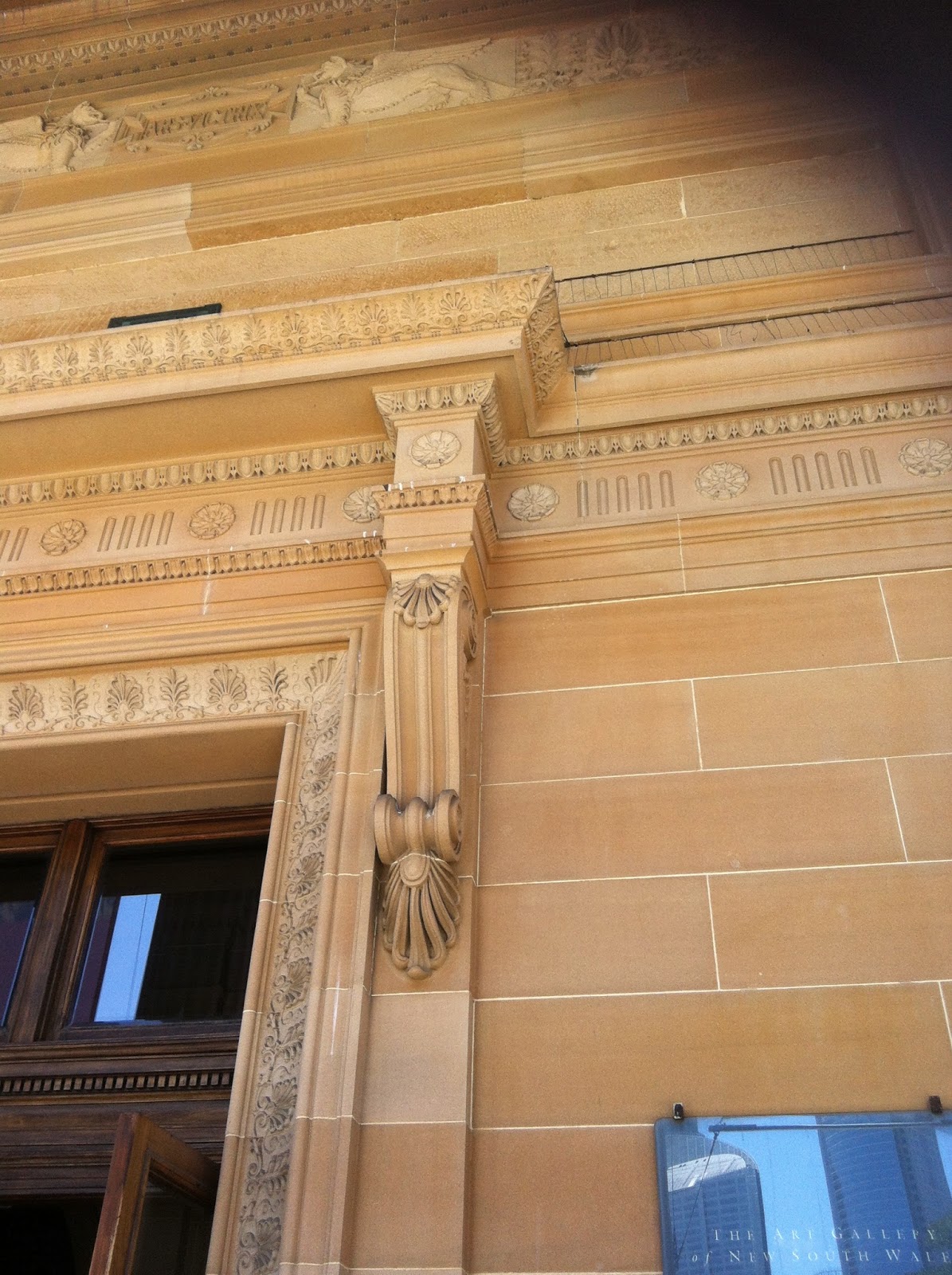
Architect John Horbury Hunt first put up a utilitarian brick gallery with a saw-tooth roof (opened 1885) — the press called it the “art barn,” and it lingered as a rear range for decades. Every one of Hunt’s designs for a permanent building was knocked back as too grand or out of keeping with the Domain, and in 1895 he was replaced by Government Architect Walter Liberty Vernon. The trustees wanted a strictly classical “temple to art”, even though Vernon himself leaned towards Gothic. Vernon’s sandstone façade and courts rose in stages from 1896; the first Vernon galleries opened 24 May 1897, the whole southern side was finished in 1901, the keystone of the portico pediment went in on 24 March 1902, and the whole façade was finished on 20 February 1909. Later wings grew behind and beside that landmark front: the Captain Cook Wing in 1972, the Bicentennial extension in 1988, and the Sydney Modern building, opened on 2 December 2022 and now called Naala Badu.
Here are my photos of the building and the collection, inside and out.
The Art Gallery of New South Wales – The Government Domain – Sydney – NSW













The Story of the Gallery in the Domain
I've walked up Art Gallery Road more times than I can count, and every time that sandstone front comes into view across the Domain it still stops me. It looks like it's been there forever, but the building behind it took almost forty years of arguing, a fire, a "barn" and three governments' worth of budgets before it looked anything like it does now. Here's how it all came together.
The Domain and Gadigal Country
The gallery sits on Gadigal Country, and the Gallery itself gives its address that way. The land around it was set aside by Governor Phillip as the "Governor's demesne" late in the eighteenth century, and Governor Macquarie opened up the Botanic Gardens and the Domain in 1816. Garry Wotherspoon, writing for the Dictionary of Sydney, points out that the Domain once ran all the way from Woolloomooloo Bay to Circular Quay and south to Hyde Park, and that the Art Gallery, the State Library, Government House, the Opera House and the Conservatorium have all been "carved out of" it as a cultural enclave.
The Domain was always the people's park as well: picnics, cricket, balloon ascents, and from the late 1800s the Sunday soapbox speakers. In the 1890s and again in the Depression, homeless men slept in the rocks and in hessian camps not far from the gallery's front steps.
.jpg)
A Society With No Pictures and No Building, 1871
The Gallery's own history says it "began without a collection and without a building" on 24 April 1871, when about 30 art-loving citizens met and formed a society to support artists and promote art. That became the New South Wales Academy of Art. One of the driving forces was Eliezer Levi Montefiore, who later became president of the trustees and then the gallery's first director in 1892, holding the job until he died in 1894.

In 1874 Parliament voted money for an art gallery, run by a board of trustees, and the first works were bought. In 1875 the trustees commissioned Conrad Martens' Apsley Falls for £50 out of the first £500 grant. The pictures first hung in Clark's Assembly Hall in Elizabeth Street, open on Friday and Saturday afternoons.
The Garden Palace Years, 1879–1882
For the 1879 Sydney International Exhibition a Fine Arts Annexe was built in the grounds of the Garden Palace, three long galleries designed by William Wardell. The collection moved in, and it was officially opened as the Art Gallery of New South Wales on 22 September 1880. From 1882 it even opened on Sunday afternoons, which Montefiore pushed for because he believed the public should have every chance to see art "bought, moreover, at the public expense". The first Asian works in the collection were ceramics and bronzes given by the Government of Japan after the 1879 Exhibition.


On 22 September 1882 the Garden Palace burned to the ground. The gallery annexe escaped, but the loss of so much in one night put real pressure on the government to give the collection a permanent home.


Hunt's "Art Barn", 1885
In 1883 the trustees took on John Horbury Hunt, an architect in private practice. The same year the gallery became the National Art Gallery of New South Wales, a name it kept until 1958. Hunt drew up four detailed designs between 1884 and 1895, but all he ever got built was a plain brick building with a saw-tooth roof that opened in the Domain in 1885. It looked like a factory, and the papers called it the "art barn". Even so, the Gallery says it became a popular Sydney outing.
Vernon's Temple to Art, 1896–1909
Walter Liberty Vernon, who had taken over from James Barnet as Government Architect in 1890, won the job in 1895. Vernon actually preferred Gothic, saying it gave a richness "not obtainable in the colder and unbending lines of Pagan Classic". The trustees weren't having it. They told him to make the building "as strictly classical as possible" and to look to William Playfair's National Gallery of Scotland in Edinburgh, opened in 1859.

Vernon's plans were approved on 2 December 1895 and work started on 13 April 1896, with the new sandstone building wrapping around Hunt's barn. The first galleries, the Fairfax Galleries and Court 8, opened on 24 May 1897. By 1900 the International Art Notes reckoned about a quarter of the whole building was done, with four halls each 100 feet by 30 feet and lighting that was "almost perfect". The whole southern side was finished in 1901.
On 24 March 1902 the keystone went into the pediment over the portico, and the Gallery says the Minister of Public Instruction was "dramatically hoisted in the air" to set it. The portico has six Ionic columns, and the tympanum above was left rough for carving that never came. Vernon's entrance vestibule, with its coupled columns, half domes and Kempsey marble, was his masterpiece. Annoyingly for Sydney, it sat closed for over four years while the floor of the main hall was raised to meet it, which set off a run of angry letters to the papers about public money spent on rooms the public couldn't use.
.jpg)

A basement gallery for the plaster casts and applied arts opened on 31 October 1904, reached by a staircase of Rockley, Fernbrook, Borenore and Molong marble, all from New South Wales. On 20 February 1909 the whole façade was finished. And that was where it stopped. Vernon's harbour wing and grand entrance court were never built. Money ran out, and the Gallery says only a quarter of the building and the façade were done, with no major building for another 60 years. Plans in the 1930s to finish it fell over in the Depression.
.jpg)
The Names Along the Front
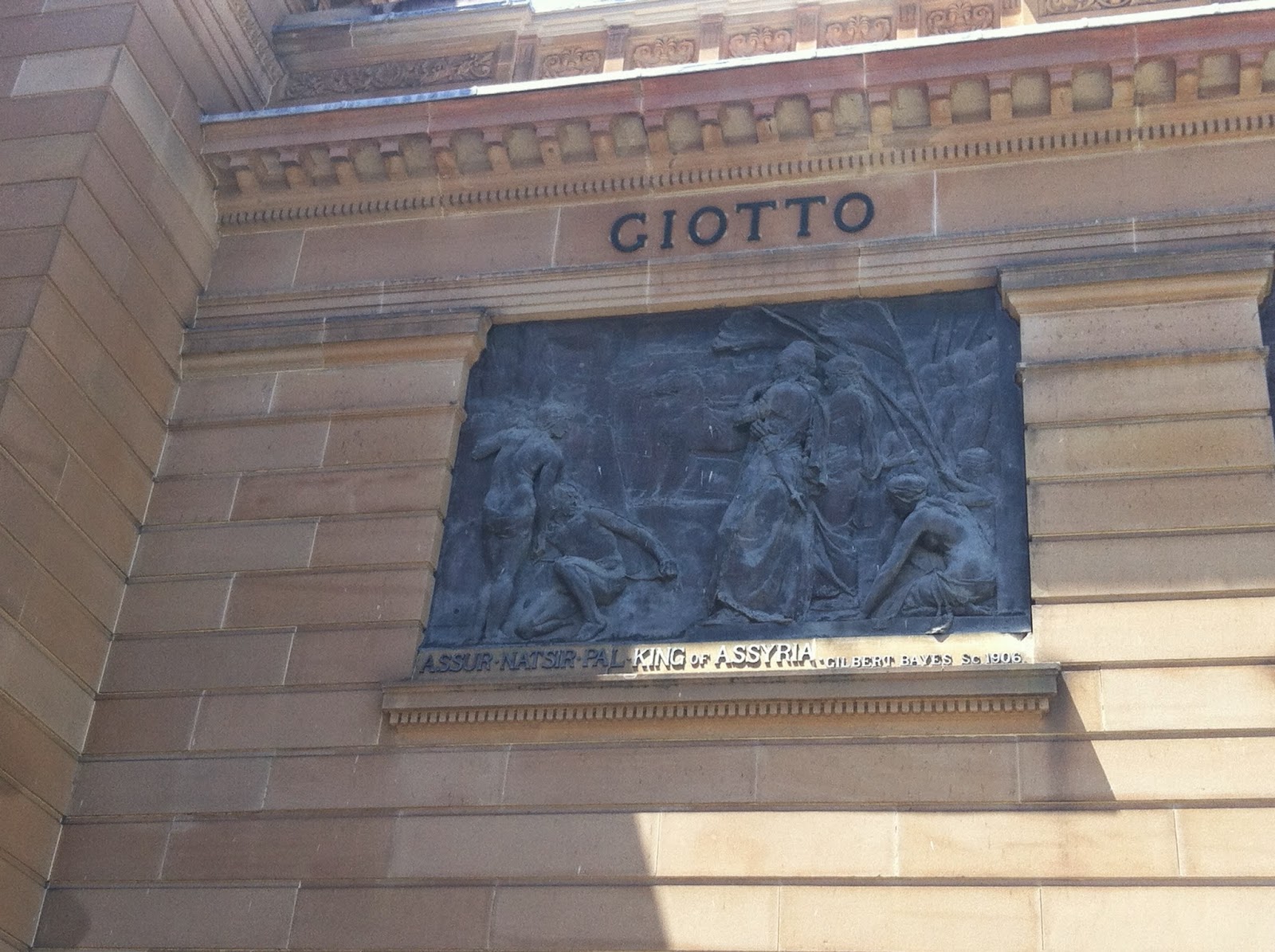
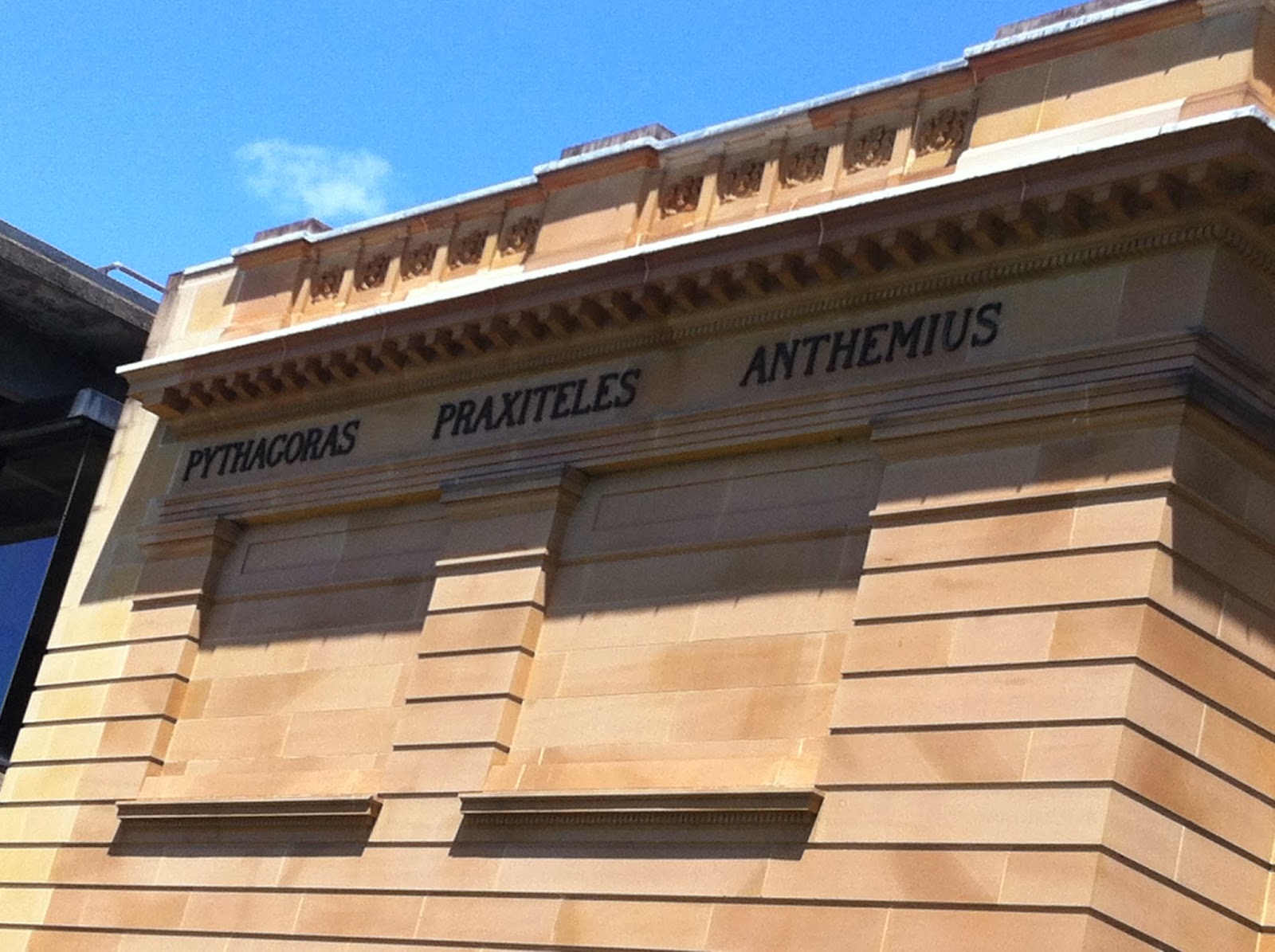
Look up under the cornice and you'll see names in bronze letters. They were picked by Frederick Eccleston Du Faur, president of the trustees from 1892 to 1915. Forty-four were planned, and 32 made it onto the walls. Painters run along the south half of the front and round the south side: Giotto, Raphael, Titian, Rembrandt, Murillo, Rubens, Andrea del Sarto, Botticelli, Bellini, Cimabue, Correggio, Leonardo da Vinci, Tintoretto, Velasquez, Vandyck and Gainsborough. Sculptors are on the north half: Michael Angelo, Donatello, Ghiberti, Pheidias, Cellini, Canova, Jean Goujon, Pythagoras, Praxiteles and Anthemius. The architects (Christopher Wren, Philibert de l'Orme, Perrault, Juan de Herrera, Mansart and Inigo Jones) are round the back.
Not everyone loved them. The Gallery quotes one critic calling them "a permanent daydream of old masterpieces, whose equivalent could never be seen inside the building". Wikipedia notes that none of the artists had work in the gallery at the time, and that calls to swap in Australian names went nowhere because the trustees couldn't agree on who. The Gallery says that as late as 1965 the artist and trustee Douglas Dundas suggested swapping in "notable Australian artists", but the trustees couldn't decide who, because names do not "always endure the test of time".


The four bronze panels set into the front came from an 1899 idea by the sculptor Percival Ball. Six were planned, showing Assyrian, Egyptian, Grecian, Roman, Gothic and Renaissance art, but only Assyria, Egypt, Greece and Rome were ever finished. The Egyptian panel, Queen Hatshepsut, was by Countess Feodora Gleichen, and the Assyrian one was by Gilbert Bayes.
The Horsemen at the Door, 1926
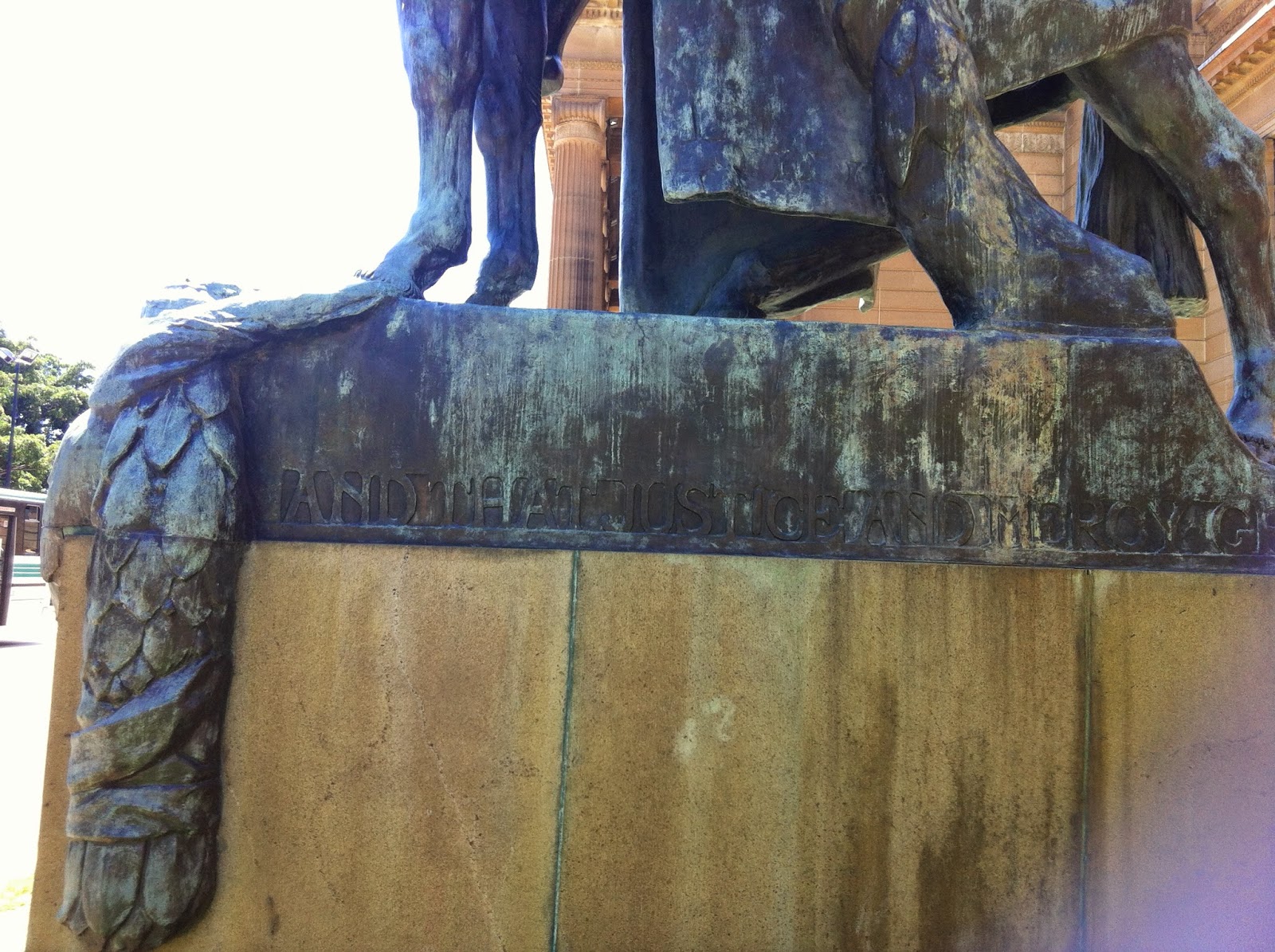
Bayes also made the two big bronze riders out the front, The Offerings of Peace and The Offerings of War, put up in 1926. Their inscriptions read "The Real and Lasting Victories Are those of Peace and Not of War" and "That our House may stand forever and that Justice and Mercy grow".
.jpg)
.jpg)

Inside, the old courts kept pulling in crowds. More than 300,000 people came in March and April 1906 to see Holman Hunt's The Light of the World. The first Archibald Prize went to William McInnes in 1921, and in 1938 Nora Heysen became the first woman to win it.
The Captain Cook Wing, 1972
In 1968 the State Government decided that finishing the gallery would be a big part of the Captain Cook Bicentenary. The new wing, by the Government Architect's office with Andrew Andersons as project architect, opened on 2 May 1972. Andersons didn't try to copy Vernon. He split old from new with a wide strip of skylights in the main court and used travertine floors and movable walls. The wing won the Sulman Medal in 1975.

The Bicentennial Extension, 1988
With Premier Neville Wran behind it, the next big extension became a Bicentennial project and opened in December 1988. It was built down the steep slope towards Woolloomooloo, squeezed between two big Moreton Bay figs, much of it underground, and it doubled the gallery's size. It added an Asian gallery, the Domain Theatre, a café looking over Woolloomooloo Bay and a rooftop sculpture garden. The Yiribana Gallery for Aboriginal and Torres Strait Islander art followed in 1994, and Richard Johnson's glowing "light box" Asian gallery opened on 25 October 2003.


.jpg)

Sydney Modern and Naala Badu, 2022
In 2015 the Tokyo firm SANAA, Kazuyo Sejima and Ryue Nishizawa, won the competition for a big new building to the north. Not everyone was happy. Andrew Andersons said it would collide with Vernon's façade, Paul Keating said it was "about money, not art", and the Friends of the Botanic Garden objected to losing green space in the Domain.
The new building opened on 2 December 2022, almost doubling exhibition space to 16,000 square metres, at a cost of $344 million, $244 million of it from the State Government. Under it is The Tank, a gallery made from a disused oil tank. The Dictionary of Sydney notes Domain land was taken for naval fuel tanks in 1942. In April 2024 the Gallery announced Sydney Language names for its two buildings: the new one is Naala Badu, "seeing waters", and the old Vernon building is Naala Nura, "seeing country".


Timeline
- Late 1700s: Governor Phillip sets aside the Governor's demesne on Gadigal Country.
- 1816: Governor Macquarie establishes the Botanic Gardens and the Domain.
- 24 April 1871: Public meeting founds what becomes the NSW Academy of Art.
- 1874: Parliament votes funds; trustees appointed; first works bought.
- 1875: Conrad Martens' Apsley Falls bought; collection shown in Clark's Assembly Hall, Elizabeth Street.
- 1879: Fine Arts Annexe built for the Sydney International Exhibition.
- 22 September 1880: Officially opened as the Art Gallery of New South Wales.
- 22 September 1882: Garden Palace burns down.
- 1883: John Horbury Hunt engaged; renamed National Art Gallery of NSW.
- 1885: Hunt's "art barn" opens in the Domain.
- 2 December 1895: Vernon's designs approved.
- 13 April 1896: Building work starts.
- 24 May 1897: First Vernon galleries open.
- 1901: Southern side finished.
- 24 March 1902: Keystone set in the portico pediment.
- 31 October 1904: Basement gallery opens.
- 20 February 1909: Whole façade finished; building stops.
- 1921: First Archibald Prize.
- 1926: Bayes' bronze horsemen installed.
- 1 July 1958: Name goes back to Art Gallery of New South Wales.
- 2 May 1972: Captain Cook Wing opens.
- December 1988: Bicentennial extension opens.
- 1994: Yiribana Gallery opens.
- 25 October 2003: Asian gallery "light box" opens.
- 2015: SANAA wins the Sydney Modern competition.
- 2 December 2022: The new North Building opens.
- April 2024: Buildings named Naala Badu and Naala Nura.
Where the Sources Disagree
- When it was founded. The Art Gallery of NSW dates its start to the public meeting of 24 April 1871. Wikipedia says the NSW Academy of Art was founded in 1872, with the 1871 meeting called to set it up.
- When Vernon became Government Architect. The Gallery says Vernon replaced James Barnet in 1890. Wikipedia calls him "newly appointed" when he got the gallery job in 1895.
- When the building was finished. The Gallery gives 20 February 1909 for the completed façade, but says only a quarter of Vernon's building was ever built, so in a real sense it was never finished.
- Opening day of the new building. Wikipedia, citing the Guardian, gives 2 December 2022. The Gallery's own illustrated history says it opened to the public on 3 December.
- The 1988 extension. Wikipedia says it "doubled the floor space", and says the same of the 2022 building, which the Guardian, as cited there, puts at almost double the exhibition space.
My Earlier Posts
- The Government Domain – Next to the Royal Botanic Gardens – Macquarie Street – Sydney – NSW
- Government House – 'The Peoples Domain'
- Sydney Garden Palace In Pictures
- Sydney Garden Palace – International Exhibition 1879
- Sydney Conservatorium of Music – The Old Government House Horse Stables
- St Mary's Cathedral – College Street & Art Gallery Road
- Royal Sydney Botanical Gardens – Government Domain
Sources
- Art Gallery of NSW, "A temple to art, 1896–1909", https://www.artgallery.nsw.gov.au/about-us/history/history-of-the-building/a-temple-to-art-1896-1909/
- Art Gallery of NSW, "Illustrated history", https://www.artgallery.nsw.gov.au/about-us/history/illustrated-history/
- Art Gallery of NSW, "The names on the exterior", https://www.artgallery.nsw.gov.au/about-us/history/history-of-the-building/the-names-on-the-exterior-of-the-building/
- Art Gallery of NSW, "Bronze reliefs, 1900–31", https://www.artgallery.nsw.gov.au/about-us/history/history-of-the-building/the-unfinished-bronze-reliefs-on-the-exterior-of-the-building-1900-31/
- Wikipedia, "Art Gallery of New South Wales", https://en.wikipedia.org/wiki/Art_Gallery_of_New_South_Wales
- Garry Wotherspoon, "The Domain", Dictionary of Sydney, 2010, https://dictionaryofsydney.org/entry/the_domain
- Wikimedia Commons, for the photos credited under each picture.