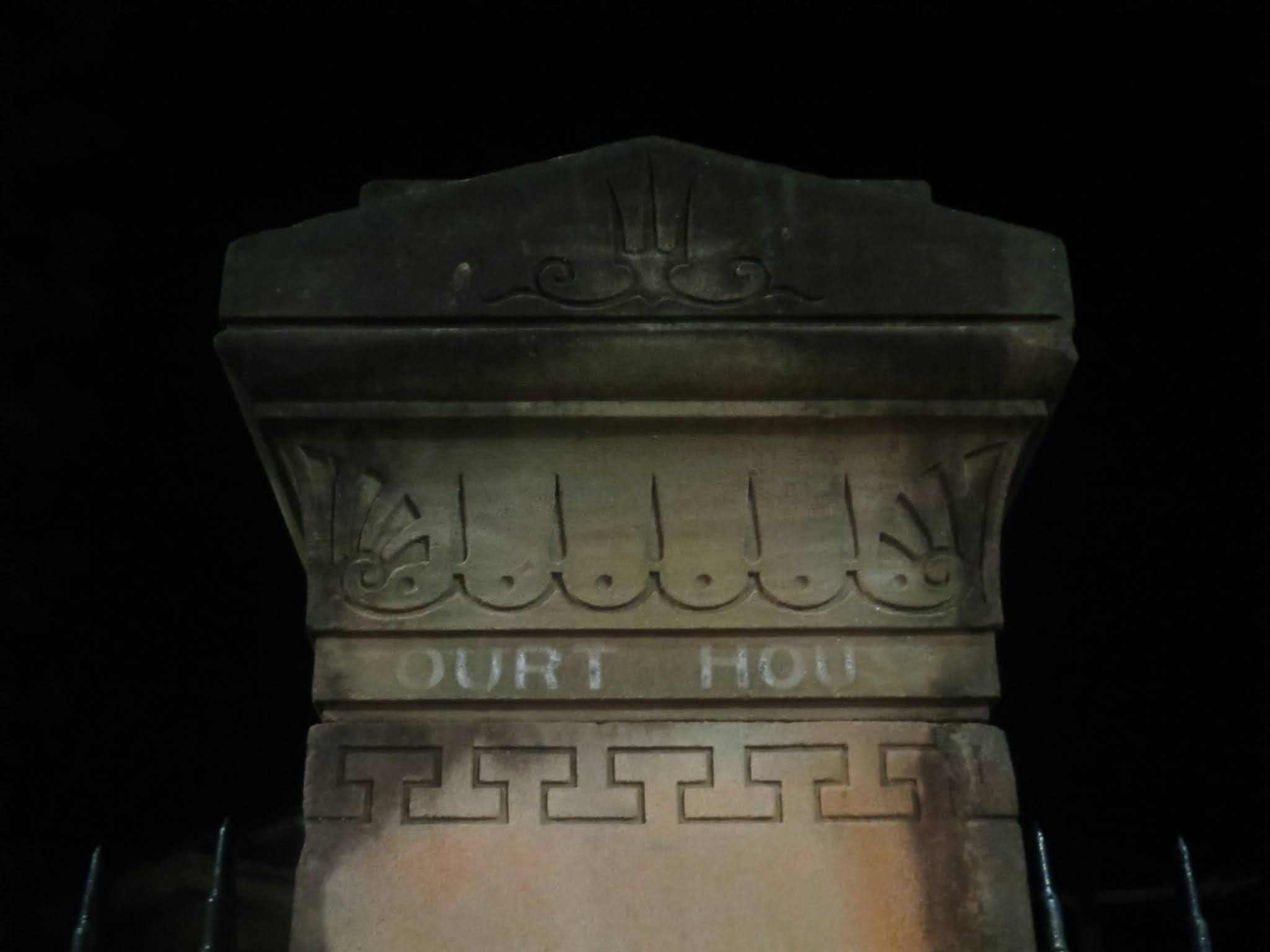
On a Thursday afternoon in January 1893, a young married woman named Annie Wilson was shot in the kitchen of a lodging house at 195 Bourke Street. In 1893 the papers called that part of Bourke Street Woolloomooloo; today it's the Darlinghurst end of the street, down near William Street. The man who fired the shot was Simon Peter Van Kaspelen, a well-known Dutch-born crayon portrait artist who lodged in the same house. After shooting Annie he went upstairs, locked himself in his room and shot himself. Annie died a little before two o'clock. She was 26.
Because the man who killed her was dead, there was no arrest, no trial and no hanging at Darlinghurst Gaol. There was an inquest the next morning in a pub on the corner of Bourke and William Streets, a funeral to the Necropolis at Rookwood the day after that, and then the story faded from the papers. This post sets out what the 1893 papers actually said about Annie, her household, the man who killed her and the days that followed. Where the old reports and the modern write-ups don't agree, I've said so.

Where It Happened – 195 Bourke Street
Bourke Street is a long one. It starts down at Woolloomooloo, climbs the hill through Darlinghurst past William Street and Oxford Street, then runs on through Surry Hills towards Redfern. In January 1893 the Sydney Morning Herald described number 195 as being in "Bourke-street, Woolloomooloo", and called the house "a substantially-built two-story lodging-house belonging to Mrs. De Monti". The inquest and the funeral notices give the same address. Today that stretch is counted as Darlinghurst, which is why the modern accounts of the case call it a Darlinghurst story.
So where does Surry Hills come into it? There are a few threads. About four weeks before the shooting, Van Kaspelen's wife Edith had left him and moved to 639 Bourke Street, Surry Hills, further up the same street. The doctor who was called to the house, Dr Alexander Dewar, had his rooms at 81 Crown Street, which runs between Woolloomooloo, Darlinghurst and Surry Hills. And when local writer Elliot Lindsay retold the case in 2023 for Neighbourhood Media, the piece went out under the heading "True Crime in Surry Hills", even though the article itself places the house in Darlinghurst. So it's easy to see how it has come to be remembered as a Surry Hills story.

Who Was Annie Wilson?
We don't know as much about Annie as I'd like. What we have comes from her family's evidence at the inquest and the funeral notices they placed in the paper.
Her full name was Annie Godlington Wilson. Three of the five funeral notices print it as "Codlington", which looks like a slip at the printer's, since the news reports, the inquest and the other two notices all have "Godlington". She was born in London and was 26 years old. Her brother, George James Edwards, told the inquest she "was of temperate habits" and that she left "neither children nor property".
Annie was married to Joseph Wilson, a French polisher who worked for Nicholson and Co. in George Street. The couple lived at 195 Bourke Street, and with the owner away, Annie was looking after the house. The funeral notices give us a glimpse of the family around her: her husband, her brother George, Joseph's brothers John and James Wilson, and two couples, Mr and Mrs James Bickerstaff and Mr and Mrs Golding, whose notices call Annie a sister-in-law. She clearly had plenty of people who cared about her.

The Household at 195 Bourke Street
The house belonged to a Mrs De Monti. (The Herald spelt it "De Monti" in its main report and "De Monté" elsewhere.) She had gone up to Liverpool with her husband, who was in poor health, and had left the place in Annie's care while she was away.
Living there at the time were Annie and Joseph, Annie's brother George Edwards, Simon Van Kaspelen, and, according to George, "three single young men" who had been out all that morning. Van Kaspelen and his wife had been lodging there for about seven months. Mrs Van Kaspelen and Annie were friends, and Edith still called in to see her after she'd left her husband.
George Edwards worked as a collector for the Citizens' Life Assurance Company. He last saw his sister alive at twenty past nine on the Thursday morning, before he went out for the day.
Simon Peter Van Kaspelen and Edith
Van Kaspelen was a native of Amsterdam. Edith told the inquest he was 43. By trade he was a crayon artist, making large portraits in French crayon from photographs, and he was very good at it. His agent was W. Aldenhoven of Hunter Street, who told the Herald that Van Kaspelen had been his principal artist in that line for nine years, and that "portraits had even been sent out from London for him to enlarge".
Sober, he was by all accounts a gentleman. Aldenhoven said "when Van Kaspelen was sober there was not a more gentlemanly man", that he was educated and spoke four languages. Drunk, it was another matter. About three months before the shooting, in a drunken rage, he had seized Aldenhoven by the throat, and only the workmen stepping in had stopped it. After that Aldenhoven banned him from the shop and sent the work out to him instead.
Edith had been married to him for ten years. They had no children. About four weeks before the shooting she left him "on account of his drunkenness and cruelty towards me" and took lodgings at 639 Bourke Street, Surry Hills. She said he had often threatened to shoot her. On the Wednesday, the day before he killed Annie, he had told her: "If I had a revolver I would shoot you." Edith's own sister had been so worried that she told her to get out of the city altogether, "because she said she was sure Mr. Van Kaspelen was going mad, he looked so bad with drink". Edith said she didn't know he actually carried a revolver.
She still spoke of him with some tenderness. "We had been married 10 years," she told the Herald, "and but for the drink we should have lived very happily together."
Thursday, 12 January 1893
The Shooting
Nobody saw what happened in that kitchen. What we know was pieced together afterwards from what was found in the house.
Van Kaspelen had gone out early that morning. At some point around one o'clock he came back, and the police and the papers took it that he had been drinking. Annie was in the kitchen at the back of the house. He shot her once in the face at close range. Then, it seems, he turned the revolver on himself. One shot went through the top of his own hard felt hat and lodged in the kitchen ceiling. Another grazed his temple. Bleeding, he went up the stairs to his room, which was both his bedroom and his studio, locked the door, lay on the bed and fired again, this time into his forehead.
The gun was a seven-chambered revolver. When the police checked it, four chambers had been fired, two were still loaded and one had never been loaded.
The Discovery
At about twenty-five past one, George Edwards came home and found Edith Van Kaspelen standing at the street door. She'd come to visit Annie and had been knocking for about five minutes without an answer. George had a key, and they went in together.
He noticed spots of blood on the floor of the passage and followed them to the kitchen. Annie was lying on her back on the floor. In George's words at the inquest, "Blood was coming from her mouth, and her left eye was black. She was not dead, but she could not speak. She was just gasping". He told Edith to run for a doctor and dashed off to a chemist's shop nearby for help. Edith ran out into the street but came straight back. As she told the Herald, "I did not like to leave Mrs. Wilson when she was not yet dead."
When George came back with the chemist they saw Van Kaspelen's hat and pipe lying on the kitchen floor. George knew the hat at once. He ran upstairs, found Van Kaspelen's door locked and burst it open. Van Kaspelen was lying dead across the bed, with the revolver beside his left hand.

The Police and the Doctor
Senior-constable Thomas O'Keefe of No. 3 police station got to the house at about half past one. Annie was still alive but unconscious. He went upstairs, took charge of the revolver, and traced the drops of blood from the kitchen up the stairs to the bedroom. He found "no sign of any struggle whatever", and George said nothing in the house had been disturbed.
Dr Alexander Dewar of 81 Crown Street told the inquest he was called to the house at about half past one. He found Annie bleeding from the nose and mouth, with a wound in the left eye socket beside the tear bone that was blackened with gunpowder, which shows the gun was fired from very close. The bullet had gone into the brain. By his account she was still alive but unconscious when he arrived, and she died about twenty minutes later, close to two o'clock. Dr Dewar told the inquest the cause of death was "unquestionably the wound in the eye", and that he could find "no other injury whatever".
Upstairs, he found that Van Kaspelen had a compound fracture over the right brow, also blackened with powder, which was the fatal wound, and a second, shallower wound on the left brow with pieces of lead in it.
The Inquest at the Burdekin Hotel
In those days inquests were often held in a pub close to where someone died, and this one opened at ten o'clock the next morning, Friday 13 January, at the Burdekin Hotel, which the Herald placed on the corner of Bourke and William Streets. The City Coroner presided. Because Van Kaspelen was a Dutch citizen, the Acting Consul of the Netherlands, Señor Don Horacio Amora, came along on behalf of his government.
Before it started, a constable handed the coroner a note that had been found in Van Kaspelen's room. The coroner read it and said it "was of a private character and had no bearing on the inquest". What it said was never published.
The jury went to the house to see the scene and view the bodies, then came back to hear the evidence.
The Evidence
Edith Van Kaspelen spoke first. She described the threats, the drinking and the separation, and said that as far as she knew her husband "had never had any quarrel with Mrs. Wilson". George Edwards told the story of coming home and finding his sister, and said he had never known Van Kaspelen to quarrel with Annie either. He also told the jury: "Mrs. Wilson and Mrs. Van Kaspelen were very much alike in general appearance."
The Verdict
The jury didn't take long. They returned a verdict that Annie Godlington Wilson and Simon Peter Van Kaspelen "had died from the effects of pistol-shot wounds inflicted by Van Kaspelen".
With the killer dead, there was nobody to arrest or put on trial, and that was as far as the law could go.
The Funeral – To the Necropolis
On Saturday 14 January the Herald carried a column of funeral notices for Annie, one after another, from her husband, her brother and each branch of the family. Her husband's read:
THE FRIENDS of Mr. JOSEPH WILSON are respectfully invited to attend the Funeral of his dearly beloved WIFE, Annie Codlington; to move from 195 Bourke-street, THIS (Saturday) AFTERNOON, at a quarter-past 1 o'clock, for the Necropolis.
(Sydney Morning Herald, 14 January 1893)
So Annie left the house where she had died almost exactly two days after she was shot, and was taken out to the Necropolis at Rookwood, the big cemetery that had replaced the old Devonshire Street burial ground. The undertaker was Mrs P. Kirby of 88 Hunter Street, with a branch in William Street. The notices don't say how the mourners got there, but in those years a great many Sydney funerals bound for the Necropolis went out on the mortuary train from the Regent Street Mortuary Station.


How the Papers Reported It
The shooting was in the papers the very next morning. On Friday 13 January the Sydney Morning Herald ran a long report under the heading "SHOCKING TRAGEDY IN WOOLLOOMOOLOO. MURDER AND SUICIDE.", along with separate pieces headed "Statement by Mr. Edwards", "Statement of Mrs. Van Kaspelen", "Statement by the Husband of the Murdered Woman" and "The Character and Ability of the Murderer". Its summary of the day's news put it plainly: "Mrs. Annie Godlington Wilson was shot dead by S. P. Van Kaspelen, a well known crayon artist, who mistook her for his wife."
Joseph Wilson's statement was short: he too "was of opinion that Van Kaspelen had mistaken Mrs. Wilson for his wife". George Edwards agreed. In the Herald's account of what he said, the two women "were alike in build and stature, and in the colour of their hair, and might easily have been mistaken for one another, even at only a few yards distance."
On Saturday 14 January the Herald reported the inquest in full under "THE WOOLLOOMOOLOO TRAGEDY. THE INQUEST AND VERDICT." According to Elliot Lindsay, other papers took a different line. He quotes the Daily Telegraph as saying it was "scarcely feasible" that Van Kaspelen would shoot another woman in broad daylight thinking she was his wife, and suggesting he had been seized with "an insane idea of revenge on the woman who he discovered was befriending the wife who had left him".
A Modern Theory – Were Annie and Edith More Than Friends?
This next part is a modern claim, not something anyone proved in 1893, and I'm including it so you know it's out there.
In 2023 Elliot Lindsay wrote up the case twice, for Murders Most Foul and for Neighbourhood Media. He argues that Annie and Edith were in a same-sex relationship, that Van Kaspelen shot Annie on purpose out of jealousy, and that Edith, Annie's husband and her brother kept the relationship quiet afterwards. He quotes Truth as reporting that Van Kaspelen complained his wife "entertained a high and unusually affectionate regard" for Annie, and that Annie was "too intimate with Mrs Van Kaspelen". The case also turns up in the 2008 book Homophobia: An Australian History, edited by Shirleene Robinson.
Against that, here's the 1893 evidence. The three people closest to it, Annie's husband Joseph, her brother George and Edith herself, all told the papers they believed it was a case of mistaken identity. George and Edith both said Van Kaspelen had never quarrelled with Annie, and George told the inquest the two women looked very much alike. The jury's verdict said nothing either way about why he did it.
The honest answer is that we can't know what was going on in Van Kaspelen's head that afternoon. Whatever his reason was, Annie did nothing to deserve what happened to her.
Where the Accounts Differ
A few details don't line up between the reports, so here's how they stand.
- Annie's age. The computer-read text of the Herald on Trove makes her "about 12" in one place and "20" in another, and Lindsay gives her age as 26. I checked the page images of the 13 and 14 January papers, and both clearly say 26: Edith said "about 26 years of age" and George told the inquest "Mrs. Wilson was 26 years of age". The 12 and 20 are just scanning errors.
- Which eye. The Herald's first report on 13 January said the bullet hole was "just above the right eye". At the inquest the next day, George Edwards, Senior-constable O'Keefe and Dr Dewar all said it was the left eye, and the doctor described the wound as being in the left eye socket. I've gone with the inquest evidence.
- How many wounds. Lindsay writes that Annie had two gunshot wounds to the face. Dr Dewar told the inquest there was "no other injury whatever" apart from the wound in the eye. The second bullet wound he described above the brow was on Van Kaspelen, not Annie.
- The time of death. Lindsay says police recorded her death at 1.55 pm. I couldn't find that exact time in the 1893 papers. The Herald said "it was not till nearly 2 o'clock that she died", so the two are close.
- Whether the doctor found her alive. The Herald's first report said Dr Dewar arrived "shortly before 2 o'clock" and that by then "life was extinct". At the inquest Dr Dewar himself said he was called at about half past one, that Annie was still alive but unconscious when he got there, and that she died about twenty minutes later. I've gone with the doctor's sworn evidence.
- Van Kaspelen's age. Edith gave his age as 43 both to the Herald and at the inquest. Design and Art Australia Online gives his birth year as 1849, which fits roughly. Lindsay describes Edith as 36 and her husband as ten years older, which would make him 46.
- The suburb. Woolloomooloo in 1893, Darlinghurst today, and remembered by some as Surry Hills, for the reasons given at the top of this post.
A Year of Bad News on Bourke Street
Annie's death wasn't the only one on Bourke Street that year. On 26 March 1893 a woman named Emma Harrison was found dead in her lodgings on the corner of Burton and Bourke Streets in Darlinghurst. That case did go to trial: George Archer was convicted of her murder and hanged at Darlinghurst Gaol on 11 July 1893. You can read about him and the other executions there in my post on the Hangings at Darlinghurst Gaol, and about the gaol itself in Darlinghurst Gaol & Darlinghurst Court. If Van Kaspelen had lived, a murder charge against him would have been heard in the Central Criminal Court at Darlinghurst, right beside the gaol.

Timeline
| Date | What happened |
|---|---|
| About 1883 | Simon Peter Van Kaspelen and Edith marry (she said in 1893 they had been married ten years). |
| About 1884 | Van Kaspelen begins working for art dealer W. Aldenhoven of Hunter Street (nine years by 1893). |
| About June 1892 | The Van Kaspelens take lodgings at 195 Bourke Street, Woolloomooloo (about seven months before the shooting). |
| About October 1892 | Drunk, Van Kaspelen seizes Aldenhoven by the throat and is banned from the shop. |
| About mid-December 1892 | Edith leaves him and moves to 639 Bourke Street, Surry Hills. |
| Wednesday 11 January 1893 | Van Kaspelen tells Edith, "If I had a revolver I would shoot you." |
| Thursday 12 January 1893, 9.20 am | George Edwards last sees his sister alive. |
| 12 January, about 1 pm | Van Kaspelen shoots Annie in the kitchen, then shoots himself upstairs. |
| 12 January, about 1.25 pm | George Edwards and Edith Van Kaspelen find Annie on the kitchen floor. |
| 12 January, about 1.30 pm | Senior-constable O'Keefe arrives and Dr Dewar is called. |
| 12 January, nearly 2 pm | Annie Godlington Wilson dies, aged 26. |
| Friday 13 January 1893 | The Herald reports the "Shocking Tragedy in Woolloomooloo". Inquest at the Burdekin Hotel, Bourke and William Streets; verdict of death from pistol-shot wounds inflicted by Van Kaspelen. |
| Saturday 14 January 1893 | Inquest reported in the Herald. Annie's funeral leaves 195 Bourke Street at 1.15 pm for the Necropolis, Rookwood. |
| 2023 | Elliot Lindsay retells the case for Murders Most Foul and Neighbourhood Media. |
Related Posts On My Blog
- Hangings at Darlinghurst Gaol – The Executions and Famous Prisoners
- Darlinghurst Gaol & Darlinghurst Court – Forbes Street & Taylor Square – Darlinghurst
- Darlinghurst Gaol – Taylor Square – Bourke Street – Forbes Street – Burton Street – Darlinghurst Road
- Crown Street – Woolloomooloo – Darlinghurst – Surry Hills
- Wesley Chapel – Built 1847 – Bourke Street – Surry Hills
- Riley Street – Woolloomooloo
- Original Villas Of Darlinghurst
- Mortuary Station – Central – Chippendale
- Rookwood Necropolis
- Rookwood Cemetery & Necropolis – Lidcombe
- Devonshire Street Cemetery – The Burial Ground Under Central Station
- The Story Of Old George Street
- John Knatchbull and the Murder of Ellen Jamieson – Sydney, 1844
- Sydney Gay and Lesbian Mardi Gras – From the 1978 March to Today
Sources
Newspapers, 1893 (via Trove, National Library of Australia)
- "Shocking Tragedy in Woolloomooloo. Murder and Suicide." Sydney Morning Herald, 13 January 1893, p. 5. http://nla.gov.au/nla.news-article13893397
- "Statement by Mr. Edwards." Sydney Morning Herald, 13 January 1893, p. 5. http://nla.gov.au/nla.news-article13893394
- "Statement of Mrs. Van Kaspelen." Sydney Morning Herald, 13 January 1893, p. 5. http://nla.gov.au/nla.news-article13893395
- "Statement by the Husband of the Murdered Woman." Sydney Morning Herald, 13 January 1893, p. 5. http://nla.gov.au/nla.news-article13893392
- "The Character and Ability of the Murderer." Sydney Morning Herald, 13 January 1893, p. 5. http://nla.gov.au/nla.news-article13893393
- News summary, Sydney Morning Herald, 13 January 1893, p. 4. http://nla.gov.au/nla.news-article13893385
- "The Woolloomooloo Tragedy. The Inquest and Verdict." Sydney Morning Herald, 14 January 1893, p. 5. http://nla.gov.au/nla.news-article13893442
- News summary (inquest), Sydney Morning Herald, 14 January 1893, p. 8. http://nla.gov.au/nla.news-article13893546
- Funeral notices, Sydney Morning Herald, 14 January 1893, p. 16. http://nla.gov.au/nla.news-article13893594
- Page images: Sydney Morning Herald, 13 January 1893, p. 5 http://nla.gov.au/nla.news-page1373980; 14 January 1893, p. 5 http://nla.gov.au/nla.news-page1373988
- "The Burton-Street Tragedy." Sydney Morning Herald, 11 April 1893, p. 3 (Emma Harrison case). http://nla.gov.au/nla.news-article13913688
- "The Bourke-street Tragedy." Evening News, 21 June 1893, p. 6 (George Archer). http://nla.gov.au/nla.news-article112606550
Later accounts
- Elliot Lindsay, "A Darlinghurst Same-Sex Love Tragedy, 1893", Murders Most Foul, 15 March 2023. https://murdersmostfoul.com/a-darlinghurst-same-sex-love-tragedy-1893/
- Elliot Lindsay, "The Bourke Street Murder" ("True Crime in Surry Hills"), Neighbourhood Media, 21 June 2023. https://www.neighbourhoodmedia.com.au/post/the-bourke-street-murder
- Design and Art Australia Online, "van Kaspelen, S. P., b. 1849". https://daao.library.unsw.edu.au/
- Shirleene Robinson (ed.), Homophobia: An Australian History, Federation Press, 2008 (index entry "Van Kaspelen case"). https://www6.austlii.edu.au/au/journals/ELECD/2008/108.pdf
- "Neville Henry Cayley", Australiana, vol. 34, no. 3, August 2012 (a portrait finished in French crayon by Van Kaspelen in 1892). https://australiana.org.au/assets/issue/Australiana_2012_3%20Aug_LR.pdf
Pictures
- All pictures are from Wikimedia Commons, with the original holders, licences and links given under each picture.