Search This Blog

Thursday, June 4, 2015

Queens Square - Macquarie Street


Queens Square - Macquarie Street 


Queens Square is a small Section at the end of Macquarie Street that was originally intended to be the Civic Square of the City Of Sydney. 


Over the years, the City Of Sydney has outgrown its Civic Square, but the story of this little corner of Colonial Sydney really tells the story of Sydney itself from a Colonial Convict Prison Settlement to a leading City Of The Colonial Era. 


Governor Lachlan Macquarie's arrival in Sydney in 1820 was a real turning point for Sydney. It began to leave behind its Penal Colony past, & look towards the future as a world city.


Governor Macquarie had a clear vision for Sydney's future & wasted no time in making it a reality.


Macquarie began by renaming all the streets, which we nothing but a maze of dirt paths when he arrived, but clearly laid out with a degree of order when he left the colony in 1821. 

in 1788, there was just over 1,100 people living in Sydney Cove, And Governor Arthur Phillip Believed at the time that one street back from the harbour was appropriate for the centre of town. By the time Governor Macquarie arrived 22 years later, the population was estimated to be 11,773, and only a small amount of townsfolk lived around the harbour


Macquarie quickly realised that the town he believed Sydney would become needed a civic centre like all the great cities of Britain and Europe had. Not forgetting that Sydney had its roots on the shores of Sydney Cove, Macquarie acknowledged this by making the site of Governor Phillip's administrative headquarters (today's Macquarie Place) the point from which all distances within the colony of New South Wales - and ultimately the whole of Australia - would be measured. But being the forward thinker he was, Macquarie was not content to re-position the centre of Sydney to where it was when he arrived. He looked further south, to what then were the southern fringes of the settlement, and established it there. Today, in spite of two centuries of growth, the centre of Sydney is still considered to be where Macquarie placed it, and that is what we now call Queens Square. It never became the impressive town square he had envisaged, but it did become - and remains - the heart of the City of Sydney.


Following the British pattern of town planning, he established a town common (Hyde Park), with all the key civic elements placed around it. By the end of his tenure, his town centre was in place, though not all the elements were finished. He had laid the foundation stone for an Anglican cathedral opposite the common (the site was later used for St Mary's Cathedral); the Rum Hospital was built on Macquarie Street (part of it later became the seat of Government for New South Wales, something he would have been pleased about); the town school was finished, though the powers-that-be changed it mid-way through construction into a church; the courthouse was in the process of being built behind it, and across the road on a common axis with them both was the barracks that housed the colony's convict workforce, Hyde Park Barracks. Government House, still to be constructed, was allocated a site further along Macquarie Street that was close enough to be considered close, but not too close that it dominated the town, or robbed the Governors of his little privacy and a little aloofness.


n spite of all the elements in Macquarie's dream for a town square - orcircus  as Macquarie would have called it - being in place, why does Queens Square fall well short of Macquarie's dream for it? For starters, someone built a semi circular road around the northern perimeter of Hyde Park, which detracts from the notion that the centre of its arc is the centre of town. Also, after Macquarie left, no one stuck with his vision for the place to ensure it all followed the plan and came to pass. Some, like Governor Ralph Darling, tried to undo all the good work Macquarie did by attempting to drag Sydney back into being a colonial prison, rather than an emerging city. During the post-Darling era, New South Wales experienced the heady days of the goldrush and post-goldrush eras when thre was money to burn and private enterprise practically built what it wanted where it wanted, and it was at that time that Kings Square - renamed Queens Square, when Queen Victoria came to the throne - began to take on the form it takes today.

Its proximity to the Supreme Court in King Street has made the area around Queens Square the legal centre of Sydney. In years gone by Macquarie street was lined with the high class homes of Sydney's professions, predominant among them being the lawyers who worked in the law courts of King Street, and the doctors who place of employment was the Sydney Hospital in Macquarie Street. Today most barristers keep chambers in Phillip Street and around the Law Courts


he statue of the beloved Queen Victoria that gave the square its present name was unveiled by the Governor's wife Lady Carrington on 24th January 1888. It stood right where the people of her day would have wanted it to be, right in the middle of the circle. But within six years, trams were introduced to Macquarie Street and the statue was circled by tram tracks laid for the new Darling Harbour to Edgecliff service. Later, covered waiting sheds were being built in a semi-circle around Queen Victoria for the electric trams which took over in 1905. The tram tracks (and the statue of Queen Victoria) stayed until 1960 when buses replaced trams and the tracks were pulled up. With the tram circle gone and motor traffic increasing year by year, suddenly Queen Victoria was in the way.


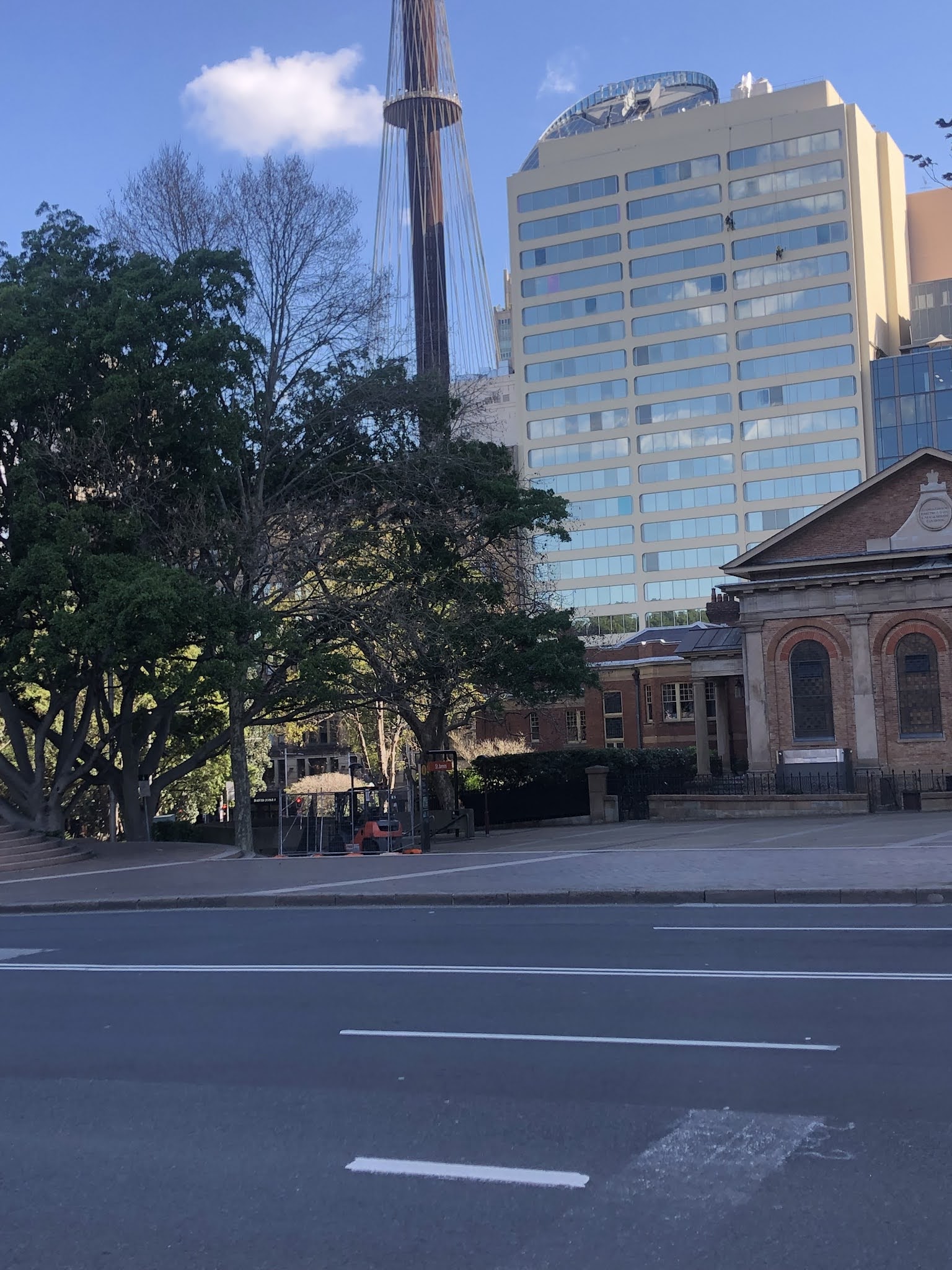


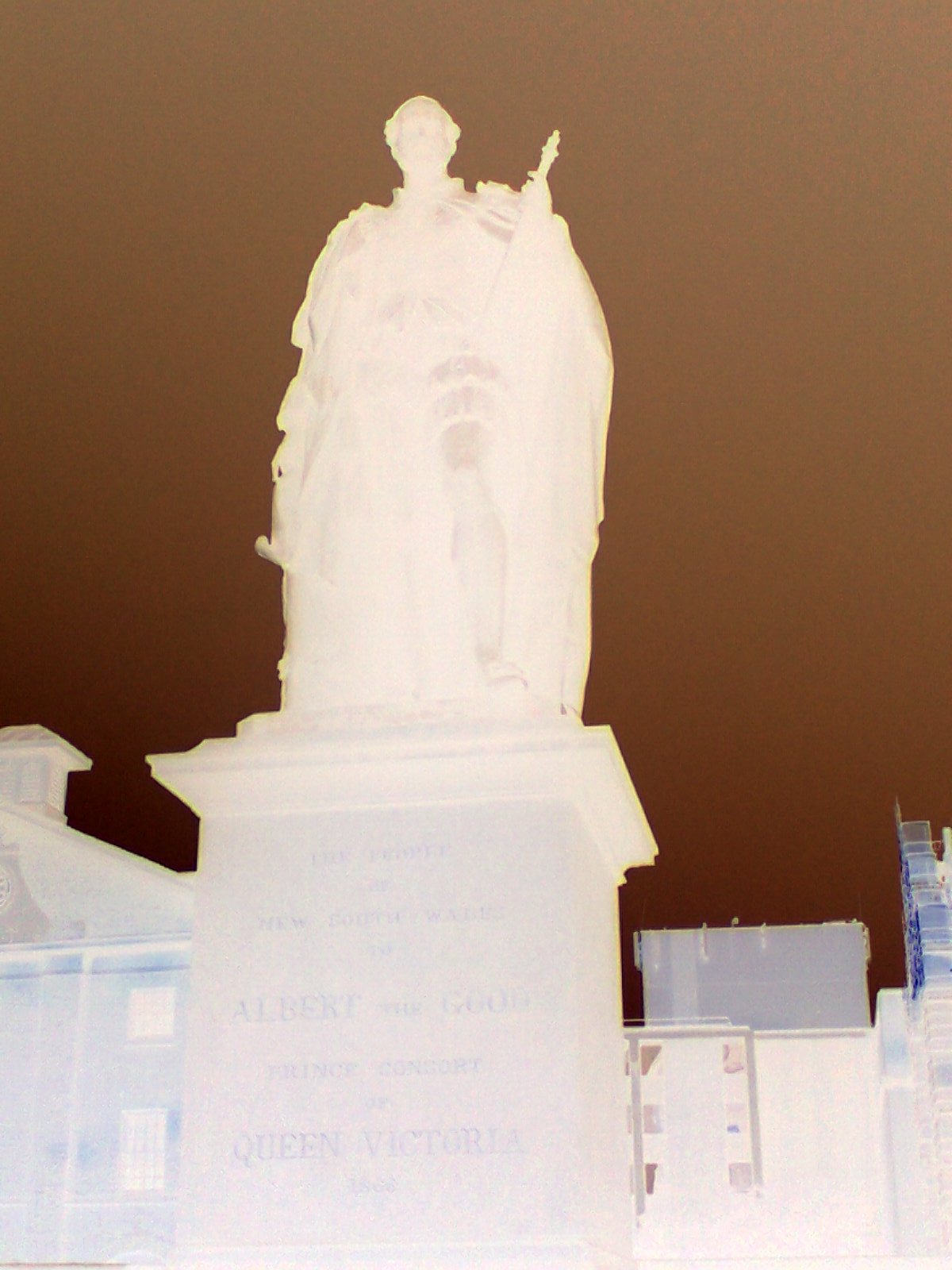
The completion of the new Law Courts in 1977 was just the excuse the authorities needed to move the statue out of the way. She and her pedestal were moved to a spot outside the new Law Courts building. Ten years later, the council dug up the pavement again and placed Queen Victoria back where she was previously. Unfortunately the road had been narrowed considerably, and where she was previously was now kerbside. The statue of her beloved consort, Prince Albert, still looks across the square towards her from the opposite corner. Sadly, Queens Square is today just another intersection in the central business district, with most who drive through it oblivious to its historical significance.

The work of British sculptor JEH Boehm, this statue, which is one of two of Queen Victoria in Sydney, stood in the centre of Queens Square when it was unveiled but six years later the statue ended up in the middle of a tram loop and stayed there until 1977 when the Law Courts were built. The bronze statue is mounted on a plinth of Moruya granite. 


St James Church - 173 King Street


St James Church


The Foundation Stone For This Building Was Laid In 1819. 


The Church Of St James , Designed By Francis Greenway, Was Consecrated In 1824 . John Verge Built The Vestries In 1832. The Exterior Reconstructed By Varney Parkes And Burcham Clamp Between 1852 And 1901


The Church Was Refurbished And The Chapel Glass Walls Were Installed In 1988. 

St. James, Sydney's Oldest Surviving Church Building, Continues To Stand As A Christian Witness To The City Of Sydney.


St. James' Church is a historic Anglican church located in Sydney, Australia. It is one of the oldest and most significant churches in the city, known for its architectural beauty and historical importance. Here's more information about St. James' Church:

History: St. James' Church was designed by the renowned colonial architect Francis Greenway. Construction of the church began in 1819 and was completed in 1824. The church's architecture is characterized by its Georgian style, featuring a simple yet elegant design with classical elements.

Architectural Features: The church's design incorporates elements such as a tall steeple, Doric columns, and a portico. Its sandstone exterior and interior reflect the prevailing architectural style of the time. St. James' is often praised for its harmonious proportions and the balance between its various architectural elements.

Significance: St. James' Church holds significant historical and cultural importance for Sydney and Australia as a whole. Some of its notable aspects include:

  1. Oldest Church in Sydney: St. James' Church is one of the oldest churches in Sydney, dating back to the early years of the colony.

  2. Greenway's Legacy: The church is one of the buildings designed by Francis Greenway, a talented architect who was a convict in the early years of the colony. Greenway's architectural contributions have left a lasting impact on Sydney's historic landscape.

  3. Community Hub: Throughout its history, St. James' Church has served as a spiritual and community center. It has been a place of worship, weddings, funerals, and other important life events for generations of Sydneysiders.

  4. Cultural Landmark: The church's architectural significance and historical associations have made it a recognized cultural landmark in the city.

Location: St. James' Church is situated on King Street, near Hyde Park in the central business district of Sydney. Its prominent location has contributed to its role as a historical and architectural focal point.

Heritage Status: The church is listed on the New South Wales State Heritage Register, acknowledging its importance in the state's history and architecture.

Visitors to Sydney often appreciate the opportunity to explore St. James' Church and its surroundings. Its architectural charm and historical significance offer a glimpse into Sydney's colonial past and its ongoing cultural heritage.


In 1828 the fashionable parish Of Saint James Anglican church, near Hyde Park, saw nothing humorous about the events for Sunday sixth of July.

The bell had scarcely ceased ringing when the commotion began. 

Wild Mr Edward shall, editor of the “Monitor” newspaper, was rustling up the door of his high sided pew, while his motherless young daughters looked on in fright.

Mr Hall, who’s come to Sydney as a Free setter,  spent a lot of his time in goal for levelling the authorities.

He’s been applying a recent stretch of freedom by taking the pastor of Saint James Archdeacon Thomas Hobbes spot. Now the Archdeacon had retaliated by locking him out with his peers.


Pork not hesitate.

Living like a kangaroo, as he later posted, he went over the top, burst a few door, and hussled his brood to their seats.

The following Sunday three Beatles were standing guard is a few, stays at the ready. Call setting self and his daughters on the stone all the steps. Divine service proceeded, the congregation rustling the shop. But the archdeacon Scott, a former wine merchant him some suspected of hastening into holy orders so we could take up the rich living of Saint James won the battle.

He boarded up the pew like the deck of the ship. He and the fight fighting a little bit but then wage a long time inconclusive battle in the courts.

Pork not hesitate.

Living like a kangaroo, as he later posted, he went over the top, burst a few door, and hussled his brood to their seats.

The following Sunday three Beatles were standing guard is a few, stays at the ready. Call setting self and his daughters on the stone all the steps. Divine service proceeded, the congregation rustling the shop. But the archdeacon Scott, a former wine merchant him some suspected of hastening into holy orders so we could take up the rich living of Saint James won the battle.

He boarded up the pew like the deck of the ship. He and the fight fighting a little bit but then wage to long in inconclusive battle in the courts.

Francis Greenway, who are designed for James and 1819 at the courthouse, had been livid when commission to be made and converted into a substitute for the cathedral he on governor McQuarrie the planning.

Methodist chapel he grumbled as he went about his conversion.

But today with my the church for George and Grace. It has been much restored, from the Coppers she fell tower to the sandstone foundations, and always beautiful to the centre period.


Wednesday, June 3, 2015

Sydney Centenary – Celebrating 100 Years of Settlement

1888 was Sydney’s big birthday party for a hundred years of British settlement — fireworks, processions, a Centennial Park carved from the old Common and Lachlan Swamp paddocks, and enough commemorative china and newspaper specials to bury a sideboard. This small gallery is that mood in pictures: the city dressing itself as a finished colonial capital. Say centenary of settlement, not “100 years of Australia” in the Federation sense — the Commonwealth is still thirteen years away.

What the celebrations papered over is part of the story too. Aboriginal Sydney was not invited to toast the anniversary; the official script was progress, wool and steam.

Sydney’s centenary celebrations in 1888 commemorated one hundred years since the arrival of the First Fleet and the establishment of the British colony at Sydney Cove. The anniversary was marked by civic ceremonies, public festivities and the opening of Centennial Park.

SYDNEY CENTENARY -

CELEBRATING 100 YEARS OF SETTLEMENT


Transcription (Sydney Morning Herald, Sesqui-Centenary Supplement, Monday 24 January 1938, page 5 – Dangar, Gedye & Malloch advertisement)

THE SYDNEY MORNING HERALD SESQUI-CENTENARY SUPPLEMENT, MONDAY, JANUARY 24, 1938. — Page Five.

"Time rolls its ceaseless course"

The centenary of Dangar, Gedye & Malloch Limited which occurs this year is invested with additional interest because it coincides with the sesqui-centenary celebrations.

1838
Closely interwoven with many important events in the development of N.S.W., the history of Dangar, Gedye & Malloch Limited forms a most picturesque and colourful story.

One hundred years ago there were three storekeepers carrying on business in the northern districts of New South Wales.

Richard Cary Dangar was in business in Muswellbrook in 1838; Jeremiah Brice Rundle was storekeeper in Page's River and Murrurundi in 1839; and James Gilchrist established himself in Armidale as storekeeper in the "forties." Each of these early colonial business men contributed in his turn to the foundation and development of the House known as Dangar, Gedye & Malloch Limited.

Richard Cary Dangar seems to have been the most enterprising of the three, inasmuch as he made several voyages between Australia and England—no small undertaking in those days—and he was the moving spirit in the partnerships that ensued. He first came to Sydney by the vessel "Florentia," in 1836, and, besides establishing himself in business two years later in Muswellbrook, he acquired pastoral interests, and seemingly took an active interest in the Church, since he was trustee of the Muswellbrook Church Fund.

Believing that Sydney offered greater scope for business than the country, Mr. Dangar and his storekeeper friend from Murrurundi, Jeremiah Brice Rundle, joined in partnership, and commenced trading as Rundle, Dangar & Co., Sydney. It was on one of his visits into the country that Mr. Dangar wrote from Gostwyck on the 13th October, 1853, to his partner, Mr. Rundle, advising that Mr. Gilchrist, storekeeper at Armidale, was "doing a very large business, especially in spirits and in gold buying;" and Mr. Dangar suggested various lines of merchandise which Rundle, Dangar & Co. might sell to Mr. Gilchrist. Evidently Mr. Dangar registered a high opinion of Mr. James Gilchrist's business ability, as he later dissolved his partnership with Mr. Rundle, and became associated with Mr. Gilchrist, trading under the name of Dangar, Gilchrist & Co., Sydney. In 1855, Mr. Dangar admitted his nephew, Mr. Frederick Holkham Dangar, into the firm.

1870
Eight years later (1867) Mr. R. C. Dangar died, and some time afterwards Mr. Gilchrist retired. Mr. F. H. Dangar, in 1870, admitted into the firm his senior assistant in the business—Mr. Charles T. Gedye—whose name was substituted for that of Mr. Gilchrist. It is of interest to note that Mr. Gedye was manager of the Meat Preserving works established in Newcastle in the "forties" by Mr. Henry Dangar, the surveyor. The firm thus became known as Dangar, Gedye & Co., and thereafter there was no change in the name for 67 years, although its activities were extended far beyond its original limits. In addition to their business as Stock and Station Holders and Financiers, Wool Shippers and General Importers, the firm had large shipping interests. They owned the sailing ship "Neotsfield," and were agents for many of the famous sailing vessels, including some of the crack wool clippers — the "Torridon," the "Brilliant," the "Halloween," and the "Cutty Sark." Incidentally, it was from the latter vessel that many of the trade names of the goods sold by the Company were derived.

Mr. F. H. Dangar went to London in 1882. It was about this time that the Company began to take an interest in Shearing Machinery. Years later, after the death of Mr. Gedye, he handed over the business to his partner, Mr. Andrew Johnstone Sievers, who carried it on until his death in 1916. In that year the business was acquired conjointly by Mr. Robert A. Malloch (then a partner of Malloch Bros., Perth, W.A.) and Mr. William H. Carver, who had been with the firm for 45 years. Mr. Carver died in 1919, and his share of the business was acquired by Mr. Malloch.

1916

1938 And so now, after one hundred years, we proudly announce our Centenary!

Dangar, Gedye & Malloch Ltd.
Malloch House, Young Street, Sydney
—1838 – 1938—


Transcription (Sydney Morning Herald, Sesqui-Centenary Supplement, Monday 24 January 1938 – "Governors of the Young Australia" (images 2–3 show the same page))

GOVERNORS of the Young AUSTRALIA
By GEORGE MACKANESS,
Author of "Admiral Arthur Phillip," etc.

WHEN Miss Fanny Chapman wrote in her Bath diary that Admiral Phillip combined in him the three essential elements that go to the making of a great man, "the gentleman, the scholar, and the seaman," she epitomized in a phrase the predominant qualities of our first Australian Governor. The stamp of merit, intellectual and moral, was undoubtedly impressed on him, a merit, as Viscount Wakefield put it, "that was revealed in the three qualities essential to creative work — vision, faith, and courage."

These qualities were so equally combined in Phillip that, to-day, we can confidently place his name high in the ranks of Empire-builders, a man, who, upon what in his day appeared to be but rotten and insecure foundations, built far better than he knew.

[The body text in the columns below is too small to read in these photos.]

[Section headings:] Reign of the Rum Officers. / The Arrest of William Bligh. / Macquarie the Nation Builder. / King's Fight [illegible]

[Caption under portrait:] Captain John Hunter.


Transcription (Sydney Morning Herald, Sesqui-Centenary Supplement, Monday 24 January 1938 – "Governors of the Young Australia" (lower part of the page))

[Caption, top, partly readable:] "If Phillip was the founder of New South Wales, Lachlan Macquarie may rightly be called the [illegible]."—A study of Macquarie.

[Caption, right:] (Above.) A portrait of Governor Bligh, and (left) a drawing made to illustrate the allegation that Bligh was hiding under a bed when he was arrested.

[End of the article, right-hand column:]
[ob]tained Bathurst's permission to retire, but did not leave Sydney until December, 1821.

His successor, Sir Thomas Brisbane, was faced with the task of putting into operation the reforms suggested by Bigge, but as an administrator he was not a success, for, being peace loving and a little deficient in energy, he was unable to prevent his best intentions from being thwarted by officials. Nevertheless, he effected many important changes.

After Brisbane came Sir Ralph Darling, a distinguished soldier and a man of high administrative ability, whose main services to the colony lay on the reorganisation of the administrative departments, the encouragement of explorers, and the opening up of the Moreton Bay district.

The administration of the next Governor, Sir Richard Bourke, was marked by much colonial progress, for his tact and sympathy ensured the adoption of many necessary social and political reforms, some suggested by the home authorities, others initiated by himself. Most important of them all was the inauguration of the "squatting" system, a device which gave room for the development of the wool industry, without disposing irrevocably of valuable Crown lands.

With the coming of Sir George Gipps, Bourke's successor, in February, 1838, we reach the end of half a century of the history of New South Wales.


Transcription (Sydney Morning Herald, Sesqui-Centenary Supplement, Monday 24 January 1938 – Harbour Bridge accounts (close-up; the left and right edges are cut off))

[Script headline, partly visible:] …g of the Ha…

EXPENDITURE.
Cost of collecting road toll …… £8,155
Maintenance and minor improvements …… 32,644
Maintenance of properties …… 706
Administrative expenses …… 1,205

LOAN CHARGES.
Interest …… £295,644
Exchange …… 38,788
Sinking fund …… 35,764
Management expenses of loans …… 2,904 — 373,100

Total …… —£415,810

The surplus of income over expenditure for the 12 months ended June 30, 1937, is £62,048. The year began with a deficit of £27,090, which reduces the surplus to £34,958. The figures shown are subject to completion of accounts and audit.

[The neighbouring column on the right is cut off at the edge of the photo.]


Transcription (Sydney Morning Herald, Sesqui-Centenary Supplement, Monday 24 January 1938, page 5 – Dangar, Gedye & Malloch advertisement (close-up))

Transcription above


Transcription (Sydney Morning Herald, Sesqui-Centenary Supplement, Monday 24 January 1938, page 5 – Dangar, Gedye & Malloch advertisement (close-up))

Transcription above


Transcription (Sydney Morning Herald, Sesqui-Centenary Supplement, Monday 24 January 1938, page 5 – Dangar, Gedye & Malloch advertisement (close-up))

Transcription above