
- Sydney Past & Present - - The City Of Sydney - - The Stories Of Its Growth -
________________________________________________________________________________________________________________________________________________________________________________________________________________________________________________________________________________________________________________
Chapter XI.
In The Forties.—(Continued.)
It was on the 24th of January, 1843, that Sir George Gipps, acting then as President of the Council, addressed the members to the effect that their existence as a Council was almost at an end, seeing that the British Parliament had at last passed an Act which made that body elective. Thus the year of grace, 1843, saw the partial death of the nominee system, and the birth of one based on the will of the people. Partial, because the nominee leaven still obtained to the extent that six of the members were to be Goverment officials, and six others appointed directly by the Governor himself. The people were allowed twenty-four representatives, whose qualifications were either the possession of freehold valued at £200 per annum, or a fixed, income of £20 per annum, derived from a residential source. Of these, six were to represent Port Phillip, and eighteen New South Wales. The voting was, of course, open; and the state of the poll was declared every hour, as nearly as might be. The first election in our city is worthy of rather more than a general notice.
Somewhere as nearly as possible on the site of Thomas Mort’s statue in Macquarie Place—the witness of so many historic scenes—was the spot chosen for the first nomination for the city electorate, which resulted in the return of Messrs. Wentworth and Bland; and here the former made that unequivocal declaration that probably placed him at the top of the poll, to the effect that “either William Charles Wentworth was unworthy to represent Sydney, or Sydney was unworthy of being represented by William Charles Wentworth. To posterity he left the deciding the question.”
Between the partisans of these two men and those of the other candidates, of whom the principal were Robert Cowper, Captain O’Connell, and William Hustler, feeling was rather strained, and encounters were consequently more or less serious throughout the day; which gave Captain Innes, the then police magistrate, and his men all they knew to suppress. The crowd started from Miller’s Point, and travelled along Kent-street, via Charlotte Place, to “Smith’s Corner,” in Market-street, just about the site of the present Kidman’s Buildings. Smith was a popular “sport” of the time, and kept a large butcher’s shop. There, so the story goes, on one of the mob attempting to pull up some palings from the fence that then bounded a cottage garden opposite, a woman rushed out, and cut off his fingers with a meat axe. And, curiously enough, whether a fact or not, the writer happening to sit, quite recently, next to an old gentleman in one of the George-street electric trams, heard him relating the story as having been himself an actual witness of the occurrence. With the addition, however, that next morning there appeared in one of the newspapers an advertisement to the effect that the victim could have the missing digits returned on personal application!
When the crowd reached the Haymarket it attempted to rush the polling place there, and, by destroying the voting papers, at least delay the election. These roughs carried poles decked with green ribbons, and were simply spoiling for a fight with Wentworthites or Blandites. The attempt on the papers was frustrated by the presence of mind of a clerk who, having one of Hustler’s placards, shouted that if they destroyed the papers they would do as much harm to their own side as to the opposition, whereupon they gave cheers for Hustler, and rioted away to Hyde Park.
During the afternoon there was a fight near St. James’ Church, and Captain Innes and some of the police were chased into the adjacent barracks, where they took refuge. But, despite all opposition, Wentworth and Bland were easily first when the final count came.
Shortly afterwards Parramatta had its turn. Mr. Charles Cowper, a son of the Archdeacon, had been beaten for Camden, by Mr. Roger Therry, afterwards the well-known judge. So his supporters determined to give him a show for Cumberland. Time was short, and the opposition candidate, James Macarthur, strong and influential The excitement was at fever heat, and although people felt that the Sydney vote was secure for Cowper, the Macarthur connection and influence amid the strongholds of the family was too strong to allow very much hope.
Towards evening people began to muster around the committee rooms, situated in a new building where Lassetter’s ironmongery department stands now, for it was known that Cowper would ride in from Parramatta with the final pollings from that town and the neighbourhood. Crowds filled the Haymarket, and George-street was impassable, so that when, very late, distant cheering was heard, his committee could not get out to discover the cause. However, they presently saw Cowper borne aloft on six men’s shoulders, and after a time, he was landed safely among them, having beaten Macarthur by 132 votes. And thus was the future Sir Charles Cowper introduced to Australian political life, after a struggle, the keenness and bitterness of which we, at this latter day, find it rather hard to realise, pretty certain, as we are, that by no efforts of our own can we change the dreary level of mediocrity that has for years distinguished each legislative see-saw in the representative Chamber.
As going to show the insecurity of life and property in Sydney in 1844, two instances may here be given of the cool brutality and heartlessness that characterised the criminal class that still made up the great part of the population of the city. In the early part of the year a ticket-of-leave-man from Norfolk Island went into the shop of a poor old widow woman at the corner of Kent and Margaret streets, and asked to be served with some trifling article. Whilst Mrs. Jamieson was serving him, the scoundrel split her head open with a tomahawk. She lingered a few days, and then died, leaving two orphan children. The murderer, John Knatchbull, was what was known as a “gentleman convict”—i.e., well-connected at home. Indeed, his brother, Sir Edward Knatchbull, on hearing of the occurrence, sent out a sum of money to be invested for the benefit of the orphans. Strong efforts were also made to get the murderer off, and he was defended by Robert Lowe, afterwards Lord Sherbrooke, who then lived in Macquarie-street, opposite the old School of Industry, and whose wife, it is said, eventually took charge of Mrs. Jamieson’s children—a girl and a boy—and had them brought up respectably. But, although the plea of insanity was set up, the man’s record was so bad that he was condemned to death, and hanged in due course. The proceeds of his crime amounted to 3s 6d. Then, in the May of the same year, there happened another, and an equally cold-blooded murder. One Sunday evening Mr. Noble, a general estate agent, and a well-known and respected citizen, was sitting reading the Bible aloud to his wife and her sister, when three men entered, one of whom snapped a pistol at Mr. Noble’s head. That gentleman turned and grappled with his assailant; the women screamed, and two of the fellows escaped by the back door. But Mr. Noble, forced to release the first one he had seized, now collared another, and held him until assistance arrived. Not till then was Noble found to have been stabbed in the stomach. The wound proved mortal, and the unfortunate man died in two days. The captive (Martin) turned approver, and presently the others (Vigors and Burdett) were captured, tried, and, of course duly hanged. But what made the citizens so excited over this affair was the fact that the three criminals—all Norfolk Island convicts —were actually under sentence in Hyde Park Barracks when they escaped and murdered poor Noble. It seems that as they were entering St. Phillip’s on that Sunday they had slipped out of the gang, and, having plain suits concealed under their branded ones, had soon transformed themselves into free men, and without the delay of a minute recommenced their career of crime by a most barbarous murder. Then, of course, people wanted to know something about the state of discipline in a gaol where such goings on were possible; and, finally, on the motion of Dr. Nicholson, a select Committee of the Legislative Council was appointed to inquire into the condition both of the Sydney police and the Hyde Park Barracks; also to consider the expediency of remonstrating against the introduction of “Norfolk Island expirees” into the colony.

Long ago a price list of necessaries, etc., in the early days was quoted in this book. It will, perhaps, be of interest to contrast them with a few figures from 1844-5.
The Australasian Sugar Refining Company then had their works at Canterbury, “about six miles from Sydney, beyond the pleasant suburbs of New Town;” and for their produce they asked for “Fine loaves, on the spot, 4½d per lb; ditto, for exportation, 4½d per lb, free on board; crushed lump, 40s per cwt.; fine pieces, 30s to 36s per cwt.; molasses, none;” and the above list is signed “E. Knox, manager.” Tea was still a luxury at from 4s 6d to 5s 6d per lb. Flour of the best quality was £9 per ton. Butcher’s meat of every kind was plentiful, and the very best description. Beef, 1½d per lb retail; mutton, 2d to 2½d; pork, 4d to 5d; veal, 4½d to 5½d. Bread was 2½d the two-pound loaf. Grapes of the finest kinds were 3d per lb; but bananas were looked upon as somewhat of a luxury, though “plentiful at 2s per dozen.” Peaches sold at from 4d to 1s per basket—of what size is not stated; but, judging from the description of the plenteous crop, probably a clothes basket. Walthall’s best colonial tobacco was 1s 6d per lb; other sorts down to 8d. House rent was considered high, £30 per annum being paid for a small cottage in an unfavorable situation. “Time,” says an old writer, “will, however, certainly remedy this evil” In which statement he has not been so thoroughly borne out as one might altogether wish.
Until the last few years imprisonment for debt still formed part of the law of the land; but that was now abolished, and the debtor’s prison, situated close to the treadmill at the corner of Pitt and Gipps streets, was untenanted. At one time, on payment of 5s a week, any creditor could keep his unfortunate victim “walking the rules” for life if he so pleased. But that was all over now; and by virtue of an Insolvency Act, passed in these early forties, many hundreds of people had been released. Braim, “walking out of town by the road leading to the interior of the country,” found the old building “standing in solitary and untenanted gloom. It appears to frown now on the barbarism which could perpetrate this custom so long, and extend it so far; while some beautiful roses and plants blooming in the front speak eloquently of the blooming of brighter days.”
Originally the place was intended, and used as a boys’ penitentiary— something after the fashion of our Carpentarian Reformatory—where the youthful offenders were taught useful trades, and otherwise reclaimed. Then, at a period when public works were being rapidly erected, it was used as quarters for the Government carters, and, from this cause, for a long time retained the name of “Carter’s Barracks.”
Close to the site of the present “House” in Macquarie-street there stood in 1843, a mean-looking little building, in which the old Council used to meet. And here, in a stuffy, close room, the Governor, with the nominee members around him, sat at a table and discussed matters of state and the affairs of the colony. When, however, the new Constitution came into being, the place was found far too small to accommodate the thirty-six representatives, to say nothing of a stranger’s gallery, committee rooms, etc. There was, however, no money to spare just then for anything grand in the way of a new Chamber; also, Governor Gipps true to his economical instinct, set his face against any decent expenditure. So he told the colonial architect to do the job as cheaply as he could, with the result that the present barracks were run up in six months —looking exactly, exteriorly, as we see them today, but, of course with many improvements inside. Macquarie would have given us a palace ugly enough, perhaps, but, like everything else he put his hand to massive and enduring. He was no jerry-builder, and, therefore, none of his work is contemptible, like that ramshackle erection approved of Gipps and which has cost us almost as much in repairs as would suffice to build another Victoria Markets.
Notable among the buildings begun and completed, or nearly so during the reign of Gipps was the R.C. Church of St. Patrick, built by subscription, assisted by a grant of £1000 from the State. The first stone was laid on August 25, 1840, by the Archbishop, Dr. Polding, in person and four years later was dedicated by him, although the interior was not finished for some time afterwards. The first Jewish Synagogue was also built at a cost of £3600. Up till then the Jews had no recognised place of worship—used, indeed, to meet in a private house, that of Mr. P. J. Cohen, in Jamieson street, offered by him for the purpose. Later on, as their numbers increased, they took possession of a large room on the northern side of Bridge-street, afterwards used as a store by a Mr. Gordon. Then, towards the end of 1841, a site in York-street was purchased at auction, a Synagogue built, and in 1844, consecrated with all the ceremonies usual upon such an occasion.
When Dr. Polding, the first R.C. Bishop of Australia, went home in 1840, and was created an Archbishop, he ordered a peal of bells. They did not arrive, however, for two years; then a belfry was erected for them, and they ushered in the new year of 1843 with their music—the first of the kind that the Currency lads and lasses had ever heard.
Although churches of the established faith were plentiful enough at this date, we had as yet only the beginnings of a cathedral to boast of. There was, however, close to the site of the present edifice, a parish church of St. Andrew’s, capable of seating 520 people, with, as minister, the Rev. R. K. Sconce. “We should like to see,” remarks a writer of the time, “greater liberality evinced by our fellow-colonists in bringing to completion the first cathedral church in Australia. Protestants would do well in this respect to learn a lesson from the Roman Catholic community, and emulate their zeal and liberality in perpetuating their worship and extending their principles.” St. James’s was still the fashionable Church, attended by the Governor and his family, and all the high officials of the colony; also, perforce, by the convicts from the neighboring barracks. Says old Braim, quaintly—he was now headmaster of Sydney College, in succession to Cape—”It has sometimes struck us that if anything can touch the hearts of these unhappy men (and who should say nothing can?) it must be when in this land of their expatriation, weekly as the Sabbath returns, they hear all classes of the community in the great congregation joining in the beautiful prayers of our inimitable Liturgy, ‘That it may please Thee to show Thy pity upon all prisoners and captives.’ ” Judging from the instances already given of the way these gentry behaved when they got a little freedom, it would have taken more than the Liturgy to convert that gloomy audience in the old St. James’s gallery.
The attendance at St. James’s, in 1844 are given as: Morning service, 1400; afternoon, 500; and evening, 1000.
Apparently, our folk then spent the day very much as the majority of them do now. Says a writer: “We cannot forbear expressing our strong disapprobation of the practice, but too prevalent in Sydney, of devoting the latter part of the Lord’s day to amusement and pleasure. Dinner parties, water or land excursions, and a thousand means are devised to ‘kill the time’ of this sacred day, at least, so soon as the morning service is closed.” To attend Divine service three times, “and spend the intervals in silent communion with holy things” was a fashion of passing Sunday no more in favour then than it is now.
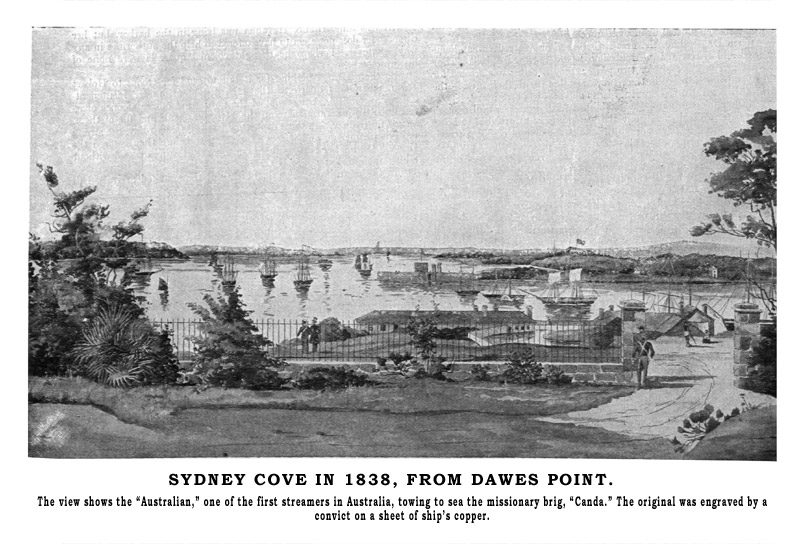
Spite, however, of its irreligiousness, the city throve apace, both by land and sea. Everywhere around the foreshores centipedal wharves thrust themselves into the water, whilst ever more and more ships came from oversea and rested alongside them to discharge the wares of the old land in return for the produce of the new. Such men as “Merchant” Campbell and “Bobby” Town were the fathers of the shipping interest, and it was through them, and the like of them, that the city was gradually being fringed with the tall spars that spelled commerce. And we had gone on building ships, too, all the time. In 1834 we built nine, amounting in all to 376 tons; but, in 1843, we put no less than 47 into the water, aggregating 1433 tons—small coasters, of course, but fine, handy, useful craft. Of vessels, exclusive of these registered in the port, there were less than 92, making up 7,022 tons altogether—only a little over the individual tonnage of some of the mail-boats of to-day, certainly; but then we were still very young, and it takes time to develop a mercantile marine. And, actually, we did more towards it during that first half-century than we have, comparatively, done ever since.
Nearing the latter end of Gipps’s governorship, an occurrence took place at the barracks, which at one period promised serious developments. At this time the 99th regiment were there under Lieutenant-Colonel Despard, “Stand-off-the-grass Despard,” so called because he had forbidden the public to walk on the turf in the barrack-square, and had put up a notice to that effect. In those days soldiers had a regular allowance of grog, and, presently, Despard stopped it. Then the troops became mutinous, and refused point-blank to obey orders. Sir Maurice O’Connell, at that time Commander, of the forces, went to the barracks, accompanied by his staff, to try and dissuade the men from their foolish action, the consequences of which he took good care to point out to them. But he spoke in vain. Then, becoming angry, he said he would arm the Cockatoo Island convicts, and lead them against the mutineers. This still more aggravated the 99th, and the men seized their arms and threatened Sir Maurice and his officers with personal violence.
At this time, H.M.S. Havanna was lying in the harbor, but her commander does not seem to have offered to help the authorities in any way whatever. Perhaps he thought colonial quarrels were none of his business.
So there seemed nothing for it but to send for troops to Hobart Town, where was quartered the 11th Regiment, under Lieutenant-Colonel Bloomfield. On receipt of the news, that officer at once chartered the barque Tasmania, and the 11th, 400 rank and file of them, set sail for Sydney. In three days, they were off Coogee Bay, the strong westerlies came up, and it was another week before they entered the Heads. During her beating about outside, the Havanna passed without taking the slightest notice of them.
In the meantime, the 99th, hearing of the expected arrivals, had thought better of things, made their submission, and returned to duty.
The 11th arrived on January 8, 1846, and were, as soon as possible, put in lighters, and landed at the Commissariat Wharf. There they formed up, and marched four deep, with fixed bayonets, towards the barracks, their band playing, “Paddy, Will You Now.”
When they arrived, they found the gates closed; but on Colonel Bloomfield’s command, they were at once opened, and the main-guard of the 99th turned out, and presented arms to the 11th, as they marched in and formed up, whilst nearly all the men, women, and children of the late mutinous regiment joined in three hearty cheers for the newcomers. And thus happily ended an episode that, but for the prompt action of the authorities, might have had a very different termination.
The 11th stayed in Sydney for a year, and Colonel Bloomfield, so far as his regiments’ portion of the barrack green was concerned, gave orders that no citizens were to be prevented from walking on it. It should be explained that, especially when the band was playing in the rotunda, it was a favorite resort of the city folk. There is still a rotunda in the square, but no band ever plays there, and “dead beats” sprawl over the grass at their own sweet will and pleasure. In the following January, the 11th returned to Van Diemen’s land, and were quartered at Launceston. But such a favorite had the regiment become in Sydney, that the townspeople petitioned the General to allow them to return, and take the place of the 99th—a noted lot of “hard cases”—and actually offered to bear the cost of the regiments’ transit both ways. This was acceded to. And, in August, 1848, the 11th returned, and were the first troops to occupy the new Victoria Barracks. As for the 99th, they were ordered from Van Diemen’s Land to India. Both colonies, apparently, being very glad indeed to get rid of them.
It may be mentioned, as showing the hold that fine soldier, Colonel Bloomfield, had over his men, that, although during the stay of the 11th in New South Wales, the gold discoveries took place, with all their ensuing excitement and feverish unrest, scarcely a soldier deserted from his regiment. Says a new arrival, writing in 1846, and staying at “Petty’s Hotel, a respectable, quiet establishment” Passing through Barrack Square to mine inn, shortly before 9 o’clock, I found tattoo going on, and drums and fifes of the 99th regiment rattling away at Mrs. Waylett’s the pretty old song of ‘I’d be a Butterfly,’ in the most spirited style, just as if we were not 16,000 miles away from the Horse Guards.”
With two regiments established in the heart of the city, the military element in those days was evidently an important factor in the social life of the place. And doubtless, conflicts between the soldiers and the “pushes”—then known as the Cabbage-Tree mob—were so common as to be hardly worth chronicling. The Cabbage-Trees are described as “an unruly set of young fellows, native-born, generally, who hung about the doors of the Sydney theatres, and, not being able to perhaps muster coin enough to enter the house, amuse themselves by molesting those who can afford that luxury. Dressed in a suit of fustian or colonial tweed, and the emblem of their order—the low-crowned cabbage-palm hat—the main object of their enmity seems to be the ordinary black headpiece worn by respectable persons.”
Well, we have improved somewhat on that sort of business, so far, at least, as the theatres are concerned; but although one of the favorite haunts of the up-to-date evolution of the cabbage-tree mob—the straw hat brigade—is a church porch, whence they can insult the worshippers at their exits and entrances, the change of venue has not improved their behaviour in any very great measure.
Chapter XII.
Sporting In The Forties.
From time to time during the course of this chronicle a glance has been taken at the sports of the people, and the progress of horse-racing, yachting, etc., among them noted. Early cricket was also touched upon, as seen then, in a rather crude and incomplete condition; but during the forties more interest was taken in cricket than at any prior period. It may, indeed, from that time be said to become the Australian game par excellence. Some years ago Mr. Harry Hilliard says: “There were perhaps, in this year (1843) 100 cricketers in Sydney. Messrs. W. and R. still were both fine bats, as was also a gentleman named Palmer, connected with banking. I myself was also accounted an excellent bat. Rowley, a cabinetmaker, was the crack bowler, underhand, of course. His bowling had a natural break of five or six inches from leg. Oh! I can tell you that Rowley would have puzzled a lot of our modern bats—for a while, anyhow.” Of course, in these days there was no foot ball; horseracing seem to have gone much out of favour, and yachting was not very popular. Therefore, cricket throve amain, and clubs sprung up everywhere. There was the Currency, composed entirely of colonials, and to which Mr. Hilliard belonged; the Union, Victorian, Albert, and Australian.
The matches of importance were played in Hyde Park The city teams, too, then, as now, went inland to Parramatta, Liverpool and Windsor. And about one of these country matches Hilliard used to tell a curious little story:
The Australian Club, it appears, went to Windsor to play the locals for whom Hilliard stood umpire, whilst Mr. Saddler performed the same office for the visitors. Among the Windsor players were two brothers named Bushell; and Saddler gave one of them out “leg before.” The batsman, however, stoutly contested this decision, backed up by his brother, who exclamed. “Don’t ‘ee go out, Bill and if t’ umpire tries to put ‘ee out, knock him down with ‘ee bat.” And, finally to avoid a free fight, another innings had to be given to Bushell. Evidently country cricket was a thing to be taken very seriously in the forties.
“We used” says Hilliard, “to have great trouble to keep the wickets anything like decent. You see there was no supervision of the ground and even the clubs would fight among themselves for the possession of a choice pitch. Sometimes we would send up boys to hold a pitch for us from daybreak on the morning of the match. A device we had to keep the people off the grass was to tar the underside of the top rail of the fences. The tar hung down in drips, and as intruders came through it would smear their clothes.” None of the Governors except Sir William Denison, according to Mr. Hilliard, took any interest in cricket, although some of the young aides, and others of the staff, used occasionally to have a game. Sir James Martin, as a youngster, played a great deal, but never attained much, proficiency. In Mr. Hilliard’s opinion the real father of New South Wales cricket was Mr. Tunks. “It was he and I who put the first spade into the present Domain ground. He kept a publichouse in those days, but always encouraged the cricketers to drink tea. Whenever we had a match, we had tea with good old Mrs. Tunks. Also, Mr. Driver, a solicitor, and an M.P., and the son of the proprietor of an hotel called the Three Tuns, which stood at the corner of King and Elizabeth streets, just where Temple Court now stands, was another great patron of the game, but he was never much of a player, though he was always ready to help us with his money.”
Hilliard was one of six Currency lads, who played in the first intercolonial match with Victoria, and he says most of the team fielded barefoot. This was in 1856, and was won by New South Wales by three wickets. Then, in 1857, the Melbourne men came to Sydney, and met in the Outer Domain, being again beaten. The excitement was intense, the Governor and all sorts and conditions of people being present, to the number of 10,000. The match lasted two days and a half. Scores: New South Wales, 80 and 86; Victoria, 63 and 38. Slow bats and cautious in those days, with a top score (Gilbert) of 31. His batting, said the newspapers, “was the theme of universal admiration.” Well, truly times have changed since that stonewalling era, and the papers of to-day would doubtless comment on such a performance somewhat differently—unless the 31 were made in as many minutes.
The group portrait of New South Wales Rifle champions marks an interesting stage in the Australian volunteer movement, and particularly in that branch of it which has for its object the making of marksmen. The picture illustrates an account of the first intercolonial rifle match held in Australia, and, appropriately enough, the contestants were New South Wales and Victoria, whose representatives since then have met in many friendly shootings, with varying fortune. The mother colony proved victorious at the first trial of skill at the targets, and there is no doubt that the wider field of fame opened up to riflemen by this intercolonial meeting did much towards establishing the present satisfactory state of affairs. From beating the men of his own colony the champion began to covert honors further afield, and ultimately the pinnacle was reached when he was sent home to meet the best shots in Great Britain. The idea of the first match originated with the members of the Victorian Rifle Association, and, although all the colonies were invited to take part, none of them could see their way clear to accept the invitation. The conditions governing the match were that each colony should contribute £50 per annum for three years, for the purpose of purchasing a challenge shield which had to be won three times in succession before passing into the possession of any colony. In consideration of the first meeting being held in Melbourne, the Victorian Association donated a further sum of £50 to the successful competitors in the first year. Bona-fide volunteers alone were eligible, and the use of any rifle with a trigger pull of 3lb was allowed. Each competitor had ten shots at each of the respective distances of 200, 300, 500, 600, 700, 800, and 900 yards, making seventy shots in all, Hythe position, and Wimbledon system of scoring. Ten of the best shots in New South Wales were selected by the association, and a like number was chosen by the Victorian Association, from their shooting in four special practices. The two teams met at the Melbourne butt on November 3, 1862, when, after a keenly contested match, especially up to 700 yards, the men from the parent colony won with 64 points to spare. Their superiority over the Victorians was principally apparent at the long ranges. In these days of shooting with uniform weapons, it is almost impossible to compare with any degree of fairness present scores with those of the match of 1862. Still, the scores made in that contest were undoubtedly good, for shooting had not been reduced to the fine art it is now. The scores on the New South Wales side were: Corporal Lynch 182, Trooper Sharp 177, Private Rayner 168, Sergeant Webb 152, Private Wyndham 150, Lieutenant Campbell 144, Sergeant Strong 140, Sergeant-Major Hellyer 134, Private Dickson 125, Captain Windeyer 125; total, 1497. On the Victorian side the total was 1432 points, made up as under: Private M’Naughton 175, Sergeant Wright 154, Sergeant Douglas 154, Sergeant Sleep 152, Private Cole 151, Captain Radcliffe 141, Sergeant Templeton 140, Private Peterson 132, Private M’Ewan 124, Private Frost 109. A banquet in the evening wound up the event, and on the following day the Sydney men embarked for home on the City of Sydney. On the way up the coast she was wrecked near Green Cape (November 5, 1862). Fortunately, all lives were saved, but uniforms, private effects, and valuable small-bore rifles were lost.
A Mr. Davis, of Bourke- street, Melbourne, photographed the victorious ten, of whom six belonged to the Sydney Battalion Volunteer Rifles, one to the suburban battalion, and one to the country corps (West Maitland). The Mounted Rifles furnished the other two—Sergeant-major Hellyer and Trooper Sharp. Captain Harbottle, S.B.V.R., accompanied the team as captain, and Sergeant-major Lees, of the Staff, acted as marker.
If ever there was a nondescript sort of a city in these forties it was Sydney. And, yet, as every visitor allowed, it bore a pre-eminently English aspect Writes one in particular: “Sydney is, I think, more exclusively English in its population than either Liverpool or London. Were it not for an occasional orange tree in full bloom or fruit in the backyard of some of the older cottages, or a flock of little green parrots whistling as they alight for a moment on a house top, one might fancy himself at Brighton or Plymouth.” This would require a rather fervid imagination, one fancies; and our author gets nearer the mark when he says, “it might be Waterford or Wapping, with a dash of Nova Scotian Halifax.” Indeed, he and many others like him, seem to have been very considerably puzzled to find comparisons. But old pictures will thoroughly bear out his remark, that the “construction of the buildings is blameably ill-suited to a semi-tropical climate—barefaced, smug-looking tenements, without verandahs or even broad eaves.” Nor, indeed, is it necessary to consult contemporary views to see the justice of this criticism, inasmuch as, at the present day, you can see, in places, the same “smug, barefaced,” old houses still standing, forlorn, disreputable, blistered by the sun and rain of many years.
Goats were still a conspicuous feature of our streets. “Nearly every cottage has its goat or family of goats. They ramble about the highways and by-ways, picking up a haphazard livelihood during the day, and going home willingly or compulsorily to be milked at night. Woe betide the suburban garden whose gate is left for a moment unclosed… In an instant the bearded tribes rush in, and, in a few seconds roses, sweet peas, carnations, stocks, etc., are as closely nibbled down as though a flock of locusts had bivouacked for a week on the spot; and the neat flower-beds are dotted over with little clover feet, as if ten thousand infantine devils had been dancing there—a juvenile sabbat.” The man who wrote that wrote feelingly, and one can see that more than once his garden-gate had been left open, even as they still are, and with the same results. Like the poor and the unemployed, the goats we seem fated to have always with us.
Pitt-street, even half a century ago or more, appears to have been noted for its linen drapers’ shops: “Whether we regard the excellence of their arrangements, the sterling value of the commodities, the costliness of their large and showy windows, and at night, the glistening splendor of their lamps, sometimes most tastefully ornamented, we cannot but feel proud of our city; and even the stranger must acknowledge that those houses of business would not disgrace any of our older towns in the mother country.” Evidently, the predecessors of our Horderns, Ways, Farmers, etc., kept as well up-to-date as do their descendants.

A picture of O’Connell-street towards the end of the forties is worth re-producing. Referring to the similarity of the name with that of the celebrated Irish agitator the old writer says: “Start not, gentle reader, at the name; the place bearing this designation is calm and peaceful as you can desire. We have no ‘agitation’ here, save the calm agitation of shrubs and flowers, which adorn the little gardens smiling on either side, fanned as they are by soft zephyrs, gaily playing around. Whatever opinion may be entertained of the name, but one can be held regarding the street. It is one of the most “tasty” in Sydney. The houses, as we have already hinted, have gardens before them, some of which are kept with much neatness by their careful owners. Here may be seen our native and English plants, vying which shall outshine the other, which shall more adorn the garden plot, which more adorn the air.”
Of course, as the writer remarks later on, the street was named “in honor of our worthy Commander of the Forces, Sir Maurice O’Connell.” But, alas, the only zephyrs there to-day are formed of sand and dust, and the perfume is mostly chemical in its nature; whilst the “tastiness” of those bygone days has fled for ever.
And they thought a lot of their streets in those times. The running of Pitt-street right through to the Quay was then under discussion; “it will thus be rendered the main street of the town; and, when completed, the line of road for traffic, nearly two miles in length, will, besides its vast accommodation, be no small ornament to our fair city. We may remark of the streets of Sydney generally that they are very regular and well-formed.—Pitt and Castlereagh streets are almost in straight lines, though each extends about a mile and a half.”
By all visitors the palm was almost unanimously awarded to the Congregational Church in Pitt-street as the handsomest building in the city. It was designed by Mr. John Bibb, and erected under his supervision, the foundation-stone having been laid by Dr. Ross, on Anniversary Day, 1841. Then, by reason of the embarrassed state of affairs in the colony, it was soon afterwards thought prudent to discontinue building. In 1844 a fresh start was made; and in January, 1846, the church was first opened for public worship. The first ornamental iron columns cast in Sydney were made for this edifice by Mr. Dawson. They were fourteen in number, of the Ionic order, fluted, and finished an imitation bronze. The organ was also of colonial manufacture, and was built specially for the church by Mr. W. J. Johnson, also of this city. In the same year, under the direction of the same architect, the Union Bank of Australia, at the corner of Pitt and Hunter streets, was added to and enlarged, until it was regarded as one of the greatest ornaments of Sydney.

In King-street, in a shop on the left-hand side, going towards Queen’s Square, which, perhaps some old residents can still identify, lived and flourished the notorious Quaker, John Tawell, transported for forgery. This remarkable man reached Sydney in 1814, and his knowledge of drugs procured his retention as assistant in the convict hospital, instead of being assigned as a servant up country. In this situation he continued some three years, when he received his ticket-of-leave, and, shortly afterwards, one of emancipation. Then, in 1832, he set up as a chemist—the first regular business of the kind in the colony—and at once began to thrive. He also embarked in the shipping trade, engaged in oil speculation, bought up all the whalebone that came to the port and was the first person in the colony to convert it into an article of profitable export. Piety and good works seem in those days to have been the keynote of his life. He became a shining light among the Society of Friends, and built them a meeting-house in Macquarie-street. Judge Therry knew him well, and says that his whole aspect and demeanour proclaimed him a very saintly personage indeed. He it was who, having ordered a large consignment of spirits from England, and having, in the meantime, changed his views respecting “the liquor traffic,” caused the whole lot to be emptied into the harbor. And Backhouse, the travelling Quaker, must have witnessed the occurrence, for he says, although not mentioning Tawell by name:
“We had the satisfaction of seeing the destruction of five puncheons of rum, containing four hundred and ninety-two gallons, and two hogsheads of Geneva, containing one hundred and sixteen gallons. They were the property of one of our friends, whose agent in England had not been apprised of a change in the views of his correspondent with respect to the use and sale of spirits, in which he cannot now be conscientiously concerned. He, therefore, represented the case to the Governor, who allowed them to be taken out of bond free of duty, and under charge of an officer of Customs placed on board a staged boat, which took them out into the Cove, where the heads of the casks were removed, and the contents poured into the sea… We were much pleased with the hearty manner in which the Custom house officers superintended the sacrifice of property to principle.” Something like an advertisement for Tawell, too, this curious business!
After absence of sixteen years Tawell returned to England a rich man, or at least fairly so, although the troubles of 1843 affected him considerably. There he married a second wife (the first had followed him to Sydney, and died in the colony). Then becoming involved in a liason with a woman named Sarah Hart, be eventually killed her by poisoning; and was tried and executed, thus ending a life of most consummate hypocrisy, intermingled with adventurous and romantic incidents that would fill a volume to relate in detail
It was on the occasion of this murder that the electric telegraph began its long existence as a factor in the detection of crime. And Tawell was its first capture. From the Slough Railway Station there flashed along the line to Paddington the message: “An elderly man, between 50 and 60; short; in the garb of a Quaker, with broad-brimmed hat and white cravat. Left here 7.42 train; watch his movements.”
So much for John Tawell, forger and murderer, but, above all, arch-hypocrite of his time.
Mention must be made of the 54th anniversary, on which day there was a big demonstration on the harbor, no less than seven steamers puffing about, laden with people to view the regatta; whilst the band of the 28th Regiment aboard the flagship (the Royal Sovereign) played various patriotic airs. Lieutenant-Colonel Barney, of the Royal Engineers gave a sort of garden party on the Fort Macquarie green, at which were present Sir George and Lady Gipps, and most of the official notabilities.
The dinner took place at the Royal Hotel at 7 o’clock that evening, and Captain O’Connell, the native-born son of Sir Maurice, and, in due time, Sir Maurice in his turn, took the chair, with Robert Nichols as vice. There were 170 guests present, and James Martin, then a youngster of 22, and articled clerk to Nichols, was called upon to reply to the toast of “Civil and Religious Liberty,” a sentiment which gives a very broad hint of what some folks were striving after, even as late as that.
In ‘46 there took place the last of these meetings, which had then lost all political significance. But on the very same evening there was a public dinner, at which there was some very strong speaking indeed. Robert Lowe, for instance, made a speech on “Reform of the Colonial Policy,” in which he hit hard at the Government, and concluded by telling his audience that “If you would be free, yourselves must strike the blow—not at the men, but at the system that enslaves you.” James Martin was present as the champion of the press, with which he was then connected, writing weekly articles for the “Atlas,” and “making things hum” with the bold versatility of youth.

Whatever visitors may have thought of our city, they invariably went into ecstacies over our Botanic Gardens, which, under the fostering care of the noted botanist, Allan Cunningham, had long been noted far and wide as “the Eden of the East.” Poor Cunningham was lost, in 1835, whilst with Major Mitchell, upon one of the latter’s exploring trips in the neighbourhood of the Bogan River, and was never more heard of. But in one of the ponds of the lower portion of the gardens he loved so well, and did so much for, there is a stone obelisk erected to his memory, and surrounded by clumps of aquatic plants. Both explorer and botanist deserve well of their fellow-colonists, inasmuch as one gave us the water-bag and the other our Gardens. Certainly, Mitchell’s first bag was a primitive affair, being merely sacking smeared over with mutton fat; but it was the fore-runner of its canvas evolution, which has not only proved a source of immeasurable comfort to bushmen throughout Australasia, but, into the bargain, saved many hundreds of lives. No statue of Mitchell should be complete without the presentment of one.

In those days the Gardens were divided into two sections, known as the Upper and the Lower, the first of which was laid out in trim walks, partrerres, and flower beds; whilst the other was left more in its natural condition, diversified by lawns, rockeries, ponds, and clumps of shrubs. Both gardens were enclosed by walls and high paling fences, and between these ran a carriage drive, giving access to the Domain from Fort Macquarie. Of late years the drive has been closed, and the whole space practically thrown into one. Under the able management of Mr. Charles Moore, who for many years was the curator, extensive additions and alterations were made, much ground reclaimed from the sea, and now the gardens cover a space of some 150 acres. A familiar feature of the grounds is the noble Norfolk Island pine, towering to a height of 107ft, with a trunk measuring 30ft at the base. Nearly thirty years ago there appeared a picture of this fine tree in the “Illustrated Sydney News.” With the accompanying letterpress was a statement that it was not known when the great pine was planted. This brought the following interesting letter, which speaks for itself:—
Redburnburg, Singleton,
March 23, 1872.
Sir,—My attention having been drawn to an article in your paper relative to the large Norfolk Island pine in the Botanic Gardens, in which you state that it is not known when the said tree was planted, I beg to inform you that I planted it in the year 1818, at which time I was employed in the Gardens. It had previously been planted in the lower garden, near the watercourse, and had been washed out during some heavy rains that occurred about that time. It was lying half-buried in sand for almost six months, when, it was removed and planted by me in its present situation, in the year above stated. Mrs. Macquarie was present on the occasion, and handed me the tree to place in the ground; it was then about two feet six inches in height.—Your obedient servant, John Richardson.”
Some time in 1847 improvements were started at the General Post Office, and a handsome portico was erected. “Six Doric columns support an elaborate entablature and pediment, with the Royal arms (executed by Mr. Abraham, an able sculptor resident in the colony) in the centre of the tympanum. The whole effect is chaste and severe, and much more befitting the aspect of a place of business than a mere ornamental and gaudy design would be. When the Barracks are removed the portico will afford a noble termination to the street which will be opened, forming a vista in front of the building.
What, one wonders, would old Fowles have thought of our present Post Office palace could he have lived to see it! And, by the way, it may be mentioned that at least three of those doric columns are still in existence. One is erected at Bradley’s Head to serve the purpose of a beacon, at that end of the measured mile between it and Fort Denison; the other two are, or were, until quite lately, serving as gate posts at the corner of Oxford and Queen-streets. Sic transit!

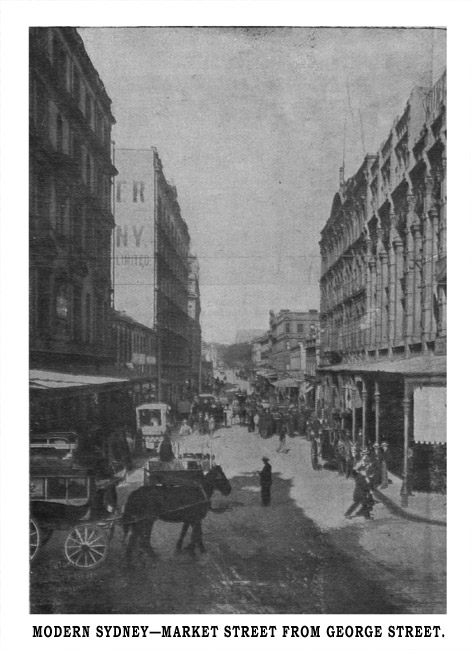
An old landmark that has recently disappeared, is the building once known as Hancock’s Tower, for over half a century a familiar object in the eyes of Sydney folk. Hancock, it seems, was a wheelwright, whose shop stood near the site of the present Roberts’s Hotel, at the corner of George and Market streets. Here he flourished, made much money, and eventually retiring from business, built himself the residence of which the curious tower formed a portion. Constructed of large squared stones, with battlemented walls, from whose lofty embrasures protruded dummy guns, or “Quakers,” it looked more like some mediaeval fortress than aught else; whilst, to heighten the effect, at each corner was the carved effigy of a knight in armour, and the low Norman roof was surmounted by a large weathercock.
All sorts of “fairy stories” clustered around this building, the favorite one being that Hancock had erected it for the purpose of therein immuring his wife, Bluebeard fashion, in some dim and gloomy chamber; and children used to look up half scared, half expectant, at the high windows, to catch a glimpse of the unfortunate lady peering from her prison.

Between the Tower and the old inn adjoining it, also once a prominent feature of the neighbourhood, Hancock had laid out a court yard with flower-beds and trellises. And here, too, he placed a statue, life-sized, and carved out of stone. This, Hancock left orders, so it is said, in his will, was to be erected over his grave. His wish was carried into effect, and the statue may still be seen by the curious at Rookwood.
No comments:
Post a Comment