

William Lawson, watercolour on ivory miniature, about 1845, artist unknown. State Library of NSW (MIN 63), via Wikimedia Commons. Public domain.
Everyone who grew up around Sydney knows the three names. Blaxland, Lawson and Wentworth, rattled off in that order like a cricket batting line-up, with three Blue Mountains towns named after them. Blaxland gets the credit for the idea and Wentworth gets the speeches, so Lawson is the one people tend to forget. That's a pity, because he was the one carrying the compass and writing down how far they'd walked each day. When the expedition was over he went back over the mountains with his cattle and stayed on the far side.
This is his story, from a chandler's son in Finchley to "Old Ironbark" of Veteran Hall. For the other two men, have a look at my pages on Gregory Blaxland and William Charles Wentworth. My earlier post on the crossing itself is Blaxland, Wentworth, Lawson and the Crossing of the Blue Mountains.
Finchley, a bit of surveying and a commission
The Dictionary of Sydney's entry by Tony Dawson says there have been several stories about where Lawson came from. The best evidence puts his birth at Finchley, Middlesex, on 2 June 1774. He was the son of John Lawson and his second wife, Hannah Summers. He had two half-siblings from his father's first marriage to Alice Dilworth, and four full siblings, James, Alice, Hannah and Rebecca. All of them turn up later in his letters or his will. Wikipedia adds that his father ran a successful chandler's business and that the family descended from the Lawsons of Cairnmuir in the Pentland Hills near Edinburgh.
Then there's the surveying. It matters, because it's the skill that earned him his place in history. The sources lean different ways on it. Wikipedia says plainly that he was educated in London and "trained as a surveyor". Dawson is more careful. He says Lawson "appears to have undertaken some basic training in surveying" but that "there is nothing to suggest that he practised as a surveyor". Either way, he knew enough to keep a proper field book, and in 1813 that turned out to be what counted.
In June 1799 he bought a commission in the New South Wales Corps. Wikipedia puts the price at £300 for an ensign's commission. The following May he sailed from Portsmouth in the Royal Admiral, a 914-ton convict transport, and he reached Port Jackson on 20 November 1800.
Norfolk Island and Sarah Leadbeater
Almost straight away he was sent to the garrison on Norfolk Island, and Dawson says he stayed there five years. Wikipedia says he served under Major Joseph Foveaux, gained his trust, and sat on the island's military court, which was accused of corrupt practices. He also took up land there and ran sheep.
On Norfolk he met Sarah Leadbeater. According to Wikipedia she was a convict serving seven years for stealing clothes. When the pair came back to Sydney in June 1806 they had three boys with them, John, William and Nelson. Nelson had been born on the Lady Nelson during the voyage from the island, so you can guess where his name came from.
The Rum Rebellion
Back in Sydney, Lawson was promoted to lieutenant and fell in with the Corps' leading men. In January 1808 Governor Bligh appointed him one of the six officers who sat with Judge Advocate Richard Atkins at John Macarthur's sedition trial. Macarthur got the trial aborted, and Bligh was arrested and deposed. Dawson notes that Lawson signed the letter demanding Bligh's removal and took an active part in the revolt. He then became aide-de-camp to Major George Johnston. You'll find more on that crowd on my Rum Corps page.
Here the sources split on the details of his reward. Wikipedia says he got a 500-acre grant at Prospect. Dawson says the 500 acres were in the district of Alnwick, near present-day Maitland, and that he was also given the 370 acres he had built up at Concord. On Dawson's version, Lawson only decided to lease Concord and make a new home at Prospect in early 1810.
Newcastle is another tangle. Dawson has him sent to Newcastle as commandant soon after his 1806 promotion, and then back again after the rebellion to take temporary charge. Wikipedia says he was acting commandant briefly in 1807 and was then appointed commandant of the Coal River settlement in 1809. It says he held Bligh's supporters there, including Sir Henry Browne Hayes of Vaucluse and the lawyer George Crossley, and worked them as hard as the other convicts. Wikipedia also says he was replaced on 10 January 1810 after Governor Macquarie arrived. Crossley later sued him for false imprisonment and won £500, cut to £300 on appeal.
After that Lawson was shipped off to England as a witness for Johnston's court martial. Dawson says he was never actually called to give evidence. Sarah ran the Prospect farm alone for almost two years, until he came home in the Guildford in January 1812. His grants had been confirmed, and Dawson says the couple, who by then had four children, married at St John's, Parramatta. Dawson suggests this was partly out of respect for Macquarie's views on couples living together unmarried. Wikipedia says they went on to have eleven children.
Liverpool, wool, and an idea
Lawson came back as a lieutenant in the new Veteran Company, which had been made up from old Corps soldiers, and he was put in charge of the troops at Liverpool. Dawson says the duties weren't onerous and left him plenty of time for his farms. In England he had met Jeremiah Thompson, who owned two woollen mills at Rawdon near Leeds, and their talk about the wool trade made up his mind. He was going to grow wool. The only trouble was the Cumberland Plain, which was hemmed in on every side, with the sandstone wall of the Blue Mountains to the west.

Portrait of William Lawson, about 1846. Ambrotype copy, about 1855 to 1860, of an earlier daguerreotype, unknown photographer. State Library of NSW, via Wikimedia Commons. Public domain.
May 1813 – over the mountains
Gregory Blaxland was the man behind the expedition. Wikipedia says that early in 1813 he got Macquarie's approval and asked Lawson and young William Charles Wentworth to join him. Dawson describes the party as Blaxland, Wentworth, Lawson, four servants, five dogs and four horses. Wikipedia names two of the servants as James Burne (or Burnes), a guide and kangaroo hunter, and Samuel Fairs, a convict who had arrived in 1810. The other two have never been identified.
Lawson's own first entry, as quoted on Wikipedia from his journal, reads:
"Mr. Blaxland Wentworth and myself with four men and four Horses- Laden with Provisions etc- took our Departure on Tuesday the 11th May 1813. Crossed the Nepean River at Mr. Chapman's Farm Emu Island at four o'clock and proceeded SW. Two miles. Encamped at 5 o'clock at the foot of the first Ridge of Hills-."
Wikipedia says the party set out from Blaxland's South Creek farm, near today's St Marys. Their trick was to stay up on the ridges and keep out of the gullies that had beaten earlier parties. Each day the three gentlemen and two of the servants went ahead and marked a line, leaving the other two men at camp. Later they turned back and cut a track wide enough for the horses before moving the whole camp forward. It was slow and hard going.
Dawson says it was Lawson, "with his knowledge of the rudiments of surveying", who recorded the details of their track. The Wikipedia account of the crossing says much the same, describing him as the one who "kept detailed notes about the route itself including the distances covered each day". Blaxland eventually published his account and Wentworth wrote the poetry. Lawson's journal is the one you'd reach for if you wanted to walk the route again.

A page of William Lawson's journal of the expedition across the Blue Mountains, 1813. State Library of NSW, via Wikimedia Commons. Public domain.
Wikipedia says they first saw the plains beyond the mountains from Mount York. They then pushed on to Mount Blaxland, about 25 kilometres south of where Lithgow is now. They got there on 31 May, and Lawson wrote:
"...this Country will I have no doubt be a great acquisition to this Colony and no difficulty in making a good Road to it, and take it in a Political point of View if in case of our Invasion it will be a safe Retreat for the Inhabitance with their Familys and that for this part of the Country is so formed by Nature that a few men would be able to defend the passes against a large body."
Wikipedia's account of the crossing quotes him calling it "the best watered Country of any I have seen in the Colony". The way over took 21 days and the way home only six. The State Library holds the journal with the dates 11 May to 6 June 1813, and Dawson's notes cite it under that title.

Sketch of Blaxland, Lawson and Wentworth's route across the Blue Mountains in 1813, prepared by Frank Walker in 1913. Via Wikimedia Commons. Public domain.
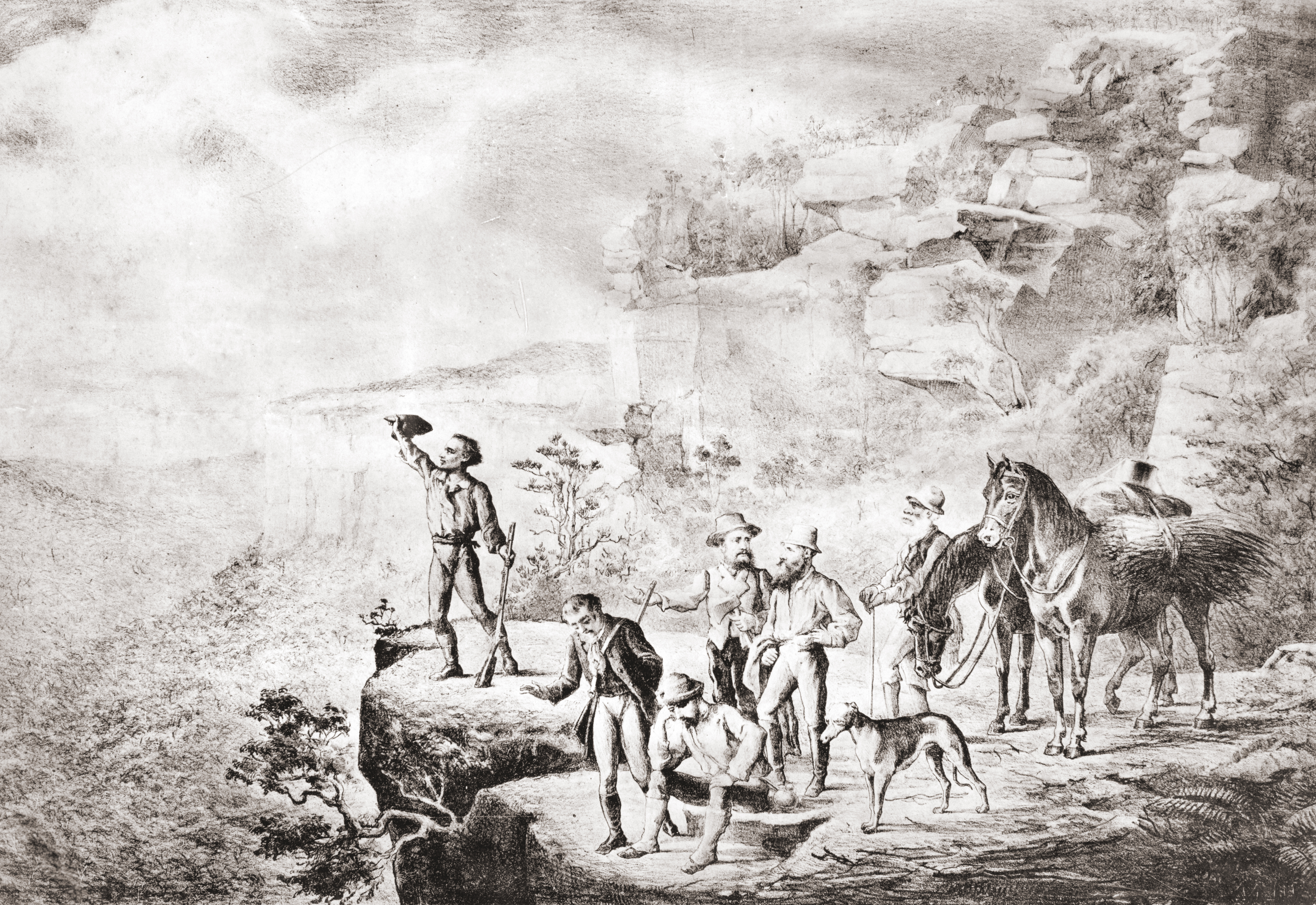
"The Blue Mountain pioneers at the summit of their expedition", lithograph by M. Emile Ulm, Sydney Mail, 1880. Via Wikimedia Commons. Public domain.
A thousand acres and the first cattle west
Each of the three explorers was granted 1,000 acres west of the mountains, and Wikipedia says Macquarie made that offer in February 1814. In the meantime Surveyor George Evans had followed their track and gone on to the Bathurst Plains, and Macquarie had William Cox build a road. Dawson writes that the Governor travelled it in April 1815 and proclaimed the site of Bathurst.
Lawson didn't waste any time. By the time the Government Domain was set up at Bathurst later in 1815, he had already driven cattle into the district. He left them grazing on the south side of the Fish River, near where it joins the Campbell to form the Macquarie. Dawson calls him the first pastoralist west of the mountains, "and, indeed, outside the Cumberland Plain". Wikipedia puts the mob at 100 head and says he named the run Macquarie.

Cox's Pass, watercolour by John Lewin, who travelled the new road with Macquarie in 1815. State Library of NSW, via Wikimedia Commons. Public domain.
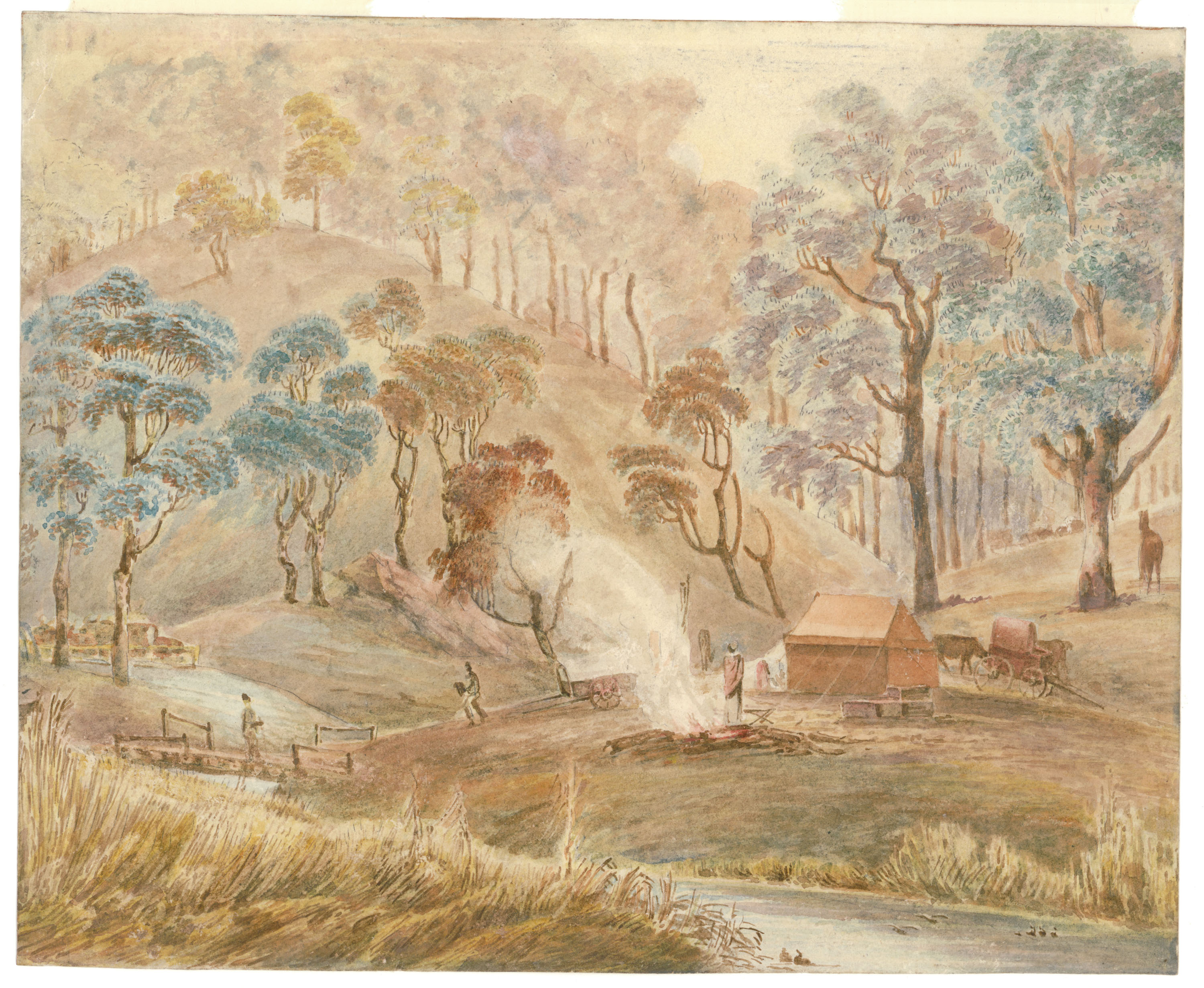
Campbell River, watercolour by John Lewin, 1815. This is the country where Lawson grazed the first cattle west of the mountains. State Library of NSW, via Wikimedia Commons. Public domain.
Commandant at Bathurst
Dawson says the Prospect farm eventually grew to 3,000 acres, but that was nowhere near enough for the flocks Lawson had in mind. So when Macquarie offered him command of the Bathurst settlement in 1819, he took it. Wikipedia dates the appointment to September 1819. He hoped it would let him explore the country to the north.
It did. Dawson lists the trips. The first left Bathurst on 8 November 1821, came back 17 days later, and reached the Cudgegong River near Mudgee. The second went about 50 miles past Mudgee to the Talbragar River near Dunedoo. The third began on 22 November 1822 and reached the upper Goulburn and Krui rivers, which Lawson wrongly took to be the head of the Hastings. Wikipedia counts four expeditions in 1821 and 1822 instead of three. It also says he followed information from James Blackman and was guided by a local Aboriginal man named Ering (Aaron).
This part of the story has a hard side that's no good skipping over. Wikipedia covers the violence between settlers and the Wiradjuri around Bathurst in some detail. Lawson's stockmen were caught up in it, and so were his properties. It says the authorities replaced him with Major James Morisset in late 1823 as things got worse. Dawson puts it differently, saying Lawson resigned in November 1823 after more than four years. Wikipedia says that in 1824 he signed the settlers' petition for troops, and that he commanded one of the divisions of Morisset's punitive expedition after martial law was declared. That was the Bathurst War, and it ended with the Wiradjuri leader Windradyne suing for peace.
Veteran Hall and "Old Ironbark"
Back at Prospect, Lawson settled into the house he called Veteran Hall, after his old Veteran Company. Wikipedia says the house was finished in 1821. Dawson calls it his "newly named farm" when he returned to it in 1823. In 1824 he imported a thoroughbred sire named Baron from England, and Dawson says he became a successful breeder of both stock horses and racehorses.

Veteran Hall, Prospect, the Lawson family home, photographed in 1913 for Frank Walker's edition of Blaxland's journal. Royal Australian Historical Society, via Wikimedia Commons. No known copyright restrictions.
His real money was in sheep. He applied to buy 5,000 acres where the Talbragar River meets Coolaburragundy Creek. Dawson says he was knocked back at first, because the land was outside the "limits of location" and hadn't been surveyed, but was approved later. It became his well-known Talbragar station. In the 1828 census he admitted to 10,000 sheep and 1,200 cattle. Dawson says some estimates run as high as 84,000 sheep and almost 15,000 cattle. His sons William and Nelson held big runs in the same districts.
Sarah died on 11 July 1830 after a long illness. Dawson calls her "a tower of strength for the family". After her death Lawson spent less time out on the stations, though he never stopped buying land. He was known as "Old Ironbark" for his strength and endurance.
Wikipedia also records the less comfortable side of his wealth. It says assigned convicts worked his properties, that runaways were sometimes flogged, and that after transportation ended he pushed for cheap imported labour. It says he brought in labourers from Chile in 1841 and later employed Chinese workers.
The Legislative Council
In 1843 Lawson was elected member for Cumberland in the first partly elected Legislative Council. Dawson says he attended regularly at first but didn't feature much in debates. Wentworth, his old companion from the mountains, was one of the big parliamentary figures by then, and Lawson didn't agree with all his views. He opposed him on a number of proposals. From 1846 Lawson turned up only now and then, and he didn't stand again in 1848. His son Nelson took his place.
Death at Veteran Hall
William Lawson died at Veteran Hall on 16 June 1850, less than a fortnight after his 76th birthday. Dawson says his goods were sworn at under £12,000, but his real wealth was in land, more than 85,000 acres. That land was left in trust to his son William and his friends Thomas Agars and Thomas Icely for his surviving children and grandchildren. Wikipedia gives a bigger figure for the 1840s, saying he held 150,000 acres with 84,000 sheep and 15,000 cattle.
He was buried in the churchyard of St Bartholomew's at Prospect, a church Dawson says he had helped to establish. Veteran Hall was knocked down in 1926, and most of its land now lies under the water of Prospect Reservoir.
How we remember him
The town of Lawson in the mountains carries his name, and so does a lot of local history. Wikipedia notes that his granddaughter Susanna married John Rendell Street, the founder of the Street family. In 1963 Lawson appeared with Blaxland and Wentworth on an Australian postage stamp marking the crossing. There are memorials to the three of them along the route, including one in Lawson itself and a cairn on Luddenham Road at Orchard Hills.

The Blaxland, Lawson and Wentworth memorial in Lawson, Blue Mountains. Photo by Clytemnestra, via Wikimedia Commons, CC BY 3.0.

The Blaxland, Wentworth and Lawson memorial cairn, Luddenham Road, Orchard Hills. Photo by JohnsonL623, via Wikimedia Commons, CC BY-SA 3.0.
So next time you're on the train up the mountains and it pulls into Lawson, spare a thought for the bloke with the field book. He counted the miles, liked what he saw, and was the first to take his cattle across.
Related pages: Gregory Blaxland · William Charles Wentworth · Blaxland, Wentworth, Lawson and the Crossing of the Blue Mountains · The Rum Corps
Sources
- Tony Dawson, "Lawson, William", Dictionary of Sydney, 2012, dictionaryofsydney.org/entry/lawson_william (draws on E. W. Dunlop, ADB vol 2, 1967, and Lawson's journal, Mitchell Library)
- "William Lawson (explorer)", Wikipedia, en.wikipedia.org/wiki/William_Lawson_(explorer)
- "1813 crossing of the Blue Mountains", Wikipedia, en.wikipedia.org/wiki/1813_crossing_of_the_Blue_Mountains
- E. W. Dunlop, "Lawson, William (1774–1850)", Australian Dictionary of Biography, vol 2, 1967, as cited by the Dictionary of Sydney
- William Lawson, Journal of an expedition across the Blue Mountains, 11 May – 6 June 1813, State Library of NSW (Mitchell Library)
- Images: Wikimedia Commons, as credited under each picture
No comments:
Post a Comment