
- Sydney Past & Present - - The City Of Sydney - - The Stories Of Its Growth -
________________________________________________________________________________________________________________________________________________________________________________________________________________________________________________________________________________________________________________
Chapter V.
Sydney in the Twenties.
Dr. LANG never forgave Brisbane for the slight put upon the Sydney Presbyterians by comparing them to their disadvantage with the Roman Catholics. Thus, when the Governor instituted yearly and half-yearly races in the capital, Lang calls him the “patron saint of Australian jockey-ship.” The Scot divine says bitterly: “There are the Sydney and the Parramatta races… There are the Windsor races, and the Liverpool and the Campbelltown races. There are races at Maitland and Patrick’s Plains; two different stations on Hunter’s River; at Bathurst, beyond the mountains; and at Goulburn Plains, 200 miles from Sydney, in the district of Argyle. In short, ‘the march of improvement’ is much too weak a phrase for the meridian of New South Wales; we must, therefore, speak of the ‘race of improvement,’ for the three appropriate and never-failing accompaniments of advancing civilisation in that colony are a racecourse, a publichouse, and a gaol.”
This was unfair and unjust. But Dr. Lang was at times both. Later he wrote:—“When I ask what Sir Thomas Brisbane did for New South Wales, I pause in vain for a reply. When I ask what memorial he left behind him to endear his memory to the country and to perpetuate his fame, a hundred fingers point to the ‘Brisbane Cup.’ ”
But Brisbane did more than this, for he established a fine Observatory at Parramatta. Also, before he left, he launched a thunderbolt at the exclusives of Sydney by actually dining with “the elite of the emanpists.” During his regime, too, was, in 1824, established our first Executive Council; and there arrived our first Chief Justice, Francis Forbes (afterwards Sir Francis); Saxe Bannister, the Attorney-General; John Stephen, father of the late Chief Justice (Sir Alfred Stephen), as Solicitor-General and Commissioner of the Court of Requests; John Mackness, as Sheriff; and T. E. Miller, as Registrar. The first trial by jury was empanelled in a civil cause in February, ‘25. Noteworthy, too, was the establishment of the first independent newspaper, the “Australian,” which was published by Messrs. Wardell and Wentworth.
It will thus be seen that if, during this period, there was little increase in the growth of the city, there were a good many events of importance that were most intimately connected with its present welfare and its future history.
Recurring to the establishment by the Governor of the periodical race meetings so contemned by Lang, it may be of interest to know how the boundaries of the old-time course ran.
The grand-stand, then, in 1821, and the winning-post stood at the top of what is now Market-street; the course took a sweep to the right in the direction of Hyde Park Barracks, thence past the site of St. Mary’s Cathedral and the Sydney Grammar School, passing in front of Lyons Terrace, obliquely to the top of Bathurst street, then along what is now Elizabeth-street, to the corner of Park-street, and thence to the winning post. When first formed, the length of the course was one mile and a quarter, but it was afterwards shortened to a mile and six yards.

The first race took place about 1810, when the 73rd Regiment arrived under the command of Lieutenant-Colonel Maurice O’Connell (the late Sir Maurice O’Connell), and the first prize was won by a horse named “Chance,” the property of Captain Ritchie; the Colonel’s mare, “Carlo,” won the second; and one belonging to D’Arcy Wentworth, the third. But shortly after Governor Brisbane’s arrival houses began to spring up so quickly around this quarter that the course was removed to what was known as the Sandy Racecourse, about four miles to the southwards, towards Botany Bay.
One curious event of 1824 was the seizing of a vessel, while at anchor in Sydney Cove, by a King’s ship, acting on behalf of the East India Company. This company, it appeared, claimed the exclusive right of trading in Eastern waters. Now, the colonial Government had chartered a ship—the Almorah—and had sent her to Batavia whence she returned with a valuable cargo of rice, tea, sugar, etc. Presently some of the Sydney merchants, jealous of official meddling with their prerogatives as traders and importers, laid an information against the Almorah with the captain of an English man-of- war, then lying in the harbor; and she was seized in open defiance of the Government, and sent off with her cargo as a prize to India, on a charge of infringing the Company’s charter. The mere fact, it was alleged, of her having tea on board was sufficient excuse for this arbitrary proceeding.
Of course there had been bushrangers in the colony before Brisbane’s time, but not any calling for special mention until the Donohoe gang, who flourished in 1825, and the three following years, instituted a very reign of terror in Sydney and its immediate neighborhood. Donohoe’s gang contained a dozen ruffians; but his chief companions were Walmsley, Webber, and Underwood—all transported convicts except the last, who was native-born. After a time, however, his mates discovered that he had been keeping a diary of their proceedings. Disgusted with this literary effort, they effectually stopped all chance of publication by deliberately murdering the unfortunate author. He had, so it was alleged, joined the gang from mere love of adventure.
For four years these men set the police at defiance, notwithstanding that a reward of £100 was offered for the ringleaders. Between Sydney and Parramatta they murdered and robbed, and fought the police with an impunity that says little for the constitution of the “force” of those days. So great did the terror of the band become that travel’ers joined together for protection. Says a newspaper of the time, speaking of Donohoe and his depredations: “Some half dozen constables or so, we believe, have been packed off up the Parramatta and Liverpool roads, but have returned to town as usual, safe and sound and empty-handed… Some effective measures should be taken, and that speedily, to suppress this alarming evil.”
The dress of the three leaders has been described, and shows that they wanted for little, in that respect at least. “Donohoe: Black hat, superfine blue cloth coat, lined with silk, surtout fashion, plaited shirt (good quality), laced boots, and snuff-coloured trousers.” He seems to have been the dandy of the trio. His two aides, however,—Walmlsey and Webber—were almost equally well-dressed.
At last the residents, harassed beyond endurance, rose in their own protection and gave battle to the bushrangers at Raby, now Bringelly. Here Donohoe was shot. But most of the others managed to escape through the thick scrub. Later on, Walmsley and Webber were captured on the Western road. Walmsley turned king’s evidence against Webber, who was presently hanged. Through the informer others of the gang were at intervals captured, and the long reign of “Bold Jack Donohoe” and his banditti was over.
But during Brisbane’s official term dozens of men seem to have taken to the bush, and had more or less long and successful careers, ending in death by the gallows or the bullet. The Bathurst district was especially prolific of bushrangers; but, compared with the bloodthirsty Donohoe gang, the majority of them appear to have been mere station-hut robbers and petty pilferers of that kind. Nor did we ever produce anything equal to the terrible Tasmanian outlaws. But whilst for robbery under arms they most surely swung, at times, a merciful judge, for simple thieving, might only send them to Norfolk Island, “to be worked in chains during their lives.”
In 1825 were first established the Mounted Police, drawn chiefly from the infantry regiments serving in Sydney. At the beginning, they consisted of only two officers and thirteen troopers. Nor was it until fourteen years later that the force could make anything like a respectable show with nine officers, a sergeant-major, and 156 non-commissioned officers and men, with 136 horses; twenty of the corps being footmen.
The officers were magistrates, and the body was subject to military law and discipline. They were armed with carbine, sword, and horse-pistols, and were uniformed as light dragoons. The headquarter division, consisting of the commandant, the adjutant, and some score of men, was stationed in Sydney. As a service, it was an excessively rough, hard, and perilous one, and not by any means so popular as it is now.
The Anniversary Dinner of 1825 demands especial notice, because of its entirely different features to those that came before it. They were merely loyal and sentimental functions. This particular one, however, was in the highest degree political as well. The chair was taken by an eloquent young Australian, who had just returned from a visit to England, full of wide and liberal ideas, eager, too, to give the benefit of them to his native land. His name was William Charles Wentworth; and he was the practical champion of constitutional government, as opposed to that military despotism so familiar to his early youth.
Tickets, on this occasion, were only 5 dollars each; the feast was held at Mrs. Hill’s tavern, Hyde Park. A military band was in attendance, and some of the toasts indicate the progress that the colony was making towards reform and freedom: “To the memory of Governor Phillip, the Founder of the Colony,” “The Memory of Major-General Macquarie, Our Late Revered and Lamented Governor.” There were also toasted: “Sir James Mackintosh and the other Advocates of Australia in the British Senate,” “Trial by Jury,” “The Freedom of the Press,” “A House of Assembly.”
The vice-president was Dr. Redfern, and amongst the stewards was Robert Campbell, son of the first real Sydney business man, known even to this day as “Merchant” Campbell.
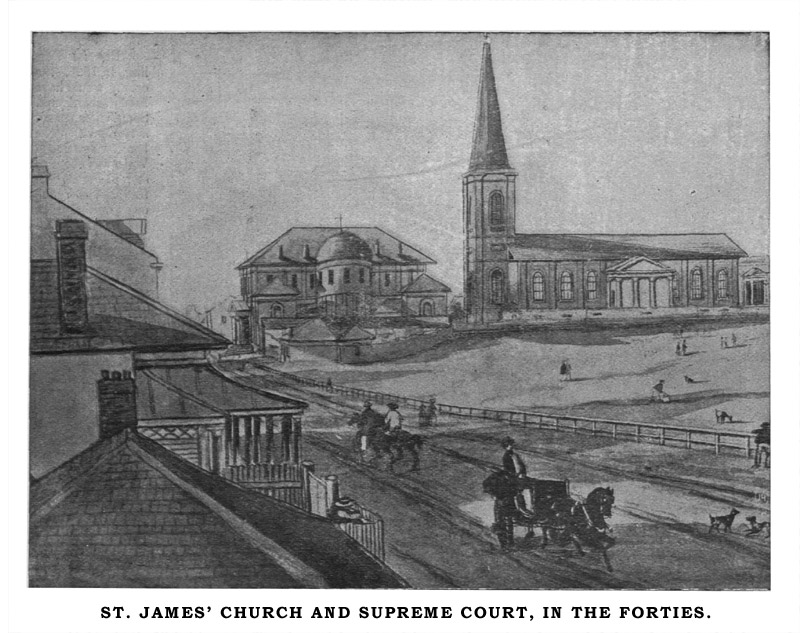
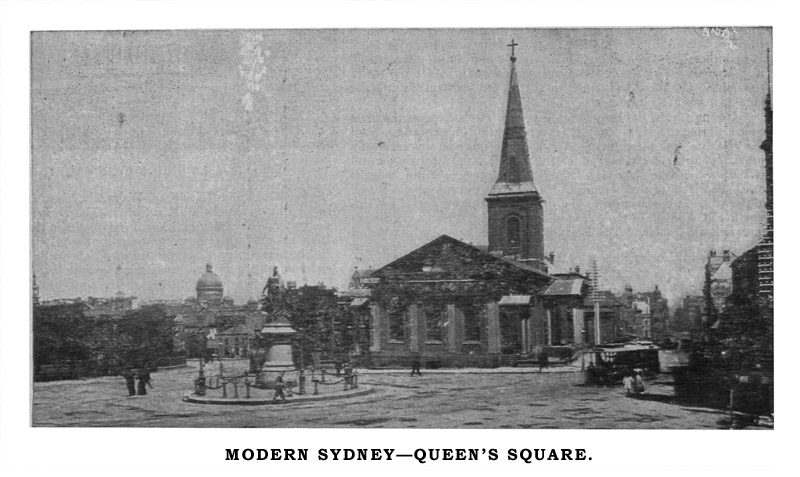
Architecturally, except in the matter of private houses, Sydney during Brisbane’s term, as has been remarked, had little more to shew than when Macquarie left—a Governor who should have been buried in the centre of the city with the one word, “Circumspice,” cut for an epitaph on his tomb. Still, the political and social happenings of Brisbane’s years, few though they were, had more effect on the future of the capital and the colony than all the building of Macquarie, and are so bound up in the early history of our city as to render ignoring any notice of them, however slight, impossible.

Between Governor Brisbane’s relinquishing the rule of the colony and the arrival of his successor, another military man, Lieutenant-General Sir Ralph Darling, K.C.B., there was only an interregnum of eighteen days, during which the administration was in the hands of Colonel (afterwards General) Stewart, of Bathurst, an honor which formed the one boast of that officer’s existence, and the standing joke of the district during the remainder of his life.
One of the chief advantages gained by Sydney and the colony during Darling’s reign seems to have been the establishment of a general Post Office; and for this purpose he set aside the piece of land in George-street then occupied by a police station. The quarters of the force were removed to the Market House (old Central Police Station), while sheds for market purposes were erected at its rear.
Readers will remember mention of Mr. Isaac Nichols, “Postmaster of Sydney,” in whose house took place the first-recorded Anniversary dinner. Well, this is the person who is said to have built the first post office in our city, using it, at the same time, as a residence. The house was only pulled down about 11 or 12 years ago, and was situated in Lower George-street, near the Queen’s wharf, Circular Quay; it was numbered 144. Behind it in those days, was a store; and directly in front of this was a wharf, on the banks of the Tank Stream, at which small coasters used to discharge goods. The house, supposed to have been built about 1800, was substantially constructed of brick, made, probably, in the old Government brickyards. When Nichols died, in 1819, the post office was removed to where the present great building stands the police, who occupied it, being, as already stated, established in the Market House.
At his death, Nichols’s post office changed hands, and became the Australia Hotel. For years prior to its being demolished it had been occupied, like so many other houses in this, the oldest quarter of Sydney, by Chinese merchants. Almost opposite to the site of the original post office there was, some years ago a butcher’s shop, once the residence of Mr. Thomas Moore, superintendent of dockyards. Further south is a structure believed to be the oldest residence in Australia. It was built by a Mr. Cubitt, at the corner of George-street and Brown Bear lane, and was of stone, and two stories high. Later on it was known as the Cat and Fiddle Hotel, and an additional story of brick was added. This old bit of history is now occupied by Chinese.
Needless to say that in Postmaster Nichols’s time there were no pillar-boxes and no postmen. People had to travel from all parts of the settlement to post or receive letters at the old house in Lower George-street. And it may be remarked of this street that not only does it give us a capital idea of what that quarter of the city looked like over half a century ago, so little has it changed, but, into the bargain, is almost a perfect facsimile of scores of streets in English country towns. Our first builders were nothing if not conservative, and they reproduced, as nearly as possible, in the new country the unsuitable conditions of architecture they had left behind in the old one. As to the new post office, it still, so far as looks went, remained allover a police station, until improved almost out of knowledge in 1847-8.
In the second year of Sir Ralph Darling’s reign an event happened that shook Sydney society, both exclusive and otherwise, to its very foundations; and, as being part of the history of the city, may be here briefly touched upon.
Sudds and Thompson were two private soldiers in the 57th Regiment doing duty in Sydney. Sudds was a steady man, who had saved some money; Thompson was a scamp. But both wished to remain in the colony, instead of returning home with the regiment.—As to procure their discharge was out of the question, Sudds proposed to his mate that they should gain the coveted paper by becoming convicts. This being agreed upon, they went to a shop and stole some cloth; were, as they intended, caught and tried; and sentenced to be transported to one of the auxiliary penal settlements for seven years. Then the Governor stepped in, took the two prisoners out of the hands of the civil power, and condemned them to work in chains on the roads for the full term of their sentence, and afterwards to be returned to service in the ranks.
On a day appointed, the Sydney garrison was assembled, and formed into a hollow square. The culprits were brought out, their uniforms stripped off, and replaced by the convict dress; iron-spiked collars, and heavy chains, made expressly to the Governor’s orders, were riveted around their necks and to their legs, and then they were drummed out of the regiment to the tune of “The Rogue’s March.” Sudds was in very bad health at the time, and his illness, aggravated by the disgrace and the long exposure in the hot sun, together with the utter downfall of his hopes, plunged him into such a fit of hopeless despondency that he died a few days afterwards. Thompson became insane.
Then the fun began. The “Gazette” defended, the “Australian” attacked, the conduct of the Governor; sides were taken, and Sydney was convulsed. Indeed, Darling may be said never to have heard the last of this extraordinary case of despotic military interference and uncalled for cruelty on his part.
In 1827 there were no less than four newspapers in Sydney—the good, old conservative “Gazette” the organ of the Government; the “Monitor,” a fighter; the “Gleaner;” and the “Australian.” And these three last were all arrainged against the “Gazette” and the Government. So sore did the authorities feel about these constant attacks that they presently imposed a duty consisting of fourpence upon any sheet, half-sheet, or piece of paper whereof any newspaper (within the meaning of the Blasphemous and Seditious Libels Act) should consist.
Howe, the editor of the “Gazette,” confident of Government support, only protested mildly against this imposition, but the others fulminated to such good purpose that the Act never came into force. Indeed, the Chief Justice refused to certify to its being a proper one. But for that, perhaps, the “Monitor” and its two contemporaries might, after all, have had to do as they threatened, and appear as magazines, to evade the duty, or to suspend altogether.
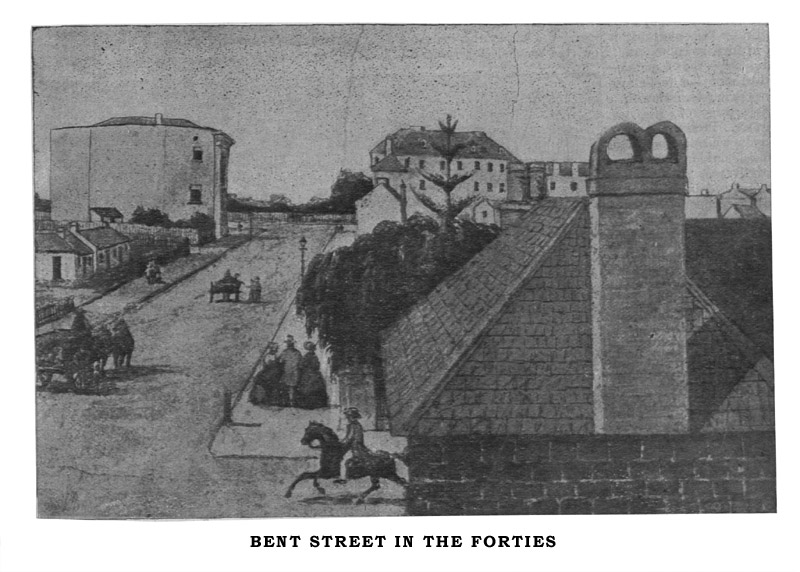
Bent-street owes a prominent old landmark to this era, i.e., the Free Public Library, originally known as the Australian Library. The originator of this institution was Thomas de la Condamine, private secretary to Governor Darling, aided by the Revs. W. Cowper and Hill, and many of the most influential merchants. The first meeting was held at the Sydney Hotel, when Alderman M’Leay was elected President. This was on February 3, 1826. By the judicious arrangement of the committee, aided by a liberal subscription list, donations from the Governor and from Archdeacon Scott, together with a bequest of books from T. Campbell, the library was opened on October 1, 1827, at No. 1, Terry’s Buildings, Pitt-street, or somewhere about the site of Messrs. Batt, Rodd, and Purves’s auction rooms. These premises were held jointly with the newly-established Sydney Dispensary, whose officer also served as a temporary librarian from 1 to 4 p.m. daily. Shortly afterwards the Governor granted for its use some valuable allotments of land. Two of these were situated in Hyde Park, between where now are St. Mary’s Cathedral and the Sydney Grammar School. There were also two other pieces above Rushcutter’s Bay. These were sold, later on, in about ‘41, by public auction, and realised £3384.
Sir Richard Burke, however, cancelled the ground in Hyde Park, notwithstanding many protests on the part of the committee and others. Finally, Sir George Gipps granted the site of the present edifice, of which the president (Alexander Macleay) laid the foundation-stone in 1843. It took three years in building, the cost being over £5000. Eventually it was purchased by the Government, and declared free for the use of the people. Additions have since been made, but substantially it is the same as it was in the twenties.
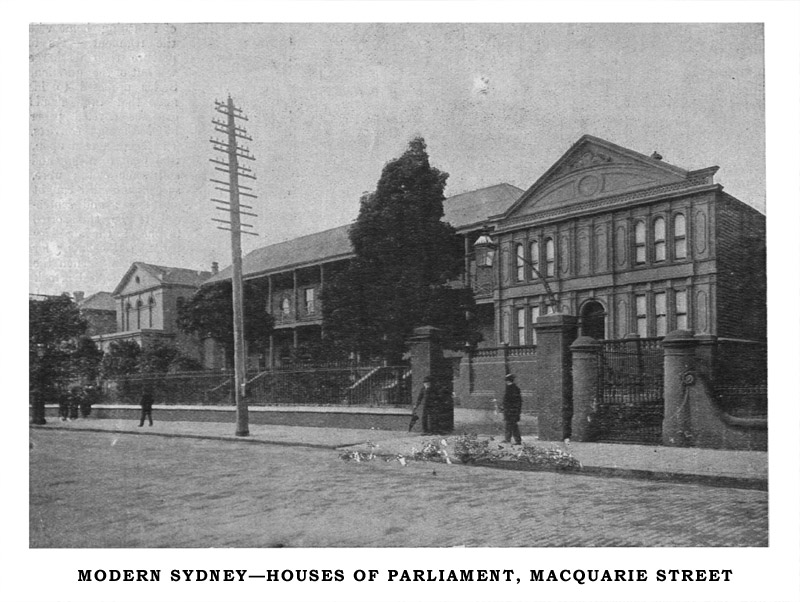
Darling’s reign has been known as one of libels, because the press seemed during the whole administration perpetually in hot water. Even the “Gazette” was bitter by the prevailing epidemic, and was criminally prosecuted for an alleged libel on the first, and retiring, Attorney-General of the colony, Saxe Bannister, Esquire. The paper, however, won its case. But Hall, of the “Monitor,” (“who had deserved especially well of the colony in having reared a numerous and virtuous family”), Wentworth and Wardell, of the “Australian,” and the others, were always more or less in trouble. The liberty of the press was certainly established but the fact was that the authorities had not as yet thoroughly realised what such a matter meant; nor had the editors, on their side, made a moderate use of their liberty. Hence the friction.
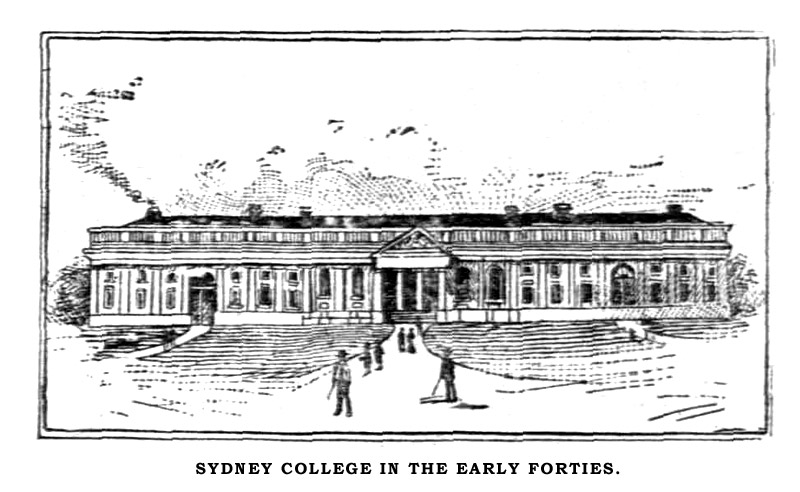
But for Darling, in 1826, the colony would have been bankrupt. Some idiots spread a rumour that the bank of New South Wales was about to stop payment. The inevitable scare followed, and only that the Governor helped the bank from the Treasury-chest, disaster would probably have taken place. Mrs. Darling, the wife of the Governor, established a Female School of Industry, not far from St. James’ Church. Major Goulburn, the first Colonial Secretary, after whom the well-known Sydney street was named, returned to England. “He was,” remarked his biographer, “a man of uncontaminated spirit, marked integrity, and indefatigable zeal. He was succeeded by the Hon. Alexander Macleay who, with his wife and family, arrived in the Marquis of Hastings.”
________________________________________________________________________________________________________________________________________________________________________________________________________________________________________________________________________________________________________________
No comments:
Post a Comment