
- Sydney Past & Present - - The City Of Sydney - - The Stories Of Its Growth -
________________________________________________________________________________________________________________________________________________________________________________________________________________________________________________________________________________________________________________
Chapter XV.
The Fifties And Sixties.
August 3, 1852, was a day remarkable in the history of Sydney as that upon which the first mail steamer arrived in port. Her name was the Chusan, an iron screw-steamer, of 720 tons, barque-rigged—a beautiful model, and with more the look of a man-of-war than a merchant vessel. She was rather heavily armed, too, carrying a long 32-pounder aft, an 18-pounder forward, and a 12-pounder amidships. Even under canvas alone, the Chusan had often done her 14 knots. Melbourne was her first port of call, and off Cape Otway a seaman was lost overboard and drowned, notwithstanding a plucky attempt at rescue by two passengers, Lieutenant Pasco, R.N., and Mr. Bencraft, who, with four of the crew, got into one of the quarter-boats, and put off in a very heavy sea. But their efforts were in vain; indeed, it was with much difficulty and not until two hours had elapsed, that the steamer was able to pick them up. The Chusan brought a heavy mail and £70,000 in sovereigns. In Melbourne—then all excitement with the gold fever—a special armed guard was placed on the steamer in order to prevent the crew deserting, as so many others had done. Before the Chusan sailed for Sydney the Governor and some other officials visited her, together with the leading merchants of the city, when champagne was opened, speeches made, and the commander, Captain Henry Down, heartily congratulated on being the pioneer of steam communication between Australia and the old country.
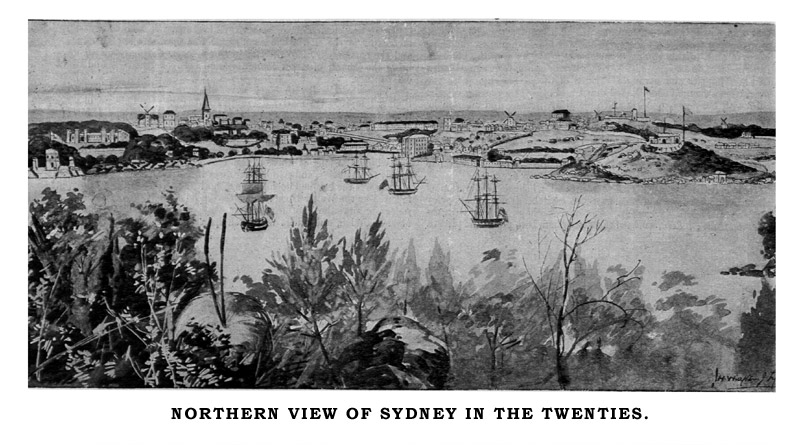
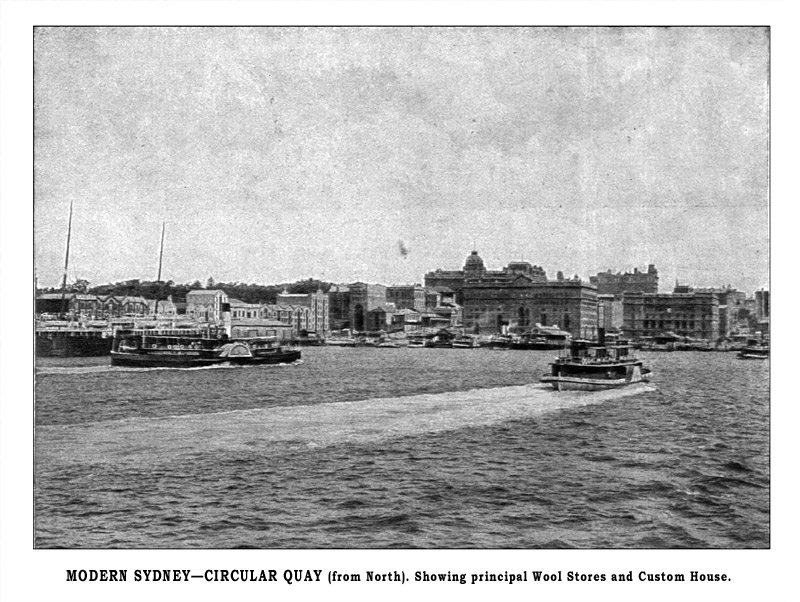
Vessels of the British Navy were, of course, frequent visitors to Sydney; in 1851 there arrived a crack frigate called the Calliope, of 26 guns, besides the Pandora and the Fantome. In 1853 came H.M.S. Herald, 22 guns, with, among her officers, Mr. F. Hixson, afterwards so well known as president of our late Marine Board The fifties, too, were the years of many of the celebrated clippers whose names are historical, and will live as long as those of the colony whose wool they bore so swiftly to the little island standing far away in northern seas. Precursor of these was the barque Phoenician, which, in 1849, came out in 91 days, followed by the Walter Hood; and, later on, by a whole fleet of fast and noble clippers—the Centurion, Omar Pasha, Harlaw, Star of Peace, Maid of Judah, and others whose tall spars lined the sides of Circular Quay, now growing into something worthy of its name. But, though to George Thompson’s White Star line must be given pride of place in the work of developing our early commerce, there were vessels besides the Aberdeen clippers who traded regularly between Sydney and other Australian ports to and from British ones. There were, for instance, the Kate, Eliza, and George Marshall, belonging to the firm of Marshall and Eldridge; the Dunbar, wrecked in the later fifties near the Gap; the Duncan Dunbar, Dunbar Castle, and Phoebe Dunbar; together with the numerous family of Duthies—all vessels of note in their day, and all in time to give way before such flyers as the Thermopylae, the Salamis, Samuel Plimsoll, and the Patriarch—all Aberdeen clippers; and the last named, of which made the trip from Sydney to London in 68 days.

The inception of our steam fleet has already been referred to; and by now the vessels of the Australasian Steam Navigation Company were rapidly increasing in number. Still, in 1845, freight to Melbourne was £3 per ton; and passengers for saloon £10 10s., intermediate £7, and steerage £4 10s. In 1857, the A.S.N. vessels consisted of the City of Sydney, Wonga Wonga, Telegraph, Governor-General, Boomerang, Yarra Yarra, Waratah, Shamrock, Illalong, Collaroy, Thistle, Tamar, Ballarat, Samson, Eagle, Rose, Ben Bolt, Brisbane, and the City of Melbourne. Some of these are still keeping the sea, old and dirty and rusty, and smothered fore and aft in coal dust, it is true, but, still to all appearance, fit to last for many more years. When people built ships in those times, they put work into them that was meant to last, and disdained the jerry business that later became so common in-the trade.
By this time the whale and seal fisheries were becoming diverted from Sydney control into the hands of the Americans. But what with our land products fast increasing in value and quantity, we could well afford to let the somewhat precarious fisheries go.

Intimately bound up with the shipping and produce trade of the city, there is one street that more especially demands a brief notice. At the time of the Queen’s Accession, Sussex-street was a long rambling thoroughfare full of gaps. In 1853 nearly all the produce came there from the Hunter River. Dealers in wheat, poultry, potatoes, etc., secured premises as convenient as possible to the wharves, and thus gradually the street grew in size and importance as a market centre. In the fifties, there were still but a few houses in it; but it was noted for several big flour mills. Even then, butter came in large quantities from the South Coast. Mr. John Pemell at that time was the principal miller. He used to buy for cash, kept no books, and the receipts were torn up and thrown away. Bullock drays thronged “the Street.” even as horse teams do now. Butter and flour were sent in large parcels to Melbourne and the north; and, ever as trade increased, new business-men arrived, and set up in the centre of it, until today the commission and produce houses number considerably over a hundred. And the members of them have always prided themselves on the establishment of an honorable code in their dealings, in which each one’s word is his bond. In the making of a bargain between themselves neither sale-note nor witness to the transaction is considered necessary. They also pride themselves on having fewer law actions than any other branch of trade in the southern hemisphere.
In 1846 the first movement had been made with respect to railway communication inland. At a meeting in Sydney it was decided to survey a line from Sydney to Goulburn. Not for two years, however, did the scheme take practical shape by the formation of the Sydney Railroad and Tramway Company, capital £10,000. The object of the company as expressed in its circular, was to, at the present, construct railways to Parramatta and Liverpool, with, later on, extensions to Bathurst and Goulburn. Mr. Charles Cowper, afterwards several times Premier of New South Wales, was the first manager. On July 3, 1850, the first sod of the new enterprise, was cut by the Hon. Mrs. Keith Stewart, daughter of Governor Sir Charles Fitzroy. The spade with which this ceremony was performed was made in Sydney, out of Australian iron and is said to be still in possession of the Government.
But for some time little or no progress was made. Public opinion did not seem particularly stirred by the notion, for one thing, and for another, money did not come in as it had been expected to do. Later on, however, the Government took the business in hand. In August, 1852, a start had been made by the contractor, Mr. W. Randle, who afterwards completed the line. He began operations in Cleveland paddock, close to where Mrs. Keith Stewart had performed with the Australian spade nearly two years before. The first gang consisted of only five men; but presently more were put on, and the company imagined they were beginning to make headway. Then, as mentioned above, the Government stepped in, and pushed on the work quite vigorously, compared with the moribund S.R, and T. Company.
In May, 1854, the first cargo of iron rails came to hand, and the work progressed rapidly, because, hitherto, only wooden ones, which required renewing every two months, had been used. But at last the Parramatta portion of the line, or, more correctly speaking, the portion as far as the spot where the Southern line now branches off, was finished. This was, much to the disgust of the inhabitants, at the junction of the Dogtrap and Liverpool roads, fully a mile from the centre of the town.
And now that the work was actually completed, people seemed doubtful about travelling on the railway, and nervous fears were expressed as to the security of the bridges, rolling stock, etc., etc. A board was then appointed to report upon the work; and, accordingly, five gentlemen tested the line with two first-class carriages, and twelve waggons loaded with sand—the whole outfit, with engine and tender, weighing 130 tons. Then the five duly certified that things were safe, and invited the public to roll up. To make assurance doubly sure, Sir William Denison and his wife and family took a trip to and fro, and finally the opening day was fixed for September 26, 1855.
On that date, proclaimed a public holiday, the largest crowd yet seen in the colony assembled at the railway station to witness the starting of the train; volunteers and Friendly Societies escorted the Governor; and to the sound of a salute of 21 guns and the waving of flags and handkerchiefs was inaugurated the beginning of our present railway system of some 3000 miles. Parramatta, much to the surprise of many people, was reached without any accident; and here the Governor lunched and congratulatory speeches were made.
During the day 2000 passengers travelled to and fro by the novel means of locomotion. Six trains a day were run, with fares in three classes, for the single journey, 4s, 3s, and 2s respectively. Said a contemporary newspaper:—
“The event of yesterday was the triumph of science, not only over natural difficulties, but of the spirit of enlightenment and civilisation—over prejudice and worldly-mindedness. The great agent of civilisation, the best and most effective servant of progress, has been retained by the antipodean colonies of Australia within the same quarter of a century to which it became the liveried vassal of civilised Europe.”
The plant was moderate enough consisting, as it did, of only four engines; eight first-class, twelve second, and twelve third-class carriages; with six brake vans and sixty waggons.
At the present date, or rather at the last returns, the rolling stock of the colony’s railways included 494 engines, 419 tenders, 1050 passenger carriages, 9429 goods vehicles, and 1041 stock trucks.
It is noteworthy that by the failure of private individuals in the first attempt at railway construction in the colony any private ownership of such undertakings seems to have received its deathblow, and thus, with very few exceptions, all railways in these colonies, are owned by the State. Possibly the original pioneers might have been more fortunate in their adventure but for the gold discoveries, which, as already shown, simply paralysed almost every description of industrial enterprise. An interesting fact in connection with the first attempt is that Sir Alfred Stephen was the first citizen to take shares in the company, an example followed by other leading men, including Messrs. Charles Kemp and John Lamb—the last named the president of the board of directors.
What with the gold discoveries, the bringing of railway communication, and ocean mails; the finishing for all time of transportation to New South Wales; the granting in full of representative Government, well these years be called the “Fruitful Fifties!” Literature and art, too, flourished mildly. A curious incident in connection with the former was the publication, in 1854, in Sydney, of a book entitled “The Diary of a Visit to England.” Dr. Campbell the author, was an Irish clergyman of some note in his day as a writer on the history and the Church of his country, who visited England at various times during the years 1775-92. “He made,” says Mowbray Morris, in his introduction to Boswell’s “Life of Johnson” (Globe edition), “what may be called the provincials ‘grand tour’ of London; visited the theatres, coffee houses and auction rooms, heard all the popular preachers, and was introduced to the studios of Reynolds and Gainsborough; he met Johnson at the Thrales’s and elsewhere, besides visiting him at his own house, and, though they seem to have been good friends enough, his portrait of the doctor is certainly not flattering. In directness and vivacity he sometimes even runs Boswell close, and his diary often supplies an interesting commentary on the biography.”
The story of how such a work came to be published in an Australian city is interesting. Its existence even, it would appear was not generally known in England until the publication of an article in the “Edinburgh Review,” and which was written in 1859, at the instance of and partly from materials supplied by Macaulay “The manuscript” says Morris, “had been discovered in one of the offices of the Supreme Court at Sydney, behind an old press which had not been moved for years. Its authenticity has fortunately been placed beyond suspicion, and its strange hiding place has been explained by the fact that one of its author’s nephews was Sheriff and Provost-Marshal of the capital of New South Wales.”
The stage flourished freely in the fifties. In 1854 Miss Catherine Hayes took the city by storm with her voice, as two years later did G.V. Brooke by his acting. At the close of the great tragedian’s first engagement he was presented at Petty’s Hotel with a testimonial in the shape of a solid silver candelabrum and plateau, with 220 gs; whilst Miss Fanny Cathcart, the “principal lady” who supported him, came in for a diamond bracelet, valued at 70gs. To those who succeeded in pleasing them, the citizens of those years were nothing if not liberal.
In the fifties, too, Sydney had a patriotic fund. The Crimean War was raging, and money flowed freely in for the relief of the British soldiers fighting in the east. On two successive nights at the Victoria Theatre during July, 1855, the proceeds of the performances were devoted to the patriotic fund, and towards the erection of a monument to Captain Cook.
A but-little-heard-of contemporary of the Victoria Theatre in these days was the City, which stood in market-street, exactly opposite the office of the “Town and Country Journal.” Melodrama of the strongest type used to be played there, and the “leading man” was an actor who bore the illustrious name of Kemble. Other theatres, too, notably the Prince of Wales’s, were now in existence; and what with such vocalists as Catherine Hayes, Mme. Anna Bishop, and Sara Flower, and June Mathews, and such actors as G. V. Brooke, Nesbitt, Coppin, and Rogers, it will be seen that Sydney was far from being badly catered for in respect of amusements.
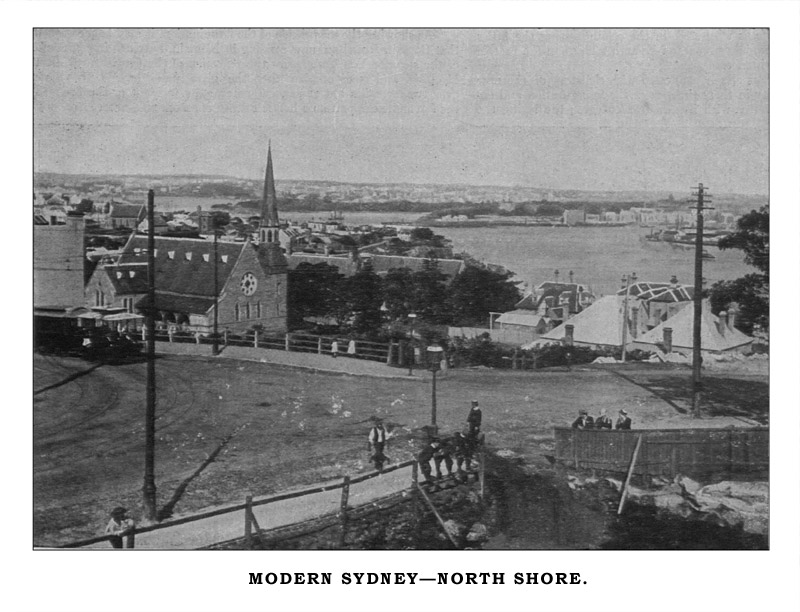
On the night of August 20, 1857, the passenger ship Dunbar was wrecked at the foot of the cliffs near the South Head Signal Station. The occurrence has so often been described as to render more than a passing reference to it needless. One curious incident, connected however, with the sad affair may not be generally known, Among the Dunbar’s passengers were a Mrs. Egan, her son, and daughter. Mr. Egan was a well-known citizen of Sydney, a member of the Legislative Assembly, and an ex-Postmaster-General. His wife and children had been “home” for a pleasure trip; meanwhile, he had built a fine house for their reception at Watson’s Bay, and not far from the fatal Gap itself. And there they perished, almost within sight of their new home. Then, as if that were not enough, thirteen years later, Mr. Egan, apparently in his usual good health, drove out to the Gap on a Saturday afternoon, put up at a hotel there, was found during the night in a comatose condition, and died the next day, nearly, one might say, on the site of the loss of his family so many years before. Besides the Egans, many well-known colonists were lost in the Dunbar, she being a favorite trader, and full of passengers. In all 120 souls perished, and, as will be recollected, only one man, Johnson, a member of the crew, escaped. He was for many years, and until quite lately, keeper of the Nobbys Lighthouse, at Newcastle.
In 1857 municipal government was re-established. It will be remembered that, although so far back as 1843 a municipal council, headed by a mayor, had been formed, so badly did the plan work, that, after something of like an eleven years’ failure, they had been superseded by three commissioners, appointed to look after the interests of the citizens of Sydney. They held office for three years, and it was during this period that the city waterworks were established at Botany, in place of Busby’s Bore and the old Hyde Park-Lachlan Swamp scheme; a system of underground sewerage was also began by the commissioners; the outlet was to be at Fort Macquarie, through a great valve of gun-metal. The late Hon. George Thornton was the first Mayor of the re-constructed council, which at that time sat in what is now the Oxford Hotel; and a memento of his term of office may still be seen in the big ventilator to the sewers in Hyde Park—Thornton’s Smelling Bottle. This upcast shaft was fitted with a furnace for establishing a draught; it is, however, doubtful whether, after it was handed over by the contractors to the council, a fire was ever lit in it.

Of all the stirring events of these well-named “Fruitful Fifties” the discovery of gold was, of course, the most important as affecting Sydney; it created a demand for all sorts of wares whose uses were undreamt of hitherto, or regarded as unnecessary; it introduced capital and immigrants into the colony; it opened up the interior, and encouraged the making of roads and railways; and, above all, it increased to a wonderful extent the value of property. Indeed, the accumulation of wealth in these years became so real, industrial development, both in city and country, so extensive, and the transformation of the social conditions of the people so amazing and complete, that the phases of life as witnessed in the colony during the fifties resembled more the imaginary scenes of Eastern fable than the prosaic realities of everyday existence.
Among other matters closely connected with the story of the now rapid growth of our city in these times were the inauguration and endowment of the University, with its affiliated colleges; the laying the first stone of the Fitzroy Dock, and the establishment of the Sydney branch of the Royal Mint.
Mention has already been made of the “Constitution of ‘56. And the efforts made by Parkes, Wentworth, Deas-Thompson, and others to guard against any undesirable amendments whilst passing through the English Houses were so practical and energetic that the two last named politicians actually travelled to England for that purpose. They were, however, unsuccessful. Lord John Russell had returned to the Colonial Office, and he, unlike Mr. Chamberlain and our Federation Bill, simply riddled the measure with amendments. The most important of these was one enabling a bare majority of members in both Houses, instead of a two-thirds majority, to alter the Constitution as they might please. Such a provision, of course, was more than likely to operate as a standing invitation to alter it; and subsequent events very soon showed the truth of this. Strangely enough, the one feature in the Constitution which provoked the greatest opposition—that of a nominee House—has never since been touched; although, as we are well aware, much discontent has often been expressed with it, right up to date, and in very strong terms, too.
The Draft Bill, however, passed through both Houses in ‘55, and became law in that year as a schedule to an Imperial Act. It was sent on to Governor Young, with a dispatch, in which Lord John Russell mentions, among other matters, that he had considered the expediency of inserting clauses to provide for a federal union of the Australian colonies; but had not been able to satisfy himself that the time had come for it.”
Well, the time has arrived now—nearly half a century later! Also the fact! But it seems remarkable that, even then, when the younger Colonies were still in the throes of their new birth, the federal idea should have crossed the mind of the great British statesman.
________________________________________________________________________________________________________________________________________________________________________________________________
No comments:
Post a Comment