
Sydney Past & Present - The City Of Sydney - The Stories Of Its Growth - Chapter
__________________________________________________________________________________________________________________________________________________________________________________________________________________________________________
Chapter VII.
The Early Thirties.
WE have seen what took place at some of the anniversary dinners, and how they gradually assumed a patriotic aspect; the emancipists, who formed the guests, talking more “reform” than social business. Wentworth, “the apostle of liberty,” and Darling could not hit it at all; the Governor looking upon a patriot as little better than a rebel. So that Wentworth had to keep pretty quiet, not even attending the great dinner of 1831—the forty-third anniversary. The promoters said they were not going to talk politics at all. Indeed, they called themselves “The Australian Society to Promote the Growth and Consumption of Colonial Produce and Manufacture;” a sort of Chamber of Commerce, established some time before by the principal men of business in Sydney. These gentlemen invited their friends to dinner at Morris’s Crown and Anchor Hotel in George-street. Tickets were 10s.
At sunrise on the 26th the Royal Standard was hoisted at Dawes Point, and the guns there and at Fort Macquarie, at noon, fired a salute of forty-three (one for each year), the two batteries firing alternately. At dinner, no less than 130 guests assembled, with Samuel Terry (then, perhaps the richest man in the colony), as president; and Daniel Cooper (the knight’s uncle) in the vice-chair. They toasted Macquarie as usual; “Currency Lads and Lasses” (the name given to the Australian-born men and women); “The Judges and the Bar,” and “William Charles Wentworth,” whose name was the subject for a tremendous outburst of cheering. Then, all at once, the meeting seems to have lost its head or, at least the younger members of it did, and violent oratory took the place of trade talk; Darling was arraigned as a tyrant; and sedition ousted commerce. Hall, the proprietor of the “Monitor,” who was present, was held up as an example of one of Darling’s victims, prosecuted time after time, imprisoned, stripped of his property, deprived of his church pew, even, for simply criticising the Government policy in his newspaper. Nicolls and other young orators fairly carried the assembly with them; and their elders, grave and reverend merchants, who had come to talk a little shop, found themselves, before they knew where they were, cheering the speakers, and volubly talking treason—or what in those days, was held to be very much akin to it. It was a memorable dinner.

Gradually the press was beginning to be a power in the land. The Howes, were gone, and men like Wentworth, Nicholls, and Hall had replaced them. Robert Howe of the “Gazette,” was dead—drowned whilst fishing off Pinchgut with his infant son. The latter was, however, rescued by a sailor. Some kind hand writes of Howe: “That he was eccentric cannot be denied, but his were errors of the head, not of the heart. As an affectionate husband and father—a kind and considerate master—he was second to none. His hand was ever open to relieve the distressed; and of his charities few knew the extent. May his errors be forgotten, and the recollection of his many redeeming qualities be at once his excuse and his epitaph.”
During the last year of Darling’s reign also died another old identity, in the person of Boongaree, king of one of the principal coast tribes in the neighbourhood of Port Jackson. Governors King, Hunter, Bligh, Macquarie and Brisbane had been his patrons and protectors. Indeed, he seems to have been a favourite with everybody. Macquarie had given him land for himself and his tribe to camp upon between Milson’s Point and George’s Head; and every King’s Birthday when the Governor put it on his new uniform Boongaree got the old one; and, minus the trousers and boots, which nothing could induce him to wear, he used to parade Sydney in great state. He was a splendid mimic—as so many of his countrymen in their wild state are still—and could, with wonderful accuracy, depict the gestures and peculiarities of the various Governors and high officials whom he had served under.
Boongaree died in November, 1830, and he was buried on Garden Island, and, finding there very good company in Major John Owens and Judge-Advocate Bent, who, together with Captain Logan, late Commandant at Moreton Bay, and mysteriously murdered there, had been brought and placed in his friend Bent’s tomb.
The island then looked very different. Its two hummocks—one to the north and one to the south—have now been levelled and built upon, and the whole place turned into a depot for naval stores belonging to the Imperial Goverment. But in those days it must have seemed an ideally peaceful place of sepulchre. Since Phillip tried to grow cabbages there, little had been done to the island; but, some thirty years before Boongaree was buried, a redoubt, carrying a few guns, had been erected fronting the harbour fairway.
When the island was made an Imperial naval depot the bodies were removed to the burial ground of St. Thomas’s church at North Sydney, where, at this day, the curious can inspect the cenotaph that covers their remains.
Queen Gooseberry, the consort of Boongaree, survived her lord and master some years. She, however, was buried over on the North Shore; but the body was afterwards removed to the Devonshire-street Cemetery, Redfern, where, until the recent removals, her tomb was still to be seen. A Sydney gentleman is in possession of the brass cup, holding about a pint, in which the old lady used to receive her state allowance of rum. Altogether, we may take it that the pair had a very good time under the rule of the white invader. Says a newspaper of the time: The well-known aboriginal Chief, Boongaree, died, after a lingering illness, at Garden Island. The facetiousness of the native Chief, and the superiority of his mental endowments over those of the generality of his race, obtained for him a more than ordinary share of regard from the whole inhabitants of the colony, which was testified to by frequent donations suited to his condition, not only from private individuals, but from the authorities.”
On May 14, 1831, the first steamer arrived from England. Her name was the Sophia Jane, Biddulph master (he was once a lieutenant in the Royal Navy). She came via the Cape of Good Hope, carrying passengers and cargo. This was the first steamer to enter Port Jackson, although a couple of months earlier a small steamer had been launched on the waters of the harbor. She was called the Surprise, and made her trial trip from Sydney Cove to Parramatta in four hours. Henry Gilbert Smith, one of the directors of the Commercial Bank, was her owner, and she was brought out from England in sections to his order, put together at Neutral Bay, and launched there on March 31, 1831. Captain Devlin, already referred to as the first to be born in the colony of Australian parents, was her commander; and the late Hon. George Thornton one of the passengers on her trial trip. She does not, however, for some reason or other, seem to have been a success, and was presently sold to a Hobart Town firm. A few particulars about the Sophia Jane may be of interest, seeing that she was our first steam coaster, as well as our first tug.
Originally, she was built for the English coasting trade, and was bought by a Sydney firm, for £8000, to run between that port and Newcastle. She had accommodation for 53 passengers in three classes; was 126ft in length, 26ft in beam, and drew 6ft of water. Her tonnage was 256; her engines of 50 horse-power, and her draught of water only 6ft. Her top speed was eight knots an hour; and she towed the first ship ever taken in that manner from her anchorage in Port Jackson out to sea. This vessel was the Lady Harewood (Storehouse master), which arrived in Sydney on March 4, 1831, from England with prisoners, and left again on June 12 in the same year, bound to London. Apparently, she was left to find her own way in—so far at least as a tow was concerned.
This year of ‘31 seems to have been prolific in steamer records, for in October there was launched on the Williams River the first one actually built in Australia. Her builder was J. H. Grose, of Parramatta, and she, too, was placed in the Newcastle-Sydney trade.
The Sophia Jane must have been as much a revelation to the citizens of her day as were the great liners of the P. and O. and Orient to those of our own. Perhaps, too, she was “thrown open to inspection,” much after the same manner as each new ship is to us, and the Currency lads and lasses paid their money, and roamed over, and explored, and wondered and praised as we do when some fresh marvel of constructive sea-science appears in our harbor. Eventually, the historic vessel was broken up by Mr. Chowne, of Pyrmont, who had seen her launched in England. Mr. Chowne used some of her timbers to build a craft called, appropriately enough, the “O.P.S.,” because constructed from old pieces of ships.
During 1831, appeared the first number of the “Sydney Herald.” The paper was started by Messrs. Stevens and Stokes, as a weekly, with the motto, “Bound to no party; of no sect am I.” This declaration, however, was dropped when the paper fell into the hands of the late Mr. James Fairfax.
Towards the end of the year, Governor Darling left the colony, “after having consistently,” as one writer puts it, “during the whole of his office, attempted to throttle the aspiration of a young people, after the freedom due to them.” Lang, on the other hand, has much to say that is good of him.
Another military governor soon took hold on the reins of office in the person of Major-General Richard Bourke, one of whose first public visits was made to the distillery of Mr. James Underwood, near to South Head road, which he minutely inspected, and doubtless liberally tested the produce of.
The new Governor, also, early showed himself a liberal patron of the drama. We have already seen how Mr. Levy had given performances in the saloon of his Royal Hotel. And here, on December 26, 1832, “money was publicly taken at the doors,” Douglas Jerrold’s “Black-Eyed Susan” was the play; whilst Moncrieff’s “Monsieur Tonson” was selected for the farce. Encouraged by the success of his venture, Mr. Levy built the Theatre Royal, and opened it in the latter part of 1833, with the best company that he could get together. Mr. Meredith was the first manager. The new theatre, it should be noted, stood just at the back of the hotel, and held about 900 people. A preliminary “At Home” was held under the special patronage of the Governor. This entertainment consisted of thirteen sketches, nine songs, (no encores allowed), and selections by the band of the 17th regiment. Half an hour interval was allowed for the audience to “liquefy their palates,” much, we may be sure, to the profit of the adjacent “Royal.” Such was the house-warming of our first actual and legitimate theatre. In October, it opened with “The Miller and His Men,” and “The Irishman in London.” The admission was 5s per head, and people thought themselves lucky to get a seat at that. The press had little to say as to the merits of the performance. Knowles being the only actor singled out for mention. Perhaps critics were blessedly scarce in those days, and wisely preferred to let alone what they were not quite certain about.
With Bourke’s advent, the press began to hold up its head again. A contemporary of the “Sydney Gazette,” on July 3, 1832, remarks mysteriously: “Gazette afflicted with cholera morbus,” also suffered much from “sore eyes” during the latter part of the year. But in November (under Bourke’s beneficent rule) we find, “Sydney Gazette,” which had been in a declining state, pronounced out of danger. “Cholera” and “sore eyes” quite gone. Jokes, these, that if falling rather dulled on our ears three generations later, were, you may depend on it, thoroughly appreciated and chuckled over by their makers and readers.
Besides the “Government Gazette,” published weekly, there were now (1834), the “Sydney Gazette,” published three times a week, and the “Herald” and “Monitor,” twice a week. The “Australian” had been discontinued for some time; but it presently started again as a weekly. There was, too, a paper called the “Currency Lad,” owned and edited by a native born, and for that reason very popular, indeed, with young Australia. But it soon died; its friends averred for lack of a proper press, its enemies for lack of principle. The first serial publication in Sydney was “The New South Wales Magazine,” edited by the Rev. Ralph Mansfield, an ex-Wesleyan missionary, and the successor of Howe in the management of the “Sydney Gazette,” and Dr. John Shlotsky, M.D., a Bavarian. Fancy the courage of those men in trying to run a magazine sixty-seven years ago! Mansfield, by the way, in addition to his other avocations, was the leading one of the four booksellers then in Sydney. What would not a bibliophile now give for the privilege of a free run amongst their original stock?
A curious incident happened in the earlier part of Bourke’s rule, and one that scared the citizens not a little. A brig called the Anne Jamieson lay alongside the King’s wharf discharging her London cargo. All her gunpowder was supposed to have been removed to the magazine on the North Shore. Nevertheless, she blew up with a tremendous explosion, and eight people were killed. The casks containing the powder had, it appears, leaked freely during the voyage, and their contents had spread among the bar and rod iron, of which her cargo was, in a great measure, composed. Thus, when discharging, the friction set up by drawing these out ignited the powder. The vessel was totally destroyed; “Indeed,” as the old chronicler remarks, “a melancholy occasion.”
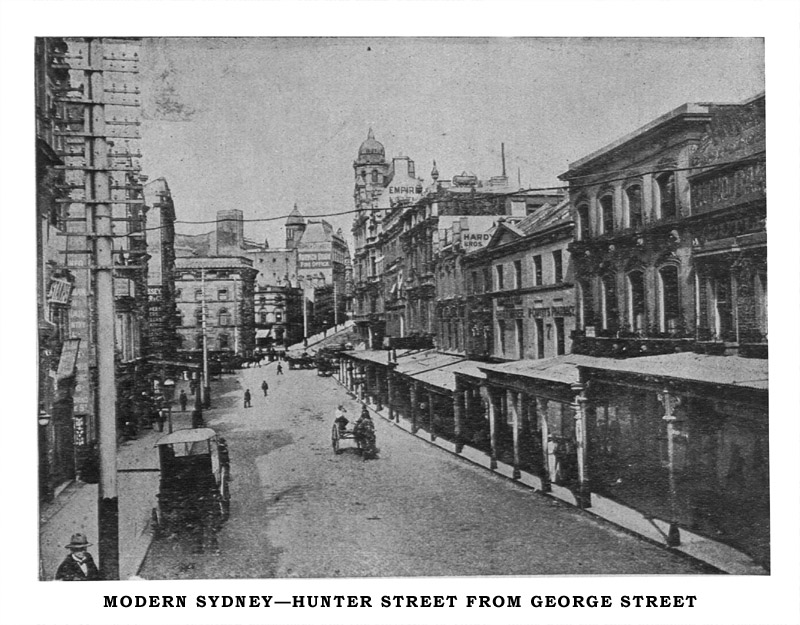
Old Dr. Lang, about this time, complains about the “grossieretes” (bad manners) frequently in evidence amongst the audience at the Theatre Royal, and, inferentially, thanks God that he has never attended a performance there. But he was always girding at something. In the language of our present “Currency lads,” he would have been termed “a hard old case.” He lived in Jamieson-street, not far from his church, and cynically studied the manners of the citizens, retaining always a deadly antipathy to emancipists; fostering free emigration (he imported Scotch masons to build his church, and encouraged thousands of immigrants to settle in the colony,) and showing, in spite of all his aggressiveness a fine pride in the city, for which, despite his many faults and foibles, he did much. Listen to his description of how the people take their pleasure:—
About 4 o’clock in the afternoon, before dinner in the haut ton circles, but some after it among people of inferior station, all the coach-house doors in Sydney fly open simultaneously, and the company begin to take their places for the afternoon drive on the South Head road (formed by Macquarie, and running out to the lighthouse erected by him). In half an hour, the streets are comparatively deserted; by far the greater portion of the well-dressed part of the population being out of town. In the meantime, the long line of equipages—from the ponderous coach of the member of council, moving leisurely and proudly along, or the lively barouche of Mr. Whalebone, the shipowner, to the one-horse shay, in which the landlord of the Tinker’s Arms drives out his blowzy dame to take the hair arter dinner doubles Hyde Park corner, and arrives on the Corso; while ever and anon some young bachelor merchant or military officer, eager to display his skill in horsemanship, dashes briskly forward along the cavalcade at full gallop.”
And in your mind’s eye, you can see the grim old doctor shake his head in censure of what he deems foolish ostentation, and waste of time, as he takes his solitary way to “contemplate the wonderful works of God in the romantic walks of the Government Domain… along the margin of beautifully romantic walks, traced with the utmost taste.”
It was during the passage of the Stirling Castle, the vessel that brought Lang and his fifty Scots masons out, that the idea of the Sydney School of Arts was first mooted, although the doctor himself, seems, just then, to have had little to do with it, leaving the matter in the hands of a fellow-minister, the Rev. Henry Carmichael. This gentleman organised, throughout the voyage, classes among his fellow-passengers, for their better education, and enlightenment; thus these hard headed Scots wrestled for months with the mysteries of algebra, Euclid, logarithms, and the higher mathematics, besides Scriptural theses and several ologies. Not only was this course of study pursued at the time, but rules and an agreement sketched for its prosecution and continuance when Australia should be reached.
But on arrival there was so much else to be thought about and done, that but for Mr. Carmichael’s tireless efforts, and the liberal encouragement of Sir Richard Bourke, the scheme would have come to naught. As it was, it flourished and took root. The story of its actual inception is most interesting. A Mr. John Riddell Fenwick, left a written statement with the then president, Mr. Dalgarno, in 1887, to the following effect :
“In the reign of William IV., year 1833, January 19, at 10 o’clock in the forenoon, three men and a boy ascended Church Hill for the purpose of forming and founding the first School of Arts in all the Australian colonies: the union being represented in the persons of Mr. John Reilly saddler, Pitt-street, formerly George-street, a native of Ireland, shrewd, sharp, and clear sighted; Mr. William Hipkiss, botanist, native of England; and Mr. David Taylor, a builder, and a native of Scotland… They entered a brick building (probably the old Surveyor-General’s Office), situated half way between Dr. Lang’s church and the windmill, by a side door into a long, narrow room at one end of which was a window, with twelve squares of 12 x 10 glass. A small bedroom table was placed end-on to the window. Three empty brandy cases were put near the table for seats. Pen, ink, paper, and a copy of the rules of an English School of Arts were put on the table. Mr. Reilly was chosen chairman, Mr. Hipkiss secretary, and Mr. Taylor treasurer. A strange noise being heard outside the building, the boy went to ascertain the cause. He returned and informed Mr. Reilly that it was made by 200 men in irons, escorted by a detachment of the 17th Regiment. Then, said Mr. Reilly, ‘the work we are engaged in to-day will assist to unrivet those chains, and allow those people to become men again, and not as now, beasts of burden.’ Then, looking at the boy, he said, ‘You will, no doubt, in the course of nature, be alive after we have passed away. Promise me that you will always mention who were the founders of the Sydney School of Arts.’ Which promise I now fulfil, and wish this statement to be read at the annual meeting.”
Mr. Dalgamo added that Messrs. Reilly, Hipkiss, and Taylor had all passed away, leaving only the boy, who accompanied them, to live to see the magnitude of the present School of Arts. Also, on the president’s motion, Mr. Fenwick, was made an honorary life member of the institution.
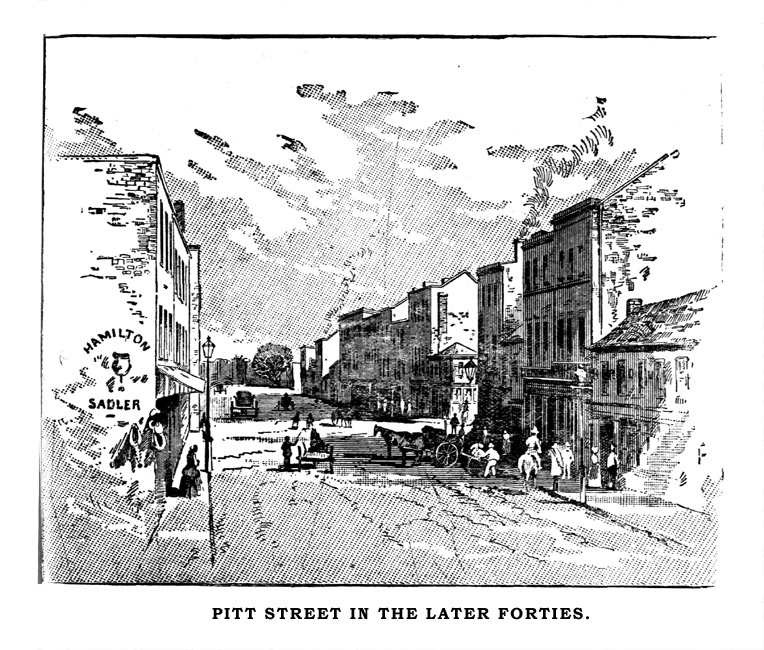
In the following March of 1833, more formal proceedings were taken and a public meeting held. Among the speakers were such men as Mr. Carmichael, Mr. Edward Deas-Thompson, the Rev. Ralph Mansfield, Mr. Charles Windeyer, and Dr. Lang. In 1835, it was removed to its present site, having then on its roll 112 members. Not, however, until 1859 did Sir W. Denison lay the foundation-stone of the building of our day. Unfortunately, no official record was kept of the proceedings of which Mr. Fenwick writes; but it was probably only a preliminary meeting on the part of the three representatives, informal, and hardly to be spoken of as a “founding” but still the first in Australia with such an object in view.
No comments:
Post a Comment