
- Sydney Past & Present - - The City Of Sydney - - The Stories Of Its Growth -
____________________________________________________________________________________________________________________________________________________________________________________________________________________________________
Chapter VI.
Sydney In The Twenties (Continued}
IN April, 1826, Mr. Howe informes us in his “Gazette,” that Mr. Iceley’s thoroughbred mare, imported ex Columbia, dropped a fine bay foal; this being the first blood horse born on Australian soil. And, by the way, it should be said, that the original Howe (George) had now been dead some years, and that Robert, his son, ran the paper in these, comparatively, good, new days. The filial eulogium is worth reproducing:
“Mr. George Howe, the Institutor, Printer, and Publisher of the ‘Sydney Gazette’ and ‘New South Wales Advertiser,’ as well as the Compiler and Publisher of the New South Wales Pocket Almanack, yielded up, on the 11th of May, all his arduous labours at the visitation of death. He has the undisputed honor of being the primary Editor of Australia, and his memory will run coeval with New South Wales; having succeeded in rearing up and establishing, amidst hosts of difficulties, that humble but important structure, the “Sydney Gazette” and thus attained the genuine Printer’s greatest ambition—even in death—a typographical monument, in which, though silent in the tomb, he will ever proclaim himself to us the Progenitor of Printing! We hope that the reprint of our paternal and beloved Typographist will (in the technical phraseology of Franklin) appear once more in a new and more beautiful edition, corrected and amended by the Author.”

Poor old man, from what can be gathered, despite his son’s tall talk, he had, on the whole, a very hard, dreary, and squalid time of it. Snubbed by one faction, kicked by another, and swindled by both.
Late in October, 26, there arrived the Waterwich, the first seventy-four to enter an Australian port. She was in command of Commander Sir James Brisbane, brother of the late Governor, and was bound from Trincomalee to South America. Fine and high and imposing she must have bulked to the eyes of the citizens.

During Darling’s time, too, we find the second recurrence of that “novel and severe distemper,” influenza, or “catarrh,” as they called it then, with which we of to-day are so unpleasantly familiar. It prevailed “throughout the colony, and gave rise to much distress.” Its first visitation was in 1820, when “it by the violence and fury of the attack, consigned many people to the grave.”
Next year whooping cough was introduced by the ship Morley, and the disease killed so many children, and became so virulent that the schooner Alligator had to be formed into a quarantine station. Later on the transport Bussorah Merchant introduced a slight epidemic of smallpox. Otherwise the health of the city and the colony kept throughout fairly good.
In the time of Governor Darling was produced the first Australian ghost story, which merits notice because from out a commonplace and brutal murder was evolved a romance which has not only had, in diversly embroidered aspects, an almost world-wide reputation, but is very firmly believed in by many persons at the present day.
The commonly accepted story, in its bare outline, is that Worrall and Fisher were two well-to-do farmers of Campbelltown. Suddenly Fisher disappeared. Worrall, pretending to be in his confidence, hinted that he had gone to England to escape prosecution for forgery, and so wished his departure kept secret. By and bye, he produced a letter empowering him to sell the farm and belongings of the absent man; also a power of attorney. Then he advertised all Fisher’s property for sale. But the very day before this came off (note the “psychological moment”), an old man saw Fisher, or his ghost, sitting on a fence. The vision according to the best etiquette in such matters, appeared three times. Rumors spread; the place was searched, blood marks and footsteps were found, the last leading towards a water-hole, in which the decomposed body was discovered by a blackfellow, and identified as that of the missing man. Suspicion naturally turned to Worrall, as being the last person seen in Fisher’s company, and as being in possession of his property. Worrall was apprehended, tried, and executed, making, at the last moment, a full confession of his guilt.
The true facts of the case were that Worrall murdered Fisher, and, coolly taking possession of his farm and effects, tried to sell them piecemeal, saying that he had documents that gave him power to do so. In one or two instances he forged receipts, in Fisher’s name, for the purchase of stock, etc. It was a long premeditated crime, to get hold of his victim’s property, which was worth some thousands of pounds, in land, houses, and horses.
Worrall, in the actual matter of fact version, never advertised the farm for sale; no talk of any ghost appeared in the proceedings at the trial. Both Fisher and Worrall were ex-convicts, and both bore but indifferent characters. The crime was an ordinary, brutal, clumsy murder. Nor were there any of the sensational effects recorded by romancists attending either its discovery or the expiation of it.

Actually the most striking and dramatic incident of the whole case was furnished by the blackfellow, Gilbert, employed as tracker, when, skimming the top of the pool with a leaf, he tasted it, and exclaimed that it was “the fat of a white man!” But Worrall did not, in spite of the story writers, throw the body of the victim into the pool at all. He merely hid it in some rushes close by. Then, growing uneasy, he removed it, and buried it a few yards away. Of course, the juices of the decomposing body may have drained into the pool. But, probably, Gilbert was only “gammoning” and he, or his fellows, had already seen indications of the grave. However, here condensed, are the false and the true stories of “Fisher’s Ghost;” but to convince many folk that the first version, ghost and all, is not the correct one, would be a very hard task.
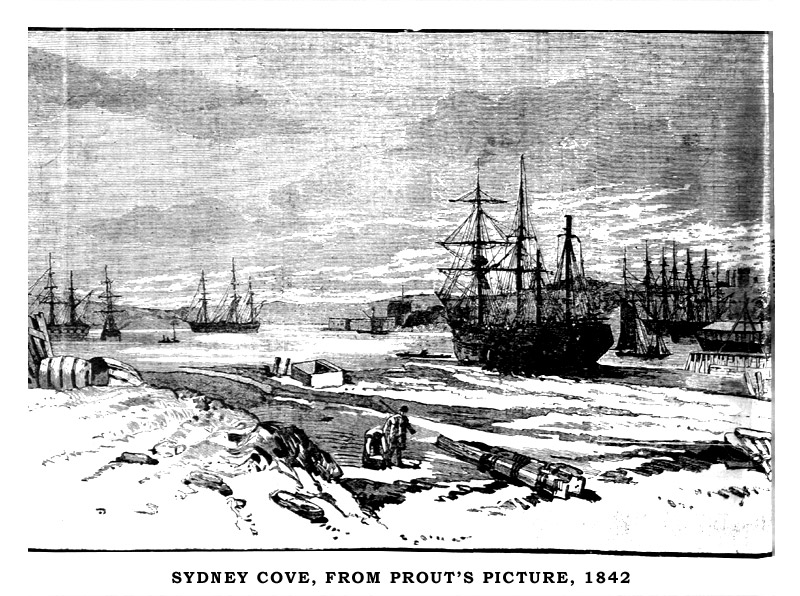
Let us now take a glance at the Sydney of 1826-28. George-street was, of course, the main, and, indeed, the only thoroughfare of importance, and extended, with many and frequent gaps, for about a mile and a half along the hollow through the centre of which once ran the Tank Stream—now a trickling rill being gradually civilised out of existence. “The town,” writes an historian of that day, “occupies the whole of the hollow, creeping up the gradual ascent on each side. The ridge on the left is successively crowned by the lofty-looking buildings of the horse barracks, the colonial hospital, the convict barracks, and a fine Gothic Catholic chapel; beyond these lies the promenade of Hyde Park, flanked towards the town by a row of pretty cottages, and towards the country by a high brick-walled garden appertaining to the Goverment. On the ridge to the right of the Cove, rows above rows of neat white cottages present themselves, overlooked by the commanding position of Fort Phillip, with its signal post and telegraphic appendages (these last probably the semaphore by means of which communication was maintained with the Governor when absent at Parramatta). Following this, we behold, in succession, the military hospital and windmill, St. James’s Church, the Gothic Presbyterian Kirk (Dr. Lang’s), and, beyond these, the military barracks, forming three-fourths of a large square (now Wynyard), and opening to George-street, with an extensive green plot in the centre for purposes of parade. The portion of the town to the right is best known as the Rocks… This is considered the St. Giles, and the division of the town to the left the St. James, portion of Sydney, most of the superior citizens inhabiting the latter, and the lower classes chiefly the former—though The Rocks can undoubtedly boast of many handsome houses, with highly respectable inmates. A few hundred yards from the head of the Cove, towards the left, stands the Governor’s house, with its beautiful domain in front. On the right shore of the Cove,” continues our author, “you first see the mansion of Mr. R. Campbell, one of our oldest and most respectable merchants, with its garden full of flowers and fruit trees, and wharf and storehouse next the beach; next, you observe the town house of Captain Piper; then the Government dockyard, against the surrounding walls whereof are built the working sheds and storehouses, with its boat landings and little wet docks scooped out of the adjoining shore; then came the high buildings composing the commissary stores, beyond which is the wooden Government wharf jutting out into the harbor; and, further on, the landing warehouses of the various merchants connected with our imports and export trade, a low wall there terminating the Cove, to prevent its being filled up by the alluvial deposits from the rivulet.”
The above is, perhaps, the best description extant of Circular Quay and its surroundings some seventy odd years ago.

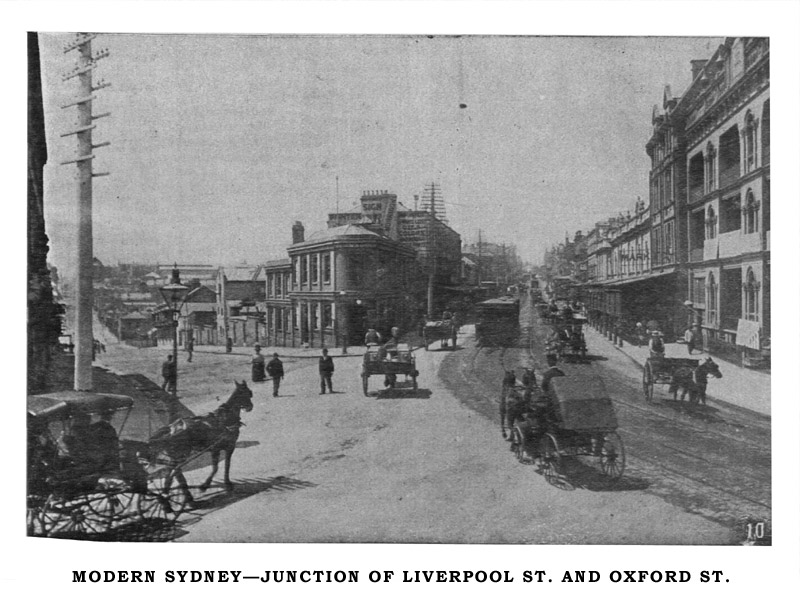
The land near the Cove was the most valuable of any, and there the houses were built adjoining each other; further along they straggled in rows of detached cottages, whitewashed, and generally one-storey in height; a verandah in front, enclosed with a paling fence, and standing each in its own garden. There are still a few of these ancient residences to be found, but not in George street. The streets were wide because their boundaries were as yet so slightly defined; they were unpaved and unlit, and troops of homeless cows and goats roamed them by night and by day.
Even then, in its second youth, Sydney must have presented a pre-eminently English aspect, for one visitor says that but for the cages of bright-coloured birds exposed for sale (look at Lower George-street now) and the gangs of convicts marching to and fro in single file in their yellow or grey jackets, and canvas overalls, “daubed with broad arrows, P.B.’s, C.B.’s and various numerals m black white, and red, with perhaps the gaol gang straggling by sulkily in their jingling leg-chains,” he might easily have imagined himself “at home.” He, however, forgets the climate.
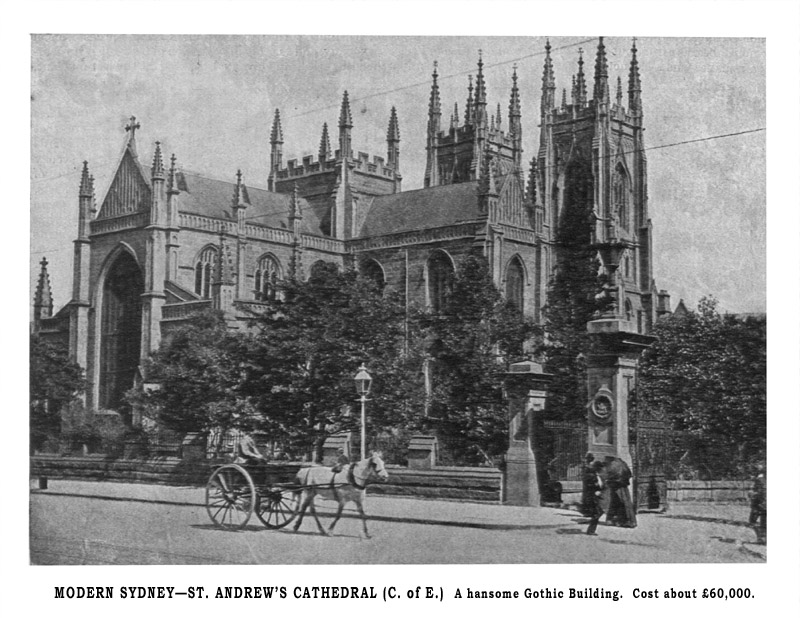
The “Gothic Catholic Chapel,” mentioned above, is, of course, St. Mary’s or rather was the forerunner of the present great cathedral of that name, not built until many years later, and even now incomplete. Writing in 1834, Dr. Lang says: “The Roman Catholic Chapel is an ambitious edifice, built of hewn stone in the form of a cross, and occuping a very prominent situation when viewed from the water.” The foundation had been laid by Macquarie in October, 1821; and the Rev. J. J. Therry was the person to whose exertions much of the success of its erection was due.
But to return to our city of ‘26-28. Goulburn-street was then absolutely houseless; and for this reason was often quoted to strangers by the jokers of the town as remarkable for no burglary ever having taken place in it.
There were six places of worship: St. Phillips’, St. George’s, the Scots’ Kirk, a Methodist chapel, and St. Mary’s; there was a male orphan school endowed by the State; and a benevolent asylum supported by private charity. There were two steam flour mills, three water mills, and numerous windmills which could turn a bushel of wheat into flour in a little over ten minutes. Sydney now, too, produced its own spirits; a Mr. Cooper having started a distillery about a mile along the Parramatta-road, a continuation of George-street. Also, a Mr. Underwood established another upon the South Head road. Thus, the citizens were amply supplied with home-made “tanglefoot” or, as the papers of the day termed it, “a pure spirit manufactured from the good grain of the colony.”

The “Australia” (once the first post office and home of Nichols) and the “Royal” hotels in George-street, and Hill’s Tavern, close to Hyde Park, were said to be as good houses as those in any English town of the same size. But there were many low pot-houses and “publics” scattered broadcast about the place. Lodgings were very reasonable, the most respectable ones seldom exceeding a pound per week, and averaging fifteen shillings each for a double room—“the landlady making all your purchases, and cooking and serving up all your meals for this sum.” At most street corners were fruit stands, from which noisy sellers bawled their wares—a feature of our city still in full swing. The town was divided into six police districts, each with a lockup and a night watch attached. As to its water supply, Sydney appears to have been still dependent on the Tank Stream excavations, but these, in a dry season, being found inadequate, the authorities were casting about for some other source of supply. Let us hope that the soldier’s wives, who, as already mentioned, a writer alleges, in 1816, washed clothes in the tanks, had discontinued the habit.
Even now amusements were very few indeed: the news of the world was six months old when it arrived, and then only brought broken and garbled accounts. Personal scandal still formed the most prominent feature of “society” talk. Certainly, Mr. James Underwood (by the way, the builder of the first vessel launched in Sydney) was said to be erecting a theatre, but of this undertaking little else is to be learned. Indeed, in these days the gaol was turned into a theatre, “a Temple of Thespis, the debtor’s room afforded the arena, and persons of the highest standing in the town were not ashamed to witness the crude representations of these dramatic enthusiasts.” Not till 1833 did Sydney possess a regular bona fide theatre, the “Theatre Royal,” opened by Mr. Barrett Levy, the licensee of the Royal Hotel in George-street, who had some time subsequently fitted up the saloon of that establishment for the exhibition of the legitimate drama.
The fair sex kept up the fashions as well as they could, natheless laboring under many disadvantages. “The moment a lady blooming fresh from England is known to be tripping along a Sydney street you will see our prying fair, singly or in groups, popping eagerly to take notes of the cut of her gown, the figure of her bonnet, and the pattern and colour of the scarf, or shawl, she displays upon her shoulders, that they may forthwith post off to put themselves in the ‘dear fashion’ too.”
Nor did our grandmothers grudge the cash to pay for their newest modes; for one person who kept a ladies’ “fashionable repository,” we are told, departed home with a nice little fortune of £12,000, all acquired in less than six years.
It may be worth noticing that in the first three months of 1826 eight hundred people, exclusive of those committed to the Criminal Court, had passed before the Sydney Bench. But on March 12, in the same year, to the amazement of the magistrates, there was not a solitary case. This unprecedented incident so staggered the court that, fearing the citizens were becoming downhearted, it issued no less than 76 spirit licences that same morning. As to the more detailed topography of the city, accounts differ materially; the earlier ones, written mostly by people on the spot, deal in generalities as to the locality, and their authors, thoughtless for posterity, seem to imagine that everybody would be always as wise as themselves respecting matters of such common knowledge. Which practice still obtains. We know for certain, however, such facts as that where Petty’s hotel now stands was in these years Captain Rossi’s garden (Rossi was then police magistrate); that cattle were slaughtered at Dawes—then Slaughter-house—Point; that people used to get their fire-wood in the neighbourhood of Cooper’s distillery, already spoken of; that where the big shop of David Jones and Company now stands was a cowyard; a butcher’s premises held the site of Kidman’s. In York-street stood a stocks, and the youngsters’ great amusement was to pelt the unfortunates both there and in the pillories with rotten eggs and vegetables from the market.
Until Busby brought water in from the Lachlan swamp, by means of a drain to Hyde Park, whence the citizens carted or carried it, the tanks formed the sole supply—useless in a drought. Surry Hills was mostly all open country, dotted sparsely with market gardens, and a few large private residences. Between Woolloomooloo and Darlinghurst lay a deep scrub-covered valley, through which a creek ran, and emptied itself into the bay. Children used to frequent Flagstaff Hill, where our Observatory now stands, to cut the bushes with which it was overgrown; out of these they made brooms. Broadly, the city boundaries were, in these days:—On the north, the harbor; on the south, the long low ridge of the Surry Hills; on the west, the “beautiful lagoon of clear and extensive salt water running two miles inland north and south” (Darling Harbor); and on the east, the deep valley already mentioned. Our limitations at this time were narrow, indeed! Still, from the last period in which we had a glance at it, the place had grown wonderfully, showing with every year that in modern parlance it had decidedly “come to stay.”
In 1830 was laid, by the Chief Justice of New South Wales, the foundation-stone of the Sydney College (now our present Sydney Grammar School). Inserted in the stone was a brass plate, with an inscription, reading: “This foundation stone of the Sydney College—an institution founded for the vigorous and pious promotion of polite literature, and the liberal arts among the youth of Australia—was laid by Francis Forbes, Chief Justice of New South Wales, on an auspicious day, viz., the 26th of January, in the year of our Lord 1830, in the happy reign of George IV., Lieutenant-General Ralph Darling being Governor of New South Wales.”
It was erected on a portion of over an acre and a half of land, the gift of Sir Thomas Brisbane, in 1825, to an institution known then as the Sydney Free Grammar School, conducted in a private house, but discontinued in the succeeding year. This land was “very eligibly situated near the racecourse,” and the foundation ceremony was attended by, besides the general public, over eighty of the trustees, who walked in procession from the Royal Hotel to the site of the building. As in our day, so in theirs, our worthy forbears probably seldom neglected the rite of “wetting the stone.” The “saloon” of the “Royal,” however, it should be in all fairness mentioned, was their usual meeting place, being rented from Mr. Levy for that purpose. The Chief Justice made a speech at the ceremony, and Dr. Lang “improved the occasion.” The function ended “with the acclamations of all present, in testimony of their joy on so interesting and auspicious an occasion.”
The first president was the Hon. Francis Forbes, with Messrs. Sam. Torry and George Allen as treasurer and secretary respectively. And on the first committee appear such well-known names as those of Sir John Jamieson, Dr. Lang, Messrs. Sydney and Francis Stephen, J. E. Manning, W. Bland, D. Cooper, S. Lord, and others, all intimately connected with the past and present history of the city.
The architect was Edward Allen, who took rank as a “benefactor” through foregoing a third of his professional fees—£125—for the benefit of the institution. The requisite sum for the erection of the college was to be raised by the sale of 200 shares of £50 each, “50 additional shares to be left open for the convenience of residents in the East Indies or elsewhere beyond seas, until the first day of January, A.D. 1833.”
In a progress payment college account, during 1830, appears an item, “Paid Mr. Iredale for spades, picks, etc., £1 4s 2d;” a memento, this, of the founding of the present house of Lassetter and Company. Amongst the shareholders occur the name of John Tawell (the convict Quaker, transported for forgery); Mrs. Reiby (at one time supposed to be Margaret Catchpole), W. C. Wentworth (late one of the committee), Robert Howe (editor of the “Sydney Gazette”), Robert Campbell (the first merchant), and many others of note and notoriety.
On January 19, 1835, the college was opened with Mr. W. T. Cape as its headmaster, and some cash and shares in hand, an omen of prosperity and good management that, as all of us well know, was not transitory, but has continued throughout the history of the colony to the present day.
________________________________________________________________________________________________________________________________________________________________________________________________
No comments:
Post a Comment