
- Sydney Past & Present -- The City Of Sydney -- The Stories Of Its Growth -
________________________________________________________________________________________________________________________________________________________________________________________________________________________________________________________________________________________________________________________
Chapter VIII.
The Later Thirties.
In the thirties there was as yet no street connecting Sydney Cove with Darling Harbor. And this fact led to the making of the Argyle Cut. “The Rocks” at this time was looked upon as a rising suburb, and Miller’s Point had become quite fashionable. Fears were on that account expressed that such an enterprise as cutting through the dividing ridge would harm the locality by introducing an undesirable class of residents. But those people whose interests lay around the shores of Darling Harbour (late Cockle Bay) persevered, and agitated a long time for either a tunnel or a cut. The Surveyor-General reported upon it, and there was as much discussion and argument about the affair as there is to-day respecting the North Shore Bridge. Finally the cut plan was adopted, the estimate for that being only £895, as against £7000 for a tunnel. Prisoners were lent by the Government, and the job was to be finished in twenty-one months from the beginning of October, 1832. Later on, the contractors made an offer to build an arch to carry a roadway over the whole affair for an extra £1500. But funds had run out; and nothing was done for a long time other than to throw a little bridge across the excavation. There seems to have been about sixteen or seventeen promoters to the affair, with a capital of some £2000. Intermittently, gangs of convicts toiled and sweated at elaborating the rude gorge left by the original contractors, until, when transportation ceased, they were withdrawn to make way for free labour.
In 1838, an old writer says: “Between the north end of Kent-street, and where it crosses to Church Hill, a deep cut has been made through the west side of the hill on which Fort Phillip stands, this part being called “The Quarries.” At the southern extremity of the street several cottages and substantial dwelling-houses have been erected, most of them having small gardens attached, together with a beautifully diversified landscape view of the water and shores of Darling Harbor.”
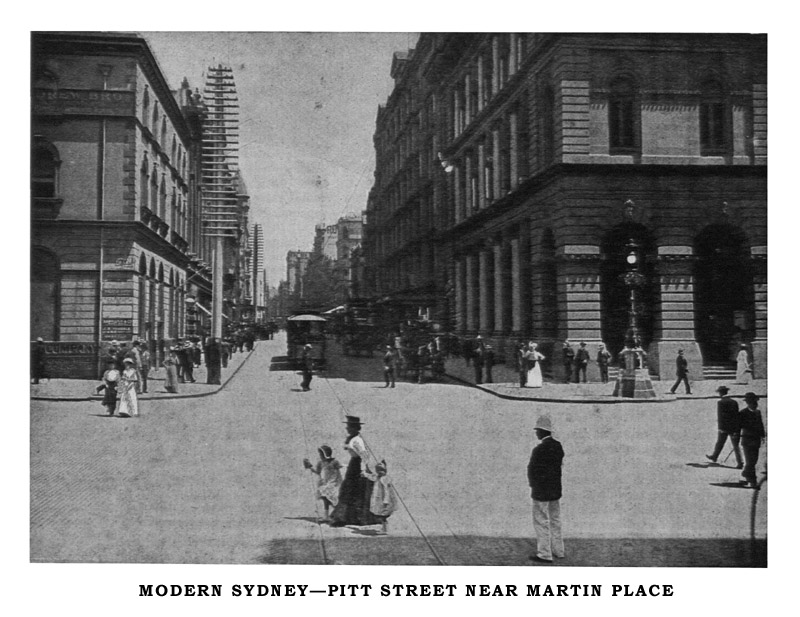
Gradually, however, the place fell into disrepute, haunted as it was by gangs of thieves, and worse characters still, whose depredations made it unsafe both by day and by night. Indeed, in our own time there are lots of folk who would rather, if possible, avoid taking a walk through the Argyle Cut towards the small hours; so difficult is it to live down a bad reputation acquired in early life. There are people living now who well remember the first bridge, a ramshackle, ricketty affair. But the second was looked upon as a very fine piece of work indeed; it was lit by a big kerosene lamp for the guidance of late wayfarers across the chasm. Before the whole work was finished it must have cost something like £30,000, including the three present massive bridges—worthy specimens of old-time masonry that will, unless the resumption scheme destroys them, last for many generations yet to come.
Just a word as to how Sydney folk amused themselves out of doors since we last glanced at them taking their scant pleasures sadly enough. Some authorities, notably Lang, as we have seen, alluded to the racing and drinking propensities of the people in Brisbane’s time, making mention, too, of not a little gambling in out-of-the-way corners. Probably, even then, there were “two-up” schools in sequestered nooks, and our grandfathers, as likely as not, were proficient at the old-time equivalent for “heading ‘em.”
But as far back as 1810 we have records that they indulged in wilder species of recreation than these. In that year, for instance, at Parramatta there was what we should now call a “carnival,” the principal attractions of a two days’ sport being cock-fighting and bull-baiting. They hunted, too, and the description of the first run is worth reading: “Having cast off by the Government hut on the Nepean, and drawn the cover around there for a native dog unsuccessfully, we tried the forest ground for a kangaroo, which we soon found. It went off in excellent style along the sands by the river side, and crossed the cow-pasture plains (Camden), running a circle of about two miles, then recrossed, taking a direction for Mr. Campbell’s stock-yard, and thence to the back of the Badge Allen Hill to the head of the Boonobohen Creek, where he was headed. Thence he took the main range of the hills between Badge Allen and Badge Allenbingiee in a straight direction for Mr. Throsby’s farm where the hounds ran into him, and he was killed after a grand run of about two hours. The weight of the animal was upwards of 120lbs.”
Evidently an “old man” with a very fine turn of speed; either that or his pursuers did not press him as closely as they might have done.
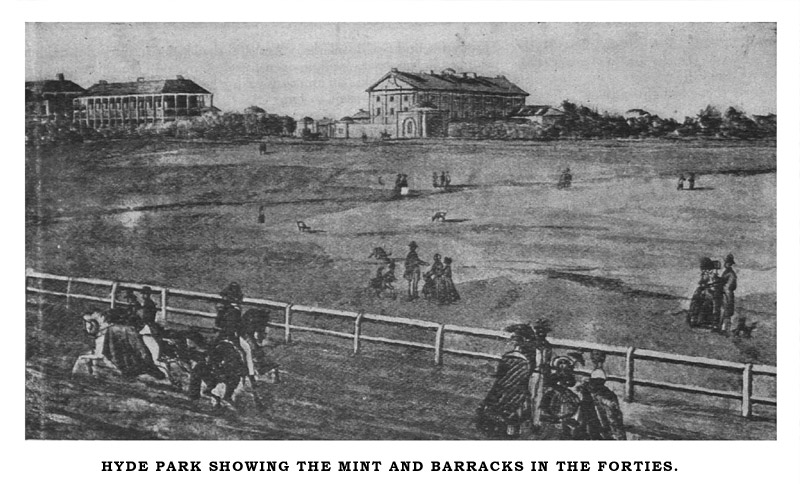
Pugilism was the rage in England in those days, but little seems to have taken place in that line out here, the first record of anything of the kind being in 1814, when John Berringer met Charles Sefton, about half a mile from the racecourse (Hyde Park), and fought for two and a half hours. Sefton is said to have been the “cleverest” of the pair. But Berringer won the “mill” after very hard fighting, by reason of his greater reach and height.
Boat racing was always a favourite pastime. Mention, in referring to Devlin, has already been made of the whale-boat race in 1830. But long before that there was a trial of speed from Bradley’s Head into the Cove, over a course of 3½ miles. The competitors were Captain Piper, naval officer of the port; Captain Lawle, of the Batavia, Captain Johnson, of the Guildford, and Captain Bell, of the Minerva—all vessels lying in the harbour. The winner was Captain Piper. In 1827, the first actual regatta took place. Its inception seems to have been due altogether to the Hon. Captain Rous (afterwards the well-known sporting admiral), who entered two boats of his own in the pulling match—the Mercury and the Centipede—and won the first and second events with them. The course was some 4 miles; time, 23min. This event was followed by a sailing race, for a purse of 50dol., put together by the officers of H. M. ships Rainbow and Success, added to a sweepstakes of 5dol. each. The course was from abreast of Farm Cove, round the Sow and Pigs, and back to the starting place. Lieutenant Preston proved the winner with his boat “Black Swan,” coming in a mile and a half ahead. Then, to finish up with, there was a race for watermen, the prize 50dol. No boat was to exceed 19ft in the keel, but could pull any number of oars. The course was round Pinchgut. There were seven starters, but four cried enough after the first heat. Finally, Black Boy, owner James Shears, took the lead and won, beating Native Youth and Bungaree by lengths.
Such is a brief record of the first regatta that ever took place in our waters, the herald of our great institution of the present day, when scores of graceful fliers spread their white wings and speed to and fro the great steamer doing duty as flagship, and moored perhaps in just the same spot as that in which the bluff-bowed old whaler or merchantman served a similar purpose over three score and ten years ago.
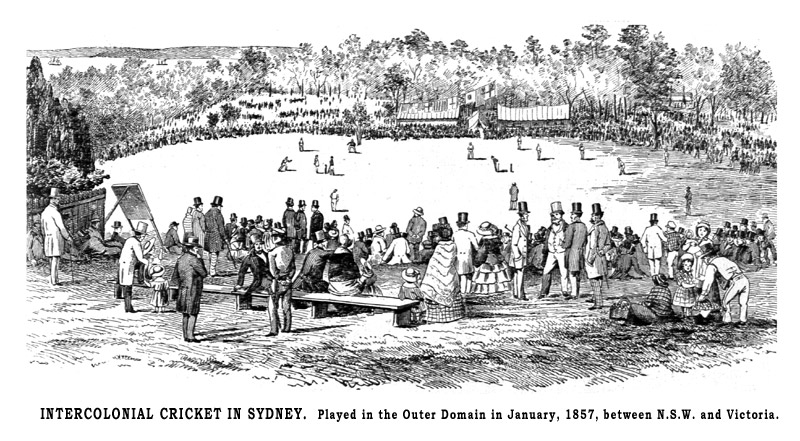
Wherever the Anglo-Saxon sets his foot he plays cricket, and Australia was no exception to the axiom. The first game that any account can be found of took place on January 1, 1827, when the members of the Australia Cricket Club played together, and had a dinner in the evening. Windsor had been challenged, but for some reason or other refused to come to the scratch. But in 1830 there was a great match between eleven Australians and an equal number of the 57th regiment, the former winning by 24 runs. In March they met again, the soldiers very confident, and played for ten guineas a side. And again the Australians won; this time by 32 runs.
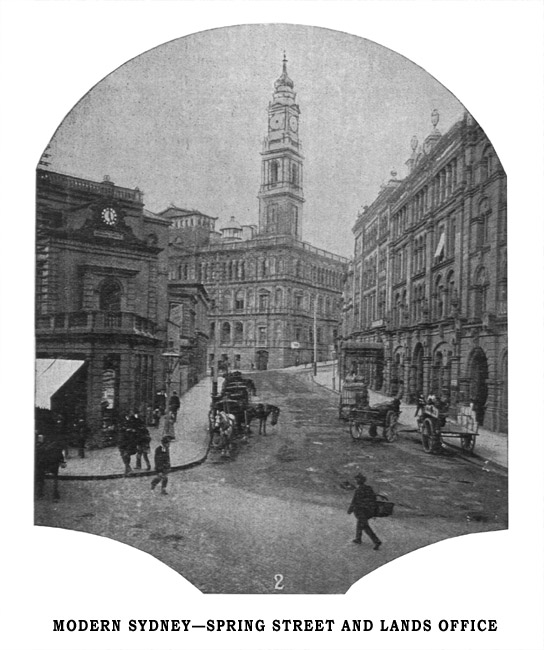
In the late thirties and early forties there was plenty of sport—horse-racing, boating, cricket, etc.,—and the well-to-do citizen could, if he were so inclined, witness or partake in one or the other of these pastimes every day in the week, and go to the play in the evening to finish off with. For strength and agility in athletic exercises our country folk were pre-eminent, especially those settled about the Hawkesbury, known even then as “Cornstalks.” One newspaper, in 1831, gives a list of 32 names of persons each of whom stood over six feet in height. Among the number was Kable, the champion boxer of that time; he stood 6ft 3½in. Even at the present day the Hawkesbury “natives” are noted for their stature. A hardy and energetic race they were, too, these men, made so by their environments, and perhaps less given to “letting things slide” than are some of their latter-day prototypes, who depend upon husbandry and stock-keeping for a livelihood.
Nor were the early-day horses a whit inferior to their masters in strength and stamina. As an instance of this, we are told that a mare, whose foal had just been weaned, and a filly, 2½ years old, were run up out of a clover field, and ridden a distance of 42 miles in two hours and fifty minutes, including several stoppages on the road. The journey was for a doctor; neither of the horses were shod; the going was rough; and the animals had never been fed on hay or corn. Yet neither of them were the worse for the trip.
During the six years of Bourke’s beneficent rule—he governed constitutionally without a constitution—much of importance took place connected with the growth of our city, both physically and politically. The Cove was still, at low tide, little better than a mud flat, littered by boatbuilders’ ricketty sheds, and temporarily and rudely constructed little wharves. It is said that the water then flowed right up to where the Custom House now stands, and that on the site of the Paragon Hotel a small vessel had been built and launched; and another one several hundred yards up Pitt-street. Also, that the Tank Stream was still navigable for small boats as far as Bridge-street. The Stream, respecting which so many arguments have been held, is now said to have had its source somewhere about the spot in Hyde Park where there is still to be seen a pond or two—one is near the corner of Liverpool and Elizabeth streets—little noticed by the general public; thence, according to the best authorities, it followed a course between George and Pitt streets through Martin Place to Hunter-street thence by Hamilton-lane, crossing Bridge-street to Pitt-street, and so into the harbor close to the present North Shore Ferry Co.’s premises. But at the best, its true course is a matter of more or less surmise. The brightest of old memories vary.
Be this as it may, the Legislative Council, in 1834 began to think of resuming and reclaiming the foreshores around the Cove, and the construction of Circular Quay was mooted. It was suggested that a civil engineer should be imported on a five years’ engagement, at a salary of £800 per annum. But the plan seems to have lapsed, and we hear nothing more of it just then. However, a good deal was done towards improving Darling Harbor. Bathing in its waters would appear to have been strictly prohibited, for we read that a certain Lieutenant Finch, of the 17th Regiment, was fined 5s for indulging in such a luxury. Most people, at the present time, would not take a dip in it if paid that sum to do so.
Here, by the way, is a curious advertisement from a London “Times” of 1834; “Any lieutenants in the Royal Navy under the age of 45, and with large families, may obtain free passages to Sydney, New South Wales. Application should be made to ‘C.T.,’ R.N., Post Office, Hythe, Kent.” Certain of the sumptuary laws of the city in these years of the middle thirties and early forties were decidedly curious. Yet are we not slowly drifting back in legislation to those benighted times? For instance, on Sunday, shops, excepting those of butchers, bakers, fishmongers, and greengrocers, were to be closed; these only kept open till 10 a.m.; bakers might trade only on that day between 1 and 2 o’clock in the afternoon; apothecaries at any hour. Constables might apprehend anybody who could not give a satisfactory account of themselves between sundown and 8 o’clock the next morning. The Surveyor-General (Sir Thomas Mitchell) was directed to align and set out the carriage and footways, and mark them by posts; also to place the names of streets on house walls, and fix numbers on the doors, which the tenant was bound to paint in at the end of a fortnight, or else pay a fine of 10s weekly. Footways were also to be levelled, and steps taken away from the path. The town surveyor, too, was adjured to be on the alert to prevent people accumulating gravel or earth before their houses “without giving notice,” in which case he was to remove it as rubbish.
At this date there were two posts a day. Every letter or “packet,” weighing less than half an ounce was charged for transit from one post office to the other, in distance not exceding 15 miles, the sum of 4d; over 15 miles, 5d; above 170 miles, 10d; for 300 miles, 1s. Letters sent by ship around the costal ports cost 4d; American letters cost 3d each. The mails, it may be remarked, were anything but regular, being forwarded when coach, vessel, or steam packet pleased to arrive or depart. Society, too, or rather the different parts of it, was being gradually merged into a more component whole, although the terms “Stirling” and “Currency”—to distinguish between the English and the Colonial born—were yet in use, and the “Pure Merinos” still prided themselves on being able to trace a stainless descent, and gave themselves airs on that account. Recently arrived convicts were still known as “Canaries,” because of their yellow uniforms, and people used any other colour for decoration than yellow. Yellow paint, indeed, was unsaleable. But the word “convict” was dying out, and giving place to “Government men.” Some years before this an emancipist had even obtained a verdict for libel, with £50 damages against a person who had called him “A d—d convict.”
In 1828-9 there were sailing out of the port four vessels, constantly employed in the whale fishery; six others in sealing. There were two regular “packets” between Sydney and Newcastle; one between Sydney and Hobart Town; others to Port Dalrymple; and a number of small craft trading to the Hawkesbury, Illawarra and other places.
But about the end of Governor Bourke’s term of office there were no less than 60 square-rigged whalers claiming Sydney as their port; 12 steamers sailed up and down the coast. Fifty-six vessels arrived from Great Britian, 94 from British colonies, 17 foreign, and 5 from American, giving altogether an aggregate of 67,360 tons. Decidedly, matters were looking up. Emigration, too, was ever on the increase, as may be judged from the fact that, in 1838, more than £12,000 was realised by the sales of stores from the emigrant ships. We drank chiefly rum—and plenty of it. The revenue from its importations totalled £189,450; and the amount of drink to 8 gallons per head per annum. But pew rents in the churches brought in only £6 15s 9d. In the same year, as showing how well the Government managed to make both ends meet, they had in hand £364,545 2s 7d, against an outlay of £240,673 11s 8½d—they don’t bother about odd halfpennies now a days. But the old-fashioned bookkeeping was nothing if not exact.
In ‘36-’37 the population of Sydney was 19,729 people, made up by 6794 free men, 2205 boys, 4744 free women, and 2209 girls; 2932 male convicts and 586 female ones. In the city there were five banks, seven or eight churches or chapels, a couple of insurance companies, three breweries, and two distilleries. And still the blacks, in puris naturalibus, camped in the streets and on open pieces of ground. In this connection a schoolmaster makes an amusingly equivocal report upon an aboriginal pupil who had been sent to him. Says the padagogue: “He shows as much sign of intellect as many of his school-fellows.”
“Police and gaols” was a big item in the budget, totalling no less than £52,344. “Miscellanies,” put shortly, came to £77,585. People were not nearly so inquisitive then as they are now. Fancy a Treasurer calmly presenting such a statement to the tender mercies of “the House” in this year of grace! Luckily, perhaps, for some folk who figured in “Miscellanies,” there was no “Opposition”—at least, no legislative “Opposition;” and no matter what Wentworth, et ces autres known as the Patriotic Association, might think or say, the power to act was as yet denied them.
The year 1837 was rendered memorable among other matters by the establishment of a new party, consisting entirely of the native-born; and this party it was that took in hand the celebration of the 49th anniversary. They called themselves the “United Australians.” Their representative was one Richard Driver, who, at the time, kept a public house—the “Three Tuns”—at the corner of King and Elizabeth streets. He was, too, the father of a smart lad, who became later on pretty widely known, both as a lawyer and in the world of politics, eventually entering Parliament, and joining Parkes’s Cabinet, in 1877. Driver’s house was the meeting-place of the new party, who determined to celebrate the anniversary by a “National Dinner” at the Royal Hotel. William Charles Wentworth was to take the chair, and their fellow-countrymen from all parts of the colony were invited to attend. The festival duly came off, as did the usual speeches and toasts; although the new association does not appear to have introduced any particularly fresh features, except perhaps in the way of a little less harmony—for folk at these gatherings were not any more wont to think alike on all political subjects than they are now.
On October 27, 1837, great news arrived in Sydney. This was nothing less than the death of William IV., and the accession of Queen Victoria to the throne of the United Kingdom. A “Gazette Extraordinary,” with a deep mourning border, was at once published announcing the fact, and excitement ran high throughout the city. By public notice the next day Sir Richard Bourke directed that 72 minute guns should be fired from the Dawes Point battery at noon; that the Royal Standard and the Union Jack should be hoisted half-mast high at the same hour; also, all the ships in harbor were to observe similar signs of mourning with their flags, whilst the bells of St. James’s and St. Phillip’s were to be tolled for one hour at sunset that day and an hour at sunrise on the next. All civil officers were to put on mourning, together with everybody else whose situation and circumstances would enable them to do so.
Another notice proclaimed that “the High and Mighty Princess Alexandrina Victoria had become “our only lawful and rightful Liege Lady Victoria, by the grace of God, etc.” To assist in the Declaration of Allegiance all the high officials of the colony, the clergy, magistrates, military and naval officers, and the principal inhabitants, repaired to Government House at midday.
Towards the appointed time Sydney, dressed in its darkest raiment, wended its way towards the old two-storeyed irregular mansion, with its wide verandah, and “one good room.” There the 50th Regiment, with detachments of the 4th and 80th, was already drawn up. Followed by all the notabilities, the Governor, in the full uniform of a Major-General, led the way to a table on which was lying the proclamation of her Majesty’s accession, waiting for signature. Sir Richard was the first to sign, followed by the others in their turn. The fourteenth was “Thomas X Tomra,” aboriginal native chief, who thus attached his mark on the part of the Australian native race. In all there were 126 names, and when the signing was over the Governor, standing on the front door-step, called for three cheers for the Queen, himself giving the time.
Then the troops fired a general salute, the Royal Standard was mast-headed and saluted with 24 guns; more volleys from the troops; more cheering and playing by bands of “God Save the Queen” ended not the least of the memorable events that old Government House had witnessed since Johnson and his drunken soldiers routed Bligh out of his hiding-place in one of its rooms.
Presently the High Sheriff (Thomas Macquoid), who had, ere this, read the Proclamation to the crowd, marshalled a procession that was to pass from Government House down Bridge-street and up George-street to the police office—the first ceremony of the kind in Sydney that there is any record of.
As in our day is the general rule, so now the procession was headed by a detachment of mounted police; then came the band and a division of the 50th Regiment, together “with a number of the inhabitants of Sydney.” Members of the bar, the magistrates of the colony, commissariat officers, the clergy, the judges, followed in order named. Then came Thomas Thomra, A.N.C., the members of the Legislative and Executive Councils, and detachments of the three regiments. Bands played, flags waved everywhere as the procession marched gaily along towards the dingy old “Central,” where the Proclamation was again to be read by the High Sheriff. And where, one wonders, is that most historical document? Sold for waste paper, or still preserved in some cellar for bubonic rats to nest in? Somebody might do worse than hunt it up, and have reproductions made for the benefit of those of our generation curious in such matters. It runs: —
PROCLAMATION
“Whereas it has pleased Almighty God to call to His mercy our late Sovereign Lord King William the Fourth, of blessed and glorious memory, by whose decease the Imperial Crown of the United Kingdom of Great Britain and Ireland, and all other His late Majesty’s dominions, is solely and rightfully come to the high and Mighty Princess Alexandrina Victoria, saving the rights of any Issue of His late Majesty King William the Fourth, which may be born of His late Majesty’s Consort:
“We, the Captain-General and Governor-in-Chief of the Territory of New South Wales and its Dependencies, the Chief Justice, the Members of the Executive Council, the Puisne Judges of the Supreme Court, the members of the Legislative Council, the Clergy, Magistrates, Civil Officers of the Government, and the Naval and Military Officers of her Majesty’s Service, with numbers of other principal inhabitants of the Colony,
“Do now hereby, with one full voice and consent of tongue and heart, Publish and Proclaim that the High and Mighty Princess Alexandrina Victoria is now, by the Death of our late Sovereign, of happy and glorious memory, become our only lawful and rightful Liege Lady Victoria, by the grace of God, Queen of the United Kingdom of Great Britain and Ireland, Defender of the Faith, saving as aforesaid, Supreme Lady of the Territory of New South Wales and its Dependencies, to Whom, saving as aforesaid, We do acknowledge all Faith and Constant Obedience, with all hearty and humble affection, beseeching God, by Whom Kings and Queens do Reign, to bless the Royal Princess Victoria with long and happy years to Reign over us.
“Given at Government House, Sydney, this twenty-seventh day of October, 1837.
“God Save the Queen!
“(Signed) Richard Bourke,
“Governor-in-Chief.”

Sydney in these days was, at the most, only a squalid town; neither trams nor trains; no corporation, no gas lamps, no drainage, no suburbs worth mentioning; stumps in the streets, and convicts in chains grubbing them; Circular Quay a mud flat; and bullock teams camped alongside the old burial ground, the site of the present Town Hall. Everything in embryo. And little the few people who listened to those high-sounding words, with their quaint turnings, guessed how fully in the long years to come, God would grant the request made in that most hearty and loyal prayer delivered in the rude capital of an almost unknown land.
No comments:
Post a Comment