

William Charles Wentworth, studio portrait by Dalton's Royal Photographic Gallery, 1861 to 1862. State Library of NSW, via Wikimedia Commons. Public domain.
Of the three young men who walked over the Blue Mountains in May 1813, only one was born out here. William Charles Wentworth was 22, a currency lad with a convict mother and a father who had dodged a highway robbery charge by signing on as a surgeon. Over the next 60 years he became an explorer, a poet, a barrister and a newspaper man. He also built Vaucluse House, helped found the University of Sydney, and drafted the constitution that set up our state parliament. When he died, Sydney gave him the colony's first state funeral.
This page follows his whole life, but the mountains are where it starts. For the other two men, see my pages on Gregory Blaxland and William Lawson. There's also my older post Blaxland, Wentworth, Lawson and the Crossing of the Blue Mountains. For the family and the house, see The Wentworth Family of Vaucluse and Vaucluse House on Historic Sydney Mansions.
Born at sea off Norfolk Island
The Dictionary of Sydney records his birth aboard the Surprize in August 1790. That was a Second Fleet transport, which had then taken 150 convict women from the Lady Juliana to Norfolk Island. His mother was Catherine Crowley. The Dictionary says she was convicted at the Staffordshire Assizes in July 1788 of stealing "wearing apparell" and was sentenced to seven years' transportation. She met D'Arcy Wentworth aboard the Neptune and became his common-law wife.
Wikipedia describes D'Arcy as a member of the aristocratic Anglo-Irish Wentworth family. It says he had escaped prosecution for highway robbery by taking the post of assistant surgeon in the new colony. The Dictionary of Sydney is kinder and calls him an Irish-born soldier and doctor who became "one of the early colony's richest men, despite his unconventional private life".
Wikipedia notes there has long been confusion about William's exact birth date, because his mother was a convict and his parents weren't married. D'Arcy acknowledged him as his son all the same. As a little boy on Norfolk Island he was known as William Crowley and was taught by "a woman of good character".
Parramatta, Greenwich and home again
The family came to Sydney in 1796 and lived at Parramatta, where D'Arcy did very well for himself. Catherine died in 1800. William and his brothers Dorset and Matthew were then sent to England to Alexander Crombie's school at Greenwich. The sources differ on the year. Wikipedia's Wentworth article says 1803, which matches the Dictionary of Sydney's "Departed Sydney 1803". Wikipedia's article on the crossing says 1802.
Wikipedia says he failed to get into both the East India Company's college and the Royal Military Academy, so he came home in 1810. He won his first bit of fame on horseback, riding his father's horse Gig to victory at the first official race meeting in Hyde Park. In 1811 Macquarie made him acting Provost Marshal and gave him 1,750 acres on the Nepean, which he called Vermont.
Over the Blue Mountains, May 1813
Wikipedia's account of the crossing says Gregory Blaxland got Governor Macquarie's approval early in 1813 and asked Lawson and Wentworth to come along. Blaxland was 34, Lawson was a 38-year-old army lieutenant, and Wentworth was the young one with something to prove. They left Blaxland's farm on South Creek on 11 May with four servants, four horses and five dogs. Wentworth opened his journal this way:
"On the Eleventh of May our party consisting of Mr. Gregory Blaxland, Lieutenant Lawson and Myself with four servants quitted Mr. Gregory Blaxland's farm on the South Creek..."
Each day they cut their way along the ridges, and on 31 May they stood on Mount Blaxland looking west over open grass country. Lawson kept the distances and Blaxland later published the official account. Wentworth's journal gives you the feel of the place:
"A country of so singular a description could in my opinion only have been produced by some Mighty convulsion in Nature."
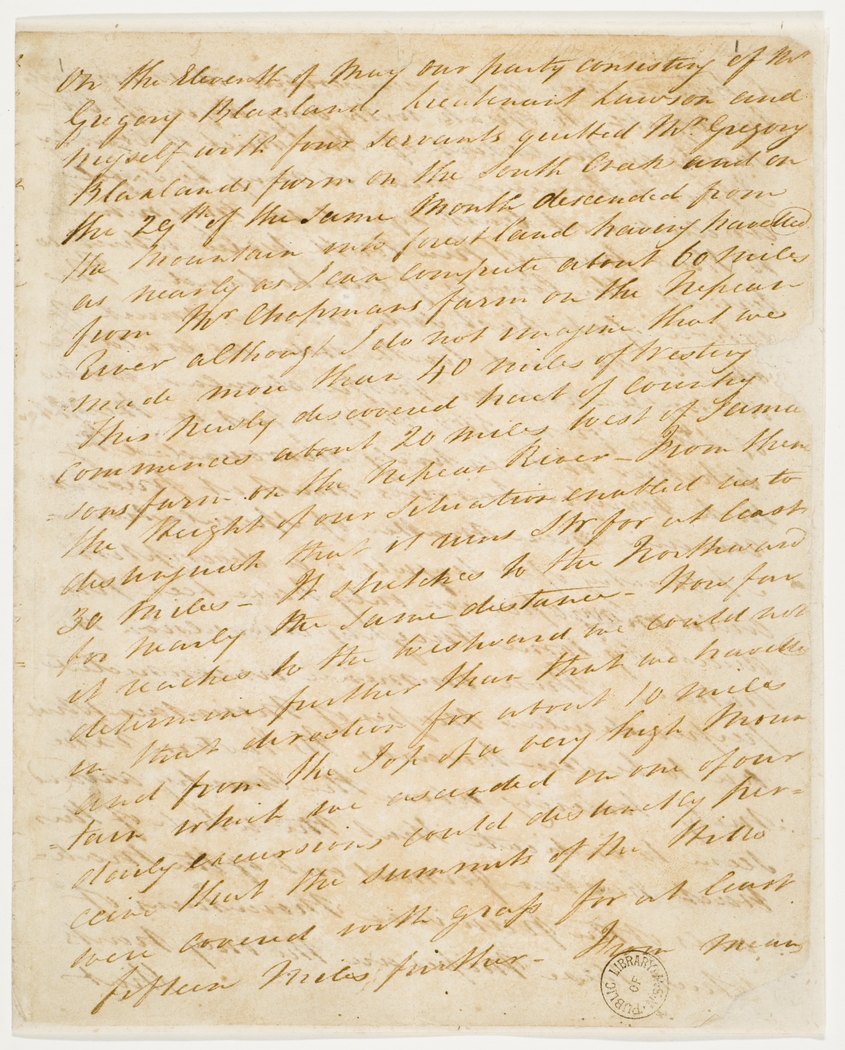
William Charles Wentworth's journal of the expedition across the Blue Mountains, 11 May to 6 June 1813. State Library of NSW, via Wikimedia Commons. Public domain.
Wikipedia records that, like the others, he was granted 1,000 acres for his part. Blaxland later claimed he had led the expedition. Wikipedia's crossing article says the records from the time suggest the three were joint leaders.
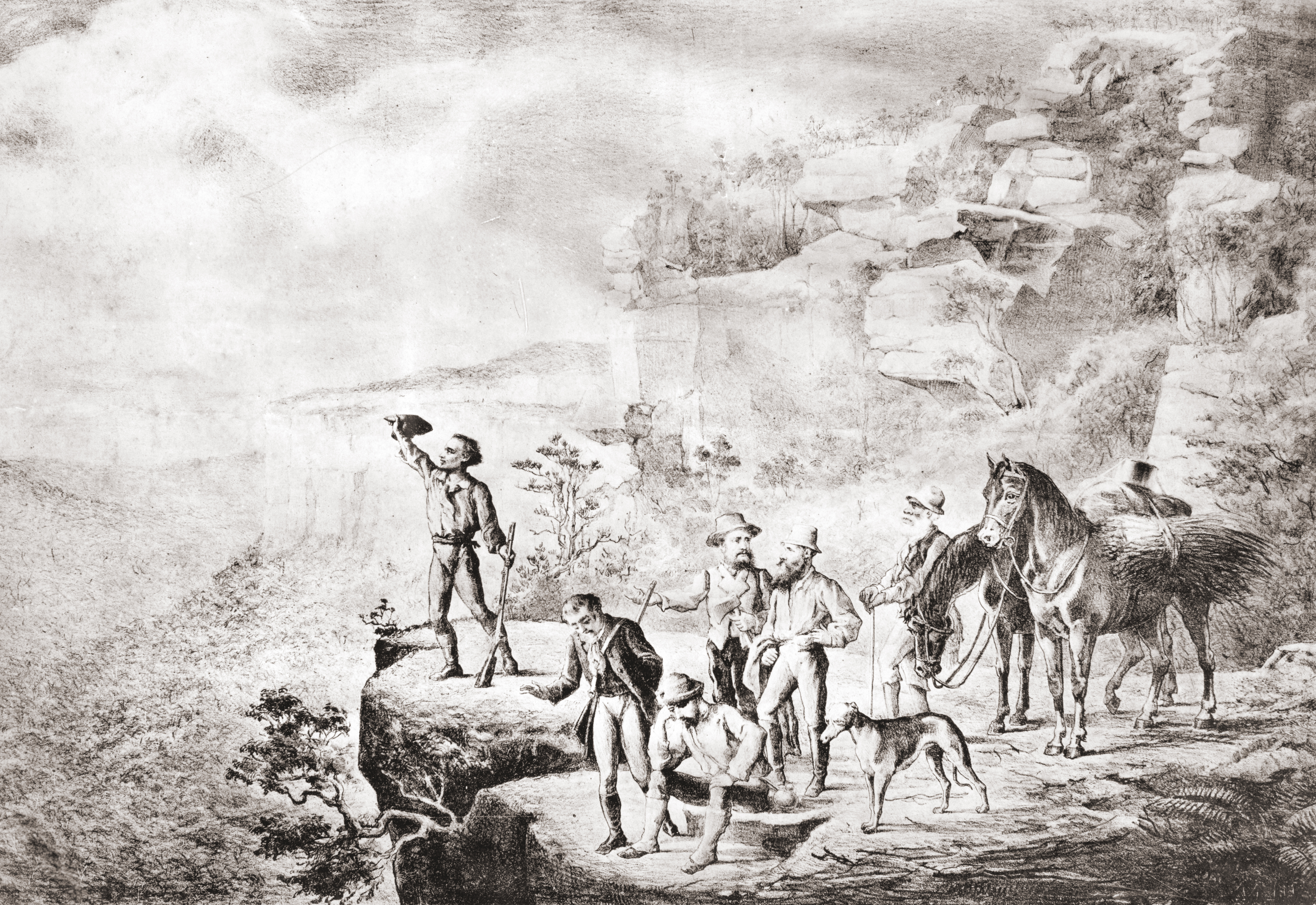
"The Blue Mountain pioneers at the summit of their expedition", lithograph by M. Emile Ulm, Sydney Mail, 1880. Via Wikimedia Commons. Public domain.

Upper Wentworth Falls in the Jamison Valley. The falls and the town are named after him. Photo by Diliff, via Wikimedia Commons, CC BY-SA 3.0.
He didn't sit still for long afterwards. In 1814, Wikipedia says, he joined a sandalwood voyage to the Pacific in the Cumberland. At Rarotonga there was a fight with the locals and five of the crew were killed. Wentworth only got back to the ship with the help of a pistol.
Cambridge, and a poem called 'Australasia'
In 1816 he went back to England to study law. Wikipedia says he attended Magdalene and Peterhouse at Cambridge and was called to the bar in 1822. In 1819 he published A Statistical, Historical, and Political Description of the Colony of New South Wales, which argued for an elected assembly, a free press, trial by jury and free immigration. He also tried to marry Elizabeth Macarthur, John Macarthur's daughter. Wikipedia says it came to nothing after he argued with her father over his convict background and a loan.
In 1823 came Australasia. Wikipedia calls it the first book of verse by a native-born Australian poet. He worked the mountains into it:
"Hail mighty ridge! That from thy azure brow
Survey'st these fertile plains, that stretch below"
Near the end come these lines:
"And Australasia float, with flag unfurl'd,
A new Britannia in another world!"
Wikipedia notes the poem also gives a romanticised picture of Aboriginal life.
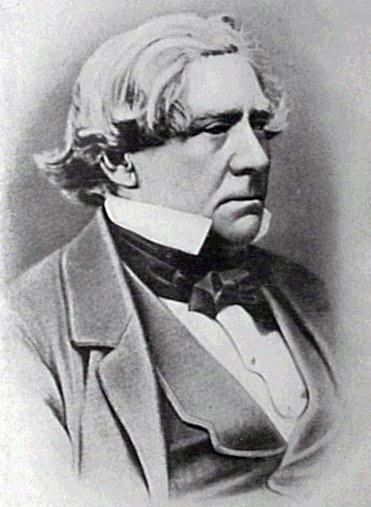
William Charles Wentworth, about 1861. Via Wikimedia Commons. Public domain.
The Australian and a free press
In 1824 Wentworth sailed home with his fellow barrister Robert Wardell, and the two founded The Australian. The Dictionary of Sydney dates the paper to 1824 and names both men as founders. Wikipedia says it was the colony's first privately owned paper, and that once it was running uncensored, Governor Brisbane saw no point in censoring the Sydney Gazette either. It says the paper often clashed with Governor Darling, who tried and failed to have it banned in 1826. Wentworth championed the emancipists against the "exclusives", and he called for trial by jury and "Taxation by Representation".

Front page of The Australian, Thursday 14 October 1824. Via Wikimedia Commons. Public domain.
Vaucluse House and Sarah
D'Arcy died in 1827, and Wikipedia says William inherited a large part of his fortune. The Dictionary of Sydney says that same year he bought the Vaucluse estate, where the convict Henry Browne Hayes had built a cottage in 1805. He enlarged it greatly into the Gothic-style house we know today.
On 26 October 1829, at St Philip's Church, he married Sarah Cox, the daughter of two convicts. He had acted for her in 1825 in a breach of promise case, which Wikipedia says was the first of its kind in Australia. They already had a daughter, Thomasine, named after Governor Sir Thomas Brisbane. The whole family is set out on my Wentworth Family of Vaucluse page.

Vaucluse House, Wentworth Road, Vaucluse. Photo by Bgabel, via Wikimedia Commons, CC BY-SA 3.0.

Vaucluse House in the 1930s. Royal Australian Historical Society, Osborne Collection, via Wikimedia Commons. No known copyright restrictions.

Sarah Wentworth, née Cox, portrait by William Nicholas. Via Wikimedia Commons. Public domain.
Squatter, politician, and the 'bunyip aristocracy'
Wikipedia says that through the 1830s and 1840s he built up huge pastoral holdings across the colony, including Windermere on the Hunter and runs on the Macquarie, Namoi and Murrumbidgee. In 1839 he tried to buy a huge slice of New Zealand's South Island from Ngāi Tahu chiefs, and Governor Gipps stopped the deal. In 1843 he was elected to the Legislative Council for the Town of Sydney. By then he was one of the richest men in the colony, and Wikipedia says his politics had turned conservative. He spoke for the squatters, and Wikipedia says he backed bringing in indentured Chinese labour once transportation ended.
Wikipedia says he pushed through the University of Sydney Act on 24 September 1850 after two attempts, and sat on the first senate. In 1853 he chaired the committee that drafted the colony's new constitution. His draft called for a colonial peerage, and Daniel Deniehy famously mocked it as a "bunyip aristocracy". Wikipedia says the final constitution was made more democratic, although the upper house stayed appointed. The same committee also floated a General Assembly of the Australian colonies, which Wikipedia calls the first official outline of a future Commonwealth.
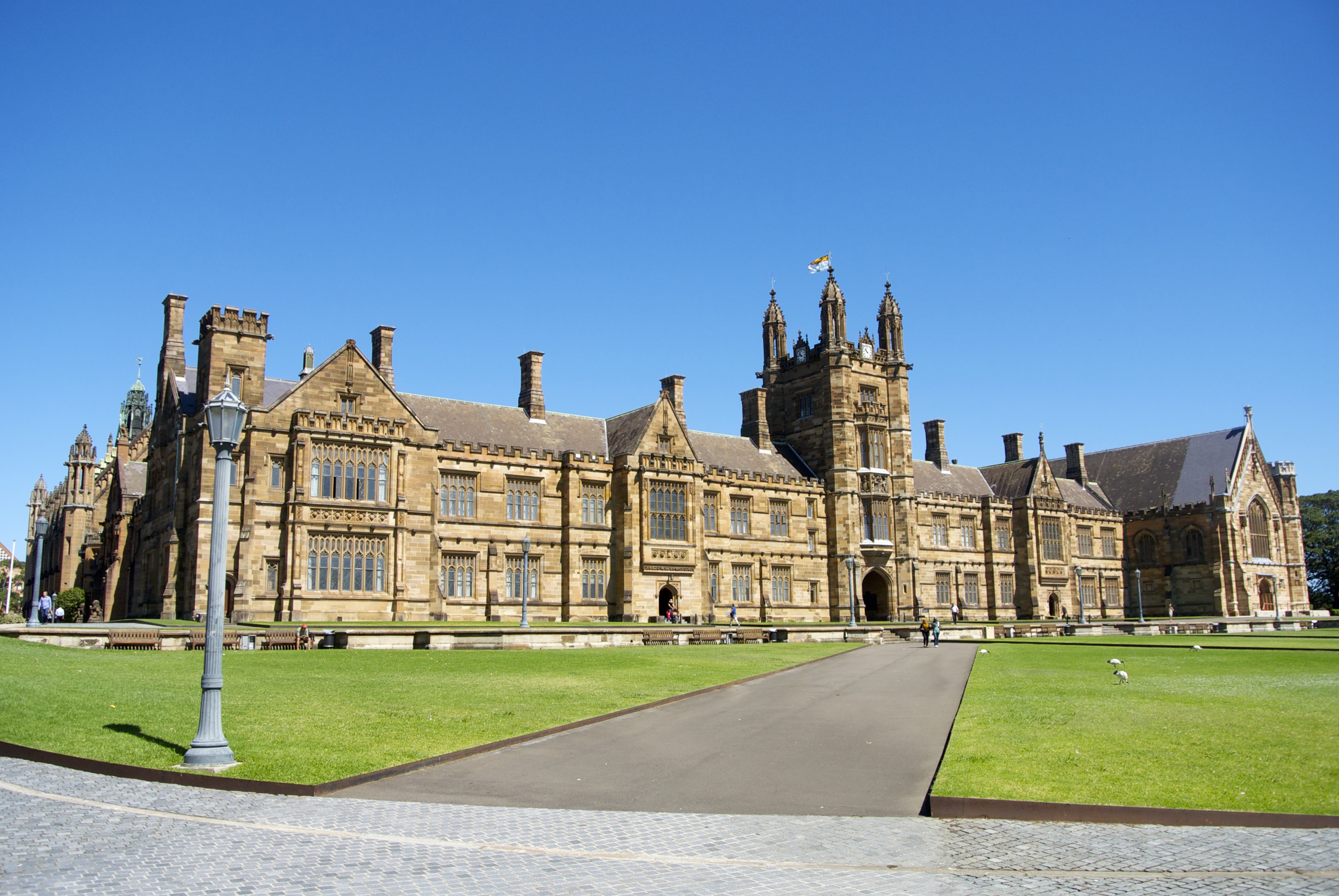
The Main Quadrangle, University of Sydney. Photo by Jason Tong, via Wikimedia Commons, CC BY-SA 3.0.
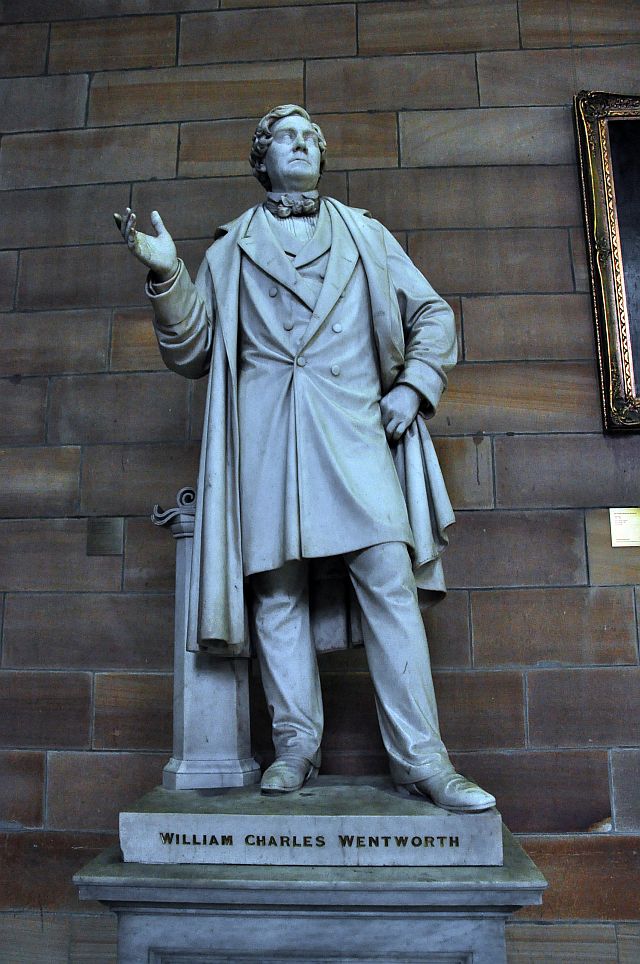
Statue of William Charles Wentworth by Pietro Tenerani of Rome, in the Great Hall, University of Sydney. Photo by Merryjack, via Wikimedia Commons, CC BY-SA 2.0.
England, and the last years
He left for England in March 1854. Wikipedia says his farewell speech at Circular Quay got both cheers and jeers. In London he founded the General Association for the Australian Colonies and turned down a baronetcy. He came back briefly in 1860–61 as President of the Legislative Council, but otherwise lived at Merly House in Dorset.

William Charles Wentworth leaving Sydney in 1854 with his daughter Fanny and her husband John Reeve. Via Wikimedia Commons. Public domain.
Sydney's first state funeral
Wentworth died at Wimborne, Dorset, on 20 March 1872. He had asked to be brought home, and his body was shipped back to Sydney. Dr Lisa Murray's Dictionary of Sydney entry on the funeral says the government voted unanimously for a State funeral, the first in colonial New South Wales. It was held on Tuesday 6 May 1873, and the Governor declared the day a public holiday.
The service was at St Andrew's Cathedral, which was hung with black cloth. The coffin was polished cedar with silver handles, and two of the wreaths on the lid were made from plants native to Vaucluse. Then the cortège wound its way out to the family vault at Vaucluse. Murray describes people perched in trees, on gateposts and on drinking fountains, and legs dangling over shop awnings. The Empire reported that when the head of the procession reached the toll-bar at Rushcutters Bay, the last carriages still hadn't left George Street. It got to Vaucluse at about 2 o'clock, by which time "the patience of the beholders was well-nigh exhausted".
The size of the crowd depends on who you read. Murray, in the Dictionary of Sydney, says between 50,000 and 70,000 Sydneysiders came out to watch. Wikipedia gives a single figure of about 65,000. Wikipedia also says the mausoleum was built over his grave soon after, with his wife Sarah overseeing the work. The Dictionary of Sydney says Sarah commissioned it at her husband's request.

"The Funeral of the Late Mr. W. C. Wentworth at Sydney", wood engraving, 1873. Via Wikimedia Commons. Public domain.

The Wentworth Mausoleum, Chapel Road, Vaucluse. Photo by Collywolly, via Wikimedia Commons, CC BY-SA 4.0.
His name around the place
Wentworth Falls in the mountains, Wentworth Park at Glebe, the federal seat of Wentworth and the Wentworth Building at the uni all carry his name. Wikipedia says Vaucluse House became Australia's first official house museum in 1915, and that a bust of him was unveiled at Coronation Park in Wentworth Falls in 2016. He was a complicated man. He fought for a free press and trial by jury, and as an old squatter he wanted a colonial peerage. On a fine day at Vaucluse, though, you can still see why he wanted to be brought home.

Bust of William Charles Wentworth at Wentworth Falls, unveiled in 2016. Photo by Will Thorpe, via Wikimedia Commons, CC BY 4.0.
Related pages: Gregory Blaxland · William Lawson · Blaxland, Wentworth, Lawson and the Crossing of the Blue Mountains · The Wentworth Family of Vaucluse · Vaucluse House (Historic Sydney Mansions) · Robert Wardell and Petersham · Sir Henry Browne Hayes
Sources
- "Wentworth, William Charles", Dictionary of Sydney, dictionaryofsydney.org/person/wentworth_william_charles (including linked entries for Catherine Crowley, D'Arcy Wentworth, Surprize, The Australian, Vaucluse House and the Wentworth Mausoleum)
- Lisa Murray, "First State funeral", Dictionary of Sydney, 2013, dictionaryofsydney.org/entry/first_state_funeral
- Tony Dawson, "Lawson, William", Dictionary of Sydney, 2012, dictionaryofsydney.org/entry/lawson_william
- "William Wentworth", Wikipedia, en.wikipedia.org/wiki/William_Wentworth
- "1813 crossing of the Blue Mountains", Wikipedia, en.wikipedia.org/wiki/1813_crossing_of_the_Blue_Mountains
- W. C. Wentworth, Journal of an expedition across the Blue Mountains, 11 May – 6 June 1813, State Library of NSW
- Images: Wikimedia Commons, as credited under each picture
No comments:
Post a Comment