
I wrote about Cleveland House in four parts back in 2015 and 2016, so here they all are together in one place, Part 1 through to Part 4, with the rest of the story added at the bottom.

Part 1
Cleveland House – Buckingham Street & Chalmers Street – Surry Hills – Built Around 1823
Cleveland House Is Situated On Part Of Section 408 Of The Parish Of Alexandria, Which Comprised About 12 Acres Of Land Originally Granted To Charles Smith In 1809 And Came To Be Known As Cleveland Gardens.
From The Date Of The Original Grant Until The Cleveland Estate Was Subdivided, The Only Roads Giving Access To Its Boundaries Were Elizabeth Street South And Devonshire Street.


Parts 2, 3 and 4 follow below.
Part 2
Cleveland House – 146–164 Chalmers Street – Surry Hills – NSW
Cleveland House sits at 146–164 Chalmers Street in Surry Hills, though you get the best look at it from Bedford Street. It was built about 1823–24 for Daniel Cooper, the ex-convict merchant, on land once known as Cleveland Gardens, which Governor Macquarie had granted to Charles Smith. Francis Greenway is said to have designed it, but nobody has found his signature on the plans. It's a two-storey stuccoed brick house with a verandah right round it, cedar joinery and cellars underneath. The Coopers only lived there a few years before they separated, and after that it was let out.
From the 1850s the estate around it was cut up as Surry Hills filled in around the railway at Redfern and later Central. Over the years the house and its outbuildings were a school, a boarding house, a laundry, a cordial factory and a bottle yard. From 1903 it was a Good Samaritan convent and refuge, then Franciscan aged care, and from 1958 the NSW Society for Crippled Children had it. Most of the later buildings came down after it was sold in the late 1980s. The house is still privately owned and on the State Heritage Register (no. 00065), and it's spent long stretches empty or waiting on repairs, hemmed in by apartments near Central.
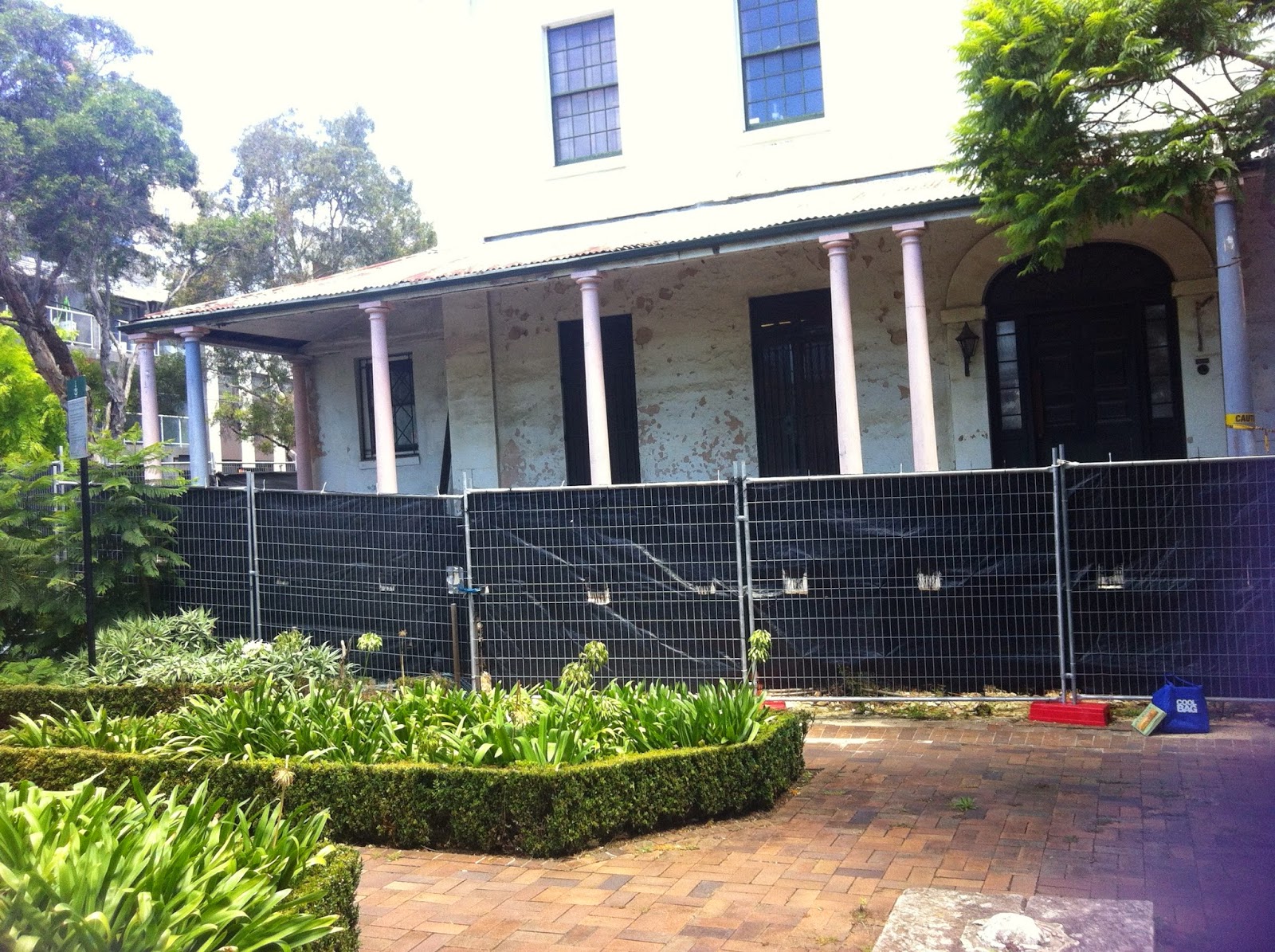
These are my photos of the house and how tight its setting is now.




Part 3
Cleveland House hides at the back of its block on 146–164 Chalmers Street, Surry Hills, and you read it best from Bedford Street — a stuccoed two-storey Georgian villa that once looked over about twelve acres of Cleveland Paddocks toward the harbour. It went up in 1823–24 for emancipist merchant Daniel Cooper and his wife Hannah Dodd, both former convicts who had done rather well. The house is believed to be the work of Francis Greenway, and it is one of the few private residences still standing that can carry that claim.
The State Heritage Register (no. 00065, gazetted 2 April 1999) calls it a rare surviving gentlemen’s residence of the 1820s. After Cooper’s death in 1853 the estate was cut to pieces as Surry Hills urbanised; railways and Redfern Terminus ate the paddocks; later lives included hospital, convent and aged care. Until 1991 it had been continuously inhabited. The verandah, cedar stair and basement are the bits to look for in this photo set.


Part 4 – Two Years Later
February 2016 — back to Cleveland House on the Chalmers / Bedford Street corner of Surry Hills, two years on from earlier visits on this blog. Same stuccoed Georgian villa that once looked over Cleveland Paddocks: built 1823–24 for emancipist merchant Daniel Cooper, long attributed to Francis Greenway, and one of the rare 1820s gentlemen’s residences still standing in the inner south (SHR 00065).
This time I walked round to see how it was holding up. The verandah, the block at the rear of Chalmers Street, the sense of a paddock estate swallowed by railways and terraces — that’s what the photographs are for. For the Cooper / Greenway chronology and the longer heritage note, see Cleveland House – Part 3.


The Rest of the Story
A Convict Who Made His Fortune
The man who built Cleveland House started out about as low as you could go in the colony. The Australian Dictionary of Biography says Daniel Cooper was born at Bolton in Lancashire around 1785, was convicted of stealing at Chester in 1815 and got transportation for life. He landed in Sydney in January 1816. Two years later he had a conditional pardon, and by 1821 an absolute one.
On 6 January 1819 he married Hannah Dodd at St Philip's. She'd been sentenced at Chester too, to fourteen years, and the ADB notes that both of them put themselves down as widowed. Cooper ran a store in George Street, held the licence of the pub next door from 1818 to 1822, and opened the Australian Brewery in 1824.
The big money came through the Waterloo Company. Cooper became a partner in Hutchinson, Terry & Co. in 1821, and by 1825 he and Solomon Levey owned the lot. As Cooper & Levey they milled flour, issued their own bank notes, sent ships to Van Diemen's Land, New Zealand, India and Mauritius, went whaling and sealing, and helped pioneer the shipping of Australian wool to England. They also bought Captain John Piper's estate, more than 1100 acres at Woollahra and Rose Bay. The State Library says their Waterloo Warehouse in George Street was described as "one stupendous mass of elegance, convenience and durability".
So when Cooper put £4,000 into a gentleman's house on the hill above the Devonshire Street burial ground, as the State Heritage Register puts it, he was building it as one of the richest men in Sydney, and an ex-convict to boot.
Charles Smith's Garden
The land had a story before Cooper got it. The Dictionary of Sydney says Charles Smith was a convict who came out on the Scarborough in 1790, and that his grant between the Devonshire burial ground and Surry Hills, known as Cleaveland Gardens, became a nursery and market garden. The State Heritage Register says Governor Macquarie granted it to him in 1809.
The Dictionary of Sydney also says Cleveland Street took its name from Cooper's house. Back then Surry Hills was still sand, scrub and swamp on the town's southern edge, and the gentry who built out there liked the breezes and the views.

Was It Really Greenway?
Francis Greenway's name has been tied to Cleveland House for a long time, but nobody has turned up a signed plan. The State Heritage Register only goes as far as "believed to be the work of" Greenway, and Wikipedia's list of his buildings marks Cleveland House "contribution uncertain".
The timing fits, though. Greenway was a forger transported in 1814. Macquarie gave him the Macquarie Lighthouse, Hyde Park Barracks and St James' Church, then Governor Brisbane dismissed him in 1822, the year before Cleveland House went up. So he was out on his own looking for private work.

The House Itself
The heritage listing describes a two-storey stuccoed house of brick on stone foundations, in the Colonial Georgian style. A verandah on stone pillars ran right round all four sides. When it was described in 1886 it had ten large rooms, six of them bedrooms, four big cellars underneath, and two staircases, one of them an outside stone stair. Out the back the outbuildings made an inner and an outer courtyard.
The roof was slate in 1840 and 1886, but a 1902 report called it a "very old iron roof", and said the verandahs were in very poor repair. When the National Trust listed the house in 1973, the Sydney Morning Herald says, it was called an excellent example of colonial Georgian domestic architecture, with two "curious entrance doors", a "splendid exterior staircase" and plenty of cedar joinery.


The Railway Comes Next Door
What really changed the neighbourhood was the railway. The NSW State Archives description of the old station says the first Sydney terminal opened in September 1855 on the Cleveland Paddock, between Devonshire and Cleveland streets. Everyone called it Redfern Station, and it was a single 30-metre wooden platform in a corrugated-iron shed. That's the same year the Cleveland Estate went under the hammer, as you can see in the 1855 Herald advertisement in Part 3.
.jpg)
.jpg)
Just to the north was the Devonshire Street Cemetery. The Dictionary of Sydney says it opened in 1820, closed in 1867 and was resumed in 1901 so Central Station could be built on it. That's why the Sandhills and Devonshire Street cemeteries keep popping up in my labels for this house.

.jpg)
.jpg)
Nuns, Bottles and Crippled Children
From the mid-1870s Barrett's cordial factory worked out of the old outbuildings, and in 1896 the business went to Peach and Jones, bottle merchants. In 1903 the Sisters of the Good Samaritan bought the place. The nuns lived in the house and in 1904 opened a four-storey refuge and a commercial laundry beside it. By the late 1920s the refuge had become a home for aged and infirm women.
The Franciscan Missionaries of Mary carried that on from 1946. Then in 1958 the NSW Society for Crippled Children bought it and used the old refuge as a hospital and clinic. After the 1988 sale everything but the house itself came down, and the Heritage Register says Cleveland House had been lived in continuously right up to 1991.

Cleveland_House-E.jpg)
Stuck in Limbo
Anyone who walks past knows the house has been fenced off and under tarps for years, and my own photos in Parts 2 and 4 show it. In July 2025 the Sydney Morning Herald called it Sydney's oldest colonial home and said neighbours reckoned it was "dying before their eyes". The paper named the owner as Brian Vincent of LGS Enterprises, and said he'd bought it in 1988.
According to the Herald, the City of Sydney put a stop-work order on the site in August 2023 after work started on a verandah awning without consent. The owner's own website puts it down to a complaint about roof repairs that Heritage NSW had already approved. Both agree the house got a $30,000 heritage grant for the re-roofing in the 2023–25 round.
The owner's site says that in August 2025 the stop-work order was lifted, but the grant was terminated and the house was made ineligible for future grants. In March 2026 Heritage NSW refused an application to strip the external render. The latest news there, from May 2026, is that a DA for a new toilet block has been approved. That would let the 1940s toilet block come off the back of the house and the courtyard verandah go back the way the owner says Greenway meant it. Two hundred years on, it's still waiting for someone to look after it properly.


Timeline
- 1790 – Convict Charles Smith arrives on the Scarborough (Dictionary of Sydney).
- 1809 – Macquarie grants Smith the land known as Cleaveland Gardens (State Heritage Register).
- 1815 – Daniel Cooper convicted at Chester and transported for life.
- January 1816 – Cooper arrives in Sydney.
- 6 January 1819 – Cooper marries Hannah Dodd at St Philip's.
- 1821 – Cooper's absolute pardon, and partnership in the Waterloo Company.
- 1822 – Governor Brisbane dismisses Francis Greenway.
- About 1823–24 – Cleveland House built for Cooper, for about £4,000.
- 1825 – The Coopers move in.
- 1829 – Cooper separates from Hannah and the house is let.
- October 1831 – Cooper sails for England.
- June 1836 – Hannah Cooper dies.
- 3 November 1853 – Daniel Cooper dies at Brighton, England.
- 1855 – Estate subdivided into eight sections; the first Sydney railway terminal opens on the Cleveland Paddock.
- 1860 – Montague Levey inherits the house from Isaac Levey.
- Mid-1870s – Barrett's cordial factory in the outbuildings.
- 1896 – Sold to Peach and Jones, bottle merchants.
- 1903–04 – Sisters of the Good Samaritan buy the site and open their refuge and laundry.
- 1946 – Franciscan Missionaries of Mary take over.
- 1958 – NSW Society for Crippled Children buys the property.
- 1973 – Listed by the National Trust.
- 1988 – Sold, and every building except the house demolished.
- 1991 – End of continuous habitation.
- 2 April 1999 – Listed on the State Heritage Register (no. 00065).
- August 2023 – City of Sydney stop-work order.
- August 2025 – Stop-work order lifted and heritage grant terminated (owner's website).
- May 2026 – New toilet block DA approved (owner's website).
Where the Sources Disagree
- How much land. The State Heritage Register says Cooper's house went up on about twelve acres granted to Charles Smith, and that the estate came to around thirteen acres when it was sold. The Dictionary of Sydney gives Smith's grant as 10 acres and says Cooper bought 19 acres from him.
- Oldest or just rare? The Heritage Register's statement of significance calls it "a rare surviving gentlemen's residence of the 1820s", but its criteria call it "the oldest surviving residence in Sydney". The Herald calls it "Sydney's oldest colonial residence". Plenty of older buildings survive around Sydney and Parramatta, so the claim depends on how you count.
- Greenway. The Heritage Register says the house is "believed to be" Greenway's work, Wikipedia lists his contribution as "uncertain", and the owner's website talks about the courtyard verandah "as originally intended by Francis Greenway".
- Who bought it in 1988. The Heritage Register says it was sold to Denerin Pty Ltd in 1988 and is now owned by LGS Enterprise. The Herald says Brian Vincent of LGS Enterprises bought it in 1988.
- Why the work stopped. The City of Sydney told the Herald the stop-work order followed verandah awning work done without consent. The owner says it came from a public complaint about approved roof repairs.
My Earlier Posts
- Central Station – From Cemetery to Train Station
- The Sandhills Cemetery – Devonshire Street Cemetery – Cnr Eddy Ave & Elizabeth St, Opposite Foveaux St
- Francis Greenway's Residence – George Street, Cnr Argyle Street – The Rocks – Sydney
- Frog Hollow – Albion St & Riley St – Surry Hills
- Kate Leigh & Tilly Devine – Sydney's Razor Gang Queens
- Woollahra House (Cooper mansion) – Point Piper
- Durham Hall – 207 Albion Street – Surry Hills
- Carlingford Terrace – Albion Street – Surry Hills
Sources
- Heritage NSW, State Heritage Register, "Cleveland House", SHR 00065: apps.environment.nsw.gov.au (listing text reproduced at Wikipedia, Cleveland House, Surry Hills, CC BY 4.0), drawing on R. Annable, Cleaveland House: An Archaeological Assessment, 1991.
- J. W. Davidson, "Cooper, Daniel (1785–1853)", Australian Dictionary of Biography: adb.anu.edu.au
- Garry Wotherspoon and Chris Keating, "Surry Hills", Dictionary of Sydney, 2009: dictionaryofsydney.org
- State Library of NSW, "Promissory note: Waterloo Warehouse, c.1830", On Sale! exhibition, 2011: sl.nsw.gov.au
- "Francis Greenway", Wikipedia: en.wikipedia.org
- Josefine Ganko and Julie Power, "Why Sydney's oldest home has been stuck in a long limbo", Sydney Morning Herald, 4 July 2025: smh.com.au
- Cleveland House owner's website, News: clevelandhouse.com.au/news and DA Proposals: clevelandhouse.com.au/proposals
- NSW State Archives and Records description of the first Sydney terminal, on Wikimedia Commons: commons.wikimedia.org
- Pictures: Wikimedia Commons, credited under each image.