
- Sydney Past & Present - - The City Of Sydney - - The Stories Of Its Growth -
________________________________________________________________________________________________________________________________________________________________________________________________________________________________________________________________________________________________________________
Chapter X.
In The Forties.
In 1842 Sydney was formed into a municipality, and the first election of councillors, aldermen, etc., took place on November 1 in that year. The house used for the meetings of the new Town Council was one built by Mr. Commissary Broughton, about the year 1813, on the site of a row of soldiers’ huts known by the expressive name of the “Rookery.” The building, often referred to in these papers, was afterwards the residence of the first Colonial Secretary, Major Goulburn; then it was occupied by Mr. Sydney Stephen; then it became a hotel, was called the “Pulteney,” and was kept by a Mr. Levien. It is now known as “Richmond House,” already mentioned as a boarding establishment, and as being the first quarters of the Australian Club. But the Town Council in those days was of an eminently migratory character. At one time it held its meetings in York-street, near where the old Masonic Hall now stands; thence it wandered to the Oxford Hotel, in King street; then we find it in a house on the site of the Imperial Hotel, in Wynyard Square, resting, finally, in a building on the opposite side, whence in, 1879, it removed to its present quarters. Alderman John Hoskins was the first Mayor, and Mr. John Rae the first Town Clerk, appointed in 1843. This gentleman afterwards became well known as Under-Secretary for Public Works and Commissioner for Railways. The Corporation managed to scrape along in some sort of fashion for eleven years; but, in 1854, it got into an even worse muddle than our late City Fathers did, and the Government found it necessary to place the affairs of the city in the hands of commissioners, who levied rates, and paid off the overdraft. They were three in number. Mr. Rae was the junior, his colleagues being Messrs. Gilbert Eliott, and Frederick Orme Darnall. In 1857 the council again became an institution, with what measure of success was well disclosed by the happenings of 1901.
In the latter forties a visitor to Sydney remarks: “The town councillors will do well to follow the more decorous example set by their seniors in the mother country, and it is to be hoped that, hereafter, they will not be quite so personal in their observations to each other as some of them were last year; such were then the proceedings that people actually compared the Town Hall to a bear garden.”
So we see that even over half a century ago our City Council was doing its best to live up to the reputation it has until quite recently done its very best to maintain.
Although Governor Gipps had not as yet taken full possession of his grand new house, still, in May 24, 1843, he opened a portion of it, including the ball-room, and gave a fine entertainment in that apartment in honor of her Majesty’s Birthday. Says an old writer enthusiastically of the new structure:—“May the solidity, the splendor, and elegance of this Vice-royal mansion be an emblem of Australia’s future history… Separated as we are by continents and oceans from our fatherland we have yet the pride of the British-born to rear in their land such buildings as their sons may be proud to contemplate; structures so firm and enduring that the storm may shake, but cannot destroy.”
The cost, when completed, was, it is said, well into £50,000, although the first estimate was only for half that sum. The stables are ornate to a degree, and have time and again been mistaken for the residential portion of the house—indeed, an English magazine once illustrated them as “a view of the seat of Government in New South Wales.”
At this first ball, just mentioned, it rained in torrents during the evening and night, and, as at that period the sheltering porch in front of the house had not been built, the approach became a regular bog; the ladies got their dresses soiled, and in the morning dozens of boots and shoes were seen sticking in the mud. Not until 1845 was the building finally occupied as a home by the Governor.
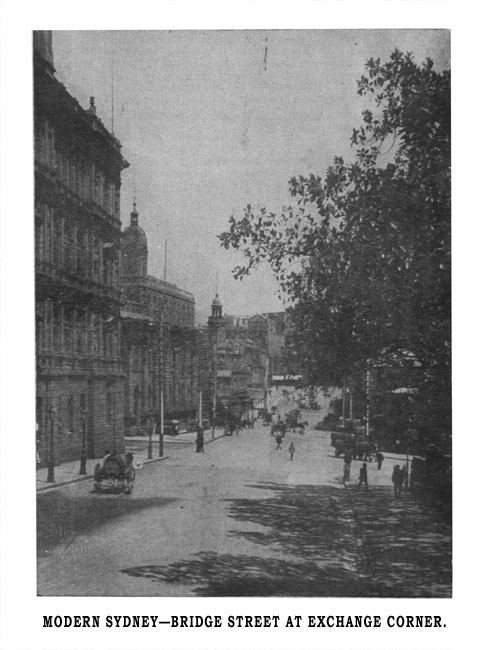
Just a few words about the often debated matter of these different Government Houses and their sites. We have long ago described Phillip’s portable canvas house, originally built in England by one Smith, of St. George’s Fields, under the personal direction of the Governor, and at a cost of £125. Supposing that it counted as the first Government House, temporary though it was, its position, judging from Hunter’s well-known picture, must have been somewhere close to the place where the copper plate was recently found embedded in old foundation-stones at a depth of 3ft 6in., under the pavement at the corner of Phillip and Bridge streets. And where the discovery was made is undoubtedly the exact site of the second and permanently built Government House, and probably the first building in Australia to be made of bricks and stones. Says Collins: “There having been found among the convicts a person qualified to conduct the business of a brickmaker, a gang of labourers was put under his direction… Another gang of labourers was put under the direction of a stonemason, and on the 15th (May, 1788) the first stone of a building intended for the residence of the Governor until the Government House could be erected was laid on the east side of the Cove.”
The projected building spoken of above was to have been on Church Hill, and, as nearly as can be gathered, on the ground where Petty’s Hotel now stands.
To return to the Bridge-street Government House, or number two, if we count it the next. It first contained only three rooms, but was subsequently enlarged to six. It was of one storey, and, although mention is made of a set of stairs, it is uncertain where they led to—perhaps to a loft or an attic. Contemporary pictures of the place show a wretched looking sort of a hut, with a “hip” roof, a door flanked by two windows of unequal size and a chimney at one end. And yet they called it “elegant,” which, perhaps, compared with its surroundings, it really was. However, it only lasted ten years, and then, finding his home threatened at any moment to fall and bury him in its ruins, Governor Hunter, in 1799, pulled it down and rebuilt it a little further along Bridge-street. This, number three, contained a drawing-room 50ft by 18ft, a dining-room 30ft by 18ft 6in, and a parlor 20ft by 16ft 6in. The rooms were 9ft, 11ft, and 7ft in height. And this edifice, transformed by Macquarie into a comfortable sort of country house with deep verandahs, serviced Vice-royalty as a home until the present building in the Domain was occupied by Governor Gipps. Thus it may be fairly said that there were, in all, four Government Houses; and it is thought that in the preceding brief account several vexed questions as to their sites, etc., have been correctly settled.
Some details of our city in these early forties will be of interest to the present generation as well as to the gradually dwindling remnant who can let their recollections carry back to the days of their youth and reconstruct the scenes among which those days were spent
Around the Cove itself the changes have been slighter since we last took a glance at it than in other parts of the town, and the new Government House dominates the landscape, standing out big and white above the surrounding trees; the Commissariat Stores still usurp the site of the Sailor’s Home and the Mariner’s Church; ships still lie off from the shore, and are approached by heavy stages forty or fifty in length. Circular Quay being yet in embryo, and all the work of reclamation only just thought of again. At the foot of George-street is a flight of steps where watermen ply for hire. Looking across to North Shore, scarcely anything but a dense mass of thick forest met the eye—eucalypti and banksia—practically unchanged since that day in 1789 when poor Francis Hill, the midshipman of the Sirius, landed at Milson’s Point, and was lost in trying to get through the scrub to his ship, then hove down in Careening Cove. Nor, despite many days of search, was he ever heard of again.
From the Cove “up town” there were still plenty of open spaces. A Mr. James Underwood owned a big slice of land extending from the “Herald” office right to the water’s edge. And on this grant he built not only houses known as “Underwood’s Buildings,” but also, in 1801, that first Australian ship, the “King George,” before referred to in the course of this book. Probably she was put together somewhere about the site of the present Paragon Hotel. The gaol was still in George-street, and the gallows stood on a hill at the back of it, where now is Princes-street.

The military barracks filled Wynyard Square, in the very heart of the town. The main building faced the east, and extended along York-street, from Margaret-street to Barrack-street. The officers’ quarters were in separate houses at each end. For some hundreds of yards a high wall shut off the barracks from George-street. Out on a sandhill, where Paddington is now, new barracks were in course of erection, having for outlook a dreary expanse of swamp and tea-tree scrub.
Between Hamilton and Pitt-streets there were no buildings at all, and standing on the banks of the Tank Stream you could see across to the back premises of the houses in George-street. In Bridge-street, on the site of the premises until lately occupied by the Union Steamship Company, was a big lumber-yard, and in one of these detached houses, which stood rather back from the street, once resided the Chief Justice, Sir Francis Forbes; and then for many years it gave accommodation for business matters connected with the Survey Department. Fine trees grew in front of the houses, which, with the buildings they beautified, have long since disappeared—the former before the axe of the Vandals who in turn have ruled our city; the latter to make room for some modern edifices.
The Government Printing Office consisted of some old wooden buildings in Bent-street; and close to these, too, were the structures used as an Emigration Depot. The emigrants, however, when the prisoners were shifted from Hyde Park Barracks, took possession of that place. In those days the building so well-known to us as Fort-street Model School was the Military Hospital. Opposite the main entrance to the Military Barracks in George-street was an old-fashioned massive stone house, “standing at a distance from the public road, and contained within railings.” This was the second bank of New South Wales, and its garden bordered the Tank Stream. Then, a little further to the south, stood the old General Post Office.
George-street was, of course, the great main artery, as it is to-day, and it extended from Dawes Point, the northern extremity of the city, to the old toll-bar, opposite the Benevolent Asylum, at the southern end, a distance of about two miles. Then for another mile it went under the name of Parramatta-street, connecting “the extensive and popular suburbs of Chippendale and Redfern with the city, and forming a grand approach from the southern and western districts.” Says good old Fowles, writing later on: “The newcomer cannot fail to be surprised with the bustle and animation that pervades this street (George) —numberless omnibusses in constant motion, hackney carriages, coaches, gigs, waggons, and every description of vehicle, from the humble ‘shay-cart’ to the regular four-in hand, passing and re-passing; with now and then a big bullock dray laden with wool or other produce, and drawn by eight or ten immense bullocks, wending its devious way to the merchants’ stores, gives character to the scene, and stamps it colonial.”

Hyde Park was still more generally known as the Racecourse, and was simply “a healthy, open common, fenced off in four different departments.” Lyon’s Terrace stood on the south side of the Park, and was considered the residential “plum” of the city. There were six houses in it; and among the early occupants at different intervals were General Wynyard, the Colonial Treasurer, C. D. Riddle, J. Thacker, W. H. Hart (manager of the Bank of Australia), Chief Justice Stephen, and A. W. Young (the Sheriff of the colony). The rent of these select and fashionable residences was from £280 to £400 per annum. At the corner of Elizabeth Street was a large house occupied by Mr. Prosper de Mestre, part owner of a whaler, the Cape Packet, and mentioned by Lang as “a highly respectable merchant of American origin, who has long settled in Sydney.”
On the east side of the park stood the Sydney College, nearly alone and now flourishing under its first head master, Mr. T. Cape. Near Governor Bourke’s statue stood the ugly School of Industry, and at the corner of King-street, the now vanished St. James parsonage. Crown-street boasted of some four or five houses only. Redfern was practically unknown till some years later, as a residential suburb, when Fowles speaks of it as “extensive and populous.” Macdonaldtown and the present “up the line” suburbs were, of course, undreamt of, although a Mr. Chisholm had a house in the neighbourhood of the former place, standing on land long since resumed by the Government for railway purposes; afterwards, it was occupied as a school by Dr. Sly. Oxford-street, more generally known as New South Head road, was still the favorite drive with many of the citizens, but there were no houses along it. The new court house at Darlinghurst was still unfinished, although one wing was utilised as a Museum, with Mr. Wall as curator; and in this most unsuitable place a gradually increasing collection of fine and valuable specimens remained until 1849, when they were removed to the present building, designed by the Colonial Architect (Mr. M. W. Lewis). But from beginning to end the contract appears to have been muddled, money wasted, and such a scandal incurred as caused the retirement of the Colonial Architect from his office.
And at Waverley there was only one house—a lofty, conspicuous building—but by whom occupied contemporary history is silent; although in recent years it did duty as a Roman Catholic school. Messrs. R. Cooper, T. Cape, F. Hely, and several other prominent citizens lived in the neighbourhood of the Glenmore-road. Paddington, Woollahra, Waverley, and Randwick were still in “the womb of futurity.” The Edgecliffe-road and its fellows of the present were so many rude and scarcely defined tracks, nameless, and formed by cattle and by wood-carters among the scrubby areas, interspersed with patches of rock and sand—worthless then, almost invaluable now. At Double Bay a solitary fisherman had built himself a hut; whilst under a projecting shelf of flat rock on the eastern side two old soldiers had taken up their quarters. They were known simply by the nicknames of “Albuera” and “Waterloo.” William-street was a sandy dray-track; and a little creek where the Asylum for the Blind now stands was spanned by a couple of decayed rails, off which unwary foot passengers now and again plumped into the water. Dr. Polding, the R.C. bishop, lived in a large house standing alone on the open stretch of ground between William-street and the head of Woolloomooloo Bay. But, gradually, as we have seen, the rich city folk were being enticed to make their homes around the foreshores of these bays, and already many fine mansions standing in extensive grounds dotted the high lands of this portion of the harbour. But so dense was the scrub, particularly about Elizabeth and Rushcutter’s, that much clearing was necessary before one of these old-time homes and its surroundings was completed.
Returning to the neighbourhood of the Cove, it may be of interest to some of the people who daily pass the Obelisk in Macquarie Place to reproduce the inscription it bears as it stands there forlorn and solitary in that most squalid and dirty patch of old Sydney, surrounded by rags, torn newspapers, decaying leaves, garbage, and refuse of all descriptions; an ancient but none the less eloquent protest against the ineptitude of these under whose care the historic space should by rights flourish in turf and blossom.
The inscription runs:—
(ON THE SOUTH SIDE.)
“This Obelisk
was erected
in Macquarie Place,
A.D. 1818,
to record that all the
Public Roads
Leading to the Interior
of the Colony
are measured from it.”
Governor L. Macquarie, Esq.
(ON THE NORTH SIDE.)
“Principal Roads.
Distance, Sydney to Bathurst,
187m.
Sydney to Windsor,
35½m.
Sydney to Parramatta. 15½m.
Sydney to Liverpool, 20m.
To Macquarie Tower at South
Head, 7m.
14 m.
The first mile stone is still to be seen at the corner of Liverpool and George streets, and the second a little way beyond the Newtown-road by the side of the University Grounds. The Obelisk is said to have been erected by one, Edward Cureton, a free man, and to have cost about £45.
Reference has, in the course of these papers, been often made to the site of what is commonly accepted as the original Bank of New South Wales—the one in front of the Barracks in George-street, and close to the General Post Office. But few people, even among the earlier historians, appear to know quite where the first bank stood, long before its quarters were removed to the old-fashioned George-street cottage, with its curious arched windows, garden, and orchard, and hut for the night-watchman, who with slug-loaded blunderbuss lay in wait for illegal exploiters of the bank’s treasure.
Through the kindness of the Hon. Reginald Black, M.L.C., the writer has been enabled to identify the house in which, on April 8, 1817, the young institution began its long and successful career. At the corner of Pitt-street and Macquarie Place stand the offices of the North Queensland Insurance Company, and next to them, partly hidden by a fruiterer’s shop and a tobacconist’s, rises an old weatherworn building, and in this, known afterwards as the Star Hotel, the present great corporation began its operations. Unless one knows just where to look for it, the house is hardly distinguishable, so hemmed in is it by others.
In those days there was a well in Macquarie Place where when, as it often did in a dry season, the Tank Stream failed, the bank officials had to go for their water. “Busby’s Bore” was not yet in existence; but, later on, it for many years was, as already mentioned, the sole water supply of the city. The “bore” was, in reality, an aqueduct of over two miles in length, cut from the Lachlan swamp, near Botany. The channel was 5ft deep and 5ft wide, having its terminus in Hyde Park, whither folks used to go and fetch the water in tubs, buckets, carts,—any thing; and the supply was intermittent, giving out when least expected. In course of time water was laid on through pipes to many houses; but it came through very slowly, and to fill a bath often took three hours—when people indulged in a home luxury of the kind. Throughout the city there were, at this time, wells of varying depth. The one in particular in Macquarie Place was declared to be “very sweet;” and there was another just opposite the old Club House in Bent-street, the water of which was held in high repute.
In this particular chapter, dealing, as it does, so largely with the old topography of our city, it must be remembered that although every possible effort has been made to confirm and verify the statements contained therein, such a question as the absolute position of a long-departed landmark must, in many cases, be a matter far from reducible to the dimensions of an exact science and, therefore, a certain amount of approximate correctness must be allowed in such matters And it is curious how, in this respect, the old chronicles and records do themselves differ, in some instances even no two being agreed upon matters of position, custom, or fashion, that we who are interested in such things deem of much moment. Nor, when one comes to think of it is this so very surprising. Take, for instance, our ever changing city of to-day, and it will not be difficult to find three average men who will in nowise be able to agree as to the shape, use, and exact position of a building which they had passed every day of their lives for many years, then had as it were suddenly missed, and found its place taken by a stranger. And so with many other matters that will be of interest to our dependents but which no man among us considers worthy of note at the present.
________________________________________________________________________________________________________________________________________________________________________________________________



_John_Sharkey_(9832048144).jpg)
.jpg)
.jpg)


.jpg)
.jpg)
_(4067550752).jpg)
_(4066794093).jpg)


.jpg)
.jpg)