Search This Blog

Sunday, October 11, 2026

Sydney Past & Present - The City Of Sydney - The Stories Of Its Growth - Chapter 8 - The Later Thirties


- Sydney Past & Present -
- The City Of Sydney -
- The Stories Of Its Growth - 


________________________________________________________________________________________________________________________________________________________________________________________________________________________________________________________________________________________________________________________


Chapter VIII.
The Later Thirties.

In the thirties there was as yet no street connecting Sydney Cove with Darling Harbor. And this fact led to the making of the Argyle Cut. “The Rocks” at this time was looked upon as a rising suburb, and Miller’s Point had become quite fashionable. Fears were on that account expressed that such an enterprise as cutting through the dividing ridge would harm the locality by introducing an undesirable class of residents. But those people whose interests lay around the shores of Darling Harbour (late Cockle Bay) persevered, and agitated a long time for either a tunnel or a cut. The Surveyor-General reported upon it, and there was as much discussion and argument about the affair as there is to-day respecting the North Shore Bridge. Finally the cut plan was adopted, the estimate for that being only £895, as against £7000 for a tunnel. Prisoners were lent by the Government, and the job was to be finished in twenty-one months from the beginning of October, 1832. Later on, the contractors made an offer to build an arch to carry a roadway over the whole affair for an extra £1500. But funds had run out; and nothing was done for a long time other than to throw a little bridge across the excavation. There seems to have been about sixteen or seventeen promoters to the affair, with a capital of some £2000. Intermittently, gangs of convicts toiled and sweated at elaborating the rude gorge left by the original contractors, until, when transportation ceased, they were withdrawn to make way for free labour.

In 1838, an old writer says: “Between the north end of Kent-street, and where it crosses to Church Hill, a deep cut has been made through the west side of the hill on which Fort Phillip stands, this part being called “The Quarries.” At the southern extremity of the street several cottages and substantial dwelling-houses have been erected, most of them having small gardens attached, together with a beautifully diversified landscape view of the water and shores of Darling Harbor.”
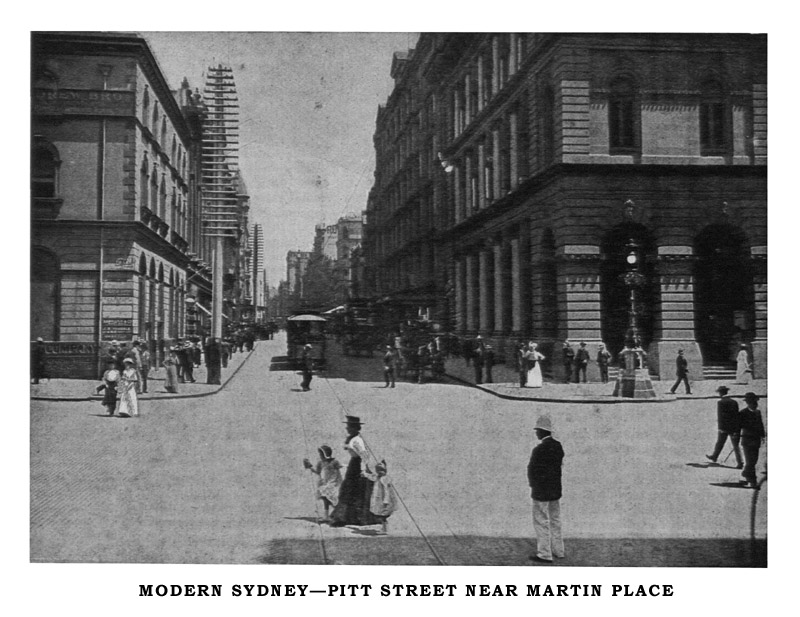
Gradually, however, the place fell into disrepute, haunted as it was by gangs of thieves, and worse characters still, whose depredations made it unsafe both by day and by night. Indeed, in our own time there are lots of folk who would rather, if possible, avoid taking a walk through the Argyle Cut towards the small hours; so difficult is it to live down a bad reputation acquired in early life. There are people living now who well remember the first bridge, a ramshackle, ricketty affair. But the second was looked upon as a very fine piece of work indeed; it was lit by a big kerosene lamp for the guidance of late wayfarers across the chasm. Before the whole work was finished it must have cost something like £30,000, including the three present massive bridges—worthy specimens of old-time masonry that will, unless the resumption scheme destroys them, last for many generations yet to come.

Just a word as to how Sydney folk amused themselves out of doors since we last glanced at them taking their scant pleasures sadly enough. Some authorities, notably Lang, as we have seen, alluded to the racing and drinking propensities of the people in Brisbane’s time, making mention, too, of not a little gambling in out-of-the-way corners. Probably, even then, there were “two-up” schools in sequestered nooks, and our grandfathers, as likely as not, were proficient at the old-time equivalent for “heading ‘em.”

But as far back as 1810 we have records that they indulged in wilder species of recreation than these. In that year, for instance, at Parramatta there was what we should now call a “carnival,” the principal attractions of a two days’ sport being cock-fighting and bull-baiting. They hunted, too, and the description of the first run is worth reading: “Having cast off by the Government hut on the Nepean, and drawn the cover around there for a native dog unsuccessfully, we tried the forest ground for a kangaroo, which we soon found. It went off in excellent style along the sands by the river side, and crossed the cow-pasture plains (Camden), running a circle of about two miles, then recrossed, taking a direction for Mr. Campbell’s stock-yard, and thence to the back of the Badge Allen Hill to the head of the Boonobohen Creek, where he was headed. Thence he took the main range of the hills between Badge Allen and Badge Allenbingiee in a straight direction for Mr. Throsby’s farm where the hounds ran into him, and he was killed after a grand run of about two hours. The weight of the animal was upwards of 120lbs.”

Evidently an “old man” with a very fine turn of speed; either that or his pursuers did not press him as closely as they might have done.

Pugilism was the rage in England in those days, but little seems to have taken place in that line out here, the first record of anything of the kind being in 1814, when John Berringer met Charles Sefton, about half a mile from the racecourse (Hyde Park), and fought for two and a half hours. Sefton is said to have been the “cleverest” of the pair. But Berringer won the “mill” after very hard fighting, by reason of his greater reach and height.

Boat racing was always a favourite pastime. Mention, in referring to Devlin, has already been made of the whale-boat race in 1830. But long before that there was a trial of speed from Bradley’s Head into the Cove, over a course of 3½ miles. The competitors were Captain Piper, naval officer of the port; Captain Lawle, of the Batavia, Captain Johnson, of the Guildford, and Captain Bell, of the Minerva—all vessels lying in the harbour. The winner was Captain Piper. In 1827, the first actual regatta took place. Its inception seems to have been due altogether to the Hon. Captain Rous (afterwards the well-known sporting admiral), who entered two boats of his own in the pulling match—the Mercury and the Centipede—and won the first and second events with them. The course was some 4 miles; time, 23min. This event was followed by a sailing race, for a purse of 50dol., put together by the officers of H. M. ships Rainbow and Success, added to a sweepstakes of 5dol. each. The course was from abreast of Farm Cove, round the Sow and Pigs, and back to the starting place. Lieutenant Preston proved the winner with his boat “Black Swan,” coming in a mile and a half ahead. Then, to finish up with, there was a race for watermen, the prize 50dol. No boat was to exceed 19ft in the keel, but could pull any number of oars. The course was round Pinchgut. There were seven starters, but four cried enough after the first heat. Finally, Black Boy, owner James Shears, took the lead and won, beating Native Youth and Bungaree by lengths.

Such is a brief record of the first regatta that ever took place in our waters, the herald of our great institution of the present day, when scores of graceful fliers spread their white wings and speed to and fro the great steamer doing duty as flagship, and moored perhaps in just the same spot as that in which the bluff-bowed old whaler or merchantman served a similar purpose over three score and ten years ago.

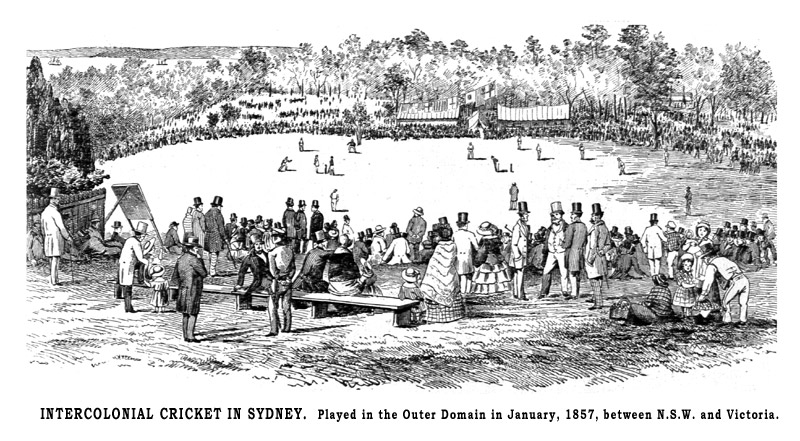
Wherever the Anglo-Saxon sets his foot he plays cricket, and Australia was no exception to the axiom. The first game that any account can be found of took place on January 1, 1827, when the members of the Australia Cricket Club played together, and had a dinner in the evening. Windsor had been challenged, but for some reason or other refused to come to the scratch. But in 1830 there was a great match between eleven Australians and an equal number of the 57th regiment, the former winning by 24 runs. In March they met again, the soldiers very confident, and played for ten guineas a side. And again the Australians won; this time by 32 runs.
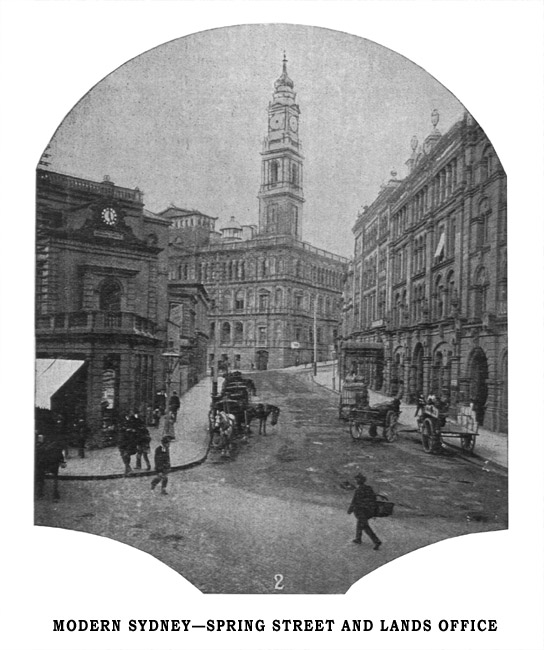
In the late thirties and early forties there was plenty of sport—horse-racing, boating, cricket, etc.,—and the well-to-do citizen could, if he were so inclined, witness or partake in one or the other of these pastimes every day in the week, and go to the play in the evening to finish off with. For strength and agility in athletic exercises our country folk were pre-eminent, especially those settled about the Hawkesbury, known even then as “Cornstalks.” One newspaper, in 1831, gives a list of 32 names of persons each of whom stood over six feet in height. Among the number was Kable, the champion boxer of that time; he stood 6ft 3½in. Even at the present day the Hawkesbury “natives” are noted for their stature. A hardy and energetic race they were, too, these men, made so by their environments, and perhaps less given to “letting things slide” than are some of their latter-day prototypes, who depend upon husbandry and stock-keeping for a livelihood.

Nor were the early-day horses a whit inferior to their masters in strength and stamina. As an instance of this, we are told that a mare, whose foal had just been weaned, and a filly, 2½ years old, were run up out of a clover field, and ridden a distance of 42 miles in two hours and fifty minutes, including several stoppages on the road. The journey was for a doctor; neither of the horses were shod; the going was rough; and the animals had never been fed on hay or corn. Yet neither of them were the worse for the trip.

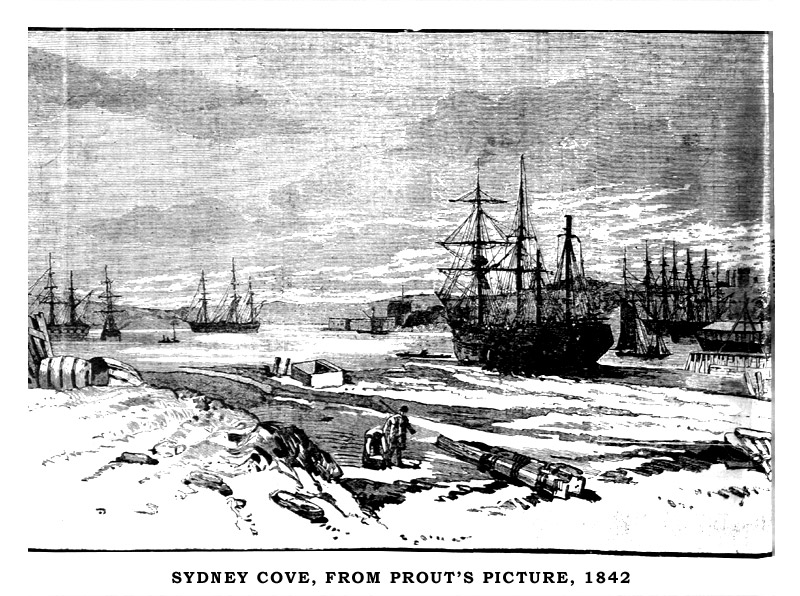
During the six years of Bourke’s beneficent rule—he governed constitutionally without a constitution—much of importance took place connected with the growth of our city, both physically and politically. The Cove was still, at low tide, little better than a mud flat, littered by boatbuilders’ ricketty sheds, and temporarily and rudely constructed little wharves. It is said that the water then flowed right up to where the Custom House now stands, and that on the site of the Paragon Hotel a small vessel had been built and launched; and another one several hundred yards up Pitt-street. Also, that the Tank Stream was still navigable for small boats as far as Bridge-street. The Stream, respecting which so many arguments have been held, is now said to have had its source somewhere about the spot in Hyde Park where there is still to be seen a pond or two—one is near the corner of Liverpool and Elizabeth streets—little noticed by the general public; thence, according to the best authorities, it followed a course between George and Pitt streets through Martin Place to Hunter-street thence by Hamilton-lane, crossing Bridge-street to Pitt-street, and so into the harbor close to the present North Shore Ferry Co.’s premises. But at the best, its true course is a matter of more or less surmise. The brightest of old memories vary.

Be this as it may, the Legislative Council, in 1834 began to think of resuming and reclaiming the foreshores around the Cove, and the construction of Circular Quay was mooted. It was suggested that a civil engineer should be imported on a five years’ engagement, at a salary of £800 per annum. But the plan seems to have lapsed, and we hear nothing more of it just then. However, a good deal was done towards improving Darling Harbor. Bathing in its waters would appear to have been strictly prohibited, for we read that a certain          Lieutenant Finch, of the 17th Regiment, was fined 5s for indulging in such a luxury. Most people, at the present time, would not take a dip in it if paid that sum to do so.

Here, by the way, is a curious advertisement from a London “Times” of 1834; “Any lieutenants in the Royal Navy under the age of 45, and with large families, may obtain free passages to Sydney, New South Wales. Application should be made to ‘C.T.,’ R.N., Post Office, Hythe, Kent.” Certain of the sumptuary laws of the city in these years of the middle thirties and early forties were decidedly curious. Yet are we not slowly drifting back in legislation to those benighted times? For instance, on Sunday, shops, excepting those of butchers, bakers, fishmongers, and greengrocers, were to be closed; these only kept open till 10 a.m.; bakers might trade only on that day between 1 and 2 o’clock in the afternoon; apothecaries at any hour. Constables might apprehend anybody who could not give a satisfactory account of themselves between sundown and 8 o’clock the next morning. The Surveyor-General (Sir Thomas Mitchell) was directed to align and set out the carriage and footways, and mark them by posts; also to place the names of streets on house walls, and fix numbers on the doors, which the tenant was bound to paint in at the end of a fortnight, or else pay a fine of 10s weekly. Footways were also to be levelled, and steps taken away from the path. The town surveyor, too, was adjured to be on the alert to prevent people accumulating gravel or earth before their houses “without giving notice,” in which case he was to remove it as rubbish.

At this date there were two posts a day. Every letter or “packet,” weighing less than half an ounce was charged for transit from one post office to the other, in distance not exceding 15 miles, the sum of 4d; over 15 miles, 5d; above 170 miles, 10d; for 300 miles, 1s. Letters sent by ship around the costal ports cost 4d; American letters cost 3d each. The mails, it may be remarked, were anything but regular, being forwarded when coach, vessel, or steam packet pleased to arrive or depart. Society, too, or rather the different parts of it, was being gradually merged into a more component whole, although the terms “Stirling” and “Currency”—to distinguish between the English and the Colonial born—were yet in use, and the “Pure Merinos” still prided themselves on being able to trace a stainless descent, and gave themselves airs on that account. Recently arrived convicts were still known as “Canaries,” because of their yellow uniforms, and people used any other colour for decoration than yellow. Yellow paint, indeed, was unsaleable. But the word “convict” was dying out, and giving place to “Government men.” Some years before this an emancipist had even obtained a verdict for libel, with £50 damages against a person who had called him “A d—d convict.”

In 1828-9 there were sailing out of the port four vessels, constantly employed in the whale fishery; six others in sealing. There were two regular “packets” between Sydney and Newcastle; one between Sydney and Hobart Town; others to Port Dalrymple; and a number of small craft trading to the Hawkesbury, Illawarra and other places.

But about the end of Governor Bourke’s term of office there were no less than 60 square-rigged whalers claiming Sydney as their port; 12 steamers sailed up and down the coast. Fifty-six vessels arrived from Great Britian, 94 from British colonies, 17 foreign, and 5 from American, giving altogether an aggregate of 67,360 tons. Decidedly, matters were looking up. Emigration, too, was ever on the increase, as may be judged from the fact that, in 1838, more than £12,000 was realised by the sales of stores from the emigrant ships. We drank chiefly rum—and plenty of it. The revenue from its importations totalled £189,450; and the amount of drink to 8 gallons per head per annum. But pew rents in the churches brought in only £6 15s 9d. In the same year, as showing how well the Government managed to make both ends meet, they had in hand £364,545 2s 7d, against an outlay of £240,673 11s 8½d—they don’t bother about odd halfpennies now a days. But the old-fashioned bookkeeping was nothing if not exact.

In ‘36-’37 the population of Sydney was 19,729 people, made up by 6794 free men, 2205 boys, 4744 free women, and 2209 girls; 2932 male convicts and 586 female ones. In the city there were five banks, seven or eight churches or chapels, a couple of insurance companies, three breweries, and two distilleries. And still the blacks, in puris naturalibus, camped in the streets and on open pieces of ground. In this connection a schoolmaster makes an amusingly equivocal report upon an aboriginal pupil who had been sent to him. Says the padagogue: “He shows as much sign of intellect as many of his school-fellows.”

“Police and gaols” was a big item in the budget, totalling no less than £52,344. “Miscellanies,” put shortly, came to £77,585. People were not nearly so inquisitive then as they are now. Fancy a Treasurer calmly presenting such a statement to the tender mercies of “the House” in this year of grace! Luckily, perhaps, for some folk who figured in “Miscellanies,” there was no “Opposition”—at least, no legislative “Opposition;” and no matter what Wentworth, et ces autres known as the Patriotic Association, might think or say, the power to act was as yet denied them.
The year 1837 was rendered memorable among other matters by the establishment of a new party, consisting entirely of the native-born; and this party it was that took in hand the celebration of the 49th anniversary. They called themselves the “United Australians.” Their representative was one Richard Driver, who, at the time, kept a public house—the “Three Tuns”—at the corner of King and Elizabeth streets. He was, too, the father of a smart lad, who became later on pretty widely known, both as a lawyer and in the world of politics, eventually entering Parliament, and joining Parkes’s Cabinet, in 1877. Driver’s house was the meeting-place of the new party, who determined to celebrate the anniversary by a “National Dinner” at the Royal Hotel. William Charles Wentworth was to take the chair, and their fellow-countrymen from all parts of the colony were invited to attend. The festival duly came off, as did the usual speeches and toasts; although the new association does not appear to have introduced any particularly fresh features, except perhaps in the way of a little less harmony—for folk at these gatherings were not any more wont to think alike on all political subjects than they are now.

On October 27, 1837, great news arrived in Sydney. This was nothing less than the death of William IV., and the accession of Queen Victoria to the throne of the United Kingdom. A “Gazette Extraordinary,” with a deep mourning border, was at once published announcing the fact, and excitement ran high throughout the city. By public notice the next day Sir Richard Bourke directed that 72 minute guns should be fired from the Dawes Point battery at noon; that the Royal Standard and the Union Jack should be hoisted half-mast high at the same hour; also, all the ships in harbor were to observe similar signs of mourning with their flags, whilst the bells of St. James’s and St. Phillip’s were to be tolled for one hour at sunset that day and an hour at sunrise on the next. All civil officers were to put on mourning, together with everybody else whose situation and circumstances would enable them to do so.

Another notice proclaimed that “the High and Mighty Princess Alexandrina Victoria had become “our only lawful and rightful Liege Lady Victoria, by the grace of God, etc.” To assist in the Declaration of Allegiance all the high officials of the colony, the clergy, magistrates, military and naval officers, and the principal inhabitants, repaired to Government House at midday.

Towards the appointed time Sydney, dressed in its darkest raiment, wended its way towards the old two-storeyed irregular mansion, with its wide verandah, and “one good room.” There the 50th Regiment, with detachments of the 4th and 80th, was already drawn up. Followed by all the notabilities, the Governor, in the full uniform of a Major-General, led the way to a table on which was lying the proclamation of her Majesty’s accession, waiting for signature. Sir Richard was the first to sign, followed by the others in their turn. The fourteenth was “Thomas X Tomra,” aboriginal native chief, who thus attached his mark on the part of the Australian native race. In all there were 126 names, and when the signing was over the Governor, standing on the front door-step, called for three cheers for the Queen, himself giving the time.

Then the troops fired a general salute, the Royal Standard was mast-headed and saluted with 24 guns; more volleys from the troops; more cheering and playing by bands of “God Save the Queen” ended not the least of the memorable events that old Government House had witnessed since Johnson and his drunken soldiers routed Bligh out of his hiding-place in one of its rooms.
Presently the High Sheriff (Thomas Macquoid), who had, ere this, read the Proclamation to the crowd, marshalled a procession that was to pass from Government House down Bridge-street and up George-street to the police office—the first ceremony of the kind in Sydney that there is any record of.

As in our day is the general rule, so now the procession was headed by a detachment of mounted police; then came the band and a division of the 50th Regiment, together “with a number of the inhabitants of Sydney.” Members of the bar, the magistrates of the colony, commissariat officers, the clergy, the judges, followed in order named. Then came Thomas Thomra, A.N.C., the members of the Legislative and Executive Councils, and detachments of the three regiments. Bands played, flags waved everywhere as the procession marched gaily along towards the dingy old “Central,” where the Proclamation was again to be read by the High Sheriff. And where, one wonders, is that most historical document? Sold for waste paper, or still preserved in some cellar for bubonic rats to nest in? Somebody might do worse than hunt it up, and have reproductions made for the benefit of those of our generation curious in such matters. It runs: —

PROCLAMATION

“Whereas it has pleased Almighty God to call to His mercy our late Sovereign Lord King William the Fourth, of blessed and glorious memory, by whose decease the Imperial Crown of the United Kingdom of Great Britain and Ireland, and all other His late Majesty’s dominions, is solely and rightfully come to the high and Mighty Princess Alexandrina Victoria, saving the rights of any Issue of His late Majesty King William the Fourth, which may be born of His late Majesty’s Consort:

“We, the Captain-General and Governor-in-Chief of the Territory of New South Wales and its Dependencies, the Chief Justice, the Members of the Executive Council, the Puisne Judges of the Supreme Court, the members of the Legislative Council, the Clergy, Magistrates, Civil Officers of the Government, and the Naval and Military Officers of her Majesty’s Service, with numbers of other principal inhabitants of the Colony,

“Do now hereby, with one full voice and consent of tongue and heart, Publish and Proclaim that the High and Mighty Princess Alexandrina Victoria is now, by the Death of our late Sovereign, of happy and glorious memory, become our only lawful and rightful Liege Lady Victoria, by the grace of God, Queen of the United Kingdom of Great Britain and Ireland, Defender of the Faith, saving as aforesaid, Supreme Lady of the Territory of New South Wales and its Dependencies, to Whom, saving as aforesaid, We do acknowledge all Faith and Constant Obedience, with all hearty and humble affection, beseeching God, by Whom Kings and Queens do Reign, to bless the Royal Princess Victoria with long and happy years to Reign over us.

“Given at Government House, Sydney, this twenty-seventh day of October, 1837.

“God Save the Queen!

“(Signed) Richard Bourke,

“Governor-in-Chief.”

Sydney in these days was, at the most, only a squalid town; neither trams nor trains; no corporation, no gas lamps, no drainage, no suburbs worth mentioning; stumps in the streets, and convicts in chains grubbing them; Circular Quay a mud flat; and bullock teams camped alongside the old burial ground, the site of the present Town Hall. Everything in embryo. And little the few people who listened to those high-sounding words, with their quaint turnings, guessed how fully in the long years to come, God would grant the request made in that most hearty and loyal prayer delivered in the rude capital of an almost unknown land.

Sydney Past & Present - The City Of Sydney - The Stories Of Its Growth - Chapter 7 - The Early Thirties

 
Sydney Past & Present  - The City Of Sydney - The Stories Of Its Growth  - Chapter


__________________________________________________________________________________________________________________________________________________________________________________________________________________________________________


Chapter VII.
The Early Thirties.

WE have seen what took place at some of the anniversary dinners, and how they gradually assumed a patriotic aspect; the emancipists, who formed the guests, talking more “reform” than social business. Wentworth, “the apostle of liberty,” and Darling could not hit it at all; the Governor looking upon a patriot as little better than a rebel. So that Wentworth had to keep pretty quiet, not even attending the great dinner of 1831—the forty-third anniversary. The promoters said they were not going to talk politics at all. Indeed, they called themselves “The Australian Society to Promote the Growth and Consumption of Colonial Produce and Manufacture;” a sort of Chamber of Commerce, established some time before by the principal men of business in Sydney. These gentlemen invited their friends to dinner at Morris’s Crown and Anchor Hotel in George-street. Tickets were 10s.

At sunrise on the 26th the Royal Standard was hoisted at Dawes Point, and the guns there and at Fort Macquarie, at noon, fired a salute of forty-three (one for each year), the two batteries firing alternately. At dinner, no less than 130 guests assembled, with Samuel Terry (then, perhaps the richest man in the colony), as president; and Daniel Cooper (the knight’s uncle) in the vice-chair. They toasted Macquarie as usual; “Currency Lads and Lasses” (the name given to the Australian-born men and women); “The Judges and the Bar,” and “William Charles Wentworth,” whose name was the subject for a tremendous outburst of cheering. Then, all at once, the meeting seems to have lost its head or, at least the younger members of it did, and violent oratory took the place of trade talk; Darling was arraigned as a tyrant; and sedition ousted commerce. Hall, the proprietor of the “Monitor,” who was present, was held up as an example of one of Darling’s victims, prosecuted time after time, imprisoned, stripped of his property, deprived of his church pew, even, for simply criticising the Government policy in his newspaper. Nicolls and other young orators fairly carried the assembly with them; and their elders, grave and reverend merchants, who had come to talk a little shop, found themselves, before they knew where they were, cheering the speakers, and volubly talking treason—or what in those days, was held to be very much akin to it. It was a memorable dinner.

Gradually the press was beginning to be a power in the land. The Howes, were gone, and men like Wentworth, Nicholls, and Hall had replaced them. Robert Howe of the “Gazette,” was dead—drowned whilst fishing off Pinchgut with his infant son. The latter was, however, rescued by a sailor. Some kind hand writes of Howe: “That he was eccentric cannot be denied, but his were errors of the head, not of the heart. As an affectionate husband and father—a kind and considerate master—he was second to none. His hand was ever open to relieve the distressed; and of his charities few knew the extent. May his errors be forgotten, and the recollection of his many redeeming qualities be at once his excuse and his epitaph.”

During the last year of Darling’s reign also died another old identity, in the person of Boongaree, king of one of the principal coast tribes in the neighbourhood of Port Jackson. Governors King, Hunter, Bligh, Macquarie and Brisbane had been his patrons and protectors. Indeed, he seems to have been a favourite with everybody. Macquarie had given him land for himself and his tribe to camp upon between Milson’s Point and George’s Head; and every King’s Birthday when the Governor put it on his new uniform Boongaree got the old one; and, minus the trousers and boots, which nothing could induce him to wear, he used to parade Sydney in great state. He was a splendid mimic—as so many of his countrymen in their wild state are still—and could, with wonderful accuracy, depict the gestures and peculiarities of the various Governors and high officials whom he had served under.

Boongaree died in November, 1830, and he was buried on Garden Island, and, finding there very good company in Major John Owens and Judge-Advocate Bent, who, together with Captain Logan, late Commandant at Moreton Bay, and mysteriously murdered there, had been brought and placed in his friend Bent’s tomb.

The island then looked very different. Its two hummocks—one to the north and one to the south—have now been levelled and built upon, and the whole place turned into a depot for naval stores belonging to the Imperial Goverment. But in those days it must have seemed an ideally peaceful place of sepulchre. Since Phillip tried to grow cabbages there, little had been done to the island; but, some thirty years before Boongaree was buried, a redoubt, carrying a few guns, had been erected fronting the harbour fairway.

When the island was made an Imperial naval depot the bodies were removed to the burial ground of St. Thomas’s church at North Sydney, where, at this day, the curious can inspect the cenotaph that covers their remains.

Queen Gooseberry, the consort of Boongaree, survived her lord and master some years. She, however, was buried over on the North Shore; but the body was afterwards removed to the Devonshire-street Cemetery, Redfern, where, until the recent removals, her tomb was still to be seen.  A Sydney gentleman is in possession of the brass cup, holding about a pint, in which the old lady used to receive her state allowance of rum. Altogether, we may take it that the pair had a very good time under the rule of the white invader. Says a newspaper of the time: The well-known aboriginal Chief, Boongaree, died, after a lingering illness, at Garden Island. The facetiousness of the native Chief, and the superiority of his mental endowments over those of the generality of his race, obtained for him a more than ordinary share of regard from the whole inhabitants of the colony, which was testified to by frequent donations suited to his condition, not only from private individuals, but from the authorities.”

On May 14, 1831, the first steamer arrived from England. Her name was the Sophia Jane, Biddulph master (he was once a lieutenant in the Royal Navy). She came via the Cape of Good Hope, carrying passengers and cargo. This was the first steamer to enter Port Jackson, although a couple of months earlier a small steamer had been launched on the waters of the harbor. She was called the Surprise, and made her trial trip from Sydney Cove to Parramatta in four hours. Henry Gilbert Smith, one of the directors of the Commercial Bank, was her owner, and she was brought out from England in sections to his order, put together at Neutral Bay, and launched there on March 31, 1831. Captain Devlin, already referred to as the first to be born in the colony of Australian parents, was her commander; and the late Hon. George Thornton one of the passengers on her trial trip. She does not, however, for some reason or other, seem to have been a success, and was presently sold to a Hobart Town firm. A few particulars about the Sophia Jane may be of interest, seeing that she was our first steam coaster, as well as our first tug.

Originally, she was built for the English coasting trade, and was bought by a Sydney firm, for £8000, to run between that port and Newcastle. She had accommodation for 53 passengers in three classes; was 126ft in length, 26ft in beam, and drew 6ft of water. Her tonnage was 256; her engines of 50 horse-power, and her draught of water only 6ft. Her top speed was eight knots an hour; and she towed the first ship ever taken in that manner from her anchorage in Port Jackson out to sea. This vessel was the Lady Harewood (Storehouse master), which arrived in Sydney on March 4, 1831, from England with prisoners, and left again on June 12 in the same year, bound to London. Apparently, she was left to find her own way in—so far at least as a tow was concerned.

This year of ‘31 seems to have been prolific in steamer records, for in October there was launched on the Williams River the first one actually built in Australia. Her builder was J. H. Grose, of Parramatta, and she, too, was placed in the Newcastle-Sydney trade.

The Sophia Jane must have been as much a revelation to the citizens of her day as were the great liners of the P. and O. and Orient to those of our own. Perhaps, too, she was “thrown open to inspection,” much after the same manner as each new ship is to us, and the Currency lads and lasses paid their money, and roamed over, and explored, and wondered and praised as we do when some fresh marvel of constructive sea-science appears in our harbor. Eventually, the historic vessel was broken up by Mr. Chowne, of Pyrmont, who had seen her launched in England. Mr. Chowne used some of her timbers to build a craft called, appropriately enough, the “O.P.S.,” because constructed from old pieces of ships.

During 1831, appeared the first number of the “Sydney Herald.” The paper was started by Messrs. Stevens and Stokes, as a weekly, with the motto, “Bound to no party; of no sect am I.” This declaration, however, was dropped when the paper fell into the hands of the late Mr. James Fairfax.

Towards the end of the year, Governor Darling left the colony, “after having consistently,” as one writer puts it, “during the whole of his office, attempted to throttle the aspiration of a young people, after the freedom due to them.” Lang, on the other hand, has much to say that is good of him.

Another military governor soon took hold on the reins of office in the person of Major-General Richard Bourke, one of whose first public visits was made to the distillery of Mr. James Underwood, near to South Head road, which he minutely inspected, and doubtless liberally tested the produce of.

The new Governor, also, early showed himself a liberal patron of the drama. We have already seen how Mr. Levy had given performances in the saloon of his Royal Hotel. And here, on December 26, 1832, “money was publicly taken at the doors,” Douglas Jerrold’s “Black-Eyed Susan” was the play; whilst Moncrieff’s “Monsieur Tonson” was selected for the farce. Encouraged by the success of his venture, Mr. Levy built the Theatre Royal, and opened it in the latter part of 1833, with the best company that he could get together. Mr. Meredith was the first manager. The new theatre, it should be noted, stood just at the back of the hotel, and held about 900 people. A preliminary “At Home” was held under the special patronage of the Governor. This entertainment consisted of thirteen sketches, nine songs, (no encores allowed), and selections by the band of the 17th regiment. Half an hour interval was allowed for the audience to “liquefy their palates,” much, we may be sure, to the profit of the adjacent “Royal.” Such was the house-warming of our first actual and legitimate theatre. In October, it opened with “The Miller and His Men,” and “The Irishman in London.” The admission was 5s per head, and people thought themselves lucky to get a seat at that. The press had little to say as to the merits of the performance. Knowles being the only actor singled out for mention. Perhaps critics were blessedly scarce in those days, and wisely preferred to let alone what they were not quite certain about.

With Bourke’s advent, the press began to hold up its head again. A contemporary of the “Sydney Gazette,” on July 3, 1832, remarks mysteriously: “Gazette afflicted with cholera morbus,” also suffered much from “sore eyes” during the latter part of the year. But in November (under Bourke’s beneficent rule) we find, “Sydney Gazette,” which had been in a declining state, pronounced out of danger. “Cholera” and “sore eyes” quite gone. Jokes, these, that if falling rather dulled on our ears three generations later, were, you may depend on it, thoroughly appreciated and chuckled over by their makers and readers.

Besides the “Government Gazette,” published weekly, there were now (1834), the “Sydney Gazette,” published three times a week, and the “Herald” and “Monitor,” twice a week. The “Australian” had been discontinued for some time; but it presently started again as a weekly. There was, too, a paper called the “Currency Lad,” owned and edited by a native born, and for that reason very popular, indeed, with young Australia. But it soon died; its friends averred for lack of a proper press, its enemies for lack of principle. The first serial publication in Sydney was “The New South Wales Magazine,” edited by the Rev. Ralph Mansfield, an ex-Wesleyan missionary, and the successor of Howe in the management of the “Sydney Gazette,” and Dr. John Shlotsky, M.D., a Bavarian. Fancy the courage of those men in trying to run a magazine sixty-seven years ago! Mansfield, by the way, in addition to his other avocations, was the leading one of the four booksellers then in Sydney. What would not a bibliophile now give for the privilege of a free run amongst their original stock?

A curious incident happened in the earlier part of Bourke’s rule, and one that scared the citizens not a little. A brig called the Anne Jamieson lay alongside the King’s wharf discharging her London cargo. All her gunpowder was supposed to have been removed to the magazine on the North Shore. Nevertheless, she blew up with a tremendous explosion, and eight people were killed. The casks containing the powder had, it appears, leaked freely during the voyage, and their contents had spread among the bar and rod iron, of which her cargo was, in a great measure, composed. Thus, when discharging, the friction set up by drawing these out ignited the powder. The vessel was totally destroyed; “Indeed,” as the old chronicler remarks, “a melancholy occasion.”

Old Dr. Lang, about this time, complains about the “grossieretes” (bad manners) frequently in evidence amongst the audience at the Theatre Royal, and, inferentially, thanks God that he has never attended a performance there. But he was always girding at something. In the language of our present “Currency lads,” he would have been termed “a hard old case.” He lived in Jamieson-street, not far from his church, and cynically studied the manners of the citizens, retaining always a deadly antipathy to emancipists; fostering free emigration (he imported Scotch masons to build his church, and encouraged thousands of immigrants to settle in the colony,) and showing, in spite of all his aggressiveness a fine pride in the city, for which, despite his many faults and foibles, he did much. Listen to his description of how the people take their pleasure:—

About 4 o’clock in the afternoon, before dinner in the haut ton circles, but some after it among people of inferior station, all the coach-house doors in Sydney fly open simultaneously, and the company begin to take their places for the afternoon drive on the South Head road (formed by Macquarie, and running out to the lighthouse erected by him). In half an hour, the streets are comparatively deserted; by far the greater portion of the well-dressed part of the population being out of town. In the meantime, the long line of equipages—from the ponderous coach of the member of council, moving leisurely and proudly along, or the lively barouche of Mr. Whalebone, the shipowner, to the one-horse shay, in which the landlord of the Tinker’s Arms drives out his blowzy dame to take the hair arter dinner doubles Hyde Park corner, and arrives on the Corso; while ever and anon some young bachelor merchant or military officer, eager to display his skill in horsemanship, dashes briskly forward along the cavalcade at full gallop.”

And in your mind’s eye, you can see the grim old doctor shake his head in censure of what he deems foolish ostentation, and waste of time, as he takes his solitary way to “contemplate the wonderful works of God in the romantic walks of the Government Domain… along the margin of beautifully romantic walks, traced with the utmost taste.”

It was during the passage of the Stirling Castle, the vessel that brought Lang and his fifty Scots masons out, that the idea of the Sydney School of Arts was first mooted, although the doctor himself, seems, just then, to have had little to do with it, leaving the matter in the hands of a fellow-minister, the Rev. Henry Carmichael. This gentleman organised, throughout the voyage, classes among his fellow-passengers, for their better education, and enlightenment; thus these hard headed Scots wrestled for months with the mysteries of algebra, Euclid, logarithms, and the higher mathematics, besides Scriptural theses and several ologies. Not only was this course of study pursued at the time, but rules and an agreement sketched for its prosecution and continuance when Australia should be reached.

But on arrival there was so much else to be thought about and done, that but for Mr. Carmichael’s tireless efforts, and the liberal encouragement of Sir Richard Bourke, the scheme would have come to naught. As it was, it flourished and took root. The story of its actual inception is most interesting. A Mr. John Riddell Fenwick, left a written statement with the then president, Mr. Dalgarno, in 1887, to the following effect :

“In the reign of William IV., year 1833, January 19, at 10 o’clock in the forenoon, three men and a boy ascended Church Hill for the purpose of forming and founding the first School of Arts in all the Australian colonies: the union being represented in the persons of Mr. John Reilly saddler, Pitt-street, formerly George-street, a native of Ireland, shrewd, sharp, and clear sighted; Mr. William Hipkiss, botanist, native of England; and Mr. David Taylor, a builder, and a native of Scotland… They entered a brick building (probably the old Surveyor-General’s Office), situated half way between Dr. Lang’s church and the windmill, by a side door into a long, narrow room at one end of which was a window, with twelve squares of 12 x 10 glass. A small bedroom table was placed end-on to the window. Three empty brandy cases were put near the table for seats. Pen, ink, paper, and a copy of the rules of an English School of Arts were put on the table. Mr. Reilly was chosen chairman, Mr. Hipkiss secretary, and Mr. Taylor treasurer. A strange noise being heard outside the building, the boy went to ascertain the cause. He returned and informed Mr. Reilly that it was made by 200 men in irons, escorted by a detachment of the 17th Regiment. Then, said Mr. Reilly, ‘the work we are engaged in to-day will assist to unrivet those chains, and allow those people to become men again, and not as now, beasts of burden.’ Then, looking at the boy, he said, ‘You will, no doubt, in the course of nature, be alive after we have passed away. Promise me that you will always mention who were the founders of the Sydney School of Arts.’ Which promise I now fulfil, and wish this statement to be read at the annual meeting.”

Mr. Dalgamo added that Messrs. Reilly, Hipkiss, and Taylor had all passed away, leaving only the boy, who accompanied them, to live to see the magnitude of the present School of Arts. Also, on the president’s motion, Mr. Fenwick, was made an honorary life member of the institution.

In the following March of 1833, more formal proceedings were taken and a public meeting held. Among the speakers were such men as Mr. Carmichael, Mr. Edward Deas-Thompson, the Rev. Ralph Mansfield, Mr. Charles Windeyer, and Dr. Lang. In 1835, it was removed to its present site, having then on its roll 112 members. Not, however, until 1859 did Sir W. Denison lay the foundation-stone of the building of our day. Unfortunately, no official record was kept of the proceedings of which Mr. Fenwick writes; but it was probably only a preliminary meeting on the part of the three representatives, informal, and hardly to be spoken of as a “founding” but still the first in Australia with such an object in view.


Sydney Past & Present - The City Of Sydney - The Stories Of Its Growth - Chapter 6 - Sydney In The Twenties Continued


- Sydney Past & Present - 
- The City Of Sydney - 
- The Stories Of Its Growth  -


____________________________________________________________________________________________________________________________________________________________________________________________________________________________________


Chapter VI.
Sydney In The Twenties (Continued}

IN April, 1826, Mr. Howe informes us in his “Gazette,” that Mr. Iceley’s thoroughbred mare, imported ex Columbia, dropped a fine bay foal; this being the first blood horse born on Australian soil. And, by the way, it should be said, that the original Howe (George) had now been dead some years, and that Robert, his son, ran the paper in these, comparatively, good, new days. The filial eulogium is worth reproducing:


“Mr. George Howe, the Institutor, Printer, and Publisher of the ‘Sydney Gazette’ and ‘New South Wales Advertiser,’ as well as the Compiler and Publisher of the New South Wales Pocket Almanack, yielded up, on the 11th of May, all his arduous labours at the visitation of death. He has the undisputed honor of being the primary Editor of Australia, and his memory will run coeval with New South Wales; having succeeded in rearing up and establishing, amidst hosts of difficulties, that humble but important structure, the “Sydney Gazette” and thus attained the genuine Printer’s greatest ambition—even in death—a typographical monument, in which, though silent in the tomb, he will ever proclaim himself to us the Progenitor of Printing! We hope that the reprint of our paternal and beloved Typographist will (in the technical phraseology of Franklin) appear once more in a new and more beautiful edition, corrected and amended by the Author.”


Poor old man, from what can be gathered, despite his son’s tall talk, he had, on the whole, a very hard, dreary, and squalid time of it. Snubbed by one faction, kicked by another, and swindled by both.


Late in October, 26, there arrived the Waterwich, the first seventy-four to enter an Australian port. She was in command of Commander Sir James Brisbane, brother of the late Governor, and was bound from Trincomalee to South America. Fine and high and imposing she must have bulked to the eyes of the citizens.


During Darling’s time, too, we find the second recurrence of that “novel and severe distemper,” influenza, or “catarrh,” as they called it then, with which we of to-day are so unpleasantly familiar. It prevailed “throughout the colony, and gave rise to much distress.” Its first visitation was in 1820, when “it by the violence and fury of the attack, consigned many people to the grave.”


Next year whooping cough was introduced by the ship Morley, and the disease killed so many children, and became so virulent that the schooner Alligator had to be formed into a quarantine station. Later on the transport Bussorah Merchant introduced a slight epidemic of smallpox. Otherwise the health of the city and the colony kept throughout fairly good.


In the time of Governor Darling was produced the first Australian ghost story, which merits notice because from out a commonplace and brutal murder was evolved a romance which has not only had, in diversly embroidered aspects, an almost world-wide reputation, but is very firmly believed in by many persons at the present day.


The commonly accepted story, in its bare outline, is that Worrall and Fisher were two well-to-do farmers of Campbelltown. Suddenly Fisher disappeared. Worrall, pretending to be in his confidence, hinted that he had gone to England to escape prosecution for forgery, and so wished his departure kept secret. By and bye, he produced a letter empowering him to sell the farm and belongings of the absent man; also a power of attorney. Then he advertised all Fisher’s property for sale. But the very day before this came off (note the “psychological moment”), an old man saw Fisher, or his ghost, sitting on a fence. The vision according to the best etiquette in such matters, appeared three times. Rumors spread; the place was searched, blood marks and footsteps were found, the last leading towards a water-hole, in which the decomposed body was discovered by a blackfellow, and identified as that of the missing man. Suspicion naturally turned to Worrall, as being the last person seen in Fisher’s company, and as being in possession of his property. Worrall was apprehended, tried, and executed, making, at the last moment, a full confession of his guilt.


The true facts of the case were that Worrall murdered Fisher, and, coolly taking possession of his farm and effects, tried to sell them piecemeal, saying that he had documents that gave him power to do so. In one or two instances he forged receipts, in Fisher’s name, for the purchase of stock, etc. It was a long premeditated crime, to get hold of his victim’s property, which was worth some thousands of pounds, in land, houses, and horses.


Worrall, in the actual matter of fact version, never advertised the farm for sale; no talk of any ghost appeared in the proceedings at the trial. Both Fisher and Worrall were ex-convicts, and both bore but indifferent characters. The crime was an ordinary, brutal, clumsy murder. Nor were there any of the sensational effects recorded by romancists attending either its discovery or the expiation of it.


Actually the most striking and dramatic incident of the whole case was furnished by the blackfellow, Gilbert, employed as tracker, when, skimming the top of the pool with a leaf, he tasted it, and exclaimed that it was “the fat of a white man!” But Worrall did not, in spite of the story writers, throw the body of the victim into the pool at all. He merely hid it in some rushes close by. Then, growing uneasy, he removed it, and buried it a few yards away. Of course, the juices of the decomposing body may have drained into the pool. But, probably, Gilbert was only “gammoning” and he, or his fellows, had already seen indications of the grave. However, here condensed, are the false and the true stories of “Fisher’s Ghost;” but to convince many folk that the first version, ghost and all, is not the correct one, would be a very hard task.


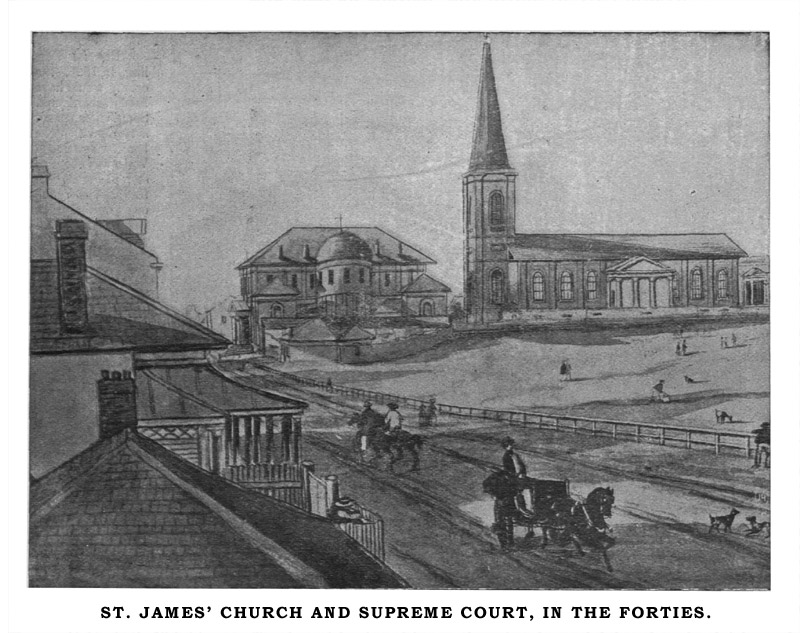
Let us now take a glance at the Sydney of 1826-28. George-street was, of course, the main, and, indeed, the only thoroughfare of importance, and extended, with many and frequent gaps, for about a mile and a half along the hollow through the centre of which once ran the Tank Stream—now a trickling rill being gradually civilised out of existence. “The town,” writes an historian of that day, “occupies the whole of the hollow, creeping up the gradual ascent on each side. The ridge on the left is successively crowned by the lofty-looking buildings of the horse barracks, the colonial hospital, the convict barracks, and a fine Gothic Catholic chapel; beyond these lies the promenade of Hyde Park, flanked towards the town by a row of pretty cottages, and towards the country by a high brick-walled garden appertaining to the Goverment. On the ridge to the right of the Cove, rows above rows of neat white cottages present themselves, overlooked by the commanding position of Fort Phillip, with its signal post and telegraphic appendages (these last probably the semaphore by means of which communication was maintained with the Governor when absent at Parramatta). Following this, we behold, in succession, the military hospital and windmill, St. James’s Church, the Gothic Presbyterian Kirk (Dr. Lang’s), and, beyond these, the military barracks, forming three-fourths of a large square (now Wynyard), and opening to George-street, with an extensive green plot in the centre for purposes of parade. The portion of the town to the right is best known as the Rocks… This is considered the St. Giles, and the division of the town to the left the St. James, portion of Sydney, most of the superior citizens inhabiting the latter, and the lower classes chiefly the former—though The Rocks can undoubtedly boast of many handsome houses, with highly respectable inmates. A few hundred yards from the head of the Cove, towards the left, stands the Governor’s house, with its beautiful domain in front. On the right shore of the Cove,” continues our author, “you first see the mansion of Mr. R. Campbell, one of our oldest and most respectable merchants, with its garden full of flowers and fruit trees, and wharf and storehouse next the beach; next, you observe the town house of Captain Piper; then the Government dockyard, against the surrounding walls whereof are built the working sheds and storehouses, with its boat landings and little wet docks scooped out of the adjoining shore; then came the high buildings composing the commissary stores, beyond which is the wooden Government wharf jutting out into the harbor; and, further on, the landing warehouses of the various merchants connected with our imports and export trade, a low wall there terminating the Cove, to prevent its being filled up by the alluvial deposits from the rivulet.”


The above is, perhaps, the best description extant of Circular Quay and its surroundings some seventy odd years ago.


The land near the Cove was the most valuable of any, and there the houses were built adjoining each other; further along they straggled in rows of detached cottages, whitewashed, and generally one-storey in height; a verandah in front, enclosed with a paling fence, and standing each in its own garden. There are still a few of these ancient residences to be found, but not in George street. The streets were wide because their boundaries were as yet so slightly defined; they were unpaved and unlit, and troops of homeless cows and goats roamed them by night and by day.


Even then, in its second youth, Sydney must have presented a pre-eminently English aspect, for one visitor says that but for the cages of bright-coloured birds exposed for sale (look at Lower George-street now) and the gangs of convicts marching to and fro in single file in their yellow or grey jackets, and canvas overalls, “daubed with broad arrows, P.B.’s, C.B.’s and various numerals m black white, and red, with perhaps the gaol gang straggling by sulkily in their jingling leg-chains,” he might easily have imagined himself “at home.” He, however, forgets the climate.


The “Gothic Catholic Chapel,” mentioned above, is, of course, St. Mary’s or rather was the forerunner of the present great cathedral of that name, not built until many years later, and even now incomplete. Writing in 1834, Dr. Lang says: “The Roman Catholic Chapel is an ambitious edifice, built of hewn stone in the form of a cross, and occuping a very prominent situation when viewed from the water.” The foundation had been laid by Macquarie in October, 1821; and the Rev. J. J. Therry was the person to whose exertions much of the success of its erection was due.


But to return to our city of ‘26-28. Goulburn-street was then absolutely houseless; and for this reason was often quoted to strangers by the jokers of the town as remarkable for no burglary ever having taken place in it.


There were six places of worship: St. Phillips’, St. George’s, the Scots’ Kirk, a Methodist chapel, and St. Mary’s; there was a male orphan school endowed by the State; and a benevolent asylum supported by private charity. There were two steam flour mills, three water mills, and numerous windmills which could turn a bushel of wheat into flour in a little over ten minutes. Sydney now, too, produced its own spirits; a Mr. Cooper having started a distillery about a mile along the Parramatta-road, a continuation of George-street. Also, a Mr. Underwood established another upon the South Head road. Thus, the citizens were amply supplied with home-made “tanglefoot” or, as the papers of the day termed it, “a pure spirit manufactured from the good grain of the colony.”


The “Australia” (once the first post office and home of Nichols) and the “Royal” hotels in George-street, and Hill’s Tavern, close to Hyde Park, were said to be as good houses as those in any English town of the same size. But there were many low pot-houses and “publics” scattered broadcast about the place. Lodgings were very reasonable, the most respectable ones seldom exceeding a pound per week, and averaging fifteen shillings each for a double room—“the landlady making all your purchases, and cooking and serving up all your meals for this sum.” At most street corners were fruit stands, from which noisy sellers bawled their wares—a feature of our city still in full swing. The town was divided into six police districts, each with a lockup and a night watch attached. As to its water supply, Sydney appears to have been still dependent on the Tank Stream excavations, but these, in a dry season, being found inadequate, the authorities were casting about for some other source of supply. Let us hope that the soldier’s wives, who, as already mentioned, a writer alleges, in 1816, washed clothes in the tanks, had discontinued the habit.


Even now amusements were very few indeed: the news of the world was six months old when it arrived, and then only brought broken and garbled accounts. Personal scandal still formed the most prominent feature of “society” talk. Certainly, Mr. James Underwood (by the way, the builder of the first vessel launched in Sydney) was said to be erecting a theatre, but of this undertaking little else is to be learned. Indeed, in these days the gaol was turned into a theatre, “a Temple of Thespis, the debtor’s room afforded the arena, and persons of the highest standing in the town were not ashamed to witness the crude representations of these dramatic enthusiasts.” Not till 1833 did Sydney possess a regular bona fide theatre, the “Theatre Royal,” opened by Mr. Barrett Levy, the licensee of the Royal Hotel in George-street, who had some time subsequently fitted up the saloon of that establishment for the exhibition of the legitimate drama.


The fair sex kept up the fashions as well as they could, natheless laboring under many disadvantages. “The moment a lady blooming fresh from England is known to be tripping along a Sydney street you will see our prying fair, singly or in groups, popping eagerly to take notes of the cut of her gown, the figure of her bonnet, and the pattern and colour of the scarf, or shawl, she displays upon her shoulders, that they may forthwith post off to put themselves in the ‘dear fashion’ too.”


Nor did our grandmothers grudge the cash to pay for their newest modes; for one person who kept a ladies’ “fashionable repository,” we are told, departed home with a nice little fortune of £12,000, all acquired in less than six years.


It may be worth noticing that in the first three months of 1826 eight hundred people, exclusive of those committed to the Criminal Court, had passed before the Sydney Bench. But on March 12, in the same year, to the amazement of the magistrates, there was not a solitary case. This unprecedented incident so staggered the court that, fearing the citizens were becoming downhearted, it issued no less than 76 spirit licences that same morning. As to the more detailed topography of the city, accounts differ materially; the earlier ones, written mostly by people on the spot, deal in generalities as to the locality, and their authors, thoughtless for posterity, seem to imagine that everybody would be always as wise as themselves respecting matters of such common knowledge. Which practice still obtains. We know for certain, however, such facts as that where Petty’s hotel now stands was in these years Captain Rossi’s garden (Rossi was then police magistrate); that cattle were slaughtered at Dawes—then Slaughter-house—Point; that people used to get their fire-wood in the neighbourhood of Cooper’s distillery, already spoken of; that where the big shop of David Jones and Company now stands was a cowyard; a butcher’s premises held the site of Kidman’s. In York-street stood a stocks, and the youngsters’ great amusement was to pelt the unfortunates both there and in the pillories with rotten eggs and vegetables from the market.


Until Busby brought water in from the Lachlan swamp, by means of a drain to Hyde Park, whence the citizens carted or carried it, the tanks formed the sole supply—useless in a drought. Surry Hills was mostly all open country, dotted sparsely with market gardens, and a few large private residences. Between Woolloomooloo and Darlinghurst lay a deep scrub-covered valley, through which a creek ran, and emptied itself into the bay. Children used to frequent Flagstaff Hill, where our Observatory now stands, to cut the bushes with which it was overgrown; out of these they made brooms. Broadly, the city boundaries were, in these days:—On the north, the harbor; on the south, the long low ridge of the Surry Hills; on the west, the “beautiful lagoon of clear and extensive salt water running two miles inland north and south” (Darling Harbor); and on the east, the deep valley already mentioned. Our limitations at this time were narrow, indeed! Still, from the last period in which we had a glance at it, the place had grown wonderfully, showing with every year that in modern parlance it had decidedly “come to stay.”


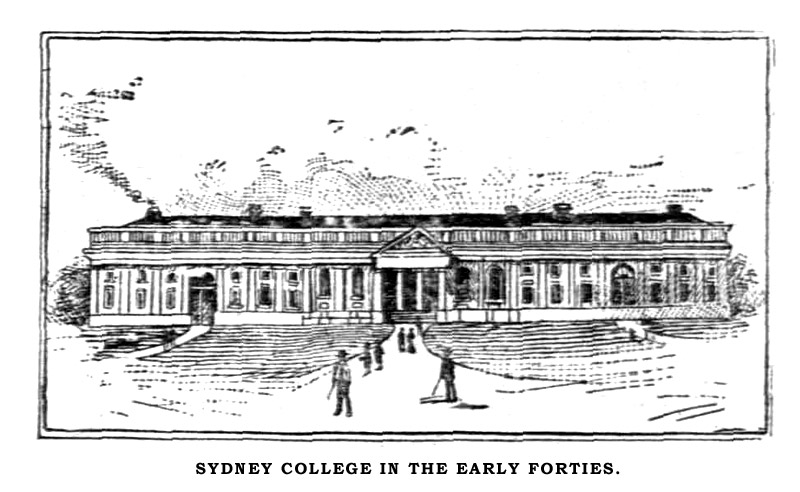
In 1830 was laid, by the Chief Justice of New South Wales, the foundation-stone of the Sydney College (now our present Sydney Grammar School). Inserted in the stone was a brass plate, with an inscription, reading: “This foundation stone of the Sydney College—an institution founded for the vigorous and pious promotion of polite literature, and the liberal arts among the youth of Australia—was laid by Francis Forbes, Chief Justice of New South Wales, on an auspicious day, viz., the 26th of January, in the year of our Lord 1830, in the happy reign of George IV., Lieutenant-General Ralph Darling being Governor of New South Wales.”

It was erected on a portion of over an acre and a half of land, the gift of Sir Thomas Brisbane, in 1825, to an institution known then as the Sydney Free Grammar School, conducted in a private house, but discontinued in the succeeding year. This land was “very eligibly situated near the racecourse,” and the foundation ceremony was attended by, besides the general public, over eighty of the trustees, who walked in procession from the Royal Hotel to the site of the building. As in our day, so in theirs, our worthy forbears probably seldom neglected the rite of “wetting the stone.” The “saloon” of the “Royal,” however, it should be in all fairness mentioned, was their usual meeting place, being rented from Mr. Levy for that purpose. The Chief Justice made a speech at the ceremony, and Dr. Lang “improved the occasion.” The function ended “with the acclamations of all present, in testimony of their joy on so interesting and auspicious an occasion.”


The first president was the Hon. Francis Forbes, with Messrs. Sam. Torry and George Allen as treasurer and secretary respectively. And on the first committee appear such well-known names as those of Sir John Jamieson, Dr. Lang, Messrs. Sydney and Francis Stephen, J. E. Manning, W. Bland, D. Cooper, S. Lord, and others, all intimately connected with the past and present history of the city.


The architect was Edward Allen, who took rank as a “benefactor” through foregoing a third of his professional fees—£125—for the benefit of the institution. The requisite sum for the erection of the college was to be raised by the sale of 200 shares of £50 each, “50 additional shares to be left open for the convenience of residents in the East Indies or elsewhere beyond seas, until the first day of January, A.D. 1833.”


In a progress payment college account, during 1830, appears an item, “Paid Mr. Iredale for spades, picks, etc., £1 4s 2d;” a memento, this, of the founding of the present house of Lassetter and Company. Amongst the shareholders occur the name of John Tawell (the convict Quaker, transported for forgery); Mrs. Reiby (at one time supposed to be Margaret Catchpole), W. C. Wentworth (late one of the committee), Robert Howe (editor of the “Sydney Gazette”), Robert Campbell (the first merchant), and many others of note and notoriety.


On January 19, 1835, the college was opened with Mr. W. T. Cape as its headmaster, and some cash and shares in hand, an omen of prosperity and good management that, as all of us well know, was not transitory, but has continued throughout the history of the colony to the present day.


________________________________________________________________________________________________________________________________________________________________________________________________


Sydney Past & Present - The City Of Sydney - The Stories Of Its Growth - Chapter 5 - Sydney In The Twenties


 - Sydney Past & Present -
 - The City Of Sydney - 
- The Stories Of Its Growth  - 

________________________________________________________________________________________________________________________________________________________________________________________________________________________________________________________________________________________________________________

Chapter V.
Sydney in the Twenties.

Dr. LANG never forgave Brisbane for the slight put upon the Sydney Presbyterians by comparing them to their disadvantage with the Roman Catholics. Thus, when the Governor instituted yearly and half-yearly races in the capital, Lang calls him the “patron saint of Australian jockey-ship.” The Scot divine says bitterly: “There are the Sydney and the Parramatta races… There are the Windsor races, and the Liverpool and the Campbelltown races. There are races at Maitland and Patrick’s Plains; two different stations on Hunter’s River; at Bathurst, beyond the mountains; and at Goulburn Plains, 200 miles from Sydney, in the district of Argyle. In short, ‘the march of improvement’ is much too weak a phrase for the meridian of New South Wales; we must, therefore, speak of the ‘race of improvement,’ for the three appropriate and never-failing accompaniments of advancing civilisation in that colony are a racecourse, a publichouse, and a gaol.”


This was unfair and unjust. But Dr. Lang was at times both. Later he wrote:—“When I ask what Sir Thomas Brisbane did for New South Wales, I pause in vain for a reply. When I ask what memorial he left behind him to endear his memory to the country and to perpetuate his fame, a hundred fingers point to the ‘Brisbane Cup.’ ”


But Brisbane did more than this, for he established a fine Observatory at Parramatta. Also, before he left, he launched a thunderbolt at the exclusives of Sydney by actually dining with “the elite of the emanpists.” During his regime, too, was, in 1824, established our first Executive Council; and there arrived our first Chief Justice, Francis Forbes (afterwards Sir Francis); Saxe Bannister, the Attorney-General; John Stephen, father of the late Chief Justice (Sir Alfred Stephen), as Solicitor-General and Commissioner of the Court of Requests; John Mackness, as Sheriff; and T. E. Miller, as Registrar. The first trial by jury was empanelled in a civil cause in February, ‘25. Noteworthy, too, was the establishment of the first independent newspaper, the “Australian,” which was published by Messrs. Wardell and Wentworth.


It will thus be seen that if, during this period, there was little increase in the growth of the city, there were a good many events of importance that were most intimately connected with its present welfare and its future history.


Recurring to the establishment by the Governor of the periodical race meetings so contemned by Lang, it may be of interest to know how the boundaries of the old-time course ran.


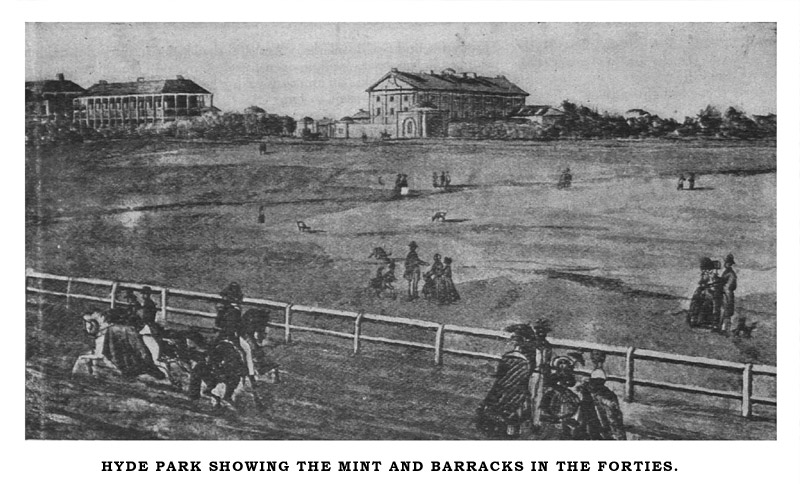
The grand-stand, then, in 1821, and the winning-post stood at the top of what is now Market-street; the course took a sweep to the right in the direction of Hyde Park Barracks, thence past the site of St. Mary’s Cathedral and the Sydney Grammar School, passing in front of Lyons Terrace, obliquely to the top of Bathurst street, then along what is now Elizabeth-street, to the corner of Park-street, and thence to the winning post. When first formed, the length of the course was one mile and a quarter, but it was afterwards shortened to a mile and six yards.


The first race took place about 1810, when the 73rd Regiment arrived under the command of Lieutenant-Colonel Maurice O’Connell (the late Sir Maurice O’Connell), and the first prize was won by a horse named “Chance,” the property of Captain Ritchie; the Colonel’s mare, “Carlo,” won the second; and one belonging to D’Arcy Wentworth, the third. But shortly after Governor Brisbane’s arrival houses began to spring up so quickly around this quarter that the course was removed to what was known as the Sandy Racecourse, about four miles to the southwards, towards Botany Bay.


One curious event of 1824 was the seizing of a vessel, while at anchor in Sydney Cove, by a King’s ship, acting on behalf of the East India Company. This company, it appeared, claimed the exclusive right of trading in Eastern waters. Now, the colonial Government had chartered a ship—the Almorah—and had sent her to Batavia whence she returned with a valuable cargo of rice, tea, sugar, etc. Presently some of the Sydney merchants, jealous of official meddling with their prerogatives as traders and importers, laid an information against the Almorah with the captain of an English man-of- war, then lying in the harbor; and she was seized in open defiance of the Government, and sent off with her cargo as a prize to India, on a charge of infringing the Company’s charter. The mere fact, it was alleged, of her having tea on board was sufficient excuse for this arbitrary proceeding.


Of course there had been bushrangers in the colony before Brisbane’s time, but not any calling for special mention until the Donohoe gang, who flourished in 1825, and the three following years, instituted a very reign of terror in Sydney and its immediate neighborhood. Donohoe’s gang contained a dozen ruffians; but his chief companions were Walmsley, Webber, and Underwood—all transported convicts except the last, who was native-born. After a time, however, his mates discovered that he had been keeping a diary of their proceedings. Disgusted with this literary effort, they effectually stopped all chance of publication by deliberately murdering the unfortunate author. He had, so it was alleged, joined the gang from mere love of adventure.


For four years these men set the police at defiance, notwithstanding that a reward of £100 was offered for the ringleaders. Between Sydney and Parramatta they murdered and robbed, and fought the police with an impunity that says little for the constitution of the “force” of those days. So great did the terror of the band become that travel’ers joined together for protection. Says a newspaper of the time, speaking of Donohoe and his depredations: “Some half dozen constables or so, we believe, have been packed off up the Parramatta and Liverpool roads, but have returned to town as usual, safe and sound and empty-handed… Some effective measures should be taken, and that speedily, to suppress this alarming evil.”


The dress of the three leaders has been described, and shows that they wanted for little, in that respect at least. “Donohoe: Black hat, superfine blue cloth coat, lined with silk, surtout fashion, plaited shirt (good quality), laced boots, and snuff-coloured trousers.” He seems to have been the dandy of the trio. His two aides, however,—Walmlsey and Webber—were almost equally well-dressed.


At last the residents, harassed beyond endurance, rose in their own protection and gave battle to the bushrangers at Raby, now Bringelly. Here Donohoe was shot. But most of the others managed to escape through the thick scrub. Later on, Walmsley and Webber were captured on the Western road. Walmsley turned king’s evidence against Webber, who was presently hanged. Through the informer others of the gang were at intervals captured, and the long reign of “Bold Jack Donohoe” and his banditti was over.


But during Brisbane’s official term dozens of men seem to have taken to the bush, and had more or less long and successful careers, ending in death by the gallows or the bullet. The Bathurst district was especially prolific of bushrangers; but, compared with the bloodthirsty Donohoe gang, the majority of them appear to have been mere station-hut robbers and petty pilferers of that kind. Nor did we ever produce anything equal to the terrible Tasmanian outlaws. But whilst for robbery under arms they most surely swung, at times, a merciful judge, for simple thieving, might only send them to Norfolk Island, “to be worked in chains during their lives.”


In 1825 were first established the Mounted Police, drawn chiefly from the infantry regiments serving in Sydney. At the beginning, they consisted of only two officers and thirteen troopers. Nor was it until fourteen years later that the force could make anything like a respectable show with nine officers, a sergeant-major, and 156 non-commissioned officers and men, with 136 horses; twenty of the corps being footmen.


The officers were magistrates, and the body was subject to military law and discipline. They were armed with carbine, sword, and horse-pistols, and were uniformed as light dragoons. The headquarter division, consisting of the commandant, the adjutant, and some score of men, was stationed in Sydney. As a service, it was an excessively rough, hard, and perilous one, and not by any means so popular as it is now.


The Anniversary Dinner of 1825 demands especial notice, because of its entirely different features to those that came before it. They were merely loyal and sentimental functions. This particular one, however, was in the highest degree political as well. The chair was taken by an eloquent young Australian, who had just returned from a visit to England, full of wide and liberal ideas, eager, too, to give the benefit of them to his native land. His name was William Charles Wentworth; and he was the practical champion of constitutional government, as opposed to that military despotism so familiar to his early youth.


Tickets, on this occasion, were only 5 dollars each; the feast was held at Mrs. Hill’s tavern, Hyde Park. A military band was in attendance, and some of the toasts indicate the progress that the colony was making towards reform and freedom: “To the memory of Governor Phillip, the Founder of the Colony,” “The Memory of Major-General Macquarie, Our Late Revered and Lamented Governor.” There were also toasted: “Sir James Mackintosh and the other Advocates of Australia in the British Senate,” “Trial by Jury,” “The Freedom of the Press,” “A House of Assembly.”


The vice-president was Dr. Redfern, and amongst the stewards was Robert Campbell, son of the first real Sydney business man, known even to this day as “Merchant” Campbell.


Architecturally, except in the matter of private houses, Sydney during Brisbane’s term, as has been remarked, had little more to shew than when Macquarie left—a Governor who should have been buried in the centre of the city with the one word, “Circumspice,” cut for an epitaph on his tomb. Still, the political and social happenings of Brisbane’s years, few though they were, had more effect on the future of the capital and the colony than all the building of Macquarie, and are so bound up in the early history of our city as to render ignoring any notice of them, however slight, impossible.


Between Governor Brisbane’s relinquishing the rule of the colony and the arrival of his successor, another military man, Lieutenant-General Sir Ralph Darling, K.C.B., there was only an interregnum of eighteen days, during which the administration was in the hands of Colonel (afterwards General) Stewart, of Bathurst, an honor which formed the one boast of that officer’s existence, and the standing joke of the district during the remainder of his life.


One of the chief advantages gained by Sydney and the colony during Darling’s reign seems to have been the establishment of a general Post Office; and for this purpose he set aside the piece of land in George-street then occupied by a police station. The quarters of the force were removed to the Market House (old Central Police Station), while sheds for market purposes were erected at its rear.


Readers will remember mention of Mr. Isaac Nichols, “Postmaster of Sydney,” in whose house took place the first-recorded Anniversary dinner. Well, this is the person who is said to have built the first post office in our city, using it, at the same time, as a residence. The house was only pulled down about 11 or 12 years ago, and was situated in Lower George-street, near the Queen’s wharf, Circular Quay; it was numbered 144. Behind it in those days, was a store; and directly in front of this was a wharf, on the banks of the Tank Stream, at which small coasters used to discharge goods. The house, supposed to have been built about 1800, was substantially constructed of brick, made, probably, in the old Government brickyards. When Nichols died, in 1819, the post office was removed to where the present great building stands the police, who occupied it, being, as already stated, established in the Market House.


At his death, Nichols’s post office changed hands, and became the Australia Hotel. For years prior to its being demolished it had been occupied, like so many other houses in this, the oldest quarter of Sydney, by Chinese merchants. Almost opposite to the site of the original post office there was, some years ago a butcher’s shop, once the residence of Mr. Thomas Moore, superintendent of dockyards. Further south is a structure believed to be the oldest residence in Australia. It was built by a Mr. Cubitt, at the corner of George-street and Brown Bear lane, and was of stone, and two stories high. Later on it was known as the Cat and Fiddle Hotel, and an additional story of brick was added. This old bit of history is now occupied by Chinese.


Needless to say that in Postmaster Nichols’s time there were no pillar-boxes and no postmen. People had to travel from all parts of the settlement to post or receive letters at the old house in Lower George-street. And it may be remarked of this street that not only does it give us a capital idea of what that quarter of the city looked like over half a century ago, so little has it changed, but, into the bargain, is almost a perfect facsimile of scores of streets in English country towns. Our first builders were nothing if not conservative, and they reproduced, as nearly as possible, in the new country the unsuitable conditions of architecture they had left behind in the old one. As to the new post office, it still, so far as looks went, remained allover a police station, until improved almost out of knowledge in 1847-8.


In the second year of Sir Ralph Darling’s reign an event happened that shook Sydney society, both exclusive and otherwise, to its very foundations; and, as being part of the history of the city, may be here briefly touched upon.


Sudds and Thompson were two private soldiers in the 57th Regiment doing duty in Sydney. Sudds was a steady man, who had saved some money; Thompson was a scamp. But both wished to remain in the colony, instead of returning home with the regiment.—As to procure their discharge was out of the question, Sudds proposed to his mate that they should gain the coveted paper by becoming convicts. This being agreed upon, they went to a shop and stole some cloth; were, as they intended, caught and tried; and sentenced to be transported to one of the auxiliary penal settlements for seven years. Then the Governor stepped in, took the two prisoners out of the hands of the civil power, and condemned them to work in chains on the roads for the full term of their sentence, and afterwards to be returned to service in the ranks.


On a day appointed, the Sydney garrison was assembled, and formed into a hollow square. The culprits were brought out, their uniforms stripped off, and replaced by the convict dress; iron-spiked collars, and heavy chains, made expressly to the Governor’s orders, were riveted around their necks and to their legs, and then they were drummed out of the regiment to the tune of “The Rogue’s March.” Sudds was in very bad health at the time, and his illness, aggravated by the disgrace and the long exposure in the hot sun, together with the utter downfall of his hopes, plunged him into such a fit of hopeless despondency that he died a few days afterwards. Thompson became insane.


Then the fun began. The “Gazette” defended, the “Australian” attacked, the conduct of the Governor; sides were taken, and Sydney was convulsed. Indeed, Darling may be said never to have heard the last of this extraordinary case of despotic military interference and uncalled for cruelty on his part.


In 1827 there were no less than four newspapers in Sydney—the good, old conservative “Gazette” the organ of the Government; the “Monitor,” a fighter; the “Gleaner;” and the “Australian.” And these three last were all arrainged against the “Gazette” and the Government. So sore did the authorities feel about these constant attacks that they presently imposed a duty consisting of fourpence upon any sheet, half-sheet, or piece of paper whereof any newspaper (within the meaning of the Blasphemous and Seditious Libels Act) should consist.


Howe, the editor of the “Gazette,” confident of Government support, only protested mildly against this imposition, but the others fulminated to such good purpose that the Act never came into force. Indeed, the Chief Justice refused to certify to its being a proper one. But for that, perhaps, the “Monitor” and its two contemporaries might, after all, have had to do as they threatened, and appear as magazines, to evade the duty, or to suspend altogether.


Bent-street owes a prominent old landmark to this era, i.e., the Free Public Library, originally known as the Australian Library. The originator of this institution was Thomas de la Condamine, private secretary to Governor Darling, aided by the Revs. W. Cowper and Hill, and many of the most influential merchants. The first meeting was held at the Sydney Hotel, when Alderman M’Leay was elected President. This was on February 3, 1826. By the judicious arrangement of the committee, aided by a liberal subscription list, donations from the Governor and from Archdeacon Scott, together with a bequest of books from T. Campbell, the library was opened on October 1, 1827, at No. 1, Terry’s Buildings, Pitt-street, or somewhere about the site of Messrs. Batt, Rodd, and Purves’s auction rooms. These premises were held jointly with the newly-established Sydney Dispensary, whose officer also served as a temporary librarian from 1 to 4 p.m. daily. Shortly afterwards the Governor granted for its use some valuable allotments of land. Two of these were situated in Hyde Park, between where now are St. Mary’s Cathedral and the Sydney Grammar School. There were also two other pieces above Rushcutter’s Bay. These were sold, later on, in about ‘41, by public auction, and realised £3384.


Sir Richard Burke, however, cancelled the ground in Hyde Park, notwithstanding many protests on the part of the committee and others. Finally, Sir George Gipps granted the site of the present edifice, of which the president (Alexander Macleay) laid the foundation-stone in 1843. It took three years in building, the cost being over £5000. Eventually it was purchased by the Government, and declared free for the use of the people. Additions have since been made, but substantially it is the same as it was in the twenties.


Darling’s reign has been known as one of libels, because the press seemed during the whole administration perpetually in hot water. Even the “Gazette” was bitter by the prevailing epidemic, and was criminally prosecuted for an alleged libel on the first, and retiring, Attorney-General of the colony, Saxe Bannister, Esquire. The paper, however, won its case. But Hall, of the “Monitor,” (“who had deserved especially well of the colony in having reared a numerous and virtuous family”), Wentworth and Wardell, of the “Australian,” and the others, were always more or less in trouble. The liberty of the press was certainly established but the fact was that the authorities had not as yet thoroughly realised what such a matter meant; nor had the editors, on their side, made a moderate use of their liberty. Hence the friction.


But for Darling, in 1826, the colony would have been bankrupt. Some idiots spread a rumour that the bank of New South Wales was about to stop payment. The inevitable scare followed, and only that the Governor helped the bank from the Treasury-chest, disaster would probably have taken place. Mrs. Darling, the wife of the Governor, established a Female School of Industry, not far from St. James’ Church. Major Goulburn, the first Colonial Secretary, after whom the well-known Sydney street was named, returned to England. “He was,” remarked his biographer, “a man of uncontaminated spirit, marked integrity, and indefatigable zeal. He was succeeded by the Hon. Alexander Macleay who, with his wife and family, arrived in the Marquis of Hastings.”


________________________________________________________________________________________________________________________________________________________________________________________________________________________________________________________________________________________________________________