Search This Blog

Sunday, March 29, 2020

Sydney Town Hall - Druitt Street And George Street Sydney


Sydney Town Hall - George Street 


The Duke of Edinborough, son of Queen Victoria laid the foundation stone on 4th April 1868.


The Sydney Town Hall is a historic and iconic building located in the heart of Sydney, Australia. It holds immense cultural, historical, and architectural significance, serving as a symbol of civic pride and a hub for various events and activities. Here's an overview of the history of the Sydney Town Hall:

Early Development:

  • The idea of constructing a grand town hall for Sydney emerged in the mid-19th century due to the city's growing population and importance.
  • An international design competition was held, and the winning design was submitted by architects John H. Wilson and Edward Bell.

Construction and Opening:

  • Construction of the Sydney Town Hall began in 1868, and the foundation stone was laid by Mayor John Young in 1869.
  • The building was constructed using local Sydney sandstone, which was quarried in Pyrmont.
  • The Town Hall was officially opened on September 3, 1889, by Lord Carrington, the Governor of New South Wales.

Architectural Style:

  • The Sydney Town Hall is designed in the Second Empire architectural style, characterized by its grandeur, ornate detailing, and distinct mansard roof.
  • The building features a clock tower and a prominent central dome that add to its visual appeal.

Function and Use:

  • From its early days, the Sydney Town Hall has served as a multifunctional space. It was used for civic functions, official ceremonies, concerts, exhibitions, and public meetings.
  • The Centennial Hall within the Town Hall is known for its excellent acoustics and has hosted numerous musical performances and events.

Cultural and Historical Significance:

  • The Sydney Town Hall holds a special place in the history of Sydney. It has witnessed numerous important events, celebrations, and milestones in the city's growth.
  • The building has been a focal point for civic and cultural activities and has hosted prominent figures, including dignitaries, performers, and political leaders.

Restorations and Upgrades:

  • Over the years, the Sydney Town Hall has undergone several restorations and renovations to preserve its historical and architectural integrity.
  • Efforts have been made to modernize the facilities while respecting the building's heritage features.


Originally the Town Hall was enclosed by iron railings and gates. The gates were removed with the construction of the Town Hall Station. It was decided not to reerect them, but to also remove all the railings on the George And Druitt Street Frontages.

The gates were acquired by St Josephs College, Hunters Hill, and are erected there.


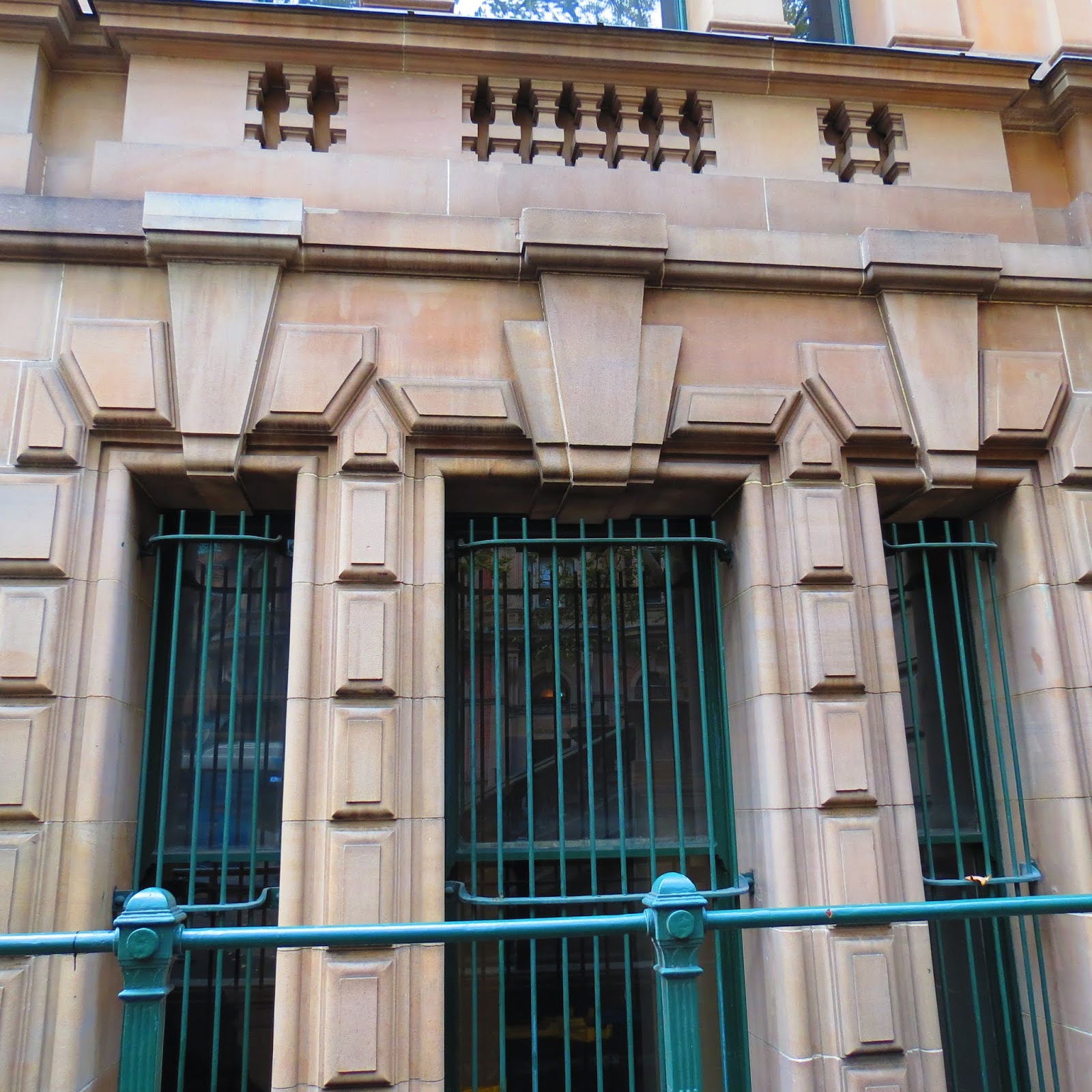
The external walls are made from Pyrmont Sandstone, and the ineternal walls of brick and cement. 


The building stands on approx 2 Acres, the external dimensions being 310 ft long, 186 ft wide and height from the ground approx 90 ft.

The Main tower is 182 Ft and 10 inches


The main entrance is on the eastern elevation from George Street. a flight of Wombeyan marble steps and a terrace lead across


Ten Things You May Not Know About Sydney Town Hall

May 2, 2014 at 7:14am


1. Sydney Town Hall Was designed By J H Wilson, As Part Of A Competition. The First Stage Was Completed Between 1868 & 1884. The Second Stage, Which Included The Grand Hall, Was Built Between 1884 And 1889. 


2. Sydney Town Hall Is Built On The Old Sydney Burial Ground, In Use Between 1793 & 1820. By The 1840's Sydney's First Official European Cemetery Had Become An Eyesore And A Health Hazard. 


3. Prince Alfred, Duke Of Ediburgh, Was Sydney's First Royal Visitor. He Laid A Foundation Stone For The Town Hall On April 4, 1868, Even Though The Transfer If The Site Had Not Been Finalised. 

4. It is Constructed Out Of Honey Coloured Yellow Block Sandstone Quarried From Pyrmont Between 1868 &1889. The Building Is Inspired By The Hotel De Ville In Paris & French Chateaux. 


5. It's Clock Was Made By English Clock Makers Gillet & Co In 1883 & Installed Into The Tower In 1884. The Clock Has Been Wound By Hand For More Than 120 Years. The Four Clock Faces Face North, South, East & West. The Hour Hand Is 1.1 Metres Long, &The Minute Hand Is 1.7 Metres.

6. Inventor Of Radio Guglielmo Marconi, Swirched On The Lights In Town Hall During The 1930 Radio & Electrical Exhibition. He Did This From His Yacht In Genoa Harbour In Italy, More Than 19,000km Away. 

7. At Age 12, Joan Sutherland Sang In Her First Concert On The Town Hall Stage. Other Performers Have Included Cold Chisel, Jimmy Barnes, Midnight Oil, Johnny O'Keefe...... & YES YES YES.... LADY GAGA. 

8. During The Torch Relay For The 1956 Olympic Games In Melbourne, A Prankster Dressed As A Runner & Presented A Smoking Silver Painted Chair Leg To The Then Lord Mayor Pat Hills. The Lord Mayor Went Along With The Joke & Claimed It Was A Trial Run For The Real Exchange. 


9. The First National Aboriginal Debutante Ball Was Held In Town Hall In 1968. The Debutantes Were Presented To The Then Prime Minister John Gorton. It Followed The Referendum That Voted To Count Aboriginal People In The Census In 1967. 

10. The We Love Town Hall Open Day Is On This Saturday.... May 3, From 10am - 3pm. Residents Are Invited To Bring Town Hall Related Souvenirs And keepsakes From Events That Took Place Over The Years, O Be Assessed For Hostorical Value.... ((I Wonder If There's Going To Be Any Dollar Signs Attached To That???? Everyone Wants To Buy Relics And Stuff From Around The World, Yet, People Don't Like To Shell Out For Our Own Historical Relics, Just Expecting A Donation...  


Friday, March 13, 2020

The Tank Stream – Sydney


When Arthur Phillip First Saw What Is Now Circular Quay & The Freshwater Estaury That Ran Into The Quay, He Must’ve Sighed One Of The Biggest Sighs OfRelief, After Being Let Down With What He’d Been Told About Botany Bay, & That The Land Was Fertile. 
Arthur Phillip was left with no choice once the first fleet arrived in botany Bay, he was left with no choice but to get in a smaller boat & search the heads & that’s for being presented to them and Port Jackson which had been marked on Captain Cook‘s map from 1774


The Watercourse Named The Tank Stream Was An Important Source Of Fresh Water For Aboriginal People Before European Settlement. As The 19th Century Progressed & The Population Of Sydney Grew, The Tank Stream  Was First Polluted & Then Channeled & Diverted Underground Into A Series Of  Drains & Pipes.
Fifty Four Worked Stone Artefcts Were Discovered In 1996 During Excavations For The Construction Of The City Recital Hall At Angel Place Which Was Built Above A Section Of The Tank Stream.
This Discovery Shows That The Aboriginal People


The Tank Stream is an underground watercourse located in the central business district of Sydney, Australia. It holds historical significance as one of the earliest sources of freshwater for the European settlers who established the colony. Here's an overview of the history of the Tank Stream:

Aboriginal Use: Before European settlement, the Tank Stream was known to the local Aboriginal people, specifically the Gadigal people of the Eora Nation. They used the stream as a source of freshwater and likely guided early European explorers to its location.

European Settlement: When the First Fleet arrived in Sydney Cove in 1788, led by Captain Arthur Phillip, they faced challenges in finding a reliable freshwater source. The Tank Stream was discovered and identified as a potential water supply due to its relatively consistent flow.

Water Supply for the Colony: The Tank Stream played a critical role in providing freshwater to the early colony. Settlers built simple wooden tanks and channels to collect and distribute water from the stream to meet their needs. The tanks gave the stream its name.

Growing Population and Pollution: As the colony grew, the demand for water increased. However, the increasing population also led to pollution of the watercourse. Human waste, industrial runoff, and other pollutants contaminated the stream, making the water less suitable for consumption.

Decline and Superseding: Over time, the Tank Stream's water quality deteriorated further, and it became inadequate to meet the needs of Sydney's growing population. The stream's role as a primary water source gradually diminished.

Urban Development: The growth of Sydney's urban landscape led to the stream being covered and built over to make way for streets, buildings, and infrastructure. The stream was progressively enclosed in underground culverts.

Rediscovery and Heritage Recognition: Despite being hidden beneath the city's surface, the historical significance of the Tank Stream was not forgotten. In the late 20th century, efforts were made to recognize and preserve the heritage of the Tank Stream. Signage, plaques, and historical markers were installed to remind Sydneysiders and visitors of the stream's importance.

Today: While the Tank Stream's water no longer flows as it once did, it remains an important historical symbol of Sydney's early days. The stream's legacy is preserved through heritage initiatives, education, and the acknowledgment of its contribution to the development of the city.

Visitors to Sydney can learn about the history of the Tank Stream through interpretive displays, plaques, and historical walks that highlight its significance in the context of the city's growth and evolution.


Don Bank Museum – 6 Napier Street – North Sydney


Don Bank Museum
6 Napier Street
North Sydney 


Don Bank isn’t early 19th century vernacular timber slab cottage – the only one of its type surviving in North Sydney.
It was originally a forum cottage and there is evidence that suggests that the house may have existed on the site before 1854. Records confirm that, by that time, the land was occupied by four rooms dwelling with detached and outbuildings. It is called Saint Leonards college – so named because much of present-day North Sydney was then known as Saint Leonards.

The house was located on a new subdivision of the Wollstonecraft/Berry estate, a large area of land granted to Edward Wollstonecraft in the 1820s and owned by his partner Alexander Berry from the 1840s. As this area was still relatively undeveloped quality, the cottage on the rise views of the harbour.

From 1854 until the early 20th century the house underwent many extensions and renovations. The buildings were incorporated into the house in later removed. And iron roof was placed over the timber shingles. Rooms were added on either side of the old four room cottage. The cottage was transformed through these changes into a substantial bungalow style dwelling by the turn of the 20th century-very similar to the house survives today.

Don bank was owned and occupied by members of the white family for much of these later decades. For these devout Catholics-part of the highest DS Bora of the midnight mid 19 century the house was in an ideal location

Don banks interior 

Interior decoration and building permit also changed is the house expanded during the 19th and 20th centuries. Through its changing history the house reflected the growing prosperity in the region and its inhabitants. It was built in the lower Northshore was still something of a rural retreat from Sydney. The cottage was in large does North Sydney‘s population grew in development within an easy walk to the water became more intense.

The name of the house also changed over time from Saint Leonards college to Don bank. This may have happened around 1903 when the white family bought the property. The origins of the name, however, remain a mystery.

Interestingly, there is a storage store in residence called Don bank in Devonport, Tasmania-presumably named after Don River there. There was a don bank private hotel in Wellington, New Zealand in the early 1900s; put on Bing else in Sheffield, England, and in the 1850s; and another in Aberdeen, Scotland around the same time. However, there are no known things between these properties, all the family who lived in them.

Very little is known about the original furnishings of the house with the change in wallcoverings depicted in the permanent display panel in the front room. In other parts of the house, particularly the two rear bedrooms in the hallway original fabric is evidenced by the original floors, and by interior fittings such as windows and fireplaces.

The current light fitting throughout or chosen to match the rooms they illuminate. In the drawer in the dining room for lights are red because of glass light fittings.

During the process of electrification of lighting in the early 1920s many homes economise to use the gas fittings to house new electric light. In the hallway, paint scrape evidence revealed the original colour on the walls and the colour is based on this evidence. The kitchen features traditional colours complete with a dollar line and one wash around the old original fuel stove

The garden

In 1854, 70 times described as having grounds in front of the cottage which are delightfully laid out and landed with the choicest fruits and shrubs.

At this time the garden included the grounds next door on the southern Boundry in the land along Napier Street up to Berry Street. Subdivision in 1903 reduce the garden to its present size

It appears that the only one of the 19 century planting survives today – the find magnolia grandiflora which dominates the garden directly in front of the house.


Tuesday, March 3, 2020

Rowe Street – Laneways – Sydney – New South Wales


Rowe Street - Laneways - Sydney - New South Wales 

No Street In Sydney Has Had More Words Written About It Than Rowe Street. By The Early 20th Century Its Fine Run Of Terrace Houses Was Being Converted Into Small Shops & Galleries, & Rowe Street Was The Closest Thing Sydney Had To European Chic. 


Upstairs Rooms Were Used As Aritsts Studios, & The Commercial Notanda Gallery Was A Gathering Place For The Artistic Community. In Adjoining Shops You Could Borrow A Book Or Buy An Elegant Hat. 


Many People Remember Window Shopping For The Latest In Interior Design And Parisian Frocks, Buying Some Music At Rowe Street Records Or Enjoying  A Bohemian Espresso At Horton's Gallery. 


The Street Remains, But The Buildings Were Demolished To Make Way For The Construction Of The MLC Centre In The 1970's. Many People Still Mourn Its Passing, & It Continues To Be Cited As A Cautionary Tale Against Overdevelopment & Wholesale Destruction Of The Fine Grain Fabric Of The City.