
History of convict colonial settlement from the beginnings of the First Fleet in 1788, and other significant parts of Old Sydney Town's heritage.
Thursday, October 22, 2015
Palmers Creek - East Sydney
Palmer's Creek, East Sydney
Though there are no records to indicate the existence of a creek by that name, it is not only likely but almost certain that the creek which once existed to the east of what is now The Domain on the western extremity of the city of Sydney was called Palmers Creek. The reason for this presumption is that it flowed into Palmers Cove, now Woolloomooloo Bay.
It was common practice among early colonial governors to give a creek the same name as the bay it flowed into. The name honours John Palmer, purser of HMS Sirius, one of a number of first fleeters who were buried in and have a marked grave in St. Johns Cemetery, Parramatta. Palmer, the colony's first Commissary, was granted the land through which the creek flowed. It has also been called Yurong Creek, perhaps its Aboriginal name and the reason why the street which followed its the western bank was called Yurong Street.
The creek rose in the vicinity of the intersection of present day Forbes and Bourke Streets. From this point it flowed north westerly down the hillside crossing Crown Street near Liverpool Lane. It then continued north towards the corner of Boomerang Place and William Street where it then followed the line of present day Sir John Young Crescent to enter Palmers Cove at its head.
In addition to the un-named squiggly line on contemporary maps, the existence of the creek is recalled in Stream Street (above), a curved laneway in East Sydney between Yurong and Stanley Lanes. Its shape and name are evidence that it follows the course of a small section of the creek as it passed through the area. The western section of Busby Lane also follows the line of the creek. A short tributary of the creek which rose in the vicinity of the site of Sydney Grammar School in College Street flowed along what now is the eastern edge of the fragrance garden of Phillip Park, entering the main creek at the northern corner of Busby Lane.
UBD Map 3 Ref K 15
Wuganmagulyav Creek - Farm Cove
After The Tank Stream, the creek which flowed into Farm Cove (Wuganmagulya) was the most important waterway to the early colonists of Sydney as it provided the water for the colony's farm located within the grounds of what is today the Royal Botanical Gardens. The root vegetables grown there thrived, but such was not the case with cereal crops about which Gov. Phillip, in his report of 28th September, 1788, said, "very little of the English wheat had vegetated and a very considerable quantity of the barley and many seeds had rotten in the ground ... all the barley and wheat likewise destroyed by the weevil."
The first fleeters weren't the first humans to utilise the land surrounding the small creek, however. The Aborigines appear to have used it as a meeting place for the various groups up and down Port Jackson long before the arrival of the white man, as they held a corroborree there during the first years of the colony. Corroborees were only held at set meeting places.
Farm Cove Creek is today the only watercourse in the inner city area which not only still flows but follows its original course as it wends its way through the Botanical Gardens.
The first fleeters weren't the first humans to utilise the land surrounding the small creek, however. The Aborigines appear to have used it as a meeting place for the various groups up and down Port Jackson long before the arrival of the white man, as they held a corroborree there during the first years of the colony. Corroborees were only held at set meeting places.
Farm Cove Creek is today the only watercourse in the inner city area which not only still flows but follows its original course as it wends its way through the Botanical Gardens.
Brickfield Creek
brickfield creek
Early colonial records indicate that a simple log bridge carried the road to Parramatta across the main creek near the Brickfields settlement's brick kilns. First marked on a map dated 1891, this bridge was located somewhere near the intersection of Hay and Pitt Streets. The section of Pitt Street between Hay Street and Railway Square was originally the beginning of Parramatta Road which began at the bridge.
According to a map dated 1802 drawn by French explorer Francois Peron, a bridge also existed over a small creek which flowed into Darling Harbour on its western side. That bridge was located where the flyover takes the Western Distributor over Pyrmont Street. The path which crossed the creek at the bridge provided access to the farm of Surgeon John Harris and followed the line of Harris Street. The creek is believed to have had its source within the site of the Sydney Institute of Technology, Ultimo. It is now an underground drain.
UBD Map 3 Ref B 14
According to a map dated 1802 drawn by French explorer Francois Peron, a bridge also existed over a small creek which flowed into Darling Harbour on its western side. That bridge was located where the flyover takes the Western Distributor over Pyrmont Street. The path which crossed the creek at the bridge provided access to the farm of Surgeon John Harris and followed the line of Harris Street. The creek is believed to have had its source within the site of the Sydney Institute of Technology, Ultimo. It is now an underground drain.
UBD Map 3 Ref B 14
Tuesday, October 20, 2015
Sydney - The 1860's
Amongst The Architects in 1850 There Were
- The Lewis Family
- The Hallens
- The Housins
- The Ginns
But The One Who Would Become
as Important As Francis Greenway at The Beginning was EDMUND BLACKET. He Became An Australian In 1842 When He And His Wife Came Ashore From
the Emigrant Ship "Eden"
In 1859, A separate Colony Of Queenzland Was Created And Sydney..... and The Colony Of New Sputh Wales Found Itself A Third Of The Size It Had Been.
So The Conaequences Led Business in Sydney Into Mini Depression.
By 1850 The Early Colonial Period In Sydney And Australia Was Coming To An End. New South Had Started As A. Convict Settlement, But By 1850 Transportation
George McCrae - New South Wales Colonial Architect - Sydney Municipality Building
Sydney Municipality Building
This Building Waa Designed By The colonial architect George McCrae And Was Built In 1896. He Had Been Appointed As The Head Colonial Architect For The City Of Sydney During The Golden Era Of the Victorian Era.
George McCrae Was Also The Architect behind The Design Of The queen Victoria Building. & Would You believe He Wet as Far As Designing Four Different Styles For The "Queen Victoria Markets" Which We Now Call The Queen Victoria Building
George McCrae Did A Gothic Revival, Queen Anne Style, Renaissance & Romanesque. I wonder where His Other versions Of The Queen Victoria Building Are Ok If They've Ever Seen the Light When The Romanesque Style Was Decided Upon.

Sydney Centennial - 1888 - A Coming Of Age
1888 was The Summer Of The Height Of The Victorian Era In Old Sudney Town As It Came Into It's Own.
It Was. A Year Of Celebrations For Sydney As It reached Is First Milestone Of 100 Years Of Settlement From The Furst Fleet Arriving With Captain Arthur Phillip In 1788.
All The Builders Were Making Every Human Effort To Have Their Buildings Finished In That Year So Those Maguc numerals of 1888 Could Be Carved Iver Doorways, And Carved Into The Centrepiece Stones Of Their Magnificent Achievements.
By The End Of The Centennial Year 1888, Sydney City Had Grown To 2,645 Acres, Amd There was Scarcely Any Building Left That Was Made Out Of Timber
Waterloo Congregational Church
On Botany Road at Waterloo — numbers 103–105 — a neat brick Gothic church still faces the street while metro precinct towers rise around it. Congregational worship started in this neighbourhood in the late 1850s: an early chapel and Sabbath school opened near Buckland Street in 1858, and a later chapel stood on the present lot from the mid-1860s. The building you see now is the substantial church whose foundation stone was laid on 24 November 1883 and which opened for worship in July 1884, the older building kept for a time as a schoolroom.
It is listed as a local heritage item (“Congregational Church Including Interior”) under the City of Sydney LEP. Waterloo Congregational Church Incorporated still appears on the national charities register at this address, and metro planning has repeatedly treated the church lot as an excluded heritage parcel. The 1865 date on older notes refers to the earlier chapel generation — not the present Botany Road façade alone.
The Waterloo Congregational Church
103 Botany Road..... Waterloo

Earlier chapel on the site, c. 1865; the present substantial church followed in 1884.


Friday, October 16, 2015
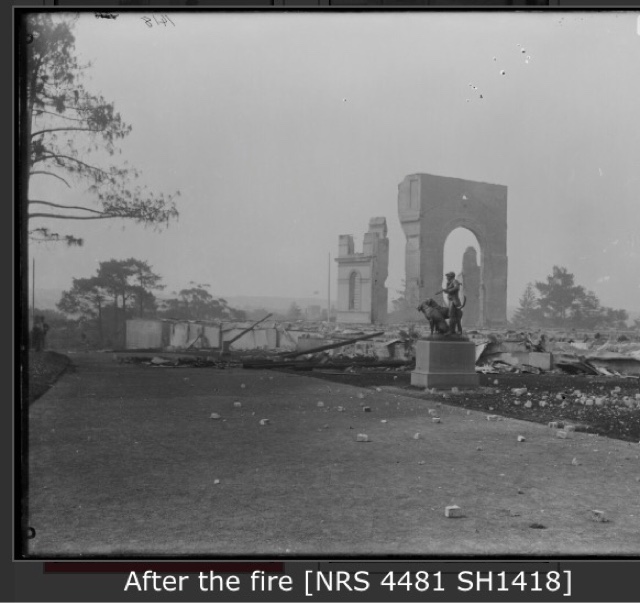
Sydney Garden Palace after The Fire
Sydney GARDEN PALACE
The Most Significant & Magnificent Building Ever In Australia. Then And There Is Nothing Now That Could Conpete With The Magnificent Roman



The Sydney Garden Palace Gates were part of the entrance to the Sydney Garden Palace, a magnificent structure that once stood in the Royal Botanic Garden of Sydney, Australia. The gates are a remnant of the Garden Palace, which was a grand exhibition building that showcased the technological and cultural achievements of the late 19th century. Here's more information about the Sydney Garden Palace Gates:
The Garden Palace:
- The Sydney Garden Palace was a vast exhibition building constructed for the Sydney International Exhibition of 1879. The building was designed by colonial architect James Barnet and was situated within the Royal Botanic Garden.
- The Garden Palace was an impressive structure made of glass and iron, and it covered an enormous area. It housed a wide variety of exhibits, including displays of art, industry, science, and technology.
Gates and Entrance:
- The entrance to the Sydney Garden Palace was marked by grand gates that led visitors into the exhibition building.
- These gates were an integral part of the overall design, serving as an introduction to the opulent architecture and cultural treasures within the Garden Palace.
Destruction and Legacy:
- Tragically, the Sydney Garden Palace was destroyed by a fire on September 22, 1882, just a few years after the exhibition. The fire was a devastating loss, as the Garden Palace housed numerous irreplaceable artifacts and exhibits.
- The only remaining physical remnant of the Garden Palace is the sandstone and iron gates that once welcomed visitors into the grand exhibition building.
Current Location:
- The surviving gates were removed from their original location at the site of the Garden Palace's entrance and repositioned elsewhere in the Royal Botanic Garden.
- The gates serve as a historical artifact and a reminder of the grandeur that once existed on the grounds. They are an enduring link to a significant event in Sydney's history.
Cultural Significance:
- The Sydney Garden Palace and its gates hold cultural and historical importance, representing a brief yet impactful moment in Sydney's past.
- The gates symbolize the aspirations, achievements, and ultimately the loss associated with the Garden Palace and the exhibition it hosted.
Heritage Preservation:
- The surviving gates are carefully preserved to ensure their historical significance is not lost. They serve as a tangible connection to an event that showcased the global ambitions of a growing colonial city.
The Sydney Garden Palace Gates stand as a poignant reminder of an ambitious project that sought to celebrate progress and innovation. While the grand exhibition building itself was lost to fire, these gates endure as a lasting testament to the cultural, technological, and architectural aspirations of 19th-century Sydney.
Subscribe to:
Posts (Atom)