Search This Blog

Saturday, January 30, 2021

10 Things You Didn't Know About Waverly.... New South Wales


10 Things You May Not Have Known About.... Waverley

1. The First Free Jewish Settler Built His House In Waverley . Barnett Levey Arrived In Sydney In 1821 From London's East End & Was Known As The Father Of The AUstralian Theatre After He Founded Australia's First Permanant Theatre.... Which Was... The Theatre Royal In George Street


2. Waverley Gets Its Name From Barnett Levey's Home. Levey Never Lived There, But Named It Waverley House In Honour Of The Book "Waverley" by Scottish Author Sir Walter Scott, Published in 1814 & Often Regarded As The First Historical Novel. 


3.  The War Memorial Hospital Is Made Up Of A Number Of Victorian Buildings. The Edina, Banksia & Witchagil Buildings Were Built By NSW Politician Ebenezer Vickery in 1884


4. Vickery Was One Of The First Politicians To SUpport Divorce. The Waverley Resident Usually Kept His Speeches To Mining But He Stood In Support Of Sir Alfred Stephen's Radical Divorce Bill in 1887


5. Australia's First Female Olympic Gold Medalist Is Buried In Waverley Cemetary. Fanny Durack's Grave Was Covered In Weeds and Unmarked Until 1990 When Fundraisers Pulled Together To Buy A Plaque And An Onyx Headstone


6. a number Of Catholic Friar's Used To Call Waverley Home.  The Victoria St Friary Was Demolished in 1985 After Sustaining Extensive Damage in 1851


7. Waverley Colege Was One Of The First Schools To Add AFL To It's Weekend Sport Program. Year 7 & 8 Students At The School Played Their First Season Of School AUssie Rules in 2013


8. Waverley College Opened With 20 Students In 1903. The School Stopped Taking Boarders in 1979 and Counts Tv Personality Scott Cam, Garden Guru Costa Georgiadis & Singer Johnny O'Keefe Among It's Old Boys.


9. The Crown Princess Of Albania, Susan Cullen Ward, Came From Waverley. The Australian Born Princess Moved From Waverley Whyen She Married Crown Prince Leka in 1975, But THe Pair Did NBot Live In ALbania As The Country Had Been Named A Communist Republic


10. Italian Is The Top Language Spoken In Waverley According To The 2011 Cencus. The Median Income Is $818....  18.2% of Families Are One Parent Families, & 55% of All Residents Live In Apartments. 


Tuesday, January 19, 2021

Australia Day 2021


Australia Day  - 2021 


Monday 18th Jan 2021 

It was 233 Years Today When Arthur Phillip & The First Fleet Finally Sailed Into Botany Bay, So Named After The Discoveries Of Flora & Fauna Sir Joseph Banks Had Discovered On The 1770 Voyage Of Captain Cook On The HMAS Endeavour After Recording The Eclipse Of Saturn In Tahiti. 
By All Records And Accounts Botany Bay Was The New “Eden” As Sir Joseph Banks Had Been Portraying For The 20 Odd Years To The Royal Society In London, As Well As Being In The Ear Of King George III. 
But As Captain Arthur Phillip Sailed In On The HMAS Sirius, The Lead Ship Of The Fleet, What He Found Was Vastly Different To What Had Been Described After The Perilous 8 Month Journey From Portsmouth In May 1787. 
Botany Bay Itself Turned Out To Be Too Shallow For a The Ships To Even Be Able To Come Close To Shore... The Wind That Had Got Them Into The Bay Itself Suddenly Died, And The Fleet Of Ships Were Left Unable To Sail Out Again Until A Southerly Or Coastal Wind Picked Up Again. 
When Arthur Phillip Sailed Ashore, He Found that The Land Was Very Sandy & Swampy All Around, As Well As The Fact There Didn’t Seem To Be Any Fresh Water Supply To Refill. 
He Also Noticed That There Ant Mounds Everywhere & These Black Ants That Had A Sharp Bite Attacked Him, And His Marines Once They Were Ashore.
He Had Been Promised By Sir Joseph Banks And The Royal Society Back In London That There Would Be Plenty Of Wild Game. 
Sir Joseph Banks Had Been Successful Bringing Back Kangaroos 🦘 For The Pleasure Of King George II
 There Was Also Very Little Wildlife So He Questioned If There Would Even Be Enough Food To Feed a The 1700 convicts And 


Wednesday, January 13, 2021

Mortuary Station - Central - Chippendale


Mortuary Station -  Central - Chippendale 


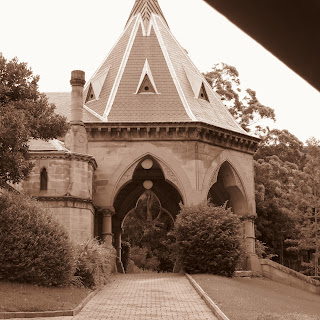
Chippendale station, sandwiched between Sydney’s Central Station and Railway Square, originally opened as Mortuary Station on June 29, 1869, and was used to transport the dead and their grieving relatives to their final resting place, Rookwood Cemetery. 


Adorned with angels, cherubs and gargoyles, the Venetian 13th century Gothic-style building was designed by James Barnet as a central stop to pick up the dead and their living families. Those families had to pay for their return tickets on the grave-y train, but the dead — I imagine due to their inability to access their wallet — generously rode free.

Apparently, the train timetable saw two trains leaving a day — one in the morning and one in the afternoon. On board, there were two types of hearse carriages used to transport the dead. The largest could hold up to 30 coffins, while the other could fit 10 at most. Mourners were held in a separate area of the train, and all disembarked at an almost identical station at the other end, aptly named Cemetery Station.

Mortuary Station

The station and train line were in use until 1947, when the last railway timetable was recorded. It read, “Sydney 2.17pm to Strathfield 2.33pm to Rookwood #1, 2.50pm." By that time, roads were in better shape and cars were a much more popular mode of transport. As such, most funeral processions travelled by car and the need for Mortuary Station was no more. It’s Rockwood sister, Cemetery Station, was dismantled in the '50s and actually rebuilt stone for stone in Canberra to become the All Saints Church. But good ol’ Morty still stands, and if its walls could talk, they’d have a lot to say about its colourful life since those dark early days.

In the 1950s, it became a depot to dispatch animals, namely horses, then moved into a new role as a parcel depot, before taking on its most ambitious role as a pancake restaurant in the '80s. That’s right, from 1986-89, two men by the name of Peter Shield and John McNally had the sweet idea of taking the original railway carriages and turning them into dining areas to eat breakfast. I don’t know about you, but nothing makes me hungrier than thinking about dead people. Know what I mean? Pass the syrup, please.

the restaurant flopped, and by 1989 it was a ghost town once more. Over the last 25 odd years, it’s been refurbished, heritage listed, vandalised and used as a wedding location. Because that’s the other thing thinking about the dead makes me want to do: marry the one I love


JANUARY 2022


The Redfern Mortuary Station, also known as the Mortuary Railway Station, is a historic railway station in Sydney, Australia. It served as a terminal station specifically designed for transporting the deceased and mourners to and from Rookwood Cemetery, one of the largest cemeteries in the Southern Hemisphere. Here's an overview of the history of the Redfern Mortuary Station:

Origins and Purpose:

  • The Redfern Mortuary Station was opened in 1869. It was built to cater to the growing need for a dignified and efficient means of transporting the deceased from Sydney to the more remote Rookwood Cemetery.
  • At the time, the state of urban cemeteries was becoming increasingly crowded and unsanitary, leading to the establishment of larger cemeteries outside the city.

Architectural Design:

  • The station was designed by colonial architect James Barnet, known for his role in designing many of Sydney's notable buildings.
  • The architectural style of the station was Gothic Revival, characterized by pointed arches, ornamental details, and other features reminiscent of medieval architecture.

Functionality:

  • The Redfern Mortuary Station featured covered platforms for the arrival and departure of funeral trains. It also included waiting rooms for mourners and facilities for the transfer of coffins.
  • The design aimed to provide a dignified and solemn atmosphere for the transportation of the deceased and their families.

Funeral Services:

  • The station was primarily used for funeral services and transporting the deceased to Rookwood Cemetery. Special funeral trains would carry coffins and mourners to the cemetery for burial.
  • The station's proximity to the main line ensured easy access to the cemetery, which was located a few kilometers away.

Decline and Closure:

  • With changes in funeral practices and urban development, the use of the Redfern Mortuary Station declined over the years.
  • The station officially closed to funeral services in 1938, as motor hearses became more common and modern transportation methods were preferred.

Preservation and Heritage Status:

  • The Redfern Mortuary Station was recognized for its historical and architectural significance. It was listed on the New South Wales State Heritage Register, ensuring its preservation for future generations.
  • The station's distinctive Gothic architecture and its association with Victorian-era funeral practices make it a unique and historically important site.

Modern Use:

  • While the Redfern Mortuary Station no longer serves its original purpose, efforts have been made to repurpose and restore the station for various uses.
  • The station occasionally hosts cultural events, exhibitions, and tours, allowing visitors to explore its architectural beauty and learn about its history.

The Redfern Mortuary Station stands as a reminder of a bygone era and provides insight into the customs and practices of the past. Its architectural significance, along with its association with Sydney's funeral history, adds to its cultural and historical value in the city's landscape.

Monday, January 4, 2021

Sydney Stairs - A Stairway To Heaven -


<: 0px; padding: 0px; vertical-ali>Stairways to heaven: The amazing history of Sydney's most impressive stepsing history of Sydney's most impressive steps" data-ffx-event-value="0" data-ffx-hittype="event" href="https://www.smh.com.au/national/nsw/stairways-to-heaven-the-amazing-history-of-sydney-s-most-impressive-steps-20201229-p56qos.html Away from the cameras surveilling Sydney, public stairs remain among the few places where people "can still be private in public", says architect Jennifer Preston. As poet A. A. Milne wrote: "Halfway up the stairs isn't up, it isn't down ... It isn't really anywhere, it's somewhere else instead." And in the case of the Steps to Nowhere on Hickson Road, Barangaroo, they lead up and down, but will take you absolutely nowhere. Over the centuries, Sydney's stairs have been the drop off point for messages written in invisible ink by Russian spy Ivan Skripov, which prompted a global scandal, as well as a rendezvous point for lovers and dealers. Before lifts and moving footways – and long before people thought of counting steps on a device – traversing Sydney was a workout. For all their film noir appeal, though, history shows you're more likely to break a leg tripping down Sydney's public stairs than have one broken by a thug, says Dr Preston. As chair of the NSW Chapter of the Australian Institute of Architects Heritage Committee she is one of the few people in the world to study the role of stairs in urban architecture. Although researchers have studied parks, neighbourhoods and footpaths, stairs have been neglected. Her interest resulted in a 90,000 word doctoral thesis, and numerous research papers. Architect Jennifer Preston, who is an expert on stairs and their weird and wonderful histories. Dr Preston's interest in Sydney's stairs was prompted by walks near her home in Glebe. "I am a pedestrian – I walk a lot," she explained. When she climbed the Chapman stairs, sandstone steps that curl up from Parramatta Road and Arundel Street with "beautiful sculpted sandstone pillars", she wondered who Chapman was and why the stairs were named after him. It turns out Michael Chapman was an Irish merchant born in 1802 who migrated to Australia where he rose to become a member of council and NSW Parliament. "Urban stairways are contested terrain, where the public and private domains meet, overlap, and sometimes conflict," Dr Preston wrote in one paper. As a result, there are often arguments over who is responsible for policing and maintenance.
Dr Preston found complaints in the Sydney City Council archive about stairs being covered with "expectoration, tobacco juice, etc". Others complained that the stairs were the "resort of people who continually lounge" about them. Public urban stairways like McElhone rising from Woolloomooloo were places of contrast: beauty and refinement contrasted with the condoms and syringes she had found there. "It leads upwards towards brightness, promise and adventure," she wrote of the McElhone stairway. "It descends into shadow, the hidden and unknown. It is enveloped in the delicious scents of flowers, gardens and nearby baking, but is also plagued by the rank smells of urine, dampness and vomit." Over the years some steps such as Carahar in the Rocks were demolished, but clues remain, such as parts of their brickwork. On Hickson Road, the Steps to Nowhere are still embedded in the sandstone, but inaccessible. Dr Preston's research shows very few surveillance cameras have been installed on Sydney's stairs, suggesting they are safer than they may feel. McElhone stairs were the drop off point for Russian spy Skripov. Here are some of her picks for the best stairs to rack up steps, be a tourist in your own city and learn about Sydney's history after colonisation (and snap some Instagrammable photos). McElhone stairs Connecting Woolloomooloo with Potts Point, the "heart thumping stairs" were also the location of a real life spy drama that saw secret documents – with instructions written in invisible ink by Russian spy Ivan Skripov. They were exchanged in a canister hidden behind a balustrade on the stairs. He was caught, expelled from Australia and the spy scandal went global. Like many of Sydney's stairs they were named after a local businessman. Fleet Steps: Often wrongly thought to relate to the arrival of the First Fleet, these steep and long stairs at Mrs Macquarie's Chair were built to celebrate the arrival of the "Great White Fleet" in 1908. The arrival of American peace time fleet – a huge armada – brought record numbers of Sydneysiders out for a day described by some newspapers as the "greatest ever" in Sydney's history. Fleet steps were named for the arrival of the Great White Fleet, a peacetime visit by US naval ships in 1908. Man O'War Steps With a name like this, they should be huge. Though there are only eight or nine, the steps near the Opera House are full of history and very likely the oldest steps in Sydney, dating back to soon after colonisation. They were built to provide Governor Macquarie and his family with direct access to a jetty. Sydney's investor-grade towers crush their tenants and kill the city's soul Quite short stairs but Sydney's "most beautiful", says Dr Preston. They were initiated by William Chard, a local who was concerned that the widening of William Street had caused a huge drop at its intersection with Forbes street. Mr Chard wrote to the council – and to move things along, he paid an architect to draw up the plans. The steps contain detailed "little gargoyley faces carved in the 1930s", Dr Preston said. Argyle stairs: Described by tourists as leg pumping, the Argyle stairs in The Rocks have a majestic entry through an arch and lead up to the Harbour Bridge walk. They also feature in the Justice and Police Museum's forensic archive (1910 to 1964). Curator Nerida Campbell says stairs are often the scene of accidents that "don't turn out to be accidents". Agar steps: A massive set of 108 steps that link Kent Street with Observatory Hill. Tall and narrow with views towards the water, they are Dr Preston's favourite. They have been portrayed by a range of Australian artists and some of the Victorian terraces that front on to the stairs use the landings as extensions of their own homes

Saturday, January 2, 2021

Nuetral Bay - Its Beginnings


NUETRAL BAY -

Anderson .Park sits over the head of neutral Bay and the creek that runs to it.

In the 1880s the mudflats exposed around his surroundings at low tide were full of residual mangroves as well as sewage and other rubbish that collected that ran it off into the harbour.

The decoration of Sydney Harbour and it’s for Shaws came at a time that coincided with an awareness of harbour music parks Parkland.

Consequently several waterfronts around Sydney were re-claimed or filled in as a Parkland for sure new.

The land he was reclaimed between 1891 and 1895 after much love being by the colonial government by East Saint Leonards council land in 1890, by the new formed North Sydney Council.

The new reserve in neutral Bay he was dedicated in 1898 and was called wearing the park. Later in 1928 it was very named Anderson Park, After former mayor William Anderson.

At the time humans were sharing land tea with horses to pastured in the 1920s. In 1932 residents petition council to build a shock proof Enclosure around the Anderson ParkBeach below the retaining wall.


The park self was given over to organise sports and landscaped with the planting of victories (focus hillii and rubigonusa ) Around the Boundry of the park.

In 1934 these trees with small enough to let the aviator Charles Kingsford Smith, With navigator PG TaylorTo use Anderson Park as a runway for the LockheedOh fair mono plane-Originally called ANZAC and then called Southern Cross, Which he had brought from America by ship.

The aviator knew the park well as he had live nearby in Yeo Street From 1911 to 1915, so when faced with the problem


Getting his aircraft from neutral Bay Anderson Park to mascotAirfield, Kingsford Smith had it transferredFrom the anchored ship in Anderson Park to mascot airfieldWhere he could fly to his destination.

The reserve was, he judged just big enough to be a runway for his aircraft


On 17th of July 1934 word spread that Kingsford Smith had his aircraftAnd he’s playing where in the area spread quicklyAnd a large crowd gathered quickly to see what would happen.

It was several hours before the wind was favourable. Joan Hall was a part of the crowd and remember the tension just before he took off and stayed low over the water.…

It wasn’t until he was well past neutral Bay wharf that he started to take off above the water, And then the people started cheering madly, Talking excitedly.

The following year Charles Kingsford Smith and JT Pethybridge disappeared without a trace find the Southern CrossFrom London to Australia.


Bridge Street - Named Oct 10th 1810 - Proclaimed Dec 31st 1834


BRIDGE STREET
NAMED OCTOBER 10TH 1810
PROCLAIMED DECEMBER 31ST - 1834


December 31, 1957 MarkedThe The Centenary Of To Exciting Events In Sydney McIntire History. One was the official opening of the Exchange, now the Royal Exchange. The second was the official operating for the first time in New South Wales of the Telegraph. Only for the unromantic and Uninformed could these be unrelated happenings yet this was no casual liaison but something deliberately planned.
, This was a child every sign of experiencing upsurge following the gold rushes.
What could have integrated the various enterprises are better than the Exchange? What could’ve linked these more startingly than the Telegraph? The tying of the knot between the Exchange and the Telegraph was a consummation of a splendid bit of matchmaking at that. They could not have been more admirable partners. What was the precise nature of the romance? A Small band of merchant princes I gathered together in 1851 to extend bush and Exchange. Among these people were Alexander Campbell, John Gill Christ, David Jones, commander John Lamb, Thomas Wisla Smith, Joshua Young, John Walker, W ascot, John Gosling, George Reese, Jason Willis and George Thorne. These men made up the first directorial. One of the first problems was to find a worthy site for the projected building. Land about the location of the Metropole, a piece at Circular Quay, McQuarrie place-over rejected in favour of the present on down I could Street, Bridge Street, Spring now Gresham Street. To take shape, stone being quarried at the top in way for the purpose of the buildup, Thomas Alston, and to the design of the architect JF difference to nationality gracefully displayed well platform was covered by crimson cloth?‘s The great day itself brought forth the rich pump occasioned by the attendance of the governor general, so William Denison, together with offices of Pacific seventh regiment. The band of the Royal Artillery struck up, gluten of the governor general speech‘ marks three chairs and one over‘ master given, followed by the air few marks rule for Tanya‘ marks.


Bridge Street was named in 1810 for the wooden bridge foot bridge crossing the tank stream, the colonies first water supply.
From the start the town was physically and socially divided by the tank stream.
On the eastern side with the governors house in the tents of the civil establishment. To the west were the makeshift barracks of the military and the convicts. Many signs of the seas social division remain today. I’ll
Along with the high eastern section of Bridge Street, you will notice several impressive early government buildings, including the lands department, the education department and the chief secretaries building.
The western end is more commercial, heading towards the once ravished rocks